One of those book that I'm amazed that I hadn't already read - it's been around me for years and years, and somehow I'd begun to imagine that I'd read it. But I hadn't, though I had read a novelisation of the life of Henri Christophe, which covered some of the same material.
It's absolutely brilliant history, with a great understanding of the balance between individual heroes (and villains) and social forces. James also has a really good grasp of the limitations of the heroes too, especially Toussaint L'Overture, who is the central character of the Haitian revolution. The writing is beautiful - even the production of the book, with detailed numbered footnotes at the foot of each page (not in some unfindable section at the back) is a pleasure.
I must admit that there were some parts where I got a bit confused. Suddenly there seemed to be too many characters on stage, and I rather lost track of who was who - some character cards would have helped here, I think. And the twists and turns of the wars and battles, especially during the revolutionary period, are really confusing - the role of the British, and the Americans, is well set out but even so it's hard to follow.
But the narrative takes off again during the final round, when Napoleon sends a French army to reconquer the island and reimpose slavery. I must say that I hadn't appreciated what a nasty, reactionary, racist Bonaparte was. The atrocities committed by the planters and the French soldiers, often with the express intention of creating terror and despair in the revolting ex-slaves, were appalling. I know comparisons with the Nazis are always invidious, but I couldn't help thinking that German civilians didn't ever turn up to watch mass executions as a form of entertainment.
Anyway, this is a great book, and I'm sorry it took me so long to get round to it. I understand it was also turned into a play, which would be interesting to see.
Wednesday, September 25, 2019
Tuesday, September 17, 2019
Review of Pepi Luci Bom
Almodovar's first film, and obviously intended to be shocking and obscene. It's a bit shapeless, with some scenes and characters that appear to have been spliced in without any connection to the main plot or the rest of the characters. The story is about three women, one (Pepi) youngish and sort of glamorous, one (Luci) middle-aged, petite bourgeois and repressed (her husband is a sleazy policeman), and one (Bom) a 15-year old singer in a punk band.
The middle-aged one is a sexual masochist and longs for her husband to beat and abuse her, but he treats her with respect 'like I'm his mother' - though he's happy to rape Pepi when he finds that she has marijuana plants in her apartment. The rape is treated very lightly in the film, as are the various degradation to which the other two women eventually come to subject Luci - of course, she wants to be degraded, so it's all right. Early on Bom pisses on Luci, and later she beats her. Eventually Luci is reconciled to her husband, after he subjects her to a savage beating when he finds that she's been living with the other two.
See what I mean?
It rather reminded me of Jubilee, though the S&M sex in that was much sexier. Olvido Gara as Bom even looks like a bit like Toyah Wilcox as Mad.
Watched via laptop, projector and informal distribution at Jane's front room in The Old Co-op on Horns Road, Stroud.
The middle-aged one is a sexual masochist and longs for her husband to beat and abuse her, but he treats her with respect 'like I'm his mother' - though he's happy to rape Pepi when he finds that she has marijuana plants in her apartment. The rape is treated very lightly in the film, as are the various degradation to which the other two women eventually come to subject Luci - of course, she wants to be degraded, so it's all right. Early on Bom pisses on Luci, and later she beats her. Eventually Luci is reconciled to her husband, after he subjects her to a savage beating when he finds that she's been living with the other two.
See what I mean?
It rather reminded me of Jubilee, though the S&M sex in that was much sexier. Olvido Gara as Bom even looks like a bit like Toyah Wilcox as Mad.
Watched via laptop, projector and informal distribution at Jane's front room in The Old Co-op on Horns Road, Stroud.
Review of 'In Red and Black: Marxian Explorations in Southern and Afro-American History'
I've had this knocking around for years, but never quite got round to actually reading. But lately I've been thinking a lot about slavery and the anti-slavery movement - there are resonances with climate change, and also with Brexit (I've never quite got round to putting my thoughts down about that...must do so soon).
Well, not reading it wasn't such a bad idea. There's not all that much Marxian exploration. There is a lot of polemical stuff against opponents who are surely now dead, or defunct, or forgotten - student radicals who want to take over the universities (which Genovese defends as disinterested communities of scholars), Black separatists who wanted an autonomous region of four Black-ruled states in the USA, dogmatic CP-USA Marxists who weren't as good at Marxist history as their English counterparts, and people who had the wrong criticism of pro-Confederate southern historians.
Much of this can only be of interest to scholars of...historiography? The sectarian left? (He's rather soft on Maoism, and even has a jarringly nice thing to say about Stalin at one point: "...as Comrade Stalin, who remains dear to some of us for the genuine accomplishments that accompanied his crimes, clearly understood..." (p371). Perhaps this is ironic, though there isn't much humour anywhere else in the book.
He's really down on what Marx and Engels said about the US Civil War (which he insists on calling the War for Southern Independence), describing it as polemical and based on poor analysis. Yeah, maybe, but working out what he really thinks about slavery, or the Civil War, is really hard - unlike Marx, he doesn't seem to me to be unequivocally on the side of the North.
The book does end with a rather nice potted version of what Gramsci says and why it's important, reminding me that it's about time I had another look at that. Curiously he seems to express Gramsci's ideas rather better than Gramsci did himself...though it's spoilt a bit by the way that he doesn't really address the issue of class - he gets it that 'the working class' isn't a useful analytical or political term, but he offers only not very useful add-ins like 'ghetto dwellers' and 'the New Middle Class'. Oh well, can't blame him for that, who else does any better?
Well, not reading it wasn't such a bad idea. There's not all that much Marxian exploration. There is a lot of polemical stuff against opponents who are surely now dead, or defunct, or forgotten - student radicals who want to take over the universities (which Genovese defends as disinterested communities of scholars), Black separatists who wanted an autonomous region of four Black-ruled states in the USA, dogmatic CP-USA Marxists who weren't as good at Marxist history as their English counterparts, and people who had the wrong criticism of pro-Confederate southern historians.
Much of this can only be of interest to scholars of...historiography? The sectarian left? (He's rather soft on Maoism, and even has a jarringly nice thing to say about Stalin at one point: "...as Comrade Stalin, who remains dear to some of us for the genuine accomplishments that accompanied his crimes, clearly understood..." (p371). Perhaps this is ironic, though there isn't much humour anywhere else in the book.
He's really down on what Marx and Engels said about the US Civil War (which he insists on calling the War for Southern Independence), describing it as polemical and based on poor analysis. Yeah, maybe, but working out what he really thinks about slavery, or the Civil War, is really hard - unlike Marx, he doesn't seem to me to be unequivocally on the side of the North.
The book does end with a rather nice potted version of what Gramsci says and why it's important, reminding me that it's about time I had another look at that. Curiously he seems to express Gramsci's ideas rather better than Gramsci did himself...though it's spoilt a bit by the way that he doesn't really address the issue of class - he gets it that 'the working class' isn't a useful analytical or political term, but he offers only not very useful add-ins like 'ghetto dwellers' and 'the New Middle Class'. Oh well, can't blame him for that, who else does any better?
Tuesday, September 10, 2019
Review of 'Ridley Walker' by Russell Hoban
Blimey this was a remarkable book - an indication is that I really hated it for the first 80 pages but persevered with it. I hated it because it's written in a weird dialect/orthography with idiosyncratic spelling and grammar, which makes it very hard to read - often you have to read the words out loud to work out what they are.
It's a post-apocalyptic dystopian fantasy, set in Kent thousands of years after some sort of catastrophe, and part of the point is trying to understand what memory of that event has remained in culture. The civilisation has retained puppet shows as a means of communication and transmission of ideas, and a garbled version of the story of St Eustace from a commentary on a wall painting.
It made me think a lot, about imminent catastrophe but also about how much of our culture, and our technological civilisation is both inter-dependent and cumulative. The eponymous hero at one point learns how many years have passed since the disaster (several thousand) and is struck by how little his civilisation seems to have advanced compared to the knowledge that the ancients had before. Is it because they are just stupider, that their brains don't work so well, as a result of the disaster? He isn't sure, but it seems to me that the people described - even though they have some metal-working skills - for the most part are living like palaeolithic people. They are just inventing settled agriculture, although they elsewhere the author says they are an Iron Age civilisation. On the other hand they seem to have remained literate and can even read such documents as they have (the St Eustace story) from before the disaster.
Well, not everything has to make sense. But I am very glad I did carry on, and almost want to read it again.
It's a post-apocalyptic dystopian fantasy, set in Kent thousands of years after some sort of catastrophe, and part of the point is trying to understand what memory of that event has remained in culture. The civilisation has retained puppet shows as a means of communication and transmission of ideas, and a garbled version of the story of St Eustace from a commentary on a wall painting.
It made me think a lot, about imminent catastrophe but also about how much of our culture, and our technological civilisation is both inter-dependent and cumulative. The eponymous hero at one point learns how many years have passed since the disaster (several thousand) and is struck by how little his civilisation seems to have advanced compared to the knowledge that the ancients had before. Is it because they are just stupider, that their brains don't work so well, as a result of the disaster? He isn't sure, but it seems to me that the people described - even though they have some metal-working skills - for the most part are living like palaeolithic people. They are just inventing settled agriculture, although they elsewhere the author says they are an Iron Age civilisation. On the other hand they seem to have remained literate and can even read such documents as they have (the St Eustace story) from before the disaster.
Well, not everything has to make sense. But I am very glad I did carry on, and almost want to read it again.
Friday, August 30, 2019
Review of 'Some Remarks' by Neal Stephenson
This is so not 'a definitive collection of Stephenson's writing' - it's a rag-bag of old journalism and short fiction, some of it really good, some of it almost embarrassing. I love Stephenson's work, especially the Baroque Cycle, but some of the essays here make me wonder whether I've projected a deeper understanding into it than is there in his head - a sort of fictional ink-blot thing. A lot of his unexamined political assumptions about America, and Capitalism, seem not all that clever and insightful to me, and that does come out in some of his contemporary-set books like The Cobweb.
I bought this for £1 at a remainder shop - it had been marked down from £9.99 to £4, then marked down again. I'm glad I didn't pay either of the higher prices. Still, he's a great, clever, elegant writer, and the insights into his process of writing make this worth reading.
Review of 'Popco' by Scarlett Thomas
An intriguing mystery book set in the world of multinational toy corporations, with lots of clever insights into marketing and demographics. Nicely written, with a good central character who's a bit on the spectrum but no less interesting or sympathetic for that. There are a number of nested narratives, including a rather good C17th bit, and - for me the best part - a portrait of the awkwardness and misery of secondary school life. As is often the case the denoument of the mystery is less interesting than the mystery itself; I actually wrote my first ever fan letter to the author before I was finished with the book, on the understanding that MI might not feel like doing it when I'd got to the end. But still a very enjoyable read, slightly enhanced by the somewhat odd physical characteristics of the paperback.
I actually picked this up from one of those 'little free libraries' in someone's front garden, which feels entirely appropriate - almost as if the book found its way to me.
Sunday, August 18, 2019
Climate change and the abolition of slavery
The comparison is often made between the struggle to abolish slavery, and the climate change movement...and other progressive movements, too. The comparison often includes the argument that slavery was once legal and seemed normal, and that the people who successfully fought to abolish it sometimes broke the law, which now seems fine.
But there is another aspect of the history of emancipation which might shed some light on the climate movement, and on one particular aspect of the resistance to climate action. It's not an entirely pleasant lesson from history, though.
It's not well understood that in most countries where slaves were emancipated, the slave owners were compensated by the government. That happened in Britain, where the amounts involved were huge, and where the debts that the government acquired as a result have only just been paid off. It happened in the French empire, the Spanish colonies, in Brazil, and in the little-known Danish Caribbean colonies. It was tried in the United States too, though only actually implemented in the District of Columbia - other states failed to pass the required legislation.
The USA was an outlier as a country that abolished slavery without compensating the slave owners. Instead, emancipation happened as the culmination of a very bloody civil war - the bloodiest war in the country's history.
Perhaps this helps to explain what might be seen as a puzzle; why do the rich and powerful, or at least some of them, fund climate change denial? After all, if failure to act on climate change really does mean that we, and most other life on the planet, are heading for extinction, then their money won't be much good to them. They - or their children - will die like everyone else.
As far as I can see there's only three possible explanations as to why rich people might want to promote delay on climate action:
And it's not surprising if rich people think they can escape the consequences of climate disaster. Much of their experience of other disasters teaches them that money can insulate you from the consequences. Some of the fantasies about escape from a dying earth (nicely illustrated in the film Elysium) play to this belief, and as David Wallace Wells points out in The Uninhabitable Earth, belief in this is quite common among wealthy Silicon Valley folk. Even if they don't think that they can escape off-world, there are plenty of rich people preparing, in a survivalist sort of way, to save themselves from climate catastrophe.
But I think the third explanation is the most important. If the political system ever really does deliver on action to prevent runaway climate change then a huge part of the world's capital will become 'stranded assets' - "assets that have suffered from unanticipated or premature write-downs, devaluations or conversion to liabilities". That's not just all the unburnable fossil fuel that is still in the ground, but also all the infrastructure associated with it - pipelines, refineries, tanker fleets, etc. It's possible that the financial system wouldn't survive such a write-down; at the very least it would be a major impact, and would hit some asset-holders much harder than others - though as the 2008 crash showed, the complexity of the financial system may mean that simply everything would crash.
Now, consider that fossil-based assets are not by any means worthless (and read this paper from Schroders if you fancy a chill as to how 'the markets' think about fossil-based assets). That means that 'the markets' don't think we're going to simply leave them in the ground - exactly what we must do if we are to avoid climate catastrophe.
So my hypothesis is that the asset owners expect that at some point they'll be compensated for their holdings, just like the slave owners were. And promoting division and delay on climate action is their way of driving the price up for when the negotiations begin.
The movement for climate justice is partly about making sure that the poorest don't suffer most from climate change, and don't have to pay disproportionately for measures taken to prevent or mitigate it - for example, through fuel or carbon taxes where the burden falls most heavily on the poorest. But what if the price of getting the asset-owners to call off their denial-promoting dogs is that governments have to pay them compensation? Either that compensation is paid for out of austerity-squeezed goverment budgets, or it's paid via some sort of quantitative easing. Either way it's a recipe for more climate injustice.
Recognising this rather concentrates the mind and ought to inform political strategy for the climate action movement. If the asset-owners are playing chicken with the climate, then it's important for them to create the sense that they are prepared to not swerve. If the alternative, and the price of confronting this strategy, is preparing for a conflict on the scale of the American Civil War, then strategies that we have pursued to date will be insufficient. Just saying.
But there is another aspect of the history of emancipation which might shed some light on the climate movement, and on one particular aspect of the resistance to climate action. It's not an entirely pleasant lesson from history, though.
It's not well understood that in most countries where slaves were emancipated, the slave owners were compensated by the government. That happened in Britain, where the amounts involved were huge, and where the debts that the government acquired as a result have only just been paid off. It happened in the French empire, the Spanish colonies, in Brazil, and in the little-known Danish Caribbean colonies. It was tried in the United States too, though only actually implemented in the District of Columbia - other states failed to pass the required legislation.
The USA was an outlier as a country that abolished slavery without compensating the slave owners. Instead, emancipation happened as the culmination of a very bloody civil war - the bloodiest war in the country's history.
Perhaps this helps to explain what might be seen as a puzzle; why do the rich and powerful, or at least some of them, fund climate change denial? After all, if failure to act on climate change really does mean that we, and most other life on the planet, are heading for extinction, then their money won't be much good to them. They - or their children - will die like everyone else.
As far as I can see there's only three possible explanations as to why rich people might want to promote delay on climate action:
- They really don't believe climate change is happening
- They think it's happening but it won't affect them
- They are promoting denial and delay as a deliberate strategy aimed at maximising compensation
And it's not surprising if rich people think they can escape the consequences of climate disaster. Much of their experience of other disasters teaches them that money can insulate you from the consequences. Some of the fantasies about escape from a dying earth (nicely illustrated in the film Elysium) play to this belief, and as David Wallace Wells points out in The Uninhabitable Earth, belief in this is quite common among wealthy Silicon Valley folk. Even if they don't think that they can escape off-world, there are plenty of rich people preparing, in a survivalist sort of way, to save themselves from climate catastrophe.
But I think the third explanation is the most important. If the political system ever really does deliver on action to prevent runaway climate change then a huge part of the world's capital will become 'stranded assets' - "assets that have suffered from unanticipated or premature write-downs, devaluations or conversion to liabilities". That's not just all the unburnable fossil fuel that is still in the ground, but also all the infrastructure associated with it - pipelines, refineries, tanker fleets, etc. It's possible that the financial system wouldn't survive such a write-down; at the very least it would be a major impact, and would hit some asset-holders much harder than others - though as the 2008 crash showed, the complexity of the financial system may mean that simply everything would crash.
Now, consider that fossil-based assets are not by any means worthless (and read this paper from Schroders if you fancy a chill as to how 'the markets' think about fossil-based assets). That means that 'the markets' don't think we're going to simply leave them in the ground - exactly what we must do if we are to avoid climate catastrophe.
So my hypothesis is that the asset owners expect that at some point they'll be compensated for their holdings, just like the slave owners were. And promoting division and delay on climate action is their way of driving the price up for when the negotiations begin.
The movement for climate justice is partly about making sure that the poorest don't suffer most from climate change, and don't have to pay disproportionately for measures taken to prevent or mitigate it - for example, through fuel or carbon taxes where the burden falls most heavily on the poorest. But what if the price of getting the asset-owners to call off their denial-promoting dogs is that governments have to pay them compensation? Either that compensation is paid for out of austerity-squeezed goverment budgets, or it's paid via some sort of quantitative easing. Either way it's a recipe for more climate injustice.
Recognising this rather concentrates the mind and ought to inform political strategy for the climate action movement. If the asset-owners are playing chicken with the climate, then it's important for them to create the sense that they are prepared to not swerve. If the alternative, and the price of confronting this strategy, is preparing for a conflict on the scale of the American Civil War, then strategies that we have pursued to date will be insufficient. Just saying.
Wednesday, August 14, 2019
Review of Animals
I intended to like this film; the trailer had made it look like a film about what happens when one of two friends grows up into a more mature adult while the other wants to remain in extended adolescence. But it wasn't really like that; both the women were actually pretty wedded to a dissolute post-teen lifestyle of booze, drugs and parties, though one of them (the pretty one, played by Holliday Grainger) seems to be drifting ever-so-slowly away from casual sex towards a monogamous relationship. Nothing really developed with either of them, and their back-stories didn't become much clearer either.
I note in passing that though they are both supposed to be in precarious low-paid jobs (one works in a warehouse, the other is a barista) they never seem short of cash, and there is absolutely no sign that their work makes any demands on their time. Every frame of the film has at least one large glass of white wine in it, to the point that I was beginning to think about going teetotal. I also note that the place they live, in a beautiful Georgian house in central Dublin, would have been gentrified in any British city, while the bourgeois suburban house that the one girl's parents live in would have been an outer-city working class suburb.
Watched at the Phoenix cinema.
I note in passing that though they are both supposed to be in precarious low-paid jobs (one works in a warehouse, the other is a barista) they never seem short of cash, and there is absolutely no sign that their work makes any demands on their time. Every frame of the film has at least one large glass of white wine in it, to the point that I was beginning to think about going teetotal. I also note that the place they live, in a beautiful Georgian house in central Dublin, would have been gentrified in any British city, while the bourgeois suburban house that the one girl's parents live in would have been an outer-city working class suburb.
Watched at the Phoenix cinema.
Friday, August 09, 2019
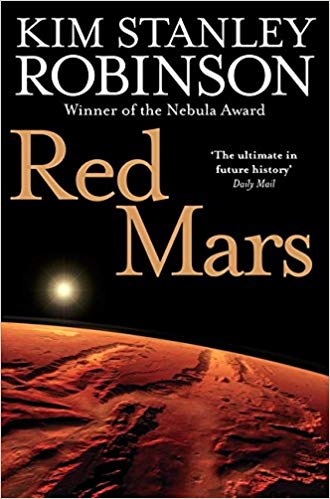
Review of 'Red Mars'
I wish I'd liked this more. It's very long, and while some of it is great - especially the political discussions, and the dynamics between the characters - there's huge swathes that I found unreadable, about Mars geology, or descriptions about technical solutions to problems. I'm sure other people have exactly the opposite reaction, loving the detail and bored by the politics. I'm sure that, as in The Martian, the point of the technical detail is to make the whole thing convincing, but as there, it doesn't work for me.
I note in passing that KSR (who is great, by the way - I heard him talk a few years ago and he's marvellous on climate change and politics) can imagine people moving to Mars without either nation-states or capitalism coming to an end...lots of the stuff on Mars is supplied by familiar corporations, though the big names that dominate our lives now - Google, Amazon, etc are of course not there. Prediction is hard, especially about the future.
Review of 'The Photograph'
A rather odd film, directed by Ritesh Batra, who made The Lunchbox. It's billed as a 'romantic drama', and it has all the elements of a romcom but without any comedy, or indeed much drama - and yet it's compelling, though a bit too long.
I don't want to spoil the plot, but the main impression I had was of being teased, because all the scenes that were flagged up as plot points - are either not shown or not dwelt on at all. The girl agrees to pretend to be a girlfriend for the photographer she doesn't really know, but we don't see the discussion where she agrees. Later, he manages to obtain, at considerable effort, a bottle of a long-existinct soft drink that she remembers from her childhood, but we don't actually see him giving it to her, or her response. It's almost like watching the out-takes from a romcom, or the bits that happen in the narrative that don't make it into the film - and for this I liked it.
It also avoids almost all of the cliches of cinematic India, and touches on issues of class. He's not nearly as wealthy as her, but she's not super-rich and he's not super-poor - not a slum-dweller or a beggar, just a street hustler sharing an attic with several other men from the countryside. Mumbai was such an awful, terrible shock to me, as was the behaviour of middle-class Indians to the poor and street people, and this film brought a lot of that back even though it didn't show it.
Watched at The Phoenix in East Finchley.
I don't want to spoil the plot, but the main impression I had was of being teased, because all the scenes that were flagged up as plot points - are either not shown or not dwelt on at all. The girl agrees to pretend to be a girlfriend for the photographer she doesn't really know, but we don't see the discussion where she agrees. Later, he manages to obtain, at considerable effort, a bottle of a long-existinct soft drink that she remembers from her childhood, but we don't actually see him giving it to her, or her response. It's almost like watching the out-takes from a romcom, or the bits that happen in the narrative that don't make it into the film - and for this I liked it.
It also avoids almost all of the cliches of cinematic India, and touches on issues of class. He's not nearly as wealthy as her, but she's not super-rich and he's not super-poor - not a slum-dweller or a beggar, just a street hustler sharing an attic with several other men from the countryside. Mumbai was such an awful, terrible shock to me, as was the behaviour of middle-class Indians to the poor and street people, and this film brought a lot of that back even though it didn't show it.
Watched at The Phoenix in East Finchley.
Thursday, August 01, 2019
Review of 'The Blind Assassin' by Margaret Attwood
I read this a couple of weeks ago, and loved it, and decided not to write a review straight away because I wanted a bit of time to process it. At the time I felt quite emotionally churned up by it - there was death, and betrayal, and sibling relations...but now, a few weeks later, I'm surprised that I don't remember all that much about it. There's a story within a story, which is the eponymous 'blind assassin', a fantasy tale that the narrator's pulp-writing lover tells her during their occasional assignations. It's meant to be pulpish, but this is Margaret Atwood, so it's actually very good - a sort of parody of bad fantasy that can't help becoming ever-more literary. There's a lot about high society in Canada, and political and labour unrest in the 1930s Canada, most of which I didn't know about.
Anyway, despite my failing memory it's good and well worth the long time it took to read.
Wednesday, July 31, 2019
Review of 'Resonance and Revolt' by Rosanne Rabinowitz
I just loved this collection of stories. Overall I think they count as 'weird fiction', but I'd say they stay well clear of the 'horror' genre to which that often tends. Instead they are sort of politically engaged urban realism. They are funny, and sexy, and the people are real characters rather than the two-dimensional stereotypes that often turn up in short fiction.
They're from different stages of life too - some coming-of-age, some from other stages - which is great, though I don't remember one about older cis het white blokes who are out the other side of middle age...I guess I will just have to wait for that one. But the politics, and the sexual politics, are well done - not heavy-handed, but not just layered on for colour.
And there's a bit of a psychogeography dimension too, which I really liked - a feeling for 'liminal spaces' and the way that the city changes under our feet.
I won't discuss the individual stories, except to say that the collection is worth buying just for 'The Matter of Meroz' (which I had read before, in the Jews Versus Aliens collection) - kind of like Isaac Babel on acid.
They're from different stages of life too - some coming-of-age, some from other stages - which is great, though I don't remember one about older cis het white blokes who are out the other side of middle age...I guess I will just have to wait for that one. But the politics, and the sexual politics, are well done - not heavy-handed, but not just layered on for colour.
And there's a bit of a psychogeography dimension too, which I really liked - a feeling for 'liminal spaces' and the way that the city changes under our feet.
I won't discuss the individual stories, except to say that the collection is worth buying just for 'The Matter of Meroz' (which I had read before, in the Jews Versus Aliens collection) - kind of like Isaac Babel on acid.
Review of 'Excursion'
A time travel film, and one that reminds me why I generally don't like the genre. Very confusing, and I'm not sure whether my confusion was because I'm a dope and couldn't follow it, or because the film-makers weren't very good at story-telling.
Surprisingly the scientists who have discovered the secret of time travel are in the Soviet Union (in 1986) so there's a lot about the end of Communism, which does make it more interesting. It's unfortunate that the Soviet institute is quite so nasty, and run by a sinister professor and a uniformed thuggish general who quickly resorts to torture with a hammer - surely they could have been more subtle, even on a low budget.
In the end I resented the time I spent on this, although there were some good touches. I don't understand how it seems to have won so many awards, though it will make me more wary of awards in the future.
Watched on Amazon Prime, one of the first to be watched via Chromecast, which Prime now supports.
Surprisingly the scientists who have discovered the secret of time travel are in the Soviet Union (in 1986) so there's a lot about the end of Communism, which does make it more interesting. It's unfortunate that the Soviet institute is quite so nasty, and run by a sinister professor and a uniformed thuggish general who quickly resorts to torture with a hammer - surely they could have been more subtle, even on a low budget.
In the end I resented the time I spent on this, although there were some good touches. I don't understand how it seems to have won so many awards, though it will make me more wary of awards in the future.
Watched on Amazon Prime, one of the first to be watched via Chromecast, which Prime now supports.
Thursday, July 18, 2019
Review of 'The Upside'
An American remake of a French film with dodgy racial politics, that was an unexpected and somewhat inexplicable success. A rich white guy who is quadiplegic after a paragliding accident takes on an unsuitable Black ex-con as his carer, partly to annoy his business assistant and perhaps also to ensure that he doesn't survive long due to the Black guy's incompetence. But in a familiar trope from the movies, the poor guy turns out to know a lot about life and revives the rich guy's sense of joy through experience.
Despite the thinness of the plot and the dodginess of the premise it's quite enjoyable to watch.
Watched on Amazon Prime.
Despite the thinness of the plot and the dodginess of the premise it's quite enjoyable to watch.
Watched on Amazon Prime.
Saturday, June 29, 2019
Review of 'The Anubis Gates' by Tim Powers
Not read any Tim Powers before, and I ended up really liking this. It's a bit of a romp, with touches of horror too (and I try to never read horror) but it's clever, and well-written too. There's plenty of action and suspense, but good characters and emotional depth - even the bad guys have their own inner life and problems.
I don't know that much about the Romantic poets, but I have the feeling that Powers did his research here - Byron and Coleridge are both characters in the plot, and they feel right to me. So does his early nineteenth century London, which includes lots of streets and neighborhoods that have now disappeared.
Thursday, June 20, 2019
Review of 'The War in the Air' by H G Wells
Re-read after many years, and not as much fun as I remember it having been. Desperate to gratify my craving for steampunk, but it's hard to find anything that's much good. Perhaps I've muddled it up with Michael Moorcock's 'Laughter of Carthage' series.
I remembered this as having lots of airship combat and ornithopters, but there isn't all that much; and the dialogue - Wells' pechant for transliterating working-class speech so that the characters who use it seem rather stupid - really grates.
Review of 'Going Underground' by Phil Brett
A worthy successor to 'Comrades Come Rally', Phil Brett's sequel is set in the same post-revolutionary Britain. Our hero Pete Kalder is recovering from trauma in a sort of therapeutic community, but is soon pulled out of convalescence to help unravel another plot to reverse the gains of the revolution. It's tightly plotted, with lots of twists, good characters and vivid descriptions of locations and settings - plenty of long meetings, which made it all feel sadly rather true to life...that's probably what a post-revolutionary Britain would be like. Kalder is a great wise-cracking, sharp-dressing lead, with an encyclopedic knowledge of mid-C20th music and a trust-nobody attitude that gets him into trouble with the party and the remnants of the police. An enjoyable read, and I hope there's more to come.
Wednesday, May 29, 2019
Review of 'I, Tonya'
I enjoyed this way more than I expected to...I'm not very interested in sport, and less so in figure skating. I have only the dimmest recollection of the events it describes.
But this was very much the antithesis of the conventional sport film in which an underprivileged outsider triumphs over adversity through will power and determination. Here adversity triumphs over the underprivileged outsider, who very obviously has plenty of talent but nothing else - no contacts, no network, no social graces, and none of the insight that she might have needed to work out how to get by without those things.
It's well acted and shot in a way that seems to recall the nastier, shinier period it depicts.
From the film's narrative Tonya Harding actually got a rough deal - she doesn't seem to have done all that much wrong apart from choosing the wrong mother, and then the wrong husband who chose the wrong friends and associates. She seems to have been punished harder than she deserved for not dobbing her vile husband in, while others got off more lightly.
Watched on Amazon Prime.
But this was very much the antithesis of the conventional sport film in which an underprivileged outsider triumphs over adversity through will power and determination. Here adversity triumphs over the underprivileged outsider, who very obviously has plenty of talent but nothing else - no contacts, no network, no social graces, and none of the insight that she might have needed to work out how to get by without those things.
It's well acted and shot in a way that seems to recall the nastier, shinier period it depicts.
From the film's narrative Tonya Harding actually got a rough deal - she doesn't seem to have done all that much wrong apart from choosing the wrong mother, and then the wrong husband who chose the wrong friends and associates. She seems to have been punished harder than she deserved for not dobbing her vile husband in, while others got off more lightly.
Watched on Amazon Prime.
Monday, May 27, 2019
Review of 'The Road Home' by Rose Tremain
Another beautifully written book by Rose Tremain, with a great portrait of the central character - Lev, a middle-aged Polish man who leaves his village to come to England so as to be able to support his mother and daughter - and lots of great secondary characters too. Despite the miseries that befall Lev, and some of the awful people that he encounters, it's basically positive and hopeful...probably more so than real life would be, but that's sometimes what we need books for.
Review of 'The City of Lost Children'
Re-watched this after attending some events at the Stroud Steampunk Weekend. I remembered the film as being visually arresting but couldn't recall much about the story line...and now, ten minutes after it ended, I understand why; the plot is basically incomprehensible, a mish-mash of images and cliches that doesn't add up to anything. There is a summary on Wikipedia which suggests that it's an anti-capitalist film...
Another film where there is a strong argument for a twenty-minute "extended trailer" or "art director's cut", so that we can enjoy the visuals and not have to worry about narrative.
Watched on the Middle Floor at Springhill, all by myself because no-one else wanted to sit through it.
Another film where there is a strong argument for a twenty-minute "extended trailer" or "art director's cut", so that we can enjoy the visuals and not have to worry about narrative.
Watched on the Middle Floor at Springhill, all by myself because no-one else wanted to sit through it.
Subscribe to:
Posts (Atom)