Saturday, May 23, 2020

Review of "Now we have your attention; the new politics of the people"

Once again I find myself wanting to write 'this is good, but has a hole at its centre'...so I am acknowledging that this might be more about me, and how I am feeling at the present, than about the book. Then again, maybe not.

First, the good. Jack Shenker is a very good writer, with an eye for detail and a way of telling illustrative anecdotes that illuminate and bring to life a political argument. I can completely understand why he was shortlisted for an Orwell Prize - in this he is actually rather like Orwell, who was also a very clear writer with a great eye for detail and anecdote. The prose just carries the reader along, and book about our present political condition just flies past like a novel with a plot.

His analysis is good, too. He has a good understanding of the roots of what some of our less insightful centrist commentators call "populism" - the toxic mix of racism, and nationalism, and a sort of plebian "anti-elitism" that is directed at experts, and London, and intellectuals, and the media, much more than it is directed at bankers and the super-rich and their corporate vehicles. I'd like to see him write even more about this, because it's a really important phenomenon. I have a sneaking suspicion that at least sometimes these people and movements could go either way - I'm thinking of the Yellow Vests in France, who started out as an anti-metropolitan, anti-environmentalist backlash movement, but now seem to have aligned themselves with the Left, - at least in the pension reform protests. I think he could and should write a really good book about this, and about the impulses behind Trump's working-class supporters that goes further than the familiar "left behind white people" stuff.

There's lots of good analysis of social movements in here, particular the mushrooming new unions like IWGB and United Voices of the World, and renters' unions incuding ACORN. He writes about some of the links between these and the groundswell of Momentum in the Corbyn-led Labour Party. In some ways this feels already out of date, because Labour's defeat in December 2019 has had a huge impact on the internal politics of Labour, and the tensions that he describes within Momentum have risen to the surface. It's possible that the whole movement has had its day - I'd like to see what he thinks about this, and will look online to see what I can find.

Now to the hole. This is all about defensive organisations, trying to improve wages and conditions, and fight back against the worst, most exploitative and vindictive landlords. But there's nothing transformational in there at all, nothing that could be either a vision of how things could be different or a route map of how to get there. He almost heads into that territory when he starts to consider just how radical the program of Corbyn's Labour really was - because actually by Northern European standards it was all pretty tame. For the most part the program was an attempt to drag anglosphere financialised Britain back towards the north European capitalist democracy mainstream. It most certainly did not envisage the end of capitalism. It would be nice to have some better welfare protection, more protection for tenants, and some non-private housing for rent, but none of this would fundamentally challenge the huge inequalities of wealth and power that exist in Britain.

There are visions for how this might happen, though they are not always convincing. My old chums in the revolutionary left imagine some sort of insurrection, which I think they hoped would happen after the ruling class had been so thoroughly discredited and demoralized that it wouldn't put up much of a fight; I assume that this is what they hoped, because they never actually did much preparing for insurrection. A few serious social democrats think that the Corbynist progam would be a first step towards a gradualist, parliamentary road to actual socialism, in which the capitalist tiger would sit quietly while it is slowly skinned claw by claw.

And there's another vision too, which is gaining ground these days, which is a sort of revived utopian socialism; that it will be possible to build little islands of equality and justice, through co-ops and community-owned enterprises, and Community Land Trusts (to be scrupulously fair, Jack Shenker does write about these latter with some enthusiasm). In this scenario the socialist commonwealth just grows within capitalism, and its success means that capitalism will eventually be bypassed and wither away. There are 'techno-utopian' versions of this, in which new technologies like open source software and 3-D printers are the enabling technologies for this new society in which most things 'want to be free'. Paul Mason - who also writes a lot about struggle - has sometimes inclined to this view (and ties it into a dissection of current conditions), as has the theorist of the Commons Michael Bauwens, and the anarchist Kevin Carson.

There's nothing about this in Jack Shenker's book - fair enough, it's a different book. But like I said, I did miss a bit of the vision thing. Perhaps he's written about this elsewhere, or perhaps he's going to. I do hope so, because his intellect and his eloquence suggests that he'd make a good job of it.

Tuesday, May 19, 2020

Review of Misbehaviour

Slightly disappointing feminist film about the womens-movement disruption of the 1970 Miss World competition in London. I'm too young to judge the historical accuracy, though I am perplexed that the theatre where it's taking place seems to be on Waterloo Place - was there ever a theatre there?

The film is a bit worthy. It's easy to laugh at the sleazy 1970s style sexism of Eric Morley, just as it's easy to be superior to 1960s redneck racists in the Southern USA, without having to address the mechanisms of either racism or sexism as they operate today.

It's also a bit dull, without much dramatic tension. It's possible to have drama even when you know how something is going to turn out, but this doesn't manage it. The poster suggests that this is going to be fun, a bit like Made in Dagenham, but it isn't that enjoyable.

There is an odd countervailing narrative in the personal stories of two Black women contestants - Miss Grenada and Miss African South, the latter introduced at the last minute alongside a white Miss South Africa in an attempt to head off anti-apartheid protests. Both of these make some suggestion that by winning they'd be striking a blow for the self-esteem of Black women and girls. Though the central character, Sally Alexander (played by Keira Knightley) challenges this, the camera-work and the sequencing of shots suggests that they may have a point.

I note in passing:

  • Tutorials at UCL in 1970 had only three students present - today's students don't get that, do they?
  • Protestors in 1970 could take water-pistols that looked like real guns to protests and use them to squirt policement - today you'd get shot dead doing that.
Watched via informal distribution and laptop connected to the TV via VGA cable.

Review of 2040

This is a bright, cheerful film about a sustainable future, but with an odd hole at the centre. It's nice to see a positive vision of 20 years hence, especially when most visions of the future, and certainly the compelling and intelligent ones, seem to be dystopian rather than utopian. Really, though, this is a look a few specific technologies - local energy microgrids, regenerative pastoral agriculture, self-driving cars as a service, and marine permaculture - and how they might contribute to that more sustainable future. It's sometimes thoughtful and reflective...for example, it's aware of the irony of making a film about sustainability by flying the narrator around the world.

But it doesn't do much reflection on social or economic structures, even though it does feature Kate Raworth and her donut economics; it mainly imagines a world substantially like that of our own day, but with the super new technologies in place - a real narrative of technological fix, in which the technologies seem to fix the donut. So the local energy microgrids are based on decentralised energy trading between local producers and consumers - it's easy to imagine distributed ledger geeks drooling over this opportunity, but there's no account of who is going to be operating and profiting from the marketplaces.

It's the same with the marine permaculture. This does look like an exciting technology, but who is going to be operating these ocean farms, and under what kinds of ownership and rights? Presumably right now someone is drawing up frameworks for the commodification of the oceanic commons, but you wouldn't know it - or even think about it - from this film.

And self-driving cars - no recognition that the driving force (oops!) behind the efforts to develop these are Google and its Big Tech competitors, or that existing ride-sharing businesses (especially Uber) work so hard to obtain and then expolit market dominance.

So two cheers - or one and a half cheers - for the film. It is great to find some reasons to be cheerful, but it would be more great of have a positive vision that included some changes to social and economic structures.

Watched via informal distribution and laptop connected to the TV via VGA cable.

Sunday, May 17, 2020

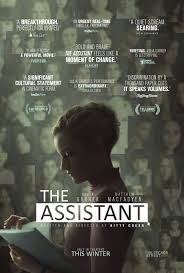
Review of 'The Assistant'

This was positioned as inspired by the "MeToo" movement, but it's not what you'd call inspiring. It depicts the working life of a young woman who is the assistant to a senior manager in what is probably a film company - it's not completely clear. Not much in the film is clear - it's very understated, and much of the dialogue is mumbled. It also manages to be tense all the time while still being boring. A few things happen in the film, but everything, every glance and gesture, seems to be invested with significance that does actually go anywhere. The film was less than 90 minutes but felt much longer.

The young woman has to clean up in the boss's office before the cleaners arrive, and we see her picking up a small item of jewellery. But there's not much sign that the boss is an exploitative lecher - we never see the boss at all, just the minions. The young woman has to book hotel rooms for other young women who arrive for vaguely defined jobs, and knows that the boss has gone to the hotel too - she has to cover for him to his wife by saying he's in a meeting.

The description of the film says that the young woman is eventually pushed to make a stand, but she doesn't really. She plucks up the courage to go and speak to someone internal (an HR person? a legal person?) and he belittles what she says and tells her that it's in her best interest to forget it - and she backs down. More or less tearfully she agrees to withdraw what wasn't even a complaint yet, and in the next scene we see that the internal person must have notified the boss, because he calls her up with a lot of swearing. But he seems to get over it pretty quickly - I can't help thinking that in real life that would be it for her, and she'd be sacked.

Much of the film is just about the misery of entry-level corporate life, and though there's always the atmosphere of sexual predation in the background, quite a lot of the misery would apply in its absence, and to male entry-level people too. Having spent some of my working life in corporate environments where there are people who are powerful (usually but not always men) and abuse that power in trivial ways, I can empathise with the feeling of having to eat a little bit of shit every day of your working life. In my experience these people were also bending or breaking the rules - particularly about abuse of expenses - and everyone knew and no-one would do anything about it. That, and the knowledge that you must remain squeaky clean all the time because you wouldn't get away with anything, reinforces that really depressing feeling of being at the bottom of the heap.

Other friends (I'm particularly thinking of Italians) have told me that it was entirely normal for young joiners to an organisation to be expected to make the coffees and work the photocopier for their more established colleagues, and this could go on for years until a new junior joined.

So sexual predators are shit, and no-one should have to endure them, but work can be pretty shit even without them.

Saturday, May 16, 2020

Review of 'In The Cut'

Billed as a feminist crime thriller, this 2003 film is dominated by murk and sleaze. Everything in New York looks grimy, and the central character - played well by Meg Ryan, rather against type - seems to thread her way in and out of strip joints and very sleazy bars with pool tables and hookers. Lots of well-contructed plot and mis-direction, and totally gripping all the way through - but I did want to have a shower when it finished. So much gore, so much dirty sex and sweat.

I haven't noticed anyone else remark on this, but it reminded me a lot of Klute, and also Looking for Mister Goodbar, both of which dwell on a New York woman's fear of murder by a serial killer - I think Meg Ryan looked quite a lot like Jane Fonda's character, and some of the stairwell shots seemed to evoke the earlier film.

Watched via laptop and VGA cable - our TV only has one HDMI slot, and we've decided to leave the Chromecast permanently in for fear of breaking it. Interestingly this was via paid for BFI Player, which does not support casting from Android - you can watch the film on your phone but you can't cast it, only 'mirror' it, which doesn't work well. And BFI Player crashed at least three times while we watched it - another example of the 'informal' option being better than the paid-for one.

Review of "HHhH" by Laurent Binet

This has sat on my bookshelf for six years. My lovely parents-in-law bought it for my birthday in 2014, which I know because there was a little note in it. I had avoided reading it because it never felt like a good time to read another book about the Nazis. I started it now because I found out that it was specifically about the assassination of Heydrich, and because I'd become friends with the lovely Dave Kaspar, whose father was the Czech intelligence officer who planned the operation. As a consequence I watched one of the films about the assassination, The Man With The Iron Heart, and I wanted to see how this book treated it.

It's made more interesting because it's as much about Laurent Binet's experience of writing it, and about the genre of historical fiction in general - how much should the author describe events and thoughts that they couldn't possibly know about in order to create dramatic effect or versmillitude? What should be done about historical uncertainties - like was Heydrich's Mercedes black or dark green?

Anyway, it turned out to be a well-written and compelling book, though I didn't much like reading it last thing at night. It chimed well with the film, perhaps because the author has obviously seen it and all the others. It didn't give much time to some of the unexplained aspects of the historical event - like, why was this the one and only time that any European resistance group assassinated a high-ranking Nazi? Was it generally policy not to do that because of the extent of the reprisals that would follow, or was it just too hard usually, and Heydrich's arrogance made it possible only here? Is there any substance to the suggestion that Churchill needed Heydrich killed because he was about to move against his intelligence rival Canaris (who is mentioned a lot in the book) because the latter was actually a British asset (which isn't suggested in the book).

Strongly recommended anyway.

Tuesday, May 12, 2020

Review of 'The Man Who Killed Don Quixote'

Definitely one of Terry Gilliam's better films - for a man with such a striking visual imagination, he has made some terrible films. But this one is good, about an obnoxious film director and his even more obnoxious minions and backers, who are making a Don Quixote film in Spain...where the director had many years previously made his student project film, also about Don Quixote. Facing a creative block, and on a whim, he returns to the village where he'd done the student project, and finds out that some of the people involved there were permanently transformed by the experience; for example, the old shoemaker that he became the Don himself now actually believes himself to be Don Quixote.

It's visually amazing to look at, but - apart from some slapstick elements that I could have done without, but presumably are related to the 'picaresque' elements of the Cervantes story - also well written, with an interesting if convoluted plot and great character acting. I can watch Adam Driver (the director) do anything, and the same applies to Jonathan Pryce, who plays the Don.

He's managed to capture the unearthliness that Spain sometimes has really well - the near-desertlandscape, the ruined castles on rocky outcrops, the baroque-horror cathedrals. I had a strong memory of the Polish film of 'The Saragossa Manuscript', particularly as there are so many dream/delusion sequences. I presume Gilliam has watched that, and wonder whether anyone else has noticed.

Watched on laptop (not entirely comfortable) having obtained via informal distribution; watched on laptop because Ruth really didn't want to watch it.

Friday, May 08, 2020

Review of 'Split: Class Divides Uncovered' by Ben Tippet

This is a short book (around 130 pages) but it's a really good and comprehensive introduction to the way the world is, with particular reference to the UK. It details the extent of inequality across a number of domains (wealth, work and 'opportunity', housing, vulnerability to environmental degradation), and then looks at the factors and processes that underly it - wealth, gender, race, education. It's well referenced, so that the book can serve as a 'gateway' to a much larger body of knowledge, but the language is accessible. It's well structured, and well argued.

I have a couple of little quibbles. The history of hostility to immigrants didn't start with immigration from the Commonwealth after WW2 - not only were there race riots in many British towns in earlier periods, but the origin of immigration controls themselves really begins with the Aliens Act of 1905, designed to prevent the admittance of Jews from Russia; and the struggles around that, and the divisions within the labour movement, illustrate well the points that the author really wants to make. It's really important not to succumb to the myth that Labour, or the socialist movement, has been consistently anti-racist, or that it was in some previous golden age.

And although he spends an entire chapter on explaining why 'class' is not about culture, and that the working class is not the same as the 'left behind white working class' celebrated by right-wing populists - he still slips into the language of 'working class vs. middle class' - even though the latter is as problematic a category as the former. In the US they use 'middle class' to mean 'working class', or at least that portion of it with regular, permanent jobs. Here in the UK 'middle class' might mean white collar workers, or professionals, or...anything really. Part of the sleight-of-hand that the right performs is to make middle class simultaneously stand for people who send their children to private schools (in reality a small fraction of the population) and at the same time refer to everyone with any distinction that lifts them off the very bottom - education, taste preference, white collar work.

We shouldn't fall for this, and we need to recognise that for the most part this middle/working class thing is really about a dividing line - or more than one - that runs through the working class, that class of people that sell their labour. It's not about culture, and it's not even about employment - lots of people are at the mercy of capital even though they are notionally or even really 'self-employed'.

But like I said, these are quibbles. This is a really good book and I'd recommend it to anyone looking for a way in to contemporary debates about politics.

Thursday, May 07, 2020

Review of 'Gothic'

Inspired by watching the National Theatre's production of Frankenstein online last week, I thought I'd watch some of the films about how it came to be written - the famous afternoon on Lake Geneva with Byron, Shelley, Dr Polidori and Mary Godwin holed up in a villa by the bad weather, and having a competition to write ghost stories. About a year ago I watched a biopic of Mary Shelley, which covers this along with her subsequent difficulties in becoming a published writer, and I said it was decent enough but I wasn't sure that it was necessary. I actually said that this story had been covered before in Ken Russel's Gothic.

Well, I must have thought I'd watched Gothic, but I couldn't have, because I wouldn't have forgotten it, and I would never, never, have decided to watch it a second time. It's not often I give up watching a film before the end, but I turned this off at the 53rd minute - it was at once boring and disgusting. It's tediously trying to shock all the time, it's not very interesting to look at, there's an abysmal score that would have disgraced a Hammer Horror film. Misogynistic in the relish it takes at the violence towards women it depicts. Just awful. How did anyone ever think Ken Russel was any good?

Sorry I was so unfair about 'Mary Shelley', the movie.


Wednesday, May 06, 2020

Review of "Sherlock Holmes: Adventures in the Realms of Steampunk, Mechanical Men and Otherworldly Endeavours by Derrick Belanger (Author), L.S. Reinholt (Author), Minerva Cerridwen (Author), & 5 more"

I started off really liking the idea - Sherlock Holmes has always felt a bit steampunk anyway. And then the first few stories really didn't do it for me - they felt plodding and self-satisfied, in the way that steampunk content often does, as if it's so pleased with itself for having had the idea that it doesn't actually have to be any good. But then the next few were much better, and the trend continued. So I'd give this three and a half stars if that was allowed.

Sunday, May 03, 2020

Review of The Sense of An Ending

Nice sensitive adaptation of Julian Barnes's book, and very much true to the original. Some nice realisation of the split narrative, especially when Tony finds his present-day self present in his memories.

Jim Broadbent very good in the role of the grumpy, awkward narrator; Charlotte Rampling slightly less good as the woman his youthful girlfriend becomes, probably because she seems too old for the part.

Watched on BBC iPlayer via smartphone and Chromecast.

Review of Live Flesh

The Almodovar films are definitely getting better as we proceed through the cannon. This one has a plot, decent characters...everything that you expect from a film really. Sufficient dramatic tension, and still beautifully shot.

I can't help wondering how Elena goes from junkie to respectable philanthropic benefactress and wife of paralympic basketball star during the seven years Victor is away in prison, or how she'd been such a lowlife in the first place given that her father was an Italian diplomat, but it's part of the strength of the film that you don't wonder about this at the time. Javier Bardem is great as the basketball star. Lots of twists, not all equally plausible, but not absurd like the earlier films.

Watched via laptop and cable, having obtained via informal distribution.

Monday, April 27, 2020

Review of 'The Fire Next Time' by James Baldwin

A beautifully written, insightful book about race in America, though one that has not aged particularly well. Much has changed about race relations in America (there's an African-American middle class, for a start) and much has stayed the same - racism is still fundamental to American class relations, even though it's not the same as it was in the mid-1960s. The 'fire' that Baldwin seems to have been predicted has not come, though.

Parts of this are really interesting - I particularly liked the description of his meeting with Elijah Muhammad of the 'Nation of Islam', a slightly mad sect that doesn't have all that much to do with Islam, and which once looked like it might become important. Unfortunately my copy is missing a few pages of this section, so I missed his discussion of where the Nation got its money from and its sometimes-cozy relationship with White Supremacists.

Friday, April 24, 2020

Review of 'England in the Late Middle Ages' by A R Myers

I really enjoyed this, even though it's not the best-written history book. Bits of it are really dull, and it has an odd structure - the chapter names repeat - 'Economic and Social Development', 'The Arts', and so on several times to reflect changes over the period covered by the book. I realised as I read it that I still don't really know what happened between the Plantagenets and the Tudors - it's all very muddled in my head, though I now suspect that this is because it is in fact very muddly. School history tries to pretend that there is an unbroken hereditary line of succession in the English monarchy, but - particularly in this period - there are a lot of opportunistic seizures of the throne by those who might be called usurpers if that term really had any meaning.

Anyway, this is great background reading if you enjoyed Wolf Hall or Bring Up The Bodies - it makes it much clearer why so many people were prepared to put with Henry VIII's capriciousness and his efforts to ensure a legitimate unchallengeable heir - anything seemed better than a return to the wars for the throne.

Monday, April 20, 2020

Review of The Dating List

Haven't watched many films during lockdown, curiously enough. There are some good films on BBC iPlayer but I've seen most of them. There are lots of bad or mediocre films on Netflix and Prime. There are probably some good ones too, but they are either hard to find or don't fit in with the mood - I don't want to watch anything too harrowing or even emotionally engaging at the moment.

But the consequence is that you end up watching stuff that's not emotionally engaging - of course - but also not engaging in any other way. Like this pointess, dull romcom - why was it made? None of the actors have anything remotely resembling presence, the script is boring, the setting bland - I thought Portland Oregon was meant to be a cool and interesting town, but it doesn't look like it here.

There ought to have been enough in the scenario to sustain interest - a would-be junior editor at a publishing house is taken on as a temp to sort out her bitch-boss's romantic life for her, because she hasn't got the time to screen the responses to her online dating profile. There's a pseudonymous author who guards his privacy (but somehow is one of the profiles that the heroine has to screen - why does that even make sense?), and some bitchy corporate politics.

But it's just boring - to be endured rather than enjoyed.

Watched on All4 via Chromecast. The ad breaks were the best bits.

Tuesday, April 14, 2020

Review of Bring Up The Bodies

Hilary Mantel doesn't need a review from me, but a few notes to remember what I liked about this brilliant book. It draws you in from the very first, and though it's years since I read 'Wolf Hall' I was back in there right away, inside Thomas Cromwell's head and seeing the world through his eyes.

What makes it so special for me is that Cromwell is at once clever, and distanced from, and critical of, his master Henry and yet utterly devoted to his business and his objectives. He is at once Trotsky and Beria to Henry's Stalin. He has no illusions about the man's childish capriciousness, and yet he has given his life - and will, we know, ultimately give his life - to his service. Some of it, as he acknowledges, is sort of in self-defence...if he doesn't act against Henry's enemies (like the Boleyns) then they will do for him and his family; but not all of it. Because Cromwell is so intelligent, and so insightful, it comes as a shock to realize every so often that he is also a brutal butcher, wiping out the obstacles to Henry's latest whims and pleasures without either regret or malice. "We're not interested in the whole truth, only the truth we can use," he says.

Can't wait to read the final book, after a decent interval to recover.

Monday, April 13, 2020

Review of Ladies in Black

It's hard to convey how inconsequential this film is. I tried describing it to a friend and she said it sounded like a dessert, sweet and enjoyable but not very nutritious. But if it were a dessert it would be Angel Delight, an artificial concoction having the form of a dessert but not really all that enjoyable. It's set in Sydney in the late 1950s, and it's striking how well the film-makers have managed to reconstruct it, down to the shots of the harbour without the Opera House, and with the trams still running in the city.

It centres on two women, and a young girl working as a temp, in a big department store, who all have their issues and problems - the girl wants to go to university (she's very clever) but her dad doesn't believe girls should, one of the women has a shy and useless-in-bed husband, and so on. But none of this amounts to any dramatic tension; as soon as an issue is introduced it is resolved or dissolved. Oddly, there's a strong migration theme - some of the main characters are European refugees...but again this is all sweetness and light, with nothing really approaching an issue; the refugees eat unfamiliar food, but the native-born Ozzies try it and like it, and that's it.

I can't imagine why Bruce Beresford wanted to direct this, or even why it was made.

Watched on Amazon Prime via Chromecast.

Thursday, April 09, 2020

Place

I'm struck by some of my friends' connection to a place - not all of my friends, but some, and especially the newer ones in Gloucestershire. I'm aware that I don't have that sort of connection. In a recent conversation about 'home' it seemed entirely natural to me, and to the person I was talking to, to make a distinction between home as an actual physical place and 'the sense of home' that you have from being in a good state of mind. I think that for some people, at least, this would seem an entirely abstract and artificial distinction, because for them 'home' is unproblematically a place. This, I think, is part of what Bruno Latour is going on about in "Down to Earth: Politics in the New Climatic Regime"...well, probably, because it's quite hard to understand.

It's hard to avoid concluding that for me, this alienation from place is a Jewish thing. We really are rootless cosmopolitans. At least one of my sons was born in a different country from both of his parents, who were themselves born in different countries from each other. In my wife's case, her father was born in a third country, and her grandfathers (and grandmothers) in fourth and fifth countries.

Jewish rootlessness has deep roots. Jew were sometimes prohibited from owning land, but even when they weren't few Jews became farmers. (The Talmud is full of rules about how to farm according to God's will, mind you.) Even when Jews do become farmers, and there seems to be a move towards this at the moment, it doesn't seem to translate into a deep connection with a place. Trotsky's parents were Jewish farmers, but they upped and moved to a town. Max Yasgur, the farmer who owned the site where the Woodstock festival was held, eventually sold up and his son is a lawyer.

I'd like to cite King Josiah as the culprit. He's the guy who created the pre-Jewish temple-based religion, in which the ancient Judaeans worshipped only one God, through animal sacrifices performed by a hereditary priesthood at a single centralised site - the temple in Jerusalem. No other place mattered at all. Josiah, and then his successor kings, spent a lot of time overthrowing other altars to God, often in 'High Places'. They destroyed sacred groves in which God, and other gods, had been worshipped; they deposed these other gods, referred to in the Bible as the 'Host of Heaven'.

It's pretty clear that until then the Israelites, or whatever name the pre-Jews went by, were keen on sacred groves and trees, and holy places, and that they used them to worship a range of divinities and supernatural beings. After the Josiah 'revolution' all this disappears, and there's only one God to be worshipped, though for a while others continue to exist - sometimes as angels or demons. It's possible that Josiah's motivation was entirely theological, and that the revolution was inspired by spiritual inspiration; but establishing that there was only one God to be worshipped, and that one at a shrine entirely under one's own control, had a political pay-off. The cultural consequence, though, was a divorce from places, and to a lesser extent from nature.

Some of this has carried over into Christianity, but unevenly. The early Christian were good at co-opting local supernatural beings into saints, and turning local sacred sites into 'holy' wells, or putting churches on them. In some churchyards the yew trees, which were considered sacred by pre-Christians, are older than the church. Reformed churches were more like the Jews, and down on made-up saints and holy sites (and very down on graven images). I came across this Calvinist website that goes into great detail about how bad sacred groves are. On the other hand, non-conformist chapels are often named after places in the Bible (Ebenezer, where Jacob's ladder had its foot, and Bethel, and Shiloh, are all favourites) - the same places where the post-Josiah kings overthrew altars and destroyed sacred groves.


Friday, April 03, 2020

Review of 'The Great Transformation' by Karl Polanyi

I finally got round to reading this book. It's been on my list for several years, mainly because I'd heard that it was about the breakdown of the global economy that existed before WW1 - and that the pre-WW1 world had been much more integrated than was the case for much of the C20th afterwards.

It does cover that, and much else, but the Great Transformation of the title is about the move to a market economy during the C18th and early C19th. Polanyi demonstrates in great detail, and with many illustrative anecdotes and historical references, how the idea of a market economy in which pretty much everything is a commodity that finds its own level through the price mechanism had to be invented, and how the economy itself had to be created. Doing so required much violence and cruelty, and this was frankly acknowledged at the time.

It was well understood that the lower orders would not sell their labour power, or not sell it in the quantities and at the prices that the emerging capitalist economy needed, unless they were driven to do so by hunger to the point of starvation. If they earned too much they wouldn't work hard enough or long enough - preferring to the take increased productivity as extra leisure - so they had to be kept lean. Their cottage gardens and customary access to growing or grazing space had to be taken away too, so that they had nothing to fall back on if the labour market did not want to buy them at a 'too-high' price. The early political economists and 'reformers' were quite explicit about this, and it's there for all to see in their writings - especially the Utilitarians and Benthamites, who I'd learned at school were progressive liberal types. So they were, except that the kind of progress and liberalism that they propounded wasn't much to do with what those terms have come to mean now. Part of the strength of Polanyi's book is that it is a history of economic thought by someone who knows about both history and economics, and about the relationship between thought and power.

It is much more than that, though. It is also a history of how social relations were transformed, and how "economic man" who maximises his utility in the way prescribed by rational economics had to be created - that this way of thinking is by no means 'human nature'. He draws on lots of examples from anthropology to illustrate how money, payment and even the notion of gain are absent from most of the history of work, and more surprisingly, trade. The idea that trade and exchange are natural consequences of different abilities and the division of labour is shown to be a construction of C18th economists, not an observation of historians or anthropologists.

Lots of the history feels chillingly contemporary. The accounts of the Speenhamland System, which provided Outdoor Relief (that is, welfare benefits without the compulsion to enter a workhouse) from the Poor Law rates, reminded me of the scandalous way in which our current benefit system is used to subsidise low wages, to the detriment of both the working poor and the taxpayer and to the benefit of shareholders in the employing companies. The accounts of the operation of the global financial system - and in particular the Gold Standard, which imposed balanced budgets and prevented any kind of economic intervention by nominally independent governments, was really reminiscent of the current Euro crisis. And in case you were wondering, this 'self-balancing' system ultimately failed to balance, and collapsed into war and then fascism, and then even more war. The lessons from the history recounted in the book are important, and suggest that we really ought to find a way to extricate ourselves from the iron cage into which the financial markets have locked us.

There's lots more too. The book is really worth reading. There are some odd twists in it, though. He seems to be a big softy as regards the traditional pre-capitalist upper class, regarding them as somehow 'custodians of nature' through their relationship with the land and customary relations with agricultural workers. And he seems to think that their efforts to slow down the transformation at least as regards agriculture was somehow benign, or at least a barrier on the absolute and ruthless operation of market forces. Elsewhere, though, he seems to have a good understanding of the way that early C19th politics, including the efforts to 'reform' the Poor Law, was about the struggle between two different groups of buyers of labour power.

Also, perhaps because of his personal history as a refugee from the short-lived Bela Kun Hungarian Soviet Republic and his involvement with Social Democratic parties, Polanyi seems to feel it's necessary to take issue with Marx's account of the role of class struggle in history. So he argues that classes are not permanent entities but are constantly in flux, and that therefore they can't be actors in the way that Marx describes them as being. As a consequence the narrative of the Great Transformation is something of a crime with a victim but no perpetrator - except the ideas of the political economists.

And his critique of class seems to me to be a bit of an Aunt Sally, though perhaps it was a more relevant argument in the context of Stalinised Marxism in the 1930s when Polanyi's ideas were developing. Incidentally, he's quite soft on Stalinism and the system it created.

Interestingly, lots of the material about pre-capitalist forms of work and trade also turns up in David Graeber's wonderful book 'Debt: The First 5000 Years', where it is supplemented with more historical research that wouldn't have been available to Polanyi.

Wednesday, April 01, 2020

Review of The Man with the Iron Heart

Really good, tense war film about the assassination of Heydrich in Prague by the Czech resistance, with good acting and visualisation. The first half is mainly about Heydrich's rise through the Nazi party, so that we are quite sure that we hate him when he comes to be killed. Rosamund Pike plays his ambitious and very Nazi wife.

A few interesting asides: we have a tiny personal connection because our lovely friend Dave Kaspar is the son of the man who planned the assassination from London, and who wanted to take part in what was pretty obviously a suicide mission but wasn't allowed to. Also, it's mentioned in the film that there hadn't been any other examples of resistance fighters or partisans killing high-ranking Nazis, and I wasn't aware of any subsequent examples of this - so why this one? A friend shared a theory that Heydrich was killed because he was planning to move against Admiral Canaris, head of the German Navy intelligence service, who was actually a secret Allied sympathiser - and that the Allies organised the assassination even though they knew the reprisals would be terrible.

Watched on BBC iPlayer via laptop and HDMI cable, because our Chromecast broke - didn't realise how dependent we had become on it until it was gone. Have ordered another one.