Tuesday, July 29, 2025

Review of The Blue Caftan

Sad, slow but engrossing Moroccan film about a man who works as a maker of embroidered kaftans, and his wife who is dying of cancer. Their business is struggling, the wife suspects their new apprentice of stealing from them, and the husband is secretly gay and goes to the hamam for casual sex with men.

Why this is described as a comedy completely escapes me. There are no laughs, though the couple laugh at something once in the film. It's about death, grief, deception, love and sex, and also about craft skill. Along the way I learned something about Moroccan society and customs, especially death and funeral customs.

This was on Channel 4, but we watched it on an old fashioned hard disc recorder at Minnie's rather than on catch-up.

Review of Deep Cover

A fun comedy-thriller that actually has some laughs. Three improv comedians (well, one is a class tutor and one has just walked in off the street by mistake) get suckered by a rogue policeman into going undercover to investigate a cigarette smuggling racket, but stumble into a much bigger and scarier drug smuggling gang war. 

It's genuinely suspenseful and funny, though don't watch it if you can't take violence.

Watched via informal distribution and a USB drive.

Review of "Veteranhood" by Joe Glenton

Interesting and thoughtful book about the politics of veterans - both the politics of the veterans themselves and the way they are used by politicians, including mainstream and far right politicians. Glenton is a good writer and he says a lot that has wider relevance, especially in terms of how the cultural left relates to actual working class people.

Wednesday, July 16, 2025

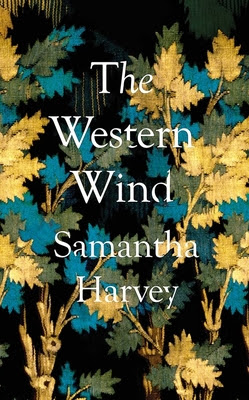
Review of "The Western Wind" by Samantha Harvey

Remarkable book by the author of "Orbital", and almost nothing like that. It's a first-person narrative set in the late C15th, in which the narrator is the parish priest in a not-very-prosperous west country village. It's of course embedded in the world of medieval Christianity, a mixture of theology and folk-superstitions and lots in between (how would you characterise the belief that someone who dies "un-shriven" cannot enter heaven?). There's a suspicious death that's being investigated by an outsider, a rural dean who is in effect the narrator's boss. 

What makes it quite so special is the narrative structure. It takes place over four days, but as readers we experience them in reverse order, so that the narrative really unfolds, but in an unexpected way - we learn gradually that what we think we have "seen" is actually something very different. 

Definitely worth a read. We listened to it as an audio book first, and I didn't get the structure properly until I actually read a paper copy.

Review of The End of The Tour

A very unusual film - about how David Lipsky (a journalist for Rolling Stone) goes to interview the writer David Foster Wallace by joining his writer's book tour, and the relationship that develops between them. In between it's about what goes on between writers and their subjects, and the business of book tours, and what integrity demands of reporters, and so on.

It's slow, and not so beautiful to look at, but really interesting. And now I want to read more of David Lipsky.

Watched on Netflix.


Wednesday, June 11, 2025

Review of "A Short History of Tractors in Ukrainian" by Marina Lewycka

Everyone loved this book when it came out, didn't they? I didn't like it so much. First there's the picaresque humour - the old man acting stupidly and irrationally over the obvious exploitative and semi-crooked "tart-ish" woman, who is also what would be called by many an illegal immigrant. The first-person narrator is politically wise to the nastiness of the stereotype, but she's really having her cake and eating it - managing to have a narrative that's a bit racist and sexist while also maintaining a distance from it. And picaresque - laughing at the stupidity of an old man - doesn't sit well with me. I never understood how anyone could find Don Quixote funny.

And the Ukrainian nationalism too. The book was written before the "Orange Revolution" and all of the stuff that followed, though after the break-up of the USSR. In the post-invasion period many progressives have become a lot less critical about the darker side of Ukrainian nationalism, and the people who bang on about it tend to be "Red-Brown" stooges for Putin. But it's there, and the book mentions in passing Stephan Bandera, and Symon Petliura, as Ukrainian nationalists without even alluding to their Nazi and pogromist histories. I can't believe that most readers of the book will know who they were, and won't learn that about them.


Thursday, June 05, 2025

Review of "Lessons in Chemistry" by Bonnie Garmus

Another really enjoyable novel. I watched the TV series first, which was also great, and then when it finished I was missing the characters so I read the novel. Which turned out to be a little different from the series - the Afro-American characters and the anti-racist theme of the series isn't really a thing in the book, though the main character Elizabeth Zott is a supporter of civil rights and racial equality, just as she's a feminist - probably a premature feminist, because she's between the two waves of feminism.

The TV series seems to have put some more complexity in, but also left out some of the scratchiness that's in the book - hard to write about without spoilers, but in some ways it's more critical of conservative and conventional America.

Review of "North Woods" by Daniel Mason

 Really enjoyable novel made up of different stories set in the same place through history.  I feel there ought to be a name for that but I can't think of it. In this case it's a rural local in Western Massachusetts, on the boundaries of forested wilderness. It gradually becomes more tame over the various stories, but not evenly - it goes from wilderness, to orchards, to farmland and then back to holiday-home wilderness. 

It works as a prism for American history - racism, colonial expropriation, slavery - the lot. There's a bit of a supernatural theme running through it too, with ghosts and fake mediums who turn out to have real experiences with ghosts. As with Cloud Atlas, the different episodes are told in different styles, and there are fragments of songs and poems and some pictures scattered through.

A joy - I was sorry when it finished.

Tuesday, June 03, 2025

Review of "Popular Resistance in Palestine A History of Hope and Empowerment" by Mazin B. Qumsiyeh

I was disappointed and upset by this book. It's not specially well written, and it feels poorly edited too - sometimes the same episode is described twice, or the same point made, within a few pages. 

But that's not the main thing that's wrong with it. Its politics and its account of history are often really bad. The first four or so chapters are a "discussion" of the role of violence in struggles of resistance, but there's nothing remotely analytical about it. Sometimes the resistance (wherever) uses violence, and sometimes it doesn't. He's obviously keen not to be seen as criticising armed struggle, whether or not it's appropriate or effective. 

Worse, there's really no distinction between different kinds of armed-struggle tactics or strategies. Sure, the South African regime and its supporters called the ANC "terrorists", but for the most part its armed wing stayed away from indiscriminate attacks on civilians, focusing instead on infrastructure. Whereas the Palestinian armed struggle focused on soft Israeli targets, with lots of attacks on civilians - kidnappings, hostage taking, and exactly the kind of bombings and shootings that had earlier been deployed by the Irgun against Palestinians in Mandate Palestine. The question here is not the abstract "do Palestinians have the right to use violence" but what kind of violence should they use. For both Fatah and later Hamas, the rhetoric was revolutionary but the tactics were those of fascism.

After this there's a long chronological account of Palestinian resistance, beginning with the Ottoman period.  The Zionists start to arrive, but there's absolutely nothing about where they are coming from or why.  As with other Palestinian and Arab Nationalist accounts of "the Zionists" they are presented as pith-helmeted colonialists. There's no indication or reflection at all as to why Jews were leaving the Russian empire. Of course the Palestinians of the time can be forgiven for not thinking about that so much - something bad was beginning to happen to them, and they correctly understood that it was going to get worse. But someone now writing a history owes their readers something better.

This tendency is exacerbated in the history of the Mandate. By the time the book reaches the 1930s it acknowledges that the flow of Zionist immigrants is increasing, but there's absolutely no account as to why. The author manages to talk about the history of this period without mentioning antisemitism or the Nazis. The only mention of the Holocaust in the book is to illustrate a point about the bad education that Jewish children in Israel receive. There's nothing at all about who made up the wave of Jewish immigrants in the immediate post-WW2 period, or about the mass emigration of Jews from Arab countries that came after that. Again, it would contradict the view that "the Zionists" were all European and American colons.

When it gets to 1967 there's a brief mention of Ahmed Shukeiri, the Egyptian-backed first head of the PLO, though no mention of his call to throw the Jews into the sea or his promise that no Jews would survive the coming war.

Overall the history in the book is like a mirror image of the bad history that I received from my Zionist education. There's lots about the pro-Zionist sympathies of the British (we were only told about the bad period in which the British tried to restrict Zionist immigration, not the preceding 16 years in which they had enabled it), and then the Americans. There is of course nothing about the way in which the USSR and the international Communist movement acted as midwives for the birth of Israel, because that would contradict the narrative that Israel was a creation of imperialism. 

It's a shame, because somewhere in there there's a better book struggling and failing to get out.  There's a lot of good documentation about the popular non-violent struggle. The account of the post-1948 and then post-1967 resistance is informative and told me lots I didn't know. Somewhere in this period some good Israelis begin to appear, though without any discussion or reflection as to what that might mean. There's a little bit of an account of Palestinians who are prepared to accept a permanent presence for Israelis, though usually in terms of them being sell-outs. At one point he does actually quote with approval that "there's no place for a second nation in Palestine", though he is far from consistent about this.

I read this on a Kindle, so it's harder to illustrate this with quotes and excerpts. In a way I'd like to write more, because this is an important juncture in the evolution of my perspective on Israel-Palestine...listening to Palestinian voices, but then not finding them easy to listen to.

Tuesday, May 27, 2025

Review of "The Jazz Scene" by Francis Newton

This has sat on my shelf for more than a year. Someone was clearing out his Jazz books collection, and I took this one, mainly because I remember that "Francis Newton" was a pseudonym for the Marxist historian Eric Hobsbawm, who wrote Jazz reviews for various left wing publications.

Anyway, it turns out that it is a very good book, intelligent, informed and very sensible about Jazz, its audience, its players, and its history. The author (whatever we want to call him) situates Jazz in its historical and social context, without resorting to vulgar Marxism or daft economic determinism. Really great, well worth reading. 


Monday, May 26, 2025

Review of Benedetta

A Paul Verhoeven historical drama with heresy, blasphemy, lurid visions and lesbian nuns. Not ridiculously over the top like Ken Russel's "The Devils", this nevertheless managed to be quite salacious, but also anticlerical and anti-religious in a good way.

Benedetta is given to a convent as a quite young child, but almost immediately begins to have visions. These become progressively more lurid, but she's also doing miracles - bleeding wounds of Christ, that sort of thing. The local clerics decide to believe her (good for the pilgrimage trade), others are not so sure but she sees them off. Then the Papal Nuncio gets involved, and it's torture and burning at the stake...

Watched on Channel 4's app via Chromecast.

Friday, May 23, 2025

Review of Lots of Kids, a Monkey and a Castle

A disappointing, ramshackle, often boring film, with occasional glints of interest. It's a fly-on-the-wall documentary - no narrative or narrator - made by a son about his eighty-year-old mother.  She's not an obvious choice for a film. She's overweight, unattractive, and she doesn't stop talking. She has not much interest in other people, and little insight into her own life.

The title comes from her own declaration of what she wanted from life. The film rather glosses over how it came about that her and her husband were wealthy enough to buy the castle. It seems that money was inherited, but it's not entirely clear from who. The family were Falangists, and some members were executed "by the Reds" during the Civil War. The woman (Julita) talks about her own membership of the Falangist youth, the uniform she wore and so on; but later on she criticises Franco for abolishing the Republic, because her present-day political views extend to disapproval of the Spanish monarchy and monarchies in general.

Much of the film centres on the amount of crap that she has accumulated and preserved. The castle, and the now abandoned engineering factory that her husband once operated, are absolutely rammed full of junk - broken objects, tattered remnants of clothes that might one day be mended, and many small and labelled boxes with dolls house furniture, pins, stationary, and so on. 

That's sort of poignant, because I can't help feeling that my own life is full of crap that I am holding on to and shouldn't. The film is inter-cut with footage from home movies of the family when the children were younger, and they look to have had a fun, happy childhood - beach holidays and so on. Again, I look at that and wonder what the arc of my own life would like if it were made into a film like this.

But most of the time it's boring and depressing, and I missed some of it when I fell asleep. Ruth missed almost all of it, but still saw enough to remember how much she didn't like it.

Watched at Jane Opher's house - the old Co-op on Horns Road - as part of an ongoing series of Spanish films. The occasion was enjoyable even if the film wasn't.

Thursday, May 08, 2025

Review of The Umbrellas of Cherbourg

I watched this as part of my birthday celebrations. A few months ago I found myself - unusually - listening to Radio 4, and there was a program about musicals where they raved about this as one of the best musicals ever. And then it was scheduled to be on the Stroud Film Festival, but I missed it.

So I obtained it and put it on in the Middle Floor at Springhill Cohousing - a bit of a challenge because the file was too big to copy on to a USB, and my mini PC sometimes forgets how to produce sound output from its earphone jack. But all sorted, and the showing was a success; quite a few people came, and they - like me - enjoyed it.

But it's a weird musical. Apart from the fact that there's no spoken dialogue at all, everything is sung - it's an anti-romantic romance. Sorry for the spoiler, but the main story line is that the young woman does not wait for her lover to return from the Algerian War, but marries someone else instead, because she is forgetting her absent lover even though she is carrying his child.

He comes back, marries someone else (the woman who had cared unceasingly for the dying aunt who raised him), and when the original pair meet again the moment of love has passed. There is no sense that they might yet get back together, just a feeling of a future that didn't happen.

The beautiful theme song for the film, performed by many artists, is "I Will Wait For You", but she doesn't.


Review of Tinker Tailor Soldier Spy

I've belated become a John Le Carre fan. I think this film captures the atmosphere of the books, especially the shabby interiors of the intelligence agency premises and safe houses. I liked the acting, but somehow I literally lost the plot - I couldn't figure out what was happening. I read the Wikipedia article about it, and realised that I'd fallen asleep and missed a major section, which might have made it easier to follow.

Watched on BBC iPlayer

Wednesday, April 23, 2025

Review of "L.A. Noir: The Struggle for the Soul of America's Most Seductive City" by John Buntin

The ratings and reviews of this book seem to be overwhelmingly positive, and I see it's been turned into a TV series. Still, I wasn't all that impressed, though it was something to read in the small hours to help me go back to sleep. 

The central conceit is that it's a dual biography of mobster Mickey Cohen and LA Police Chief William H Parker. But Cohen is a lesser figure, and his biography and career are not all that interesting. Parker bestrode the city as it grew, and dominated its politics and its policing, and it's hard to avoid the conclusion that Buntin really wanted to write a biography of him, or should have anyway. 

The author has had a lot of help from the LAPD and various Parker-related foundations and organisations, so though it's pretty obvious from reading the book that the man was a megalomaniac and a racist, and a right-wing operator who couldn't get on with other right-wing operators (especially J Edgar Hoover), the author doesn't want to say so. The book almost ends with Parker's death, though there's a longish epilogue that covers the 1991 riots. It's not clear whether it wants to say that the riots were Parker's legacy, or that if he'd been in charge they would have been crushed more effectively - I think it wanted to have it both ways, which makes it confusing and unsatisfactory.

I read this on kindle, so I'm not putting up a cover picture. 

Tuesday, April 15, 2025

Review of Shoshana


This is a film about Shoshana Borochov, a real person who was the daughter of Dov Ber Borochov, a "Marxist Zionist". There's lots to say about his ideas and his politics, which were in my lifetime influential in a retro sort of way about young Jews with contradictory ideas about Zionism and revolutionary socialism - but the film doesn't say much about his, though it alludes to the way he would have liked Zionism to have turned out nice. 

The film is about Shoshana's relationship with a British policeman, who is part of the Mandate authority trying to fight against the Irgun and its breakaway faction Lehi. This troubled love story is the centre of the film

The Irgun suspended hostilities against the British for the duration of WW2, Lehi didn't, and famously tried to develop a relationship with the Nazis on the basis of common hostility to the British Empire.

The film does make some efforts to show the different currents within the Palestinian-Jewish community in Palestine, but it's pretty cartoon-ish. We see that the mainstream Zionists (Labour Zionists, though it doesn't really say so) don't like the Revisionist Zionists (Irgun, and then Lehi) much, but there's not all that much substance to the disagreement - though the mainstream Zionists do call the Irgun fascists, which is justified. There are occasional Palestinian-Arab victims depicted (an Irgun attack on a bus, and then bombs in marketplaces) but there are no voices from the Arab community, no Arab characters...apart from one scene where the Mandatory Police carry out frightening round-ups in a village.

The Revisionist Zionists want to proclaim a Jewish (or rather a Hebrew) state right now, even though there's nothing like a Jewish majority. The mainstream Zionists are gradualists, and believe that continued Jewish immigration will eventually produce a Jewish majority, at which point the locals will accept a Jewish state. I can't help wondering when they thought this was going to be - the 1950s? The 1960s? With the British providing the umbrella under which this demographic and political shift would take place?

The film ends with the very beginning of what Israelis call the War of Independence and Palestinian Arabs the Nakhba...but all that's shown is a group of disorganised Arab fighters running to attack a group of Haganah fighters, lying in wait with machine guns. There's no refugees, no displacement...nothing of the civil war between the Haganah and the Irgun either. 

A few details are worth noting. We see the Irgunists flyposting their posters, with the emblem of a fist holding a rifle over a map including both Palestine and Transjordan, and the slogan (in Ivrit) "Rak Kach" - that is, "Only Thus". Until this point I hadn't really appreciated the continuity between the Irgun and the Kahanist party, which was of course called "Kach".

Also, Shoshana and her mother seem to be speaking to each other in Russian - presumably this was much more common in the Yishuv than we are given to understand, though Dov Ber Borochov was a Yiddishist as well as a Zionist, and the party he founded (Left Poalei Zion) was also pro-Yiddish. 

At one point in the film some bright-eyed young Zionists say that they have recently arrived from Kiev - was this ever possible in the 1930s?

Watched via informal distribution.

Thursday, March 27, 2025

Review of "Altered Carbon" by Richard Morgan

The hardest science fiction I've read for a long time, and a mashup of cyberpunk and hard boiled detective noir. I really loved it. It's been on my Kindle for years, but somehow I never got round to reading it. I must say that I couldn't follow every twist and turn of the plot - the fact that characters can die and be restored most of the time, and that they slip in and out of each other's bodies - sorry, "sleeves" - makes this harder. I couldn't explain who turned out to have done it if any of my lives depended on it. Still, it was good if not great, and I will be back for more. I have a feeling that I started to watch the TV series once, and I might even have another look at that.

Review of Radical Love: The Life and Legacy of Satish Kumar

I watched this in the company of about a hundred people who were devotees of Kumar and thought he was perhaps literally God's gift to humanity. Some of these people were friends whom I admire, and others were fascist-adjacent woo lovers, so perhaps he is some sort of Rorschach inkblot on to who you can project whatever you want. 

I was depressed and bored by the film, which at just over an hour felt way too long. Lots of spiritual practices and pilgrimages, described as if they were effective political actions. A long section with Vananda Shiva, which brought to mind the film about her watched in the same place, and which left me with the same uncomfortable feeling. 

So yeah, watched at Hawkwood as part of Stroud Film Festival. Based on the venue I had an expectation about what the film would be like, which was not disappointed. However, Ruth and I walked there across the fields and through the woods by moonlight, and that was wonderful.

Tuesday, March 18, 2025

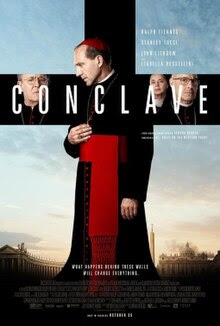
Review of Conclave

A papal election thriller, with lots of twists as the various candidates are revealed to have things in their past, or even in their presents, that don't look good in a putative Pope.

Very lush to look at, but not that much actually happens - unsurprisingly, because the cardinals doing the voting are locked in to the Vatican, so all that we can really see are side conversations and voting procedures.

Sort of tense without being actually interesting, though it held our attention.

Watched via USB and informal distribution.

Review of No Other Land

Absolutely relentless documentation of the way that first the Israeli army, and then settlers, try to evict a group of Palestinian villagers from their land in the West Hebron hills. It's crushing to watch, and there's no Hollywood-style redemption. One of the film makers is a Jewish Israeli, and the villagers are suspicious of him - not unreasonably, as we see him leaving the West Bank via the Israelis-only road back into Israel. 

There's been a lot of controversy over the film, which won an Oscar for best foreign film. Unsurprisingly many Israelis think it's propaganda, but some Palestinians also condemned it because the Israeli-Palestinian team that made it didn't use the right words to denounce Israel's occupation and genocide, and were therefore guilty of "normalisation". Fortunately other Palestinians, including the villagers most directly affected, were wiser.

Watched via informal distribution, even though it was available for free on Channel 4...mainly because I wanted to show it from a USB stick on the DVD player in the Springhill Common House. Only it wouldn't play there, even though it worked fine at home.