Thursday, September 24, 2020

Review of 'The Many Headed Hydra: The Hidden History of the Revolutionary Atlantic' by Peter Linebaugh and Marcus Rediker


I really enjoyed this book - intellectual and social history, with lots of the best kind of political analysis but rarely inaccessible in its language. Lots that I sort of knew about...the Diggers, the Maroons, the revolution in Haiti (well, I've only recently read The Black Jacobins, and I grew up on The Kingdom of This World and also a novel about Henri Christophe that I think must have been Black Fire), but also lots that I knew much less about - the antislavery of the radicals in the English Revolution, the multi-racial solidarity of sailors in England and North America, antinomianism (I had to look that up).  I didn't know about the image of the hydra as a ruling-class metaphor for resistance, or of the extent to which Hercules is a symbol of ruling-class power. I knew a bit about the democratic culture of piracy, but I loved reading about it in such detail, and it's inspired me to read a bit more.

Inspiring and a reminder about why it's important to do History, and why struggles over memory are so important. I have mixed feelings about pulling down statues and renaming streets...I think that we if we erase the colonial past then what chance do we have of contesting the way it's remembered? But why isn't there a statue to the fabulous Edward and Catherine Despard, about whom much more should be widely known? Or at least a few streets or pubs named after them? Small afternote: there is a pub named after Charlotte Despard, who was pretty amazing but no relation of the other Despards.


Monday, September 21, 2020

Review of 'Dean Spanley'

A rather slow period comedy-drama that ends up being quite interesting, though I can't really say why without spoiling it. Good actors, nicely shot and staged (and it does feel a bit stagey and could probably be done as a play), with lots of period details. There's a reincarnation theme, something about loss and mourning, and quite a bit about dogs. If you are interested in any of those then it's worth the time.

Watched on Amazon Prime via Chromecast and smartphone.


Review of 'The Notebook'


Mainly slushy period-set love story about a young man from a poor background and a young woman from an affluent family who fall in love despite their tempestous and conflicted relationship and...

This is mainly slushy and over-sweet, though there's a split narrative past/present thing going on, in which the future old version of the young woman has dementia and only dimly recognizes the history as her own which is almost interesting. It's mainly a romanticised and implausible version of America, particularly the deep South where it's mainly set, in which most of the bad things - especially the racism - are taken out.

Ryan Gosling in it. Sometimes he's in good films, but this isn't one of them.

Watched on BBC iPlayer.


Sunday, September 13, 2020

Review of 'As Ants to the Gods' by Alex Burcher


I really enjoyed this work of alternate history, which imagines the seventeenth-century world if the Moors had been victorious at the battle of Tours and gone on to conquer western Europe. It’s mainly a much more civilised, tolerant and educated world, though there are some jarring exceptions - amputation, branding and floggings as punishments for crimes, for example.

It’s got a complex and interesting plot, lots of alt-history detail (though I’m not keen on the device of a counterfactual within the counterfactual, which so many alt-history writers can’t seem to resist), including intellectual disputes within Islam (or rather the near-Islam of the book), not one but two secret conspiracies struggling for domination, and a thriving Norse civilisation in Europe and North America.


Some of the descriptions of violence were a bit graphic for my tastes - I know these things happen, especially in wartime, but I’m not convinced I need to know about every slash and bone-crush. But I liked the other details, and I liked the main character and quite a few of the others, including the Pepys-like diarist who befriends the hero’s family. I cared about what happened to them, and was emotionally involved with their stories - something that doesn’t always happen with alt-history. I look forward to reading more by this author.


Tuesday, September 08, 2020

Review of "Molly's Game"


Surprisingly good film about high-stakes poker...in the middle I lost it a bit, because everyone and everything (even the interior decoration, which that dark and gloomy stuff that Americans seem to think constitutes class) was so horrible. But we stayed with it, and it was worth it. The eponymous Molly is a driven young woman with dad issues, who falls into running poker games, and becomes illegal when she starts taking a portion of the pot to cover the debts that she's getting into, apparently because she is letting the high rollers play on credit. And then there's the Russian mob, and the proper Italian mob...

Nice to see Kevin Costner in a decent film and role (as the psychologist pushy dad) for once.

Watched on BBC iPlayer


Review of 'Talk to Her'


Another one in Jane's Almodovar season, and they keep getting better and better...and now I understand why it was worth bothering with all the bad ones at the beginning, because it's a pleasure to see a talent emerge...and also because some of the people that were there in the beginning are still with him as he matures.

This is a beautiful, clever, well-crafted film about two men with women partners in comas, and the bond it creates between them. One of the women is a dancer (and it's fair to say that the man is not her partner except in him imagination), and the other is a bullfighter, so there are some hard-to-watch bullfighting scenes. Hard to say more without spoilers, but it's really good and worth watching.

By 2002 when this is made Spain has changed from the repressive, repressed, religious society of the early films into a much more modern and liberal place. I note in passing that when one of the men visits the other in prison it seems more liberal, and decent, than any prison in the UK would be.

Watched in the round house at Days Cottage, on mac laptop and projector, having been obtained from informal distribution.


Monday, September 07, 2020

Review of 'Dirt Road to Lafayette'

Nice film about a young man and his dad visiting relatives who migrated from Scotland to the southern US a long time ago. The mother of the family, and the boy's older sister, have both died from a hereditary disease (unspecified) and the relationship between the dad and boy is very strained.  On their journey to meet the relatives they get stuck in a mainly-Black southern town, and the boy wanders off and hears some music playing...and then he joins in on a borrowed accordion, and we see him smile for the first time. 

It's a film about redemption through playing music, particularly Zydeco. Weirdly, that's supposed to the theme of a German film that we watched recently, in which the promised redemption never happens. Hear, though, it does, and it's a real pleasure to watch this transcending racial, class and other divisions.

There's lots to like, including the acting and the music. The film doesn't hide the racism of the country, but it rather makes it look like Cajun/Zydeco music is one aspect of the US that appears to be genuinely integrated, at the level of the bands and the audience. It's great the way that it manages to both illustrate and distance itself from the religious weirdness that Americans take for granted, and most Europeans don't get any more - without being heavy-handed.

Based on a book by James Kelman, which I will try to read, and apparently there's no poster for the film, which is a first for me.

Watched on BBC iPlayer via smartphone and Chromecast.


Monday, August 31, 2020

Review of Radioactive


A biopic of Marie Curie that I quite liked, though the reviews are all terrible. Nice to Rosamund Pike playing against type as an older woman who's not a romantic character, and I quite liked the occasional bits of weirdness (dream sequences and the like) in the narrative. Some of the flash-forwards to show how radioactive worked out for everyone (the atom bomb, radiotherapy) seemed a bit laboured, but I was quite satisfied with the film, including the dialogue (which some critics hated) and the settings.

Watched on Amazon Prime via Chromecast and tablet.

Monday, August 24, 2020

Review of Waking Ned

One of those films in which a whole village conspires to deceive an outsider (it reminded me of The Grand Seduction) - in this case the man from the lottery, because the bloke who has won the six million pound jackpot has died with the winning ticket in his hand, and the two men who find him decide that one of them will impersonate the deceased so as to claim the winnings. It's mainly comic, despite the death thing, and nicely done, with lots of good village-life detail. Not too long, nice music and stunning landscapes.

Monday, August 17, 2020

Review of "All About My Mother"


Another Almodovar film (part of the Jane Opher program), and another good one - he's obviously hit his stride by now. This one has everything that you expect from Almodovar - junkies, prostitutes, transexuals - but now they are proper characters in a proper film with a plot. Curiously this one starts with the same plot device as "The Flower of My Secret" - a woman faced with the death of her son who has to deal with the transplant doctors' request for his organs, and as in that film, it turns out to be a training video that she's making. Only this time the woman, who is a transplant nurse, then does lose her son almost immediately afterwards in an unpredictable car accident, and then has to deal with the same situation for real. 

Hard to convey the plot without giving too much away (in fact I have already spoiled the car accident death thing, haven't I?) but it's complex, and on the boundary of plausibility, but gripping and full of pathos.

Watched at Days Cottage in a beautiful roundhouse yurt, on Jane's laptop and projector, the film having been obtained by informal distribution.


Saturday, August 15, 2020

Review of 'Flights' by Olga Torkarczuk


Oh my...an unusual, amazingly different sort of book...one of the weirdest and most 'modern' that I've ever read. It's described on the back as 'a novel about travel in the twenty-first century and human anatomy', but it's not a novel in the sense that I was expecting or (I think) most people would understand. There aren't characters, there isn't a plot or even a continuous narrative. It's a series of fragments with different narrators. Sometimes they are like substantial short stories with engaging characters and situations, and some of these resolve and some don't. Some are only a few sentences long. Some re-appear through the book, and some don't.

There's an anatomical theme, but it's as much about anatomists - and how the discipline and its skills developed - as it as about the subject matter. There's a travel theme, but it's mainly not about the places we go but how it feels to travel, to be dislocated and in the liminal places that are involved in the process of travelling...airports, departure lounges, the tunnel on to the aeroplane, and so on.

I absolutely hated this book for the first 150 pages, and that would normally be quite enough for me to give up, content that I'd have given it a fair go. But it was for a book group so I ploughed on, which was a good thing because it has turned out to be rather an amazing experience that I'm glad I didn't miss. A meditation on the human condition, an exploration of identity and self and physicality, and beautifully written. 


Thursday, August 06, 2020

Review of Moana


As with Frozen, I think I'm not the target market for this Disney film, but I wanted to catch up on it. There was lots to like. The visuals, especially the tattoos and the animated tattoos on the Maui character, really look Polynesian, rather in the way that Frozen acknowledges the Sami visual culture. It's thoroughly pagan, with no concessions to a Christian world-view. There aren't any redeeming white people - it's just a Polynesian story. The heroine is a little girl, and one of the other significant characters is her grandmother. But it's not hard to see why it isn't a Disney classic. The songs are mainly not great, and the sidekick animals - a pig and a chicken - are not good enough to inspire affection or humour. Which is a shame, because there's a lot to like. I loved the depiction of the outrigger canoes, especially the big ocean-going ones that make an appearance at the end. And the way that Moana learns to do the Polynesian hand navigation theme is great, and represents part of the film's homage to the navigational feats of the Polynesians
One thing I didn't like, though, was the implicit message of the ending - that it's important not to be confined by the ecological constraints of your island. There's a song early on that says 'The Island Gives Us Everything We Need', but it turns out to be wrong - the answer to the ecological crisis that besets the islanders turns out to be partly magical, but also involves learning to voyage beyond the island again, as the ancestors did. Which is a nice anti-colonial message, but not a good one in terms of recognising ecological limits and learning to live within them. I can't help thinking of the nutjobs in California who think that Elon Musk's private rocket program is the 'answer' to climate change.

Review of "The Luminaries" by Eleanor Catton

I just loved reading this book. I was led to it by the BBC TV series, which I enjoyed - but the book is so much better. The TV series was quite a free adaptation, and doesn't stay true to the narrative of the book - unsurprisingly it telescopes the plot, gets rid of some complexity and characters, and so on. Curiously it makes much more of the astrological affinity between Emory Staines and Anna Wetherell - that barely gets a mention in the book, even though it does do some of the heavy plot explication. 

The last part seemed a bit disappointing, almost as if the author thought it had gone on long enough and needed to be finished - which it does in a series of very small vignette-like chapters, all of which are set in the period before the main narrative. But I still loved it sufficiently for that not to matter.

Friday, July 24, 2020

Review of 'Late Night'

Cheerful and enjoyable but not very consequential film, in which Emma Thompson (looking gorgeous with great clothes and hair) plays a host on a late night talk show that's been going downhill, and she tries to put some life into it by hiring a new writer - ending up with an Indian woman with no TV experience who just sort of walks in to an interview. The other writers are all men of a certain age and demeanour, with no enthusiasm, who Thompson's character barely knows. It has some good funny moments, but is rather spoiled by taking the business of late night TV too seriously, so that we are really supposed to believe, and admire, and care about the fact, that the host character has devoted her life to delivering 'excellence' in late night talk show hosting.

Watched on Amazon Prime via Chromecast and smartphone.

Sunday, July 12, 2020

Review of 'One Day'

I read the book a long time ago - 2011 - and remember it more fondly than my review (which only gave it two stars) suggests. It's sort of a romcom/romantic drama, with an odd twist rarely seen in the genre...yeah, avoiding spoilers here. One of the two principal characters is very obnoxious, though less so in the film; and while the book is a fairy-tale about Britain's class system, this dimension is largely absent from the book - Dexter is obviously a self-assured posh boy, but Emma is faintly Northern but otherwise classless and indeed background-less...she just doesn't have any backstory at all.

The film is from the same year as the book, but I'd managed to avoid watching it until now. Did David Nicholls write anything else ever again?

So watchable, and quite enjoyable, but not memorable.

Watched on Netflix via smartphone and Chromecast.

Review of 'Margin Call'

A film set in a trading house at the very beginning of the 2008 financial crisis, with the implication that this institution and its Mortgage Backed Securities was responsible. Lots of good actors and good acting, but sort of vaccuous. The drama is about the way that the characters plan to stick it to each other and let each other take the blame. There's just a faint whiff of criticism of capitalism in there - the Kevin Spacey character says, as part of his farewell to the troops who are all busy liquidating the company's "position" and will all be sacked shortly afterwards, that the work that they have done has somehow made the world a better place, but you can see that he doesn't believe it and can barely bring himself to say the words. And all of the suits who preside over this have empty, meaningless but wealthy lives. But that's it...no sign that this is a gross, evil system that wrecks lives, wastes resources, mis-applies creative and intellectual resource...if you weren't minded to be anti-capitalist before, this won't make you any more critical of the system. If you think that working in finance is glamourous and interesting, you will probably still think so.

Watched on Amazon Prime via smartphone and Chromecast.

Saturday, July 04, 2020

Review of Dating Amber

A nice coming-of-age drama-comedy about two young people, at school in rural Ireland in the mid-1990s, both gay, who agree to pretend to have a relationship so that everyone else will leave them alone. They develop a nice friendship, even though the young man is in part-denial about whether he's really gay, and confused as to whether his friendship with the eponymous Amber is romantic or a relationship of solidarity.

Hilarious Catholic-school sex education film, and I learned a new word - "beard".

I note in passing that the film feels entirely contemporary - the clothes, the language, the music (the club the two protagonists go to in Dublin looks much the same as one would now, I think) - except that there are no mobile phones and no IT at all...no laptops, no internet, because it's 25 years ago and none of that existed. And yet social relationships seem to be mainly the same.

Watched on Amazon Prime via smartphone and chromecast.

Wednesday, July 01, 2020

Review of Tully (spoiler alert - plot twist revealed, sorry)

Another Hollywood film, billed as a 'comedy-drama' but with no actual laughs - look at that poster and tell me this is supposed to be a comedy. Marlo (Charlize Theron) is an affluent mum with two 'challenging' children and an unplanned third one on the way, when her even-more-affluent brother suggests that she and her husband get a 'night nanny' At first Marlo refuses to share the intimate parts of her life with a stranger but after the baby is born, and she's overwhelmed with the workload and the stress, and then the night-nanny arrives. She's beautiful, and cool, and she solves all of Marlo's problems - she cleans the house at night while Marlo sleeps, she bakes muffins for the children, she discusses Marlo's career frustrations and disappointments in life, and so on.

Then she helps Marlo to re-engage with her husband sexually, and then the two women go out on the town, get drunk and have a car accident that almost kills Marlo - and while she is recovering in hospital we realise that the night-nanny is actually a product of Marlo's imagination. She's been solving her problems herself, via her imaginary helper, but doing so in a way that is frankly psychotic. No-one else seems to have noticed.

So it's interesting, and has led to some thoughtful reflections about post-partum psychosis, but ultimately unsatisfactory as a film. It just doesn't seem fair to have been so misled without any hint that this is a psychological film, not a buddy movie - though in fairness, the sex scene with night-nanny in a diner waitress uniform ought to have been a clue.

Watched on Netflix via smartphone and Chromecast.

Sunday, June 28, 2020

Review of 'The Girl on the Train'

Great to see that Hollywood can sometimes turn out a really good film - a mystery thriller without stupid supernatural elements or a spirit-led redemption, but a really good plot and good acting.

Rachel is an alcoholic with an unreliable memory who spies on her ex-husband from the window of a train as she commutes past the Long Island suburb in which he, his new wife and their baby live. She spies on another neighbouring couple too, and creates a fantasy around what seems to be their perfect love. But she is moved to intervene in their lives, and this puts her inside a chain of events that forms the basis for the murder mystery plot.

One thing that I didn't like was that for the first three quarters of the film, the story is told - sometimes unreliably - through the eyes of the women characters. Then, in the last quarter, we get to see "what really happened", seen through the eyes of an omniscient camera-narrator. I find this unsatisfactory, and I think it was unnecessary.

But it's a good film, tense and well-crafted, and I can't say much more than that without ruining it for you.

Worth noting that although this is the Greater New York area everyone is white - no black people or latinos at all.

Watched on actual live TV, the first time for a while.

Review of 'The Watcher in the Shadows' by Carlos Ruiz Zafon

I picked this up almost by accident; I was stuck outside for a few hours with nothing to read, and miraculously one of the charity shops was open, and it felt safe to go inside (almost my first time inside a shop for weeks), and I recognised the author and didn't feel like picking up and touching a lot of other books till I found one that I liked better. I'd quite liked The Shadow of the Wind, and been less keen on The Angel's Game.

A little way in I realised that this was a "young adults" book, and also something he wrote years ago, before he was a success. It's a bit cliched, and there were bits of description that were a chore to read. Nevertheless you can see that he knows how to tell a story and to maintain tension, even when the story itself is a bit nonsensical...it relies on supernatural elements that are grounded in a unfamiliar and unstated supernatural universe. I mean, if you read something that's basically Christian, with a Devil and Hell, and demons and so on, you know where you are. Here that's not the case - there's a horrid evil at the heart of the story, but we don't understand where it comes from or what are the rules by which it works.

I note in passing that the story is set in the 1930s, and that in an afternote there are references to the war - and some of the backstory narrative is set in 1916, though there are only the darkest of hints about the war that was going on then. But at one point in the story the characters find themselves in a a large disused shower room, and something nasty comes out of the shower heads. I couldn't help but find that objectionable...it's obviously drawing on the reality of the fake showers in the Nazi concentration camps, but this felt to me like exploitation rather than explication.

In an afterword the author explains that it's a work aimed at young adults around 13 years of age, and he cites Jules Verne, Victor Hugo and Enid Blyton as the sort of thing he thinks his target audience is reading...which seems odd to me. Is anyone reading Enid Blyton by the time they are 13? And reading Victor Hugo as well?

Saturday, June 27, 2020

Ratko's dilemma

When I was writing 'The Girl in the Red Cape' this quote, from Engels' fab book The Peasant War in Germany kept coming back to me.

"“The worst thing that can befall a leader of an extreme party is to be compelled to take over a government in an epoch when the movement is not yet ripe for the domination of the class which he represents and for the realisation of the measures which that domination would imply. What he can do depends not upon his will but upon the sharpness of the clash of interests between the various classes, and upon the degree of development of the material means of existence, the relations of production and means of communication upon which the clash of interests of the classes is based every time.

What he ought to do, what his party demands of him, again depends not upon him, or upon the degree of development of the class struggle and its conditions. He is bound to his doctrines and the demands hitherto propounded which do not emanate from the interrelations of the social classes at a given moment, or from the more or less accidental level of relations of production and means of communication, but from his more or less penetrating insight into the general result of the social and political movement.

Thus he necessarily finds himself in a dilemma. What he can do is in contrast to all his actions as hitherto practised, to all his principles and to the present interests of his party; what he ought to do cannot be achieved. In a word, he is compelled to represent not his party or his class, but the class for whom conditions are ripe for domination. In the interests of the movement itself, he is compelled to defend the interests of an alien class, and to feed his own class with phrases and promises, with the assertion that the interests of that alien class are their own interests. Whoever puts himself in this awkward position is irrevocably lost."

I think Engels was writing about Thomas Müntzer, but it was so similar to the dilemma facing Ratko and his revolutionary government that I wanted to work it into the text - perhaps as a speech by Ratko himself. I didn't manage it, so I've put it here instead.

Friday, June 26, 2020

Review of 'The Salt of the Earth' by Josef Wittlin

I really enjoyed this book about the outbreak of WW1 from the perspective of a single, not-very-bright, Polish-Ruthenian man. It covers his life history before the outbreak of war, his feelings for the Austro-Hungarian empire, and the process by which he is conscripted and then taken away for basic training at a garrison town in Hungary. It's beautifully written, and it introduces lots of fantastic detail about Ruthenia, the natural landscape, farming, and an ethnic group I'd never heard of before (hutnuls).

Most of the time I was reading it I was comparing it to Von Rezzori, whose writing - about the neighbouring region of the Bukovina - I love.

It's a bit Schweik-like...our main character is a bit simple (though not also shrewd like Schweik), and there's a lot of journeying, and there is some lampooning of the bureaucratic absurdities of the army. The tone is as much tragic as comic, though, which I rather preferred...I've never really got into Schweik.

It's impossible not to comment on the tone of the writing about Jews, of which there is rather a lot. Jews are ever-present in the story, and they are described in lots of detail, as weak, crafty, and somewhat physically repulsive. It's not a very vicious portrayal - it's almost like the way a not-very-nasty anti-black racist would talk about Africans as physical specimens. It just goes with the territory; Jews were part of the social landscape in Galicia and Ruthenia (and the empire), and the stereotype of Jews was part of the mental landscape - again, hard not to think of Von Rezzori's Memoirs of An Antisemite. From time to time it made me feel uncomfortable. Afterwards, I learned that Josef Wittlin was a baptized Jew who identified as Jewish and wrote Jewish-Polish poetry in the interwar years. Go figure.

Sunday, June 21, 2020

Wobblies! A Graphic History of the Industrial Workers of the World

I'm not all that fond of graphic novels...though this is more of a collection than a single narrative, with different authors and artists telling different bits of the Wobbly story. The makes it slightly more palatable to me, though I'd just as happily have read a straightforward narrative text.

It's a pretty comprehensive work, and a good introduction for people who no nothing about either the Wobblies or how much effort went into suppressing socialism in the US. I learned lots that I didn't know.

Two things stand out for me: how grim the struggle was, and how limited were the Wobblies' successes - lots more heroic defeats and martydoms than success stories; and how important the divide was between skilled workers, organised in the 'labour aristocracy' unions in the AFL, and unskilled workers, in the IWW and other industrial unions. Perhaps the AFL unions actually did represent the class interests, at least in a narrow sense, of their memberships. Something similar happened in the UK, I think, though the division seems to have blurred in the twentieth century.
And perhaps our current divide, between a 'working class' and a 'middle class' defined in terms of culture is closer to this than we realise.

Review of 'The Essex Serpent' by Sarah Perry

I so loved this historical novel - the atmosphere, the writing style, the characters, and the plot. I became as involved with the characters as I would in a TV series, and I cared what happened to them and shared the triumphs and sorrows. I missed them when the book ended.

It's set in a late-Victorian England, in many ways recognisably like our world, with a London that includes electricity and the Tube. But it's also a world in which things that seem primitive - superstitions, belief in monsters, strange requirements of etiquette - sit alongside this modernity.

Hard to say much more without describing the story or giving it away, even though it's not strongly plot-driven. But I won't, I'll just say that I'm really pleased that I read it and will certainly try to read more by Sarah Perry.

Saturday, June 13, 2020

Review of Days of the Bagnold Summer

Gentle, mildly humourous British film about a fifteen year old heavy metal fan unexpectedly spending the summer with his mum after his divorced dad, who has moved to Florida and has a new younger wife, cancels his visit. Nicely observed, and Monica Dolan (the lead character really, though not listed among the 'stars') is good as the downtrodden and dowdy mum. Some good bits of dialogue - I liked the 'vegetarian' girl at the wedding who won't eat chicken but is fine with ham.

Watched on Amazon Prime, and paid for...not sure it was really worth the money, even though it wasn't too bad.

Monday, June 08, 2020

Review of “The Evil Eye; the magic of envy and destruction” by Jack Shamash

I sort of grew up with the evil eye, or at least the idea of it. When we went on a long journey my mum would remind us – in a jokey way, of course – that we should wear something red, like socks or pants; and she would say ‘puh puh puh’, mock-spitting, if she said something that seemed to be risking the evil eye, like referring to some good fortune. It was all in fun, of course, and we would all have been shocked if anyone had seriously suggested that we were in thrall to ancient superstitions, but we still did it.

So I’m familiar with some of the material that is covered in this book – some of the charms and strategies to ward off the evil eye, for example. Others are completely strange, because as it turns out, just about everything is used somewhere as a protective charm – plants, metals, things that are the shape of a penis, hand gestures that represent a penis or something horned, semi-precious stones...funnily enough one of the few things not listed seems to be wood (I may have missed this, among the shit, piss, milk and other substances), though most of us are familiar with touching wood when we might have invited some ill-luck.

Among the things that I learned from this book is that the Evil Eye is a separate thing from supernatural entities like gods and demons, and separate too from witchcraft and sorcery. It’s almost like a force of nature such as magnetism, a property of eyes that can bring bad luck despite the intention of the person to whom the eyes belong. Although the eye is sometimes put on people or things deliberately by ill-wishers, at other times it can happen even though the person casting it wishes the receiving person or thing no harm. There’s a whole chapter more or less taken up with Pope Pius IX, who seems to have caused no end of harm with his unfortunate gaze.

If you have even a passing interest in folklore or popular superstition you’ll enjoy this book. It’s beautifully written, with some nice illustrations (a shame there aren’t more!) and lots of personal and historical anecdotes.

Review of 'One Green Field' by Edward Thomas

This is a beautiful little book...a collection of short descriptive pieces about the English countryside that I might never have read. It was given to me by our lovely friend Pat Kattenhorn as a birthday present. If it hadn’t been for Covid-19 and Lockdown I wouldn’t have got nearly so much out of it; but we’ve tried to pass some of the time by going for very long walks away from roads and people. The weather has been glorious, and we’ve taken in some wonderful scenery. We’ve been much more aware of nature, both plants and animals. At the beginning it was all very quiet too, so it seemed much closer to Thomas’s world of the early twentieth century. As the pandemic has worn on  there’s been more traffic on the roads, and even though we’ve been on the footpaths we can hear it again. Even so, I can still feel a connection with the world that Thomas describes. Like him we’ve come across hidden brooks that splash and meander on their way towards rivers, and cattle resting in fields, and old farm machinery left to rust. 

If it hadn’t been for this time I’m not sure I would have appreciated the book so much. It’s been perfect for late-night reading, full of wonderful imagery without much plot or narrative, at once capturing and pacifying the restless mind. When I finished it I read a little of Thomas’s biography, and learned that he was a friend of Robert Frost, and that in a way Frost’s poem ‘The Road Not Taken’ killed him. I guess I won’t hear that again in the same way.

Saturday, June 06, 2020

Review of The Banker

A film about Black capitalists in the 1960s, Joe Morris (Jackson) and Bernard S. Garrett Sr. The two men succeed in the real estate business in Los Angeles through their intelligence and hard work, and then go on to buy a bank back in Garrett's home town in Texas. They know this isn't a good business decision but - particularly Garrett - are motivated because they can see how it will help hardworking members of the Black community, who can't get loans to buy homes or invest in their businesses. They are helped by a young white man, depicted as utterly devoid of racism ("I don't care what colour you are, as long as your dollars are green"), who fronts various businesses for them, even though he starts out not knowing anything about money or finance...some of the film works in the way that the TV show 'Faking It' used to, by showing how it's possible to coach someone into appearing to know stuff that others have spent a lifetime acquiring.

The film is about racism, of course, but it's also about capitalism, and the message seems to be that the latter is the opposite of the former - capitalism, exemplified by thrift and hard work, is the best opportunity for Black people to rise. Even though this is the time of the Black Panthers and Malcolm X, there's no sign that anyone else has a different strategy. In California racism is represented by the slightly snooty disdain with which conventional bankers won't meet with Garrett, and the social prejudice of an older white woman (with a Southern accent) in the first building that Garrett buys. In general racism is a thing that happens back in Texas. Even when it all goes wrong it's not because of white backlash against Black-owned capitalism, but rather the political machinations of a Senator who wants to tighten up banking regulations.

Enjoyable to watch, and with good music, but I couldn't help being disatissfied with the underlying message.

Watched via informal distribution, despite the fact that this is apparently exclusive to Apple TV.


Review of Mad to be Normal

A film about R D Laing, focusing on the therapeutic community at Kelsey Hall in London's East End in the period 1965-70. Nicely acted - David Tennant is good as Laing himself, and Elizabeth Moss is very good as Angie Wood, the woman who become his lover and has a child with him (he has another family with four children in Glasgow).

But - like lots of people at the time and subsequently - the film is not sure whether Laing is a messianic genius who had developed a therapeutic alternative to conventional psychiatry, or a charlatan who actually did a lot of harm and never really helped anyone. It shows him criticizing psychiatry...all the conventional shrinks are stuffy men in pinstripe suits who are smugly confident in their abusive treatments, and we see his kind empathy with mad people that seems to work at getting through to them and understanding the symbolic meanings of their apparently bizarre behaviour.

But the film also shows it all ending in failure, and not all of that is the fault of the system's backlash. The people living in the therapeutic community don't actually get 'better', they just develop a different way of living with their illness, and one in particular becomes ever more set in his terrifying religious mania so as to become a threat to everyone else. We see this, but we don't see whether Laing has an answer, only that he feels bad about it.

Not a bad film, despite this contradiction at the centre of it.

Watched on Amazon Prime via Chromecast. Small technical afternote; this week I threw away our Amazon Fire Stick. Weird to think that a year ago Amazon thought it was OK to develop its own entirely independent technical device for streaming, and that we would all be fine with that. I would have liked to have given it to someone, but couldn't work out how to remove my account and password from the device...the advice on the support pages didn't appear to work.

Tuesday, June 02, 2020

Review of "A Supposedly Fun Thing I'll Never Do Again: Essays and Arguments" by David Foster Wallace

A supposedly fun book but actually not very enjoyable. DFW is a very good writer, and he's very clever, and he can be very funny...but somehow this collection of essays (many of which are really quite old now) is less than the sum of its parts. There's a really interesting one about his brief career as a competition-level junior tennis player, which also includes lots about growing up in the Mid-West (a part of the USA that is especially foreign to me), and then there's another less interesting one about how tennis competitions are organised and conducted. I started out thinking 'all this detail is really interesting, who knew?', and then the feeling passed and instead I thought 'why would I ever want to know this much detail since I neither play nor watch tennis?'.

There are two essays about 'ordinary folk' - one about the State Fair, and one about cruise ships, and both of them are very well observed but have a nasty trace of sneer about them. There's one about David Lynch, whose films I quite like, but this went on and on, and had so many footnotes, that I lost the will to read to the end. Another one is about post-structualist literary theory, but written in sort of popular, muscular language so as to make it faux-accessible, and again I couldn't face reading all the way to the end.

And of course it's all from a bygone age, before the internet and when the idea that lots of people might have 'cellular' phones was still interesting.

A supposedly funny book that I will never open again.

Friday, May 29, 2020

Review of Brick

Watched again after at least five years, mainly because we just watched 'Knives Out', also written and directed by Rian Johnson. At the first watching Brick made a really good impression - mashing up High School drama and Detective Noire seems like such a brilliant idea. On second watching it was still good, but not nearly as good as Knives Out. The dialogue was so quiet and mumbly it was hard to make sense of some of it, and I'm still not sure I got all of the plot. I had to read the Wikipedia article just to get some of the characters' names.

The behind the scenes loyalty of Brendan's friend 'Brain' is kind of implausible...they don't seem to have any other relationship at all. And I know we ought to suspend disbelief, but the fact that all these hard-nosed hard-bitten gangsters are still in school and living at home with their parents seemed hard to take - though of course lots of the gang members in the UK are doing exactly that.

Is this the last film in which young people seem to do all of their communications via payphones? It's 2005, didn't everyone have a mobile by then? Brain does, though it seems to be a dumb flip-phone, and everyone writes each other little paper notes rather than sends texts.

Liked the moody noire music, and the cinematography was still enjoyable.

Watched via laptop, VGA cable and informal distribution.

Monday, May 25, 2020

Review of 'The Silver Sword' by Ian Serrailier

I didn't read this book as a child. I think my youngest son read it, but at a stage after he'd started reading for himself, so I didn't read it to him. It's about a group of Polish children who cross Europe in the very last days of the war, and the immediate aftermath, to find their parents; their mother is Swiss and their father has managed to escape from a concentration camp and make his way to Switzerland.

It's beautifully written, simple but engaging. The characters are vivid and differentiated without being caricatures. It's not at all a Holocaust story, though there is some mention of Jews hiding in the woods around Warsaw, where the children go before the Warsaw uprising of 1944.

It rather reminded me of I F Stone's "Underground to Palestine" which I read quite recently - particularly in the way that so much depends on the people who are kind to the refugees as they travel across Europe, and also in the sympathetic descriptions of the Russians and the Red Army - in contrast to the way that they are described in more recent books.

In the afterword Ian's daughter, my dear friend Jane, writes that some adults criticized the book as being to horrific to give to children to read; it's hard to get such things right. I rather think it's not horrific enough - almost all of the people that the children meet along the way are either kind to them or not-so-kind for well-meaning bureaucratic reasons, like the Burgomaster who wants to send them back to Poland because that's where refugees must go. The most frightening things in the book are two episodes on water, where the risk is natural disaster rather than human agency - almost like something out of Swallows and Amazons.

But it's a very good book, and one that I'd happily give to any thoughtful children who liked reading.

Saturday, May 23, 2020

Review of 'Knives Out'

At last a good film! Clever, taut (despite being over two hours long), well-plotted, nice to look at (especially the interiors of the house, and especially the study!), and thoroughly enjoyable. Unusual in that it's a who-dunnit where the audience knows the answer for most of the film, but there's still a mystery hanging over us. It's got lots of familiar house-mystery devices, but these are either subverted or just sent up. It's 'inspired by' rather than based on several Agatha Christie novels, which is just as well as she's mainly awful - whereas this is brilliant. Not at all surprised to find it's directed and written by the same guy who did the very clever and atmospheric Brick.

The acting is mainly great, though I was a little bit dubious about Daniel Craig as a southern-gentleman private detective.

Once again watched via informal distribution and VGA cable on our TV; informal distribution seems to be coming into its own as so much of the films available on Netflix and Amazon Prime seem to be crap.

Review of "Now we have your attention; the new politics of the people"

Once again I find myself wanting to write 'this is good, but has a hole at its centre'...so I am acknowledging that this might be more about me, and how I am feeling at the present, than about the book. Then again, maybe not.

First, the good. Jack Shenker is a very good writer, with an eye for detail and a way of telling illustrative anecdotes that illuminate and bring to life a political argument. I can completely understand why he was shortlisted for an Orwell Prize - in this he is actually rather like Orwell, who was also a very clear writer with a great eye for detail and anecdote. The prose just carries the reader along, and book about our present political condition just flies past like a novel with a plot.

His analysis is good, too. He has a good understanding of the roots of what some of our less insightful centrist commentators call "populism" - the toxic mix of racism, and nationalism, and a sort of plebian "anti-elitism" that is directed at experts, and London, and intellectuals, and the media, much more than it is directed at bankers and the super-rich and their corporate vehicles. I'd like to see him write even more about this, because it's a really important phenomenon. I have a sneaking suspicion that at least sometimes these people and movements could go either way - I'm thinking of the Yellow Vests in France, who started out as an anti-metropolitan, anti-environmentalist backlash movement, but now seem to have aligned themselves with the Left, - at least in the pension reform protests. I think he could and should write a really good book about this, and about the impulses behind Trump's working-class supporters that goes further than the familiar "left behind white people" stuff.

There's lots of good analysis of social movements in here, particular the mushrooming new unions like IWGB and United Voices of the World, and renters' unions incuding ACORN. He writes about some of the links between these and the groundswell of Momentum in the Corbyn-led Labour Party. In some ways this feels already out of date, because Labour's defeat in December 2019 has had a huge impact on the internal politics of Labour, and the tensions that he describes within Momentum have risen to the surface. It's possible that the whole movement has had its day - I'd like to see what he thinks about this, and will look online to see what I can find.

Now to the hole. This is all about defensive organisations, trying to improve wages and conditions, and fight back against the worst, most exploitative and vindictive landlords. But there's nothing transformational in there at all, nothing that could be either a vision of how things could be different or a route map of how to get there. He almost heads into that territory when he starts to consider just how radical the program of Corbyn's Labour really was - because actually by Northern European standards it was all pretty tame. For the most part the program was an attempt to drag anglosphere financialised Britain back towards the north European capitalist democracy mainstream. It most certainly did not envisage the end of capitalism. It would be nice to have some better welfare protection, more protection for tenants, and some non-private housing for rent, but none of this would fundamentally challenge the huge inequalities of wealth and power that exist in Britain.

There are visions for how this might happen, though they are not always convincing. My old chums in the revolutionary left imagine some sort of insurrection, which I think they hoped would happen after the ruling class had been so thoroughly discredited and demoralized that it wouldn't put up much of a fight; I assume that this is what they hoped, because they never actually did much preparing for insurrection. A few serious social democrats think that the Corbynist progam would be a first step towards a gradualist, parliamentary road to actual socialism, in which the capitalist tiger would sit quietly while it is slowly skinned claw by claw.

And there's another vision too, which is gaining ground these days, which is a sort of revived utopian socialism; that it will be possible to build little islands of equality and justice, through co-ops and community-owned enterprises, and Community Land Trusts (to be scrupulously fair, Jack Shenker does write about these latter with some enthusiasm). In this scenario the socialist commonwealth just grows within capitalism, and its success means that capitalism will eventually be bypassed and wither away. There are 'techno-utopian' versions of this, in which new technologies like open source software and 3-D printers are the enabling technologies for this new society in which most things 'want to be free'. Paul Mason - who also writes a lot about struggle - has sometimes inclined to this view (and ties it into a dissection of current conditions), as has the theorist of the Commons Michael Bauwens, and the anarchist Kevin Carson.

There's nothing about this in Jack Shenker's book - fair enough, it's a different book. But like I said, I did miss a bit of the vision thing. Perhaps he's written about this elsewhere, or perhaps he's going to. I do hope so, because his intellect and his eloquence suggests that he'd make a good job of it.

Tuesday, May 19, 2020

Review of Misbehaviour

Slightly disappointing feminist film about the womens-movement disruption of the 1970 Miss World competition in London. I'm too young to judge the historical accuracy, though I am perplexed that the theatre where it's taking place seems to be on Waterloo Place - was there ever a theatre there?

The film is a bit worthy. It's easy to laugh at the sleazy 1970s style sexism of Eric Morley, just as it's easy to be superior to 1960s redneck racists in the Southern USA, without having to address the mechanisms of either racism or sexism as they operate today.

It's also a bit dull, without much dramatic tension. It's possible to have drama even when you know how something is going to turn out, but this doesn't manage it. The poster suggests that this is going to be fun, a bit like Made in Dagenham, but it isn't that enjoyable.

There is an odd countervailing narrative in the personal stories of two Black women contestants - Miss Grenada and Miss African South, the latter introduced at the last minute alongside a white Miss South Africa in an attempt to head off anti-apartheid protests. Both of these make some suggestion that by winning they'd be striking a blow for the self-esteem of Black women and girls. Though the central character, Sally Alexander (played by Keira Knightley) challenges this, the camera-work and the sequencing of shots suggests that they may have a point.

I note in passing:

  • Tutorials at UCL in 1970 had only three students present - today's students don't get that, do they?
  • Protestors in 1970 could take water-pistols that looked like real guns to protests and use them to squirt policement - today you'd get shot dead doing that.
Watched via informal distribution and laptop connected to the TV via VGA cable.

Review of 2040

This is a bright, cheerful film about a sustainable future, but with an odd hole at the centre. It's nice to see a positive vision of 20 years hence, especially when most visions of the future, and certainly the compelling and intelligent ones, seem to be dystopian rather than utopian. Really, though, this is a look a few specific technologies - local energy microgrids, regenerative pastoral agriculture, self-driving cars as a service, and marine permaculture - and how they might contribute to that more sustainable future. It's sometimes thoughtful and reflective...for example, it's aware of the irony of making a film about sustainability by flying the narrator around the world.

But it doesn't do much reflection on social or economic structures, even though it does feature Kate Raworth and her donut economics; it mainly imagines a world substantially like that of our own day, but with the super new technologies in place - a real narrative of technological fix, in which the technologies seem to fix the donut. So the local energy microgrids are based on decentralised energy trading between local producers and consumers - it's easy to imagine distributed ledger geeks drooling over this opportunity, but there's no account of who is going to be operating and profiting from the marketplaces.

It's the same with the marine permaculture. This does look like an exciting technology, but who is going to be operating these ocean farms, and under what kinds of ownership and rights? Presumably right now someone is drawing up frameworks for the commodification of the oceanic commons, but you wouldn't know it - or even think about it - from this film.

And self-driving cars - no recognition that the driving force (oops!) behind the efforts to develop these are Google and its Big Tech competitors, or that existing ride-sharing businesses (especially Uber) work so hard to obtain and then expolit market dominance.

So two cheers - or one and a half cheers - for the film. It is great to find some reasons to be cheerful, but it would be more great of have a positive vision that included some changes to social and economic structures.

Watched via informal distribution and laptop connected to the TV via VGA cable.

Sunday, May 17, 2020

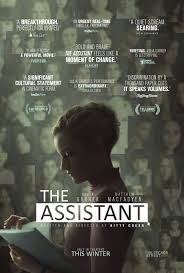
Review of 'The Assistant'

This was positioned as inspired by the "MeToo" movement, but it's not what you'd call inspiring. It depicts the working life of a young woman who is the assistant to a senior manager in what is probably a film company - it's not completely clear. Not much in the film is clear - it's very understated, and much of the dialogue is mumbled. It also manages to be tense all the time while still being boring. A few things happen in the film, but everything, every glance and gesture, seems to be invested with significance that does actually go anywhere. The film was less than 90 minutes but felt much longer.

The young woman has to clean up in the boss's office before the cleaners arrive, and we see her picking up a small item of jewellery. But there's not much sign that the boss is an exploitative lecher - we never see the boss at all, just the minions. The young woman has to book hotel rooms for other young women who arrive for vaguely defined jobs, and knows that the boss has gone to the hotel too - she has to cover for him to his wife by saying he's in a meeting.

The description of the film says that the young woman is eventually pushed to make a stand, but she doesn't really. She plucks up the courage to go and speak to someone internal (an HR person? a legal person?) and he belittles what she says and tells her that it's in her best interest to forget it - and she backs down. More or less tearfully she agrees to withdraw what wasn't even a complaint yet, and in the next scene we see that the internal person must have notified the boss, because he calls her up with a lot of swearing. But he seems to get over it pretty quickly - I can't help thinking that in real life that would be it for her, and she'd be sacked.

Much of the film is just about the misery of entry-level corporate life, and though there's always the atmosphere of sexual predation in the background, quite a lot of the misery would apply in its absence, and to male entry-level people too. Having spent some of my working life in corporate environments where there are people who are powerful (usually but not always men) and abuse that power in trivial ways, I can empathise with the feeling of having to eat a little bit of shit every day of your working life. In my experience these people were also bending or breaking the rules - particularly about abuse of expenses - and everyone knew and no-one would do anything about it. That, and the knowledge that you must remain squeaky clean all the time because you wouldn't get away with anything, reinforces that really depressing feeling of being at the bottom of the heap.
Other friends (I'm particularly thinking of Italians) have told me that it was entirely normal for young joiners to an organisation to be expected to make the coffees and work the photocopier for their more established colleagues, and this could go on for years until a new junior joined.

So sexual predators are shit, and no-one should have to endure them, but work can be pretty shit even without them.

Saturday, May 16, 2020

Review of 'In The Cut'

Billed as a feminist crime thriller, this 2003 film is dominated by murk and sleaze. Everything in New York looks grimy, and the central character - played well by Meg Ryan, rather against type - seems to thread her way in and out of strip joints and very sleazy bars with pool tables and hookers. Lots of well-contructed plot and mis-direction, and totally gripping all the way through - but I did want to have a shower when it finished. So much gore, so much dirty sex and sweat.

I haven't noticed anyone else remark on this, but it reminded me a lot of Klute, and also Looking for Mister Goodbar, both of which dwell on a New York woman's fear of murder by a serial killer - I think Meg Ryan looked quite a lot like Jane Fonda's character, and some of the stairwell shots seemed to evoke the earlier film.

Watched via laptop and VGA cable - our TV only has one HDMI slot, and we've decided to leave the Chromecast permanently in for fear of breaking it. Interestingly this was via paid for BFI Player, which does not support casting from Android - you can watch the film on your phone but you can't cast it, only 'mirror' it, which doesn't work well. And BFI Player crashed at least three times while we watched it - another example of the 'informal' option being better than the paid-for one.

Review of "HHhH" by Laurent Binet

This has sat on my bookshelf for six years. My lovely parents-in-law bought it for my birthday in 2014, which I know because there was a little note in it. I had avoided reading it because it never felt like a good time to read another book about the Nazis. I started it now because I found out that it was specifically about the assassination of Heydrich, and because I'd become friends with the lovely Dave Kaspar, whose father was the Czech intelligence officer who planned the operation. As a consequence I watched one of the films about the assassination, The Man With The Iron Heart, and I wanted to see how this book treated it.

It's made more interesting because it's as much about Laurent Binet's experience of writing it, and about the genre of historical fiction in general - how much should the author describe events and thoughts that they couldn't possibly know about in order to create dramatic effect or versmillitude? What should be done about historical uncertainties - like was Heydrich's Mercedes black or dark green?

Anyway, it turned out to be a well-written and compelling book, though I didn't much like reading it last thing at night. It chimed well with the film, perhaps because the author has obviously seen it and all the others. It didn't give much time to some of the unexplained aspects of the historical event - like, why was this the one and only time that any European resistance group assassinated a high-ranking Nazi? Was it generally policy not to do that because of the extent of the reprisals that would follow, or was it just too hard usually, and Heydrich's arrogance made it possible only here? Is there any substance to the suggestion that Churchill needed Heydrich killed because he was about to move against his intelligence rival Canaris (who is mentioned a lot in the book) because the latter was actually a British asset (which isn't suggested in the book).

Strongly recommended anyway.

Tuesday, May 12, 2020

Review of 'The Man Who Killed Don Quixote'

Definitely one of Terry Gilliam's better films - for a man with such a striking visual imagination, he has made some terrible films. But this one is good, about an obnoxious film director and his even more obnoxious minions and backers, who are making a Don Quixote film in Spain...where the director had many years previously made his student project film, also about Don Quixote. Facing a creative block, and on a whim, he returns to the village where he'd done the student project, and finds out that some of the people involved there were permanently transformed by the experience; for example, the old shoemaker that he became the Don himself now actually believes himself to be Don Quixote.

It's visually amazing to look at, but - apart from some slapstick elements that I could have done without, but presumably are related to the 'picaresque' elements of the Cervantes story - also well written, with an interesting if convoluted plot and great character acting. I can watch Adam Driver (the director) do anything, and the same applies to Jonathan Pryce, who plays the Don.

He's managed to capture the unearthliness that Spain sometimes has really well - the near-desertlandscape, the ruined castles on rocky outcrops, the baroque-horror cathedrals. I had a strong memory of the Polish film of 'The Saragossa Manuscript', particularly as there are so many dream/delusion sequences. I presume Gilliam has watched that, and wonder whether anyone else has noticed.

Watched on laptop (not entirely comfortable) having obtained via informal distribution; watched on laptop because Ruth really didn't want to watch it.

Friday, May 08, 2020

Review of 'Split: Class Divides Uncovered' by Ben Tippet

This is a short book (around 130 pages) but it's a really good and comprehensive introduction to the way the world is, with particular reference to the UK. It details the extent of inequality across a number of domains (wealth, work and 'opportunity', housing, vulnerability to environmental degradation), and then looks at the factors and processes that underly it - wealth, gender, race, education. It's well referenced, so that the book can serve as a 'gateway' to a much larger body of knowledge, but the language is accessible. It's well structured, and well argued.

I have a couple of little quibbles. The history of hostility to immigrants didn't start with immigration from the Commonwealth after WW2 - not only were there race riots in many British towns in earlier periods, but the origin of immigration controls themselves really begins with the Aliens Act of 1905, designed to prevent the admittance of Jews from Russia; and the struggles around that, and the divisions within the labour movement, illustrate well the points that the author really wants to make. It's really important not to succumb to the myth that Labour, or the socialist movement, has been consistently anti-racist, or that it was in some previous golden age.

And although he spends an entire chapter on explaining why 'class' is not about culture, and that the working class is not the same as the 'left behind white working class' celebrated by right-wing populists - he still slips into the language of 'working class vs. middle class' - even though the latter is as problematic a category as the former. In the US they use 'middle class' to mean 'working class', or at least that portion of it with regular, permanent jobs. Here in the UK 'middle class' might mean white collar workers, or professionals, or...anything really. Part of the sleight-of-hand that the right performs is to make middle class simultaneously stand for people who send their children to private schools (in reality a small fraction of the population) and at the same time refer to everyone with any distinction that lifts them off the very bottom - education, taste preference, white collar work.

We shouldn't fall for this, and we need to recognise that for the most part this middle/working class thing is really about a dividing line - or more than one - that runs through the working class, that class of people that sell their labour. It's not about culture, and it's not even about employment - lots of people are at the mercy of capital even though they are notionally or even really 'self-employed'.

But like I said, these are quibbles. This is a really good book and I'd recommend it to anyone looking for a way in to contemporary debates about politics.

Thursday, May 07, 2020

Review of 'Gothic'

Inspired by watching the National Theatre's production of Frankenstein online last week, I thought I'd watch some of the films about how it came to be written - the famous afternoon on Lake Geneva with Byron, Shelley, Dr Polidori and Mary Godwin holed up in a villa by the bad weather, and having a competition to write ghost stories. About a year ago I watched a biopic of Mary Shelley, which covers this along with her subsequent difficulties in becoming a published writer, and I said it was decent enough but I wasn't sure that it was necessary. I actually said that this story had been covered before in Ken Russel's Gothic.

Well, I must have thought I'd watched Gothic, but I couldn't have, because I wouldn't have forgotten it, and I would never, never, have decided to watch it a second time. It's not often I give up watching a film before the end, but I turned this off at the 53rd minute - it was at once boring and disgusting. It's tediously trying to shock all the time, it's not very interesting to look at, there's an abysmal score that would have disgraced a Hammer Horror film. Misogynistic in the relish it takes at the violence towards women it depicts. Just awful. How did anyone ever think Ken Russel was any good?

Sorry I was so unfair about 'Mary Shelley', the movie.


Wednesday, May 06, 2020

Review of "Sherlock Holmes: Adventures in the Realms of Steampunk, Mechanical Men and Otherworldly Endeavours by Derrick Belanger (Author), L.S. Reinholt (Author), Minerva Cerridwen (Author), & 5 more"

I started off really liking the idea - Sherlock Holmes has always felt a bit steampunk anyway. And then the first few stories really didn't do it for me - they felt plodding and self-satisfied, in the way that steampunk content often does, as if it's so pleased with itself for having had the idea that it doesn't actually have to be any good. But then the next few were much better, and the trend continued. So I'd give this three and a half stars if that was allowed.

Sunday, May 03, 2020

Review of The Sense of An Ending

Nice sensitive adaptation of Julian Barnes's book, and very much true to the original. Some nice realisation of the split narrative, especially when Tony finds his present-day self present in his memories.

Jim Broadbent very good in the role of the grumpy, awkward narrator; Charlotte Rampling slightly less good as the woman his youthful girlfriend becomes, probably because she seems too old for the part.

Watched on BBC iPlayer via smartphone and Chromecast.

Review of Live Flesh

The Almodovar films are definitely getting better as we proceed through the cannon. This one has a plot, decent characters...everything that you expect from a film really. Sufficient dramatic tension, and still beautifully shot.

I can't help wondering how Elena goes from junkie to respectable philanthropic benefactress and wife of paralympic basketball star during the seven years Victor is away in prison, or how she'd been such a lowlife in the first place given that her father was an Italian diplomat, but it's part of the strength of the film that you don't wonder about this at the time. Javier Bardem is great as the basketball star. Lots of twists, not all equally plausible, but not absurd like the earlier films.

Watched via laptop and cable, having obtained via informal distribution.