Friday, April 07, 2023

Review of "Number 9 Dream" by David Mitchell

It's really annoying that there are two David Mitchells, the author and the comedian. It's even more annoying that they are both so talented, especially the author, who has written a lot of good books and only a few duff ones.

This is an early work but really good - it's set in quite-modern Japan, with a Japanese protagonist (is he an otaku?) and only Japanese character. It acknowledges a bit of a debt to Haruki Murakami, but it reads to me as an authentically Japanese novel. It's sometimes a bit surreal and fantastical, and the style varies between sections, but in a good way. It's a novel with a quest, and coming of age, and in between there are some fantasy sections and a gritty violent yakuza story. 

It's pretty great, read it.


Review of Elvis

Really rather good biopic, which foregrounds but does not demonise the figure of Colonel Tom Parker, Elvis's manager who took 50% of everything that he earned.

Elvis comes out rather well...anti-racist, though not political or public about it, and rather more talented musically than I'd recognised. Elvis died at 42 when I was 19 and I barely marked it - I thought of him as a washed-up has-been playing a kind of music that I didn't think much of or about. 

It's a Baz Luhrmann film so lush and very colourful, but quite inventive in the shooting, cutting and editing. 

Parker is at least as much the focus of the film as Elvis, and he's a complex figure. The film says Elvis never toured abroad because Parker didn't have a passport, or indeed any legal identity at all. Oddly the colonel title seems to have been the only thing about him that was genuine...the colonelcy was bestowed upon him in 1948 by Jimmie Davis, the crooning governor of Louisiana. Jimmie Davis was a racist and a segregationist, btw, so perhaps the colonel didn't share Elvis's feelings about Black people.

Watched on TV via HDMI cable to laptop and informal distribution.


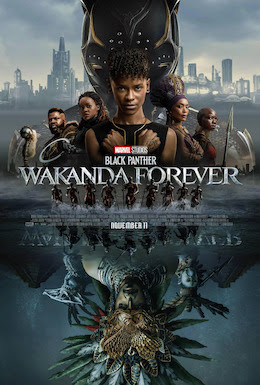
Review of Black Panther: Wakanda Forever:

What a wasted opportunity! The first fifteen minutes are great - views of the prosperous and beautiful fictional African country, a great anti-colonial scene in the UN, and it seems that this is going to be the Afrocentric, Afrofuturist film that I've been waiting for. And then just superhero trash...two and a half hours of things crashing into each other and people hitting each other, mostly to no purpose.

Which is a shame, because somewhere in there might be a good film struggling to get out. No, not really, just a good art director looking for a good film to work on. 

It's made worse by the fact that the two different groups of non-white anti-colonial people in the film, the Wakandans and the crypto-Mayan water people, are locked in an unnecessary war over...well, I'm not really sure. They ought to be fighting the extractive imperialists, and they both know this, but something about honour...so not only are the mass battle scenes tedious, but the viewer doesn't even want one side or the other to win. In that sense it's worse than Star Wars, where at least the baddies are clearly defined.

I realise how much superhero stuff is about the use of physical force and weaponry, sometimes high-tech weaponry, to overcome over-confident enemies. Perhaps this speaks to the fears and fantasies of ground-down teenage boys, or the inner teenage boy of so many grown-up men. I find this depressing to watch and rather sad.

Watched in two tranches, because it was too much to sit through. Ruth gave up at the half way mark and I watched some more, and then finished it a few days later. On the big screen at Springhill, following informal distribution.

Tuesday, April 04, 2023

Kasatchok!

For years the Red Band in London, and then the Stroud Red Band, played a tune called Kasatchok. It's a Russian traditional dance tune, or so I thought. Since the Russian invasion of Ukraine we stopped playing it, not because we're boycotting everything that ever was Russian, but it didn't feel too good. Someone pointed out that a kasatchok was also a Ukrainian dance; did that make it better? Did the fact that it was a Ukrainian cossack dance make it worse again? After all fear and hatred of cossacks in part of Jewish folk-memory; my dad told me that in the 43 Group they used to call the mounted police in London "cossacks".

Then a friend reminded me that there are Italian words to the tune, which became a song of the Italian partisan resistance to the Nazis - Fischia il Vento. With that name it was programmed into a little electric keyboard that his child has. Here is a nice version by the Modena City Ramblers, an Italian lefty band...for some reason they are wearing kilts to perform this, perhaps because they think of themselves as playing Irish traditional music.

And then I remembered that the song used to be played a lot at Jewish weddings and barmitzvahs, at which the young men would try to dance a pseudo-Russian squatting dance that they would call the "kazotzkas", which would result in everyone getting very sore thighs. In fact I had once thought of it as a Jewish tune, and I recalled that there was a Hebrew version. I'm pretty sure we sang it once or twice in my Zionist youth movement, and it turns out that it was translated into Hebrew as early as 1945, probably as part of the Socialist-Zionist love affair with all things Soviet.

And finding the Hebrew version on YouTube, I also came across this, which has to be a strong contender for the weirdest thing on the internet - a Yiddish version, syncopated, performed by some sort of folk choir from Birobidzhan, in a made-up Jewish folk costume. Are these people actually even Jews? What tradition does this costume, and this song and dance, form part of?

Of course it turns out that the tune is not a traditional one but was written by Matvey Isaakovich Blanter,  a Soviet (Jewish) composer in 1938. 

Monday, April 03, 2023

Review of Mr Jones

A well-told tale about the Welsh reporter who broke the story about the 1930s famine in the Ukraine, when the rest of the Moscow-based western press corps didn't...because they were too lazy and supine, it's implied. There's a bit of a hint that they judged the Communists to be the lesser evil vs. the Nazis, and some of them probably did. One of the main characters is Walter Duranty, the New York Times bureau chief, who was actually even weirder than the he is portrayed in the film...he hung out with Aleister Crowley for a start. 

I understand the family of Gareth Jones were unhappy about some of the details, and it's perhaps not unreasonable to think about the wider context of the famine...the Soviet drive to industrialise, the scissors crisis during the early Soviet period ...and so on. Don't know whether he really met Eric Blair either...certainly Animal Farm wasn't written until after 1943 and Blair's experiences in the Spanish Civil War, which turned him into an anti-Stalinist, though the film implies that he was writing it during the 1930s as he met Gareth Jones.

But a decent film nonetheless, cinematically interesting and with decent acting and dialogue. Watched on BBC iPlayer.

Sunday, March 26, 2023

Review of Living

Is it possible for a film to be boring and enjoyable at the same time? Well, this one does a pretty good job. Bill Nighy is a bureaucrat at the London County Council in the 1950s, and he's emotionally sclerotic (with his co-workers and his son) and acts as a road block to stop anything happening - a group of women from an estate in the East End want to turn a bomb site into a children's playground, and they are routed back and forth between departments to ensure that nothing ever happens to their proposal.

Then he learns that he's going to die from cancer, and he goes very slightly off the rails, visiting an improbably bohemian Brighton, taking a young woman who is a former colleague to lunch at Fortnum's, not turning up to work, and so on. 

It's all beautifully done, though not much really happens. It's all about the feelings, and the facial expressions that are about not revealing them.

I note in passing that there's something of a geographical error in the film. The bureaucrat and his colleagues arrive by suburban commuter train into Waterloo Station, and then cross a bridge over the Thames to approach County Hall, then the HQ of the London County Council. Except that County Hall is on the same side of the river as Waterloo, so how can they be crossing the river to approach it?

Watched in the Middle Floor at Springhill, having obtained it via informal download.

There's a very good review in the London Review of Books here.


Thursday, March 23, 2023

Review of "On Earth We're Briefly Gorgeous" by Ocean Vuong

A short book, but one with a lot to it...coming of age as gay in rural Connecticut, the Vietnam war and its impact on Vietnamese and Americans, the devastation wrought by opioids on working class communities, deindustrialisation and poverty...and what it's like to be a writer in the shadow of all that. And death, and abandonment, and separation. Just brilliant really, and I may read it again.

Review of Where the Crawdads Sing

A feel-good film about nature, child abuse, male violence, rape, murder...what's not to like? Actually a really good film, with a moderately complex narrative structure, some nice acting, lovely nature footage, a courtroom drama aspect, and a great ending. Hard to say much else without spoiling, but well worth watching.

Watched in the middle floor at Springhill, obtained via informal distribution.


Wednesday, March 15, 2023

Review of "The Debt to Pleasure" by John Lanchester

Hard to do justice to this while avoiding spoilers. It's a great, clever, well-written and thoroughly nasty book. It's written in the first person by a snobbish food bore, who writes pretentiously about a journey to his summer home in France through a series of menus and recipes. Despite the fact that he's deeply unpleasant it's not too terrible to spend all this time in his company, because some of his knowledge about food and history is actually enjoyable. 

It's so pretentious that there are laugh-out-loud moments, along with insights into the narrator's history and personality of which he seems to be unaware. We gradually learn that he's an unreliable narrator, though this is done so slowly that it wasn't apparent to me. 

And that's pretty much all I can say without ruining it for you. 

Review of Flee

Really good animated feature film about a young gay man who is fleeing from Afghanistan. Every so often it's inter-cut with some archive film, including scenes of pre-war Kabul, and it's sort of shocking how modern the dress and the shops look. Lots of happy, smiling young women in modern dress on the streets and on public transport. There are also some scenes from what must be Communist Party congresses, with lots of uniformed mustachioed men single The Internationale. And without wanting to romanticise the period of Communist rule, it's hard not to wonder where all those men went, and whether any of them are still there as the potential constituency for a very different kind of Afghanistan.

But it's mainly about the experience of being a displaced refugee, and it's grim and very effective. 

Watched via informal distribution.

Wednesday, March 08, 2023

Review of "Elmet" by Fiona Mozley

Oh blimey, what a book! A depiction of rural, underclass, off-the-grid life. The people here are one fraction of that subculture...the kind that intermingles with Travellers, takes part in illegal bare knuckle prizefights, poaches and hunts...not the solar-powered vegan off-grid van-dwelling underclass, even though vans also feature here. Heroin addiction is in the background, though not specifically mentioned.

It's rough and violent, and often shocking. The book is also well written, structured and has some very evocative nature writing. It sometimes uses language that I don't think the first-person narrator would actually use, but that doesn't matter too much.

This is a debut novel, and it's pretty brilliant, though not an easy read.

Tuesday, March 07, 2023

Review of Vandana Shiva: Seeds of Change

A film about activist and scientist Vandana Shiva that left me slightly uneasy. It's more or less a biopic, from her early days as a sort of privileged middle-class Indian woman who wants to study Physics even though her convent school tries to dissuade her, to her involvement with the Chipko movement, and on to her campaigns in support of small farmers in India and against the global seed companies in general, and GMO in particular. And then there she is, on the stage at the anti-globalisation protests in Seattle alongside trade unionists and campaigners, and being cheered to the rafters.

Most of the time I was carried along and just thought how wonderful she was, but I was surprised to see that one of the people she cites as a sort of corporate shill who's been attacking her was Mark Lynas, who I had always thought well of as a climate activist and writer. So I searched a little, and I found that George Monbiot - who I also think well of - is not very keen. And some of this is about the debate over veganism and lab-grown meat vs. "natural" organic farming, and I've said before that I am not entirely happy with Monbiot's uncritical acceptance of food produced in factories rather than on farms. I wish it were true that we could feed everyone well from small organic mixed farms, but I don't think it is.

So there's something about Vandana Shiva that doesn't quite feel right either..the big bindi on her forehead, the spiritual influences that she cites, and which the audience for the film lapped up . For her Gandhi is the shaping influence, but I can't feel entirely good about him since I read Perry Anderson's rather critical articles...like this one and also this.

Watched at a special screening at Hawkwood College, which has also been a venue for some dodgy events in the past, which didn't help any.


Monday, March 06, 2023

Review of Neptune Frost

Really interesting as a phenomenon, but as a film...well, that's two hours of my life I'm not going to get back. Nothing that you call a plot, or dialogue...just a long stream of declaimed technospeak from the various characters, and striking images and scenes juxtaposed next to each other without any purpose or narrative. I read a plot summary and a blurb, and that might describe what's going on, but it might easily not. 

Watched at the Stroud Film Festival, and I had a little doze despite the fiercely uncomfortable chairs. For all the understanding that I got I might as well have slept through the whole thing.

Review of Ali and Ava

Nice, sweet film about the relationship between an older white woman and an isolated British-Asian young man in Bradford. Among the things I liked about it were the positive depictions of what white people had got from their encounter with their Asian-origin neighbours...the little white girl doing Indian-style dancing from a video (with her sometimes-racist older brother joining in) is the example that struck me first. This is a depiction of two communities living alongside each other and picking stuff up...not exactly integrating, but not hostile and hating either. 

In an understated way both the protagonists are people who are not completely limited by their class position either; she's been to university and got a degree in Criminology, he reads poetry. And it avoids the familiar rom-com tropes of will-they-won't-they, while remaining gentle and affection all along.

This is the second time I've watched it, but I couldn't find an earlier review.

Watched via informal distribution too.

Review of Chatter

A lovely short film shot within 100m of where I live, with people I know as actors. Despite the brevity (11 minutes) it covers a lot of stuff, including depression and family relationships, and relationships with nature. Mainly it's about the impact of the pandemic and lockdown, especially the early period when we really didn't know what was happening or whether we were all going to die.

Watched at the Stroud Film Festival.

Review of Mario's Cafe

I was so excited by Roland Denning's film about James Castle, The Society for the Protection of Unwanted Buildings, that I had to watch others....he'd referred to this one at the Q&A after the other film, and I knew the area. It's nice, but without the personal connection it didn't do as much for me. Maybe it would have been better at a public showing too.

Review of The Society for the Protection of Unwanted Objects

I'd seen this film before, about my friend and fellow Red Band member James Castle, but it was different watching it with an audience...last time I'd watched it at home via Vimeo. It's nominally about his business, the eponymous Society for the Protection of Unwanted Objects, though really it's about him, and his hoarding addiction, and what it has done to his relationships, especially with his former partner Karen. 

The film is as charming and funny as James is, but it's also sad, watching someone destroy their relationships and damage themselves as a result of what really is an addiction. James (who I really love dearly) has all the characteristics of a fully-fledged addict, including denial and bargaining, and subterfuge. The moment when he says "I only have two cars - two Audis and two Alpha Romeos" is both hilarious and tragic, because at the moment he says it he really does believe it.

A genius film, only 30 minutes long, but really worth watching. You can see it online here, but we got more out of watching it at Stroud Film Festival.

Thursday, March 02, 2023

Review of Dunkirk

A fairly straightforward war film, rather well done by Christopher Nolan as director. I didn't recognise many of the actors, so it felt like it was real stories...even though there are some big names in there. It cuts backwards and forwards between different groups in various kinds of peril, thus keeping up the tension. It's very well done, with more horror than heroism...the civilians are rather more heroic than the soldiers. There are a few cliched lump-in-throat moments...the navy captain on the mole remaining unflustered as the bombs fall around, the arrival of the little ships. The soldiers do look genuinely shell-shocked and fatigued.

Oddly the Germans barely appear at all, except as the origination point of bombs and shots. Right at the very end there are some shadowy figures in coal-scuttle helmets, but otherwise we see German planes but no pilots, whereas the British pilots get lots of close-ups. Come to think of it, there are no French people either, even though this is a town in France and 1,000 French civilians were killed. Actually tens of thousands of French soldiers were evacuated, and the French navy was heavily involved, but you wouldn't know it from the film. Nor would you know about the Indian, Moroccan and Senegalese soldiers present.

And there's no feeling for the battle itself, which was hard-fought and quite complicated, and involved strategic choices on both sides that had long-lasting implications. The Germans stopped their attack and concentrated on other pockets of British troops. The British refused the French request that they counter-attack rather than evacuate. 

Wednesday, March 01, 2023

Review of "The Song of Achilles" by Madeline Miller

Not as enjoyable as her Circe. The latter part seems to be mainly a straightforward retelling of the Illiad, which was made even less enjoyable because I'd just read the rather more creative retelling in Pat Barker's "The Silence of The Girls". The earlier sections which seem to me to more made-up (especially the backstory of Achilles and Patroclus) are more enjoyable, though I think there's something not quite right about the shame that the two boys seem to feel about their homosexual love - not very Greek, surely?

Also by making Patroclus the first-person narrator she's sort of stuck once he dies. First it seems that there's no narrator at all - or rather an omniscient third-person narrator...and then it seems that it's Patroclus's spirit after all, which isn't very satisfying either.

Sunday, February 26, 2023

Review of Schooling The World: The Last White Man's Burden

A polemical, one-sided look at the damage done by exporting western models of education to non-western societies, with a particular focus on Ladakh. Lots about how western-mode education destroys traditional culture and robust, locally-adapted societies, which are seen through a rose-coloured filter. Yeah, Ladakh does seem pretty great, and the way in which western-style education has been imposed as part of a development model that assumes the path followed by the West is the best and only way to develop is pretty awful. A more nuanced film would have taken a more critical look at some of the other non-western cultures, where sometimes there is a genuine, well-founded and justified hunger for any education...think about the girls that the Taliban is preventing from getting any kind of education. I suspect the Taliban wouldn't have many problems with this film.

There is of course plenty wrong with the western model of education, which was designed to discipline working-class children for a life in factories and mills, and to teach them what they needed to know for that life, and to indoctrinate them into cultural submission to the values of capitalist society. Even with its own terms it's not a great success. 

And there's no doubt that, as the film illustrates with quotes and artefacts like old posters, the export of this model was tied in to the expansion of imperialism; there most certainly was an intention to eradicate the "backward" cultures of those who were sitting on land that the imperialist powers wanted. There was a similar move to eradicate Welsh, and Catalan, within the metropolitan territories of the imperialist powers.

And it's lovely to see the ethnobotanist Wade Davis interviewed as one of the talking heads in the film. He makes lots of good points about what might be thought as "cultural biodiversity" - that as we increasingly inhabit a world of multiple concurrent crises one of those "primitive" cultures might contain something that we are going to need, and it would be shame if it were too late to pick it up because we'd extinguished it.

But there's lots left out that doesn't fit into the monodimensional critique that the film offers.Most of all I missed even a hat-tip to Paolo Freire, the Brazilian educational theorist whose "Pedagogy of The Oppressed" not only anticipated the film's critique but actually proposed something more positive, and more useful, than the "everything traditional is just great" panacea that the film effectively endorses. And there are other kinds of informal and community-organised education that ought to be recognised...I know I'm partial, but think of the musical education provided by brass band culture without conservatoires.

The uneasy feeling that I had as I watched was that in essence this film is rooted in the conservative critique of modernity, not a progressive critique. Traditional societies are not, for the most part, utopias. They are often hierarchical, oppressive, and reactionary. And outside tiny isolated pockets they don't really exist...in a capitalist world everything is touched by the hand of capital. We can do better than this.

Thursday, February 23, 2023

Review of "No one round here reads Tolstoy" by Mark Hodgkinson

Occasionally interesting but mainly rambling and self-indulgent book about a man's love of books and what they meant to him through his life. He's slightly younger than me, but there are some things from his life that I recognise, even though he grew up in a poor working class family in the north and I grew up in a comfortably lower-middle class family in the north London suburbs...the Essex ones, mind, not the posh and cultured ones in the north-west. I enjoyed a lot of his reading choices, but didn't really share his love of punk and new wave...even then I knew it wasn't that good, though I was less interested in music then.

There are bits of life story, bits about the publishing industry (he creates his own publishing company), and lots about bookshops, but it doesn't add up to anything that was really enjoyable to read. I think I may have had it with white male autobiographies.

Monday, February 20, 2023

Review of "Station Eleven" by Emily St John Mandel

Really good dystopian/post-apocalyptic novel about a world devastated by a pandemic that kills 99 per cent of the population. Quite a complex narrative that darts about across the timeline, pre- and post-pandemic, and some implausible link-ups between the characters that survive...but it doesn't matter, this is brilliant writing, and full of menace and danger without any need for graphic descriptions of death or violence. 

Most of all it brought the early days of the Covid-19 pandemic back to me; our pandemic was not nearly as terrible as the one in the book, but in the early days we didn't know how bad it was going to be. I've been dreaming about our pandemic, and disasters and terrorist attacks, ever since I read it.

Review of Ay Carmela

Not very satisfying film by Carlos Saura about an entertainer couple in the Spanish Civil War. Early on in the film they are busy cheering up a mixed bunch of Republican soldiers - some proper soldiers mixed in with anarchist militia, both men and women. It's 1938, so that may be a historical inaccuracy - weren't the women relegated to behind-the-lines roles by then? 

The entertainers get lost on the road to Valencia and find themselves trapped behind enemy lines, and they transform their act into a pro-fascist one, even though the woman half of the couple is not so happy about it. But there's something lacking in the depiction - they are neither agonized (though she is a bit, sometimes) not cynical. Maybe that's realistic, but it doesn't feel right in the film. 

Some great details in the filming...flags, and posters, and trashed towns and villages, but a bit of a disappointment.

Watched via PC, HDMI cable and informal distribution.

Thursday, February 16, 2023

Review of Who Killed The KLF?

A film almost as weird as the KLF itself, which seems to have been as much prank as music band. I must admit that I rather liked "Last Train to Transcentral", and I really loved "Justified and Ancient", and now I'm not sure if that makes me a dupe of the prank or a knowing participant in the satire - I don't know whether it matters either. I quite enjoyed The Illuminatus trilogy, about which they made quite a big deal...though in the world in which we now live it doesn't seem quite as funny as it did.

This stuff was all coming out in the early 1990s, when I was the dad of very young children and not in any way a participant in rave culture, but I did like the KLF. The film is interesting and shows the extent to which they were always as much pranksters (and perhaps even conmen) as much as artists. Their early hits were based on ripping off other stuff and a sharp understanding of howto game the music business, which - delightfully - they then shared with others.

I am pleased to see that though they were absolutely embedded in the music business, they don't seem to have been posh boys - their rejection of the business was not based on noblesse and largesse.

The film spends quite a lot of time talking about the famous money-burning stunt. I still have very mixed feelings about that, but I'm also aware that it shows a better and more nuanced critique of what mone means in a capitalist system than the daft twats who claim that "cash is freedom".

Monday, February 13, 2023

Review of "Back to The Bible" by H G G Herklots

A surprisingly enjoyable read from the 1950s, written by the Vicar of Doncaster and intended as a guide for other parish priests covering what they need to know about the scriptures. Amazing that at that period it seemed possible for a local vicar to be familiar with and on top of this stuff...I rather feel that their equivalents today don't have the time or inclination to deal with any of this. I wonder how many local vicars even know what Aramaic is - I rather thnk that the one here, who is a lovely man in many ways, might not. 

This is primarily a straightforward non-fundamentalist view of how the various texts were created and transmitted. The early bit focuses on translations of the texts, and the later bit on different versions. There's not much on how texts were chosen or rejected for inclusion in the canon, which I would have liked. And the author assumes familiarity with the structure of the New Testament, though not so much with the Hebrew Bible (the "Old Testament")...whereas for me the opposite is true.

I got a lot out of it, though, including a confirmation of my gradually strengthening view that Christianity is not a "descendant" of Judaism, but that both religions are descendants of the earlier "Judaite" (my word, I'm sure there is a better one) religion, that centred on a single temple, hereditary priests and animal sacrifice - nothing at all like present-day Judaism, even though the latter presents itself as a natural continuation of the former. 

Saturday, February 11, 2023

Review of The Lobster

Oh blimey this is a weird, mind-blowing one. In a future in which it's not permissible to be single, those without relationships are sent to a special hotel where they have 45 days to partner up, and if they fail they are turned into an animal of their choice. The hotel is presided over by a cruel manager brilliantly played by Olivia Colman, and there are some tropes that wouldn't be out of place in a BDSM-themed porn film - the chambermaids provide perfunctory regular sexual teasing to keep the male "guests" focused on their task of finding a mate, and masturbation is punished with mutiliation of the hand by insertion into a toaster. The acting is weirdly dead-pan, and there are lots of strange details.

Oh, and in the woods there is a community of singles, The Loners, who enforce the state of not being partnered with the same cruelty that the mainstream society punishes singleness. This community is also provided over by a matriach, played by the gorgeous Lea Seydoux. The hotel dwellers hunt the loners with dart guns, and when they catch them they are allowed extra days at the hotel before the ultimate penalty of being turned into an animal is enforced.

There are lots of other weird and horrible details, but really you are going to have to watch this one for yourself...and you should.

Watched on Netflix.

Review of Master Cheng

A soppy, sentimental film about migration and being a foreigner by Finnish director Mika Kaurismäki, who has done much better than this. Chinese guy turns up in a small Lapland town looking for a Finnish hockey player who bailed him out of a debt to "bad guys", and ends up staying to become the cook in the gruesome local diner where the cute but troubled owner reguarly provides horrible food to a community of humourous curmudgeons. He wins her heart and theirs, and ends up marrying her and staying, and becoming reconciled to Finnish culture as they all become enthusiasts for Chinese cooking.

It's a sweet, beautiful but not very interesting film, and it soft-soaps the problems of migration and exile into a fairy tale. It's also oddly like the film Le Havre, by Kaurismäki's younger brother Ari, which also features a refugee taken in and cherished by the local community.  

Review of "The Second Sleep" by Robert Harris

Not one of his better books, but I am amazed at the volume of his output, all of which is at least good enough. This is a post-apocalyptic story, set in an England which has returned to a mainly medieval level of technological and economic civilisation, dominated by an Anglican church that jealously guards access to any knowledge about the past. The world making is a bit better than the plot and the characters, and it carried me along, but I wasn't all that engaged.

Thursday, February 02, 2023

Review of Bergman Island

Beautiful but slightly boring film about a film-making couple on a trip to the island where Bergman made a lot of his films...they are a bit troubled in their relationship - he's more successful and famous, she is stuck on a film that she can't finish. And then we get the story of her film as a story-within-the-story, still on the same island and with some overlapping actors. And that's a good thing, because it's much more interesting than the frame-story. Forty-five minutes in and I couldn't see how the film could be saved, because it was so dull, but the story-within-the-story redeemed it. Lots of messing with your head with narrative inconsistencies, buildings that aren't there in both stories, etc.

Watched at Lansdown Film Club, sitting on the agonizingly painful chairs.

Review of You People

Mainly grim "comedy" about relations between Black people and Jews in contemporary America, framed by a youngish Jewish man (who loves "the culture", meaning Black American culture) who accidentally meets and then falls in love with a young Afro-American woman. Then they introduce each other to their respective families and it all goes wrong - the Jewish family is painfully and awkwardly liberal, the Black family father is a follower of the antisemite Louis Farrakhan, and they break up before being re-united in an implausible fairy-tale reconciliation ending.

Netflix.

Review of "Lila: An Inquiry into Morals" by Robert Pirsig

I made it to about page 100 and then gave up. This is pompous, pseudy unreadable stuff, and if there are important philosophical ideas in there then I will have to find them some other way. I've had it on my bookshelf for years, thinking that I ought to read it one day because I had some vague memory of enjoying the author's first book, "Zen and The Art of Motorcycle Maintenance". As I tried to plough through this I began to remember that I hadn't actually enjoyed that either...I just thought that it was somehow good for me, because it was supposed to be profound and all the cool people were reading it.

Now I know better and life is too short.

Review of Gravity

Enjoyable gripping space-set disaster movie, with Sandra Bullock as a non-astronaut scientist marooned in space by a debris storm that kills her colleagues and destroys her spacecraft. Agrophobia, claustrophobia, and vertigo in equal measures, but very well made and engaging.

Watched on Prime Video via Louis's phone.

Sunday, January 22, 2023

Review of "All Together Now?: One Man's Walk in Search of His Father and a Lost England" by Mike Carter


Not a brilliant book, but quite a good one. It's a "journey across England" book, and they all have some things in common - the writer-traveller meets some nice people and has heartwarming experiences, and he/she meets some nasty people and has some horrible experiences. Sometimes people are welcoming and kind, sometimes the accomodation is really awful. The balance between these sets the feeling for the book.

But this is also a personal story, because Mike Carter is doing the journey to achieve some sort of reconciliation with his now-dead father Peter Carter, a Communist Party and UCATT militant who organised the early 1980s People's March for Jobs. I may be reading things backwards, but even at the time I was a bit underwhelmed with this project, and I think I was right...it feels and felt like an exercise in supplication, not militancy or direct action.

The parts of the book that are most moving are where he deals with the personal stuff - his estrangement from his father and his family via his brief bit of upwards social mobility, and it's interesting when he sets that in the narrative of the working class as a whole. Other parts read they've been cut and pasted from features in The Guardian...the increase in income and wealth inequality, the unaffordability of housing, the largely pointless expansion in higher education vs vocational education...foreign ownership of prime housing and strategic industries...it might have been better if he'd put that all in one place, or left it out all together and concentrated on his observations and personal reflections.

As regards what he finds on his journey, it strikes me that he is conflating several different things, al of which contribute to how shit a tour round most British small town are, but which are not at all the same. First, going on foot across the country you are going to experience a lot of "liminal spaces" - bits that are not for public view, like janitor's cupboards and service ducts. You find these in even the nicest public spaces if you look hard enough, and they are rarely pretty - it's part of what I hate about hotels. If you write about this, and if you pay attention, then things are going to look a bit grim.

Second, he is travelling through a country that is in relative industrial and economic decline. Britain was never going to be top nation for ever, and even if all the urban planning had been great and the inequality addressed by a benign and well-funded social democratic state, things would still have got worse relative to other places and countries.

Third, technological changes - especially the internet and online retail - mean that the face of town centres would have changed whatever. Online shopping is mainly a better experience; local shops can't afford to carry the inventory of everything that I might want, and it's unusual if the staff can help a customer much or even know what's in stock. And the cost of real estate - related of course to another thing that is wrong with Britain - means that online shopping is also going to be cheaper, even with delivery charges. So many local shops are going to close, and thus far what is taking their place is stuff that can't be delivered online - hairdressers, nail bars, tattoo places...

Review of Everything Everywhere All At Once

Too long, and much less than the sum of its parts. Good acting, decent special effects and cinematography, and early on there's a genuine feeling of unease and uncanniness that says we can't be sure whether the central character is really experiencing a breakdown...but it becomes more and more silly, and full of cod-symbols and philosophy, and I started to lose interest. If only they had spent a bit less on special effects and a bit more on the writing.

Watched on Amazon Prime via tablet and Chromecast.

Thursday, January 19, 2023

The Smithsonian Incident

I spent my twenty-fifth birthday in Washington DC. Specifically, I spent it walking around The Mall, and visiting the museums there. I was on a paid-for research trip for my Ph D, but I felt I deserved to have my birthday off. So the afternoon found me in the Smithsonian Institute, a big and deservedly popular museum of American history. In the foyer there was a big display about the words of the song “The Star Spangled Banner”, which featured the actual flag from Fort M’Henry, a huge facsimile of the hand-written words and a picture of the poet Francis Scott Key, who had written them. Looking online I see that the flag is now part of a different display.

I had known a little bit about Scott Key, because he is one of the characters in Sabbatical, a novel by John Barth, an author that I was then rather fond of. In the book Scott Key is a sort of reluctant and belated convert to American patriotism, so his writing the poem “Defence of Fort M'Henry” is all the more poignant; the display does not mention the racist dimension to the lyrics, which include the words “No refuge could save the hireling and slave, From the terror of flight or the gloom of the grave, And the star-spangled banner in triumph doth wave” referring to the fact that the British forces included newly freed slaves.

And while I was musing on this a coiffured southern woman began to tell her daughter, in a loud voice, about how the sight of the still flying flag had inspired Scott Keys to write the poem. She was reading from the caption to the display, but she hadn’t twigged that Francis Scott Keys was a man. Well, the black and white engraving showed a head with long flowing locks, and Francis - or at least Frances - is a woman’s name.

And hearing this, I was transfixed - held between the need to correct her mistake and the rudeness of contradicting a parent in front of their child. It would be worse because my voice would clearly identify me as British, and the Brits were the villains of this story (and most Hollywood films). I did a little wrestle with both sides of my conscience. Imagine the daughter in the future, repeating the same stupid error, and being humiliated by it. Imagine the woman’s humiliation at being corrected in front of her daughter, and by a Brit. 

I did nothing. The moment passed, they walked away to look at something else. I’m still not sure if it was the right choice. 


Review of "Barcelona" by Robert Hughes

I haven't read any Robert Hughes for years - not since The Fatal Shore, about Britain's penal transportation colonies in Australia. That was great, and so is this. He's an art historian by background, and I'm not all that interested in art history, but the descriptions of what is called modernism (and is really art nouveau rather than what everyone else means by modernism) in art, architecture and planning are just wonderful. He's really good on Gaudi, the man and his buildings, but also on some of the other architects and buildings. A bit of a shame that it stops with Gaudi, because it would be nice to hear what he'd make of later architecture too. I've spent a lot of time in Barcelona - I went there every year for Mobile World Congress for years, but even so this book made me want to go there again right now.

I didn't like every aspect of the politics, which is present all the time, but he's rather good on the smug superiority underlying Catalan nationalism and separatism. Mind you, he's not going to win any awards for predictions, since he seems to think that Catalan separatism is over and done with, and that it will gradually fade away.

Thursday, January 12, 2023

Review of Words on Bathroom Walls

Well-meaning young adult film about a young man with schizophrenia, which attempts to convey something of what that's like. Sometimes scary, but the film almost makes it seem a bit cool - I note that like John Nash in "A Beautiful Mind" he is haunted, if that's the right word, by some consistent imaginary people - a young hippy woman, a cool dude version of himself/best friend, and a group of threatening African-American bodyguards with a baseball bats. Do real schizophrenics experience their hallucinations like that? I don't know - other reviews seem to hint that the film pretties up what it feels like to be schizophrenic.

It was a decent enough film to watch, on Netflix, despite a rash of high-school movie cliches.

Thursday, January 05, 2023

Review of "Living Revolution: Anarchism in the Kibbutz Movement" by James Horrox

This is, for the most part, 137 pages of disappointment, with the feeling that somewhere in there is a better book struggling to get out. I'd hoped that the author really had uncovered some unknown-to-me connections between proper class struggle anarchists and the people who had founded developed the kibbutz movement. Spoiler alert; he hasn't. The book is about how the early kibbutzim were, to an extent, inspired by the writings of some utopian socialists and spiritually oriented Tolstoyans, and not only driven by necessity towards communal living, but that's hardly a surprise. After finding out that Emma Goldman had written favourably about anarchist comrades among the Jewish settlers in Palestine I was hoping to find out more, but I didn't. 

Instead we learn that some of the founders of the utopian and "nonpolitical" socialist currents among the early Zionist settlers had read Kropotkin. Others were inspired by a mainly-forgotten German utopian called Gustav Landauer, who had once been a class struggle anarchist but moved towards the slightly creepy spiritual-awakening, personal transformation tendency. Ironically, Landauer ended up Education Minister in the short-lived Bavarian Soviet Republic before being murdered by the Freikorps as the republic was overthrown. 

More familiar figures are also discussed, like the prophet of Jewish personal transformation through physical labour A D Gordon and the Labour Zionist Chaim Arlosoroff - the book doesn't mention it, but his former girlfriend Magda became Mrs Goebbels, which surely merits a Netfix mini-series. Horrox cites both of these as influencers of another sort of socialism, distinct from the Marxism of the Labour Zionists in Poalei Zion and Left Poalei Zion, in the emerging Jewish settler community in interwar Palestine, which he chooses to call anarchism. I'd be very surprised if either Gordon or Arlosoroff ever thought of themselves as anarchists. Arlosoroff was a big fan of staying close to the British, and was also intrumental in the Haavara agreement with the Nazis, so not exactly your typical anarchist.

Weirdly, there is almost no account of the historical and political context in which this was happening. Zionist immigration, the construction of the Zionist state-in-waiting, and the creation of the network of utopian communes on which the book focuses, all took place in the framework enabled by a British colonial occupation. Zionist settlers could be Marxists or anarchists or anything else, but they could not do without the shelter of the British military force and civil administration. An independent, majority-ruled Palestine, democratic or not, would have put an end to Jewish mass immigration. 

Horrox touches on this in passing, but it's far from the focus of the book. And he entirely buys into the Zionist argument that the refusal to employ Arab labour was a principled, moral refusal to be exploiters, rather than a conscious attempt to create an ethnically segregated labour market, explicitly on the South African model. He treats the Histradrut as if it were a "normal" trade union, rather than an instrument for the construction of that segregated labour market, ignoring the historical analysis of - for example Zachary Lockman's "Comrades and Enemies". 

There is another book to be written about the subjective commitment to socialism and even Marxism by people who were objectively engaged in a colonial enterprise that was tied to British imperialism. It's not a straightforward matter of hypocrisy. History is full of ironies like this, with the eco-anarchist Rojava enclave in northern Syria that sheltered under the umbrella of US air power is only the most recent. The Zionist socialist parties were mainly accepted as such by their comrades in other countries, even in apparently revolutionary internationals like the International Revolutionary Marxist Centre, in which Left Poalei Zion and Hashomer Hatzair participated at the representatives of Palestine alongside the Bund from Poland and the POUM from Spain.

Horrox does describe the minutiae of kibbutz organisation in the glowing terms I remember from my days in a Zionist youth movement, but doesn't give a moment's cosideration to the the fact that some kibbutzim were built on the ruins of depopulated arab villages, or that almost none of them have ever admitted an arab member. Oh, and he repeats uncritically the assertion that there was "no crime" within kibbutzim, ignoring all that has come to light about sexual harrassment and rape.

It's really a shame, because there is an important book to be written about what the kibbutz experience means for at least one kind of anarchist model of the transition from capitalism to something better. Despite all the above, and despite the awful context, it's possible to still be enthusiastic about the kind of self-managed enterprise and collective consumption offered by the kibbutz, and to see a very high level of communal sharing and a very low level of private property as a viable and even luxurious alternative to privatised individual and family existence. Even knowing what I do about the history, I still retain a great affection for the feel of kibbutz life that I experienced in the 1970s and 1980s.

These ideas about "secession" and walkaway, of building an alternative economy within the shell of the existing society, are increasingly popular, as they often are when more direct political programs for change seem hopeless. There is a lot of hope placed on Community Land Trusts, cooperatives, social enterprises, and mutual aid networks.

And the kibbutz experience was perhaps the best opportunity that this model has ever been given. The kibbutzim were not marginalized or despised outsiders in the Zionist proto-state, or later in Israel; they were cherished, cossetted, and treated as an elite, akin to the English landed gentry. They had access to cheap land from the Jewish National Fund, and cheap credit from state and semi-private financial institutions. 

So the ultimate failure of the kibbutzim to thrive, even in these favourable circumstances, but within the overall context of an increasingly unequal and consumption-driven society, ought to be instructive. Rather than radiating socialism, however defined, out into the wider Israeli society, the kibbutzim instead absorbed the worst aspects of it into themselves. Horrox does describe what can only be seen as the degeneration of the kibbutz model, even within its own terms, though he doesn't really explain why the kibbutzniks themselves don't for the most part seem to have thought it was worth preserving or defending. There's some quite interesting stuff in the end about new forms of urban collective living, and about the small anarchist groups in Israel that are, to Horrox's disdain, mainly uninterested in the kibbutz history, but it can't make up for the missed opportunities of the book.

POSTSCRIPT: On p58 the author writes "During the 1930s many anarchists within the kibbutz movement travelled to Spain themselves to join the CNT-FAI militia." Although the book has a lot of footnotes he doesn't cite any source for this. I couldn't find any trace of it in web searches. There isn't any mention of it in "Madrid Before Hanita", the film about Jews from Palestine who went to fight in the Spanish Civil War, though that does focus on the International Brigades so is more about volunteers who were Communist-oriented. So I wrote to the author, and he hasn't responded yet. I also wrote to a few others with some expertise in this area, including Professor Raanan Rein, who knew nothing about it. I am left with the unavoidable conclusion that this "fact" is just made up to suit a narrative.


Tuesday, January 03, 2023

Review of "Glass Onion: A Knives Out Mystery"

Knives out was good, so I had high hopes of this, but it was over-long, over-hyped, obvious and boring. I dozed off a few times. I know the characters are supposed to be nasty, but couldn't they have been a bit nuanced, and...interesting?

I could summarize the plot, but I can't be bothered. You can read the Wikipedia article if you want. 

Watched on Netflix.

Review of Shiva Baby

A low-budget independent film which takes place almost entirely in a shiva at a house in suburban New York, this is a gem...funny (in a painful way), clever, well-observed, well acted. It brings up lots of issues, some more obviously than others. The main protagonist is a young woman trying to live independently but without much cash, and selling sex for money to a single client, who she then meets at the eponymous shiva, where she's gone with her parents, and where she also meets her ex-girlfriend...and the client's wife and baby...

I note in passing that I didn't recognise any of the actors except Fred Melamed, who has been in lots of films, mainly playing the same awkward Jewish man. But the budget for the film was apparently $200k, so did he work for nothing?

There's a lot of sex stuff, and food stuff, and less obviously there is a story about young people and how impossible it is for them to get decent jobs (rather than unpaid internships) or find anywhere to live. Some of the scenese with Jews eating are grotesque and bit sickening, but this is more than made up for by the dialogue and the acting. Well worth seeing.

Watched on All4, which annoying re-started a little way into the film.

Wednesday, December 28, 2022

Review of Newsies

A 1992 Disney musical film about the 1899 New York newsboys' strike, recently adapted into a stage musical and now on in London. It's not a great film, and I have already forgotten all the songs, but it's likeable, and it's an actual Disney film and a musical about a strike in which the strikers are the heroes, beating up scabs is celebrated, and the strikers win through calling on working class solidarity. 

Sure, there are some less correct touches - at one point the strikers appear to have decided that physical confrontation with scabs is not a good thing, because it makes them look bad...though if my memory serves me right they then carry on doing it anyway. They also fight with the cops, who are almost always depicted negatively. And there's an intervention by NY Governor Teddy Roosevelt which means that the strike is at least partly won by appeal to the "good" authorities over the bad ones. And the depiction of Joseph Pullitzer verges on the antisemitic, which should be no surprise in a Disney film. And there's some schmaltzy scenes with the hero getting the girl at the end, though I'd have been disappointed if they didn't end up together.

But still, it's a strike movie with strikers as heroes, and with lines like "My dad's got no protection, they don't have a union in his factory." And somebody must have decided that now was a good time to turn it into a stage musical, which is interesting.

Watched via informal distribution and and HDMI cable.

Monday, December 19, 2022

Review of Pinoccio

I was surprisingly touched by this, which doesn't feel entirely like a children's film. It's a bit darker than the Disney Pinoccio, even though I have a memory of finding bits of that really menacing as a child. This is beautiful to look at, with backgrounds that look much more like traditional paintings than CGI landscapes. It's at least partly done with stop-motion puppet animation rather than CGI, and some of the puppets are brilliant to look at.

It's also very much an anti-fascist Pinoccio, set in 1920s and then wartime Italy, with Mussolini posters and fascist slogans on the walls, and a sinister fascist official in the village. It's not a sophisticated critique of fascist ideology or purpose, but at least the bad guys are recognisably historical bad guys rather than just all-purpose tyrants.

It felt to me like there were a few big ideas in there too, like the sweetness of human life coming from the knowledge that we are mortal - Pinoccio is reborn each time he dies, after a brief spell in a gloomy bardo populated with card-playing, Yiddish-inflected rabbits. And there is quite a lot about relations between fathers and sons, which got to me too.

And I noted in passing that one of the places visited by the travelling puppet show to which Pinoccio is seduced is Alessandria, outside Torino...which reminded me of my odd work trip there back in the 1980s, and convinced me that I ought to write up the memory of it.

Watched on Netflix.

Tuesday, December 13, 2022

Review of "Britt-Marie Was Here"

Dreadful Swedish "comedy drama" about a woman in late middle age (63, please tell me that's late middle age rather than elderly) who finds out that her boring husband is having an affair and leaves him, getting a job as a youth worker in a remote town where she is expected to coach the under-10s football team in a decrepit youth centre. 

It has all the cliches of an "underdog team" is redeemed by engaged coach type film, but someone forgot to write an actual plot. Hard to understand why this was released, it is so bad. Lots of plot elements casually strewn across the narrative as if something wandered across the script taking random shits...the inspiring older sister who dies in a car crash aged 10 and therefore blights the central character's life, the would-be love interest policeman in the remote town, the youth centre is going to be closed down...none of them treated with anything like attention. 

The mainly positive reviews of this film cast doubt on the whole online review system. It's based on a book, part of a series, with the character being recycled from an earlier one in the series. The reviews of this fourth book seem to have been bad, which suggests perhaps that the book reviewing process is not so corrupted.

Watched on BBC iPlayer, and a disgrace to the service.

Sunday, December 11, 2022

Review of The Swimmers


Really good film about two young Syrian women who flee to Europe via the Istambul-Aegean route...scary scenes of the sea crossing in a deflating rubber boat with a faulty motor, and then having to deal with crooked and violent people smugglers. The two were champion swimmers, and the tale end of the film turns a bit into a sporting triumph movie - the younger one gets to swim in the Rio Olympic games as part of a refugee team, and that's not as interesting as the rest but sort of a come-down from the earlier tension. 

I was struck by how normal the family's Damascus life was - they really were people like us, not insurgents or Islamists, absolutely the opposite. Early in the film the girls are groped by a soldier who stops their bus at a checkpoint, and I wondered whether the family might actually have been regime supporters...not that it matters, and not that everyone either is or isn't, but it might have fleshed out their background.

Anyway, a good film - one of the best I've seen on Netflix for a while.

Review of "Cloud Cuckoo Land" by Anthony Doer

Really great multi-threaded novel, with five very different stories united around an almost-lost ancient greek text, a comic novel about a shepherd who gets turned into a donkey. Some of it's set around the fall of Constatinople, some in our time in Idaho, and some in the distant future aboard an ark-spaceship that has rescued a few people from a dying earth. The writing, the plotting, is all fantastic. Hard to say much more without spoliers, but I'm stunned by how good and clever this...and despite a lot of heaviness it's ultimately redemptive rather than depressing.

And now I have to read his other stuff - can't believe I have waited so long.

Review of Stutz


Surprisingly thoughtful and enjoyable black and white documentary movie about a youngish film-maker's relationship with his aging, Parkinson-crippled therapist, the eponymous Stutz. Some odd filming - the set looks like a therapist's room, but it's made clear to us that it's a set, as is also the case with the bedroom to which the therapist sometimes retires.

Two things stayed with me. First, Stutz's insistence that he wanted therapy to give people benefits right away - he doesn't hold to the "worse before it gets better" school of therapy, and he wants to give his patients tips and tricks (he calls them tools)to make them feel better right away - that's why the film-maker loves him so much. Second, he provides a pyramid model of human needs (a bit like the Maslow hierarchy, but simpler). The bottom is the body - you have to be right with your body, so eat well and exercise if you want your mind to be right. Obvious, but it bears saying. The middle is other people - you need to be right in your relationships with others, so fix things - again, obvious but still good. And the top level is yourself, you need to be right with yourself, and - he says - you address that by writing. 

So I started doing the morning pages thing that Ruth used to do with Marcus and Carly years ago, and I write three pages as early in the morning as I can. Just stream of consciousness, no editing or pre-thinking...and it really is amazing.

Thursday, December 01, 2022

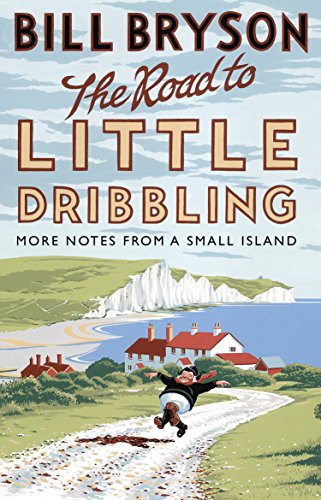
Review of "The Road to Little Dribbling: More Notes from a Small Island" by Bill Bryson

Mainly lovely, like sitting in a pub listening to Bill Bryson ramble on about things that he just finds interesting, whether they are relevant to the conversation or not. A nice break from darkness and somber stuff, with no underlying message - though a well-expressed hatred of Tories and other kinds of meanness and nastiness. He has a dislike of the National Trust that I find endearing.

His style might get wearing after a while, but I just enjoyed this from end to end.