Still enjoyable, mind you.

Do young adult readers respond to an account of racism in which the positions of blacks and whites are reversed, and Black Africans have colonised white Europe? Maybe they do, though I can't see why. And there's so much about the scenario that's not really fleshed out. Why are the Blacks called Crosses and the Whites Noughts? Are the Crosses and Noughts roughly equal in number, or are the Crosses a tiny colonial elite? There's some suggestion that the Noughts were once enslaved, but we don't know how long ago this was...within living memory, like in the US? Or way back in history? Is this our Earth with a point of departure in history, or a parallel one? And so on...

It's a great book, another triumph from Barbara Kingsolver.

Whisper it not, but I was a bit bored by the end, despite the chases and the drama. For the most part the peril never felt very perilous. Still, it was lovely to look at.
Watched via informal distribution.

Some of this was compellingly awful, and other parts were mind-numbingly boringly awful...not the author's fault, it's just that there's only so much of this you can take.
Sometimes his political instincts are spot on - he manages to despise the right-wing nutjobs who perpetrate this stuff without embracing their opponents, the mainstream Democrats who really don't give a shit about the damage that they've done with their policies and their wars.
At other times he - no doubt exasperated by the depth of the bullshit he's had to wade through - descends into sarcasm that isn't interesting or edifying to read. That's a shame, a better editor would have cut a lot of that out.
He's quite well informed on the historical background to conspiracy theories, but I found that there are things that I wish he'd known about - for example, he cites Will Eisner's "The Plot: The Secret Story of The Protocols of the Elders of Zion" for an explanation of the historical background to this foundational conspiracy theory, rather than Norman Cohn's "Warrant for Genocide: The Myth of the Jewish World-Conspiracy and the Protocols of the Elders of Zion".
Probably not the definitive source on Qanon, but a good one to read. I was reading this as the news came through about Trump's indictment, and it made me glad that there was a prospect, however small, that the bastards responsible for all this might go to jail.

Firstly, this film is overtly self-referential - it doesn't quite have characters addressing the fourth wall, but the narrator does refer to it being a film, with casting choices - not something I remember from anything else. It does't need to make sense of the fact that Barbieland is a fantasy, and instead it chooses to make fun of this...Barbie doesn't expect drinking vessels to have fluids in them when she's in the real world, and the wave on the beach is of course solid, as is the surface of the pool at Barbie's dream house.
Is this lost on what I assume is the film's target audience...young girls who either still play with Barbies or did until recently? Or is that not the target audience at all? The film opens with a parody of the opening of 2001 A Space Odyssey, complete with Thus Spake Zarathustra, and showing very young girls smashing their baby dolls as they embrace the possibilities of the new Barbie toy. I thought it was funny...but who else did? Is today's pre-teen audience so media-literate that they get this joke too? Or what?
Watched at an actual cinema, the Vue in Stroud - the first time in ages!
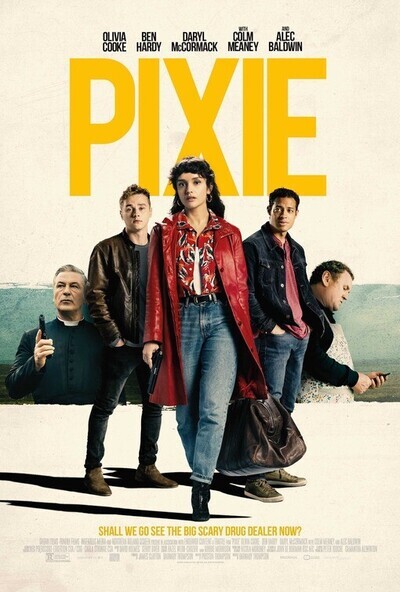
I note in passing that the font for the titles suggested the 1974 film "Foxy Brown", which was also about a woman taking revenge on drug gangs. Pixie, Foxy, that's not an accident, is it?

But then we see things quickly slide into pogroms and burning-out of Catholics from the Protestant streets, and vigilantes and barricades - though only in a Protestant street. In fact, Catholics are largely absent from the story, except in the imaginations and conversations of the Protestant characters, especially the ones from the central family.
One thing struck me - the family, especially the mum and the dad, and some of the other characters including the local Protestant thug-gangster - are all really gorgeous to look at. Funny how striking that is, because almost everyone in documentary footage from this period looks so ugly.
Watched in the Middle Floor at Springhill, via usb stick and informal distribution...one consequence of this was odd melting transitions between some scenes, because the video player couldn't quite cope. It made it even more arty.

It's occasionally a bit confusing - most of the narrative is set during the holiday but some of it is in the future when the girl is grown up and reflecting back on the past...and perhaps some of it is in the further past, depicting the dad's break-up with the girl's mother - it's not 100% clear.
Not what you'd call enjoyable but I am pleased I watched it...via informal distribution and USB stick to the projector in the Springhill Middle Floor.


There's so much about this film that's weird - of course - but also so much that is unsatisfactory. There's not much consideration about the roots of Nazism and White Supremacy in the US, and no examination at all of what it means to escape from racists by going to live in Israel. The main character has moved to Israel with his mum, who speaks with a strong Southern accent, obviously misses the food and culture of the American South, and has a twin sister (who has also moved to Israel), and the two of them dress identically. Which would have been enough for a weird documentary in itself.

This one features an unhappy man who has left his family to live in the wilds of Norway so that he can reconnect with his proper, natural, manly self...but he's actually not very good at it. Failing to kill anything to eat bigger than a frog, he ends up robbing a petrol station instead, and is then half-hardheartedly pursued by the local police, who are mainly oblivious of a trio of drug smugglers in their neighbourhood. The drug smugglers hit a moose/elk, and one of them runs off with the cash leaving the others for dead, but they aren't, and then they run in to the aspirant wild man.
Lots of violence, and blood, and unhappiness, and almost no laughs at all. Even so I found it quite thoughtful and interesting, though Ruth didn't.
Watched on BBC iPlayer.

Lots of drugs, some sex, not much rock and roll.
It took me a little while to get into it, but I ended up enjoying it and was almost sorry when it ended.

There's almost no reflection at all on the ethics or the politics of copyright infringement - I'm rather relaxed about such matters, but I would have at least liked some reflections on who are the winners and losers from this.
Watched on Netflix, and a good example of why one perhaps ought to cancel one's subscription.

I was a bit bored at the beginning...it looks up briefly in the middle, but it's a bit self-indulgent and not all that engaging. Sometimes films about movies are great, but this isn't one of those.
I don't know how autobiographical it is, but the not making it until the parents were dead suggests that it must have been seen as potentially hurtful to them.
Watched via informal distribution and an HDMI cable.

There are some good moments in it, and it gradually grew on me, but it wasn't especially memorable.
On the other hand, I've just read the Wikipedia article, and I learn (a) that the author was only 19 when she wrote it, which is remarkable, and (b) that the Spectator said "Bonjour, Tristesse, which has achieved remarkable celebrity by virtue of its subject-matter and its authoress's age, is a vulgar, sad little book." So now I like it a little more.

The plot is quite simple (if implausible - Israeli intelligence recruits a young English actress to infiltrate pro-Palestinian networks in Europe) but as with other Le Carre, he's good at providing the detail, of atmosphere and interiors and characters.
It was a good lesson for me in the secondary importance of plot...I sometimes got a bit confused, and I don't really think that this would have happened (though I was rather reminded of the scene in Spielberg's Munich where the two competing groups of Palestinians and Israelis are staying in the same safe house in Athens), but it didn't detract from my enjoyment.
I'm also aware that this is a novel about a double agent/infiltrator, and that here as in real life the cultivation of a successful infiltrator personality results in a lot of inner emotional turmoil. Being convincing as an infiltrator means that you have to develop friendships and connections with the members of the group that you are targeting, while partitioning off the "real" you that is reporting back to your own side. I think I'd like to look at other books that deal with this, both fiction and non-fiction...I'm aware of the story about a Shin Bet infiltrator of left groups in Israel in the 1970s, who went native, and also of Philip K Dick's "A Scanner Darkly". But there must be lots of others, surely?

I haven't read any terrorist (or urban guerrilla, if you prefer) memoirs, but I suspect that there isn't a great deal in them about the nuts and bolts of bomb-making. Perhaps if there was then the crew in the film wouldn't have made such heavy weather of it. Can't help thinking that the IRA had an easier time...perhaps because they had access to supplies from supportive governments?
Most of the film is like a heist movie...about the individuals' back-stories, and about the preparations and mechanics of the operation itself, with tension supplied by unexpected appearances and so on...there's another thing but I won't talk about that because I don't want to commit a spoiler.
Nice that one of the gang is a conventional Texas farmer who looks like he would have been at home in the Tea Party or storming the Capitol, and who has been radicalised by the compulsory purchase of his family farm for the pipeline.
The author of the eponymous book, Andreas Malm, is said to have a walk-on part somewhere in the film, but I didn't see him.
In its own terms it's quite gripping, though I haven't thought much about it afterwards. There's not much political discussion or reflection about the tactic of sabotage and how it might relate to a wider movement, and what there is not very thoughtful.
Worth watching though - how many films about climate activists are there?
Watched in the middle floor at Springhill, via informal distribution.

My mum's grandfather, who I knew when I was a little child (until I was about eight, when he died) was usually called Solomon Epstein, though he seems to have sometimes been called Itzko. He was a tailor in the East End, and worked for other master tailors. He was never a master himself, and seems to have been unemployed outside the season. Family tradition says he had attended a yeshiva but became a Bundist, back in the town of Pruzhana (now in Belarus but then Eastern Poland). Later he was very pro-Communist, if not a party member, and thought very highly of Stalin.
He hadn’t meant to emigrate to England. He’d taken a boat to America but was refused entry, perhaps at Ellis Island, because he was suffering from the eye disease trachoma. As a result he ended up in London.
He must have already been married to Sarah Trappski, who was the mother of his three daughters and a son; I know this because Sylvia’s father, Louis Epstein, was born in Poland (then part of the Russian Empire). I have a picture of him with his wife and four children, in which Sarah looks quite plump. A later picture of her, when she was probably already ill (I think with TB but it might have been cancer), shows a very emaciated woman.
He was married two more times after Sarah Trappski died (she’s buried in Frankfurt, where I think she went for treatment which was unsuccessful). The first time he married the widowed mother of Louis’s wife (Sylvia’s mother, known variously as Fay, Fayge, and Ruchel), the second time another widow called Lena, who had a daughter in Israel - I remember a picture of her in her army uniform. Lena kept chickens in the backyard, and fermented and pickled, and my mum remembers her infusing cherries in alcohol.
When conscription was introduced in WW1 he wasn’t liable to be conscripted, because he wasn’t naturalised British. The British government went to some effort to sign military conventions with the governments of allied nations, allowing it to either conscript non-naturalised immigrants or deport them to serve in their ‘home’ armies, but it didn’t do this with Russians because there was some recognition that they were refugees from Czarist oppression. This changed in March 1917 when the first revolution overthrew the Czar, and the Kerensky government continued to fight alongside the allies. In August 1917 the Anglo Russian military convention was signed, making Russian subjects liable to conscription or deportation.
One of the documents in my possession is of some sort of certificate, issued in 1918, by the Russian Embassy in London, then based in Gordon Square. It shows that the embassy staff have manually corrected the headed notepaper to remove the word ‘Imperial’. On the back, in pencil, is some text in the first person about Shlomo/Itzko - I don’t think he wrote it himself. It describes how he came to England and concludes with words that emphasise his claim to be a Russian.
As described in Harold Shukman’s book ‘War Or Revolution: Russian Jews and Conscription in Britain, 1917’, the mainly anti-war immigrants were advised by their socialist leaders to opt for deportation - it was assumed that the government was too busy to organise deportation and transport to Russia. This turned out to be wrong (though perhaps not bad advice, given the level of slaughter on the western front by then) and the immigrants - Jews, but also Lithuanian miners in Scotland - were rounded up and put on a ship for Archangel.
Shukman describes what happened to them thereafter. By the time they arrived there was no Russian army left for them to serve in, and they wandered around Russia during the early stages of the civil war. At some point in 1918 they reached Ekaterinoslav, now Dnipro in Ukraine. I have a composite picture, with lots of insets, showing portraits of what was probably the deportees; some text on one of the insets says ‘Members of the Convention, taken in Ekaterinoslav XI 1918.’ There is also a picture of a ship and some railway lines.
Shlomo spent several years in Russia, during what must have been the civil war. At some point he is said to have found his way to family members who stayed behind in Russia, and there recovered from typhus. Eventually he found his way back to London (some time in the early 1920s), though family tradition says that when the ship docked he wasn’t allowed to disembark, and had to return the following day on another ferry.

It made me think whether the climate movement, broadly, has focused too much on the latter, and not enough on fascist-tinged denialism. Until recently I've rather thought that actual deniers were a tiny band of nutters - after reading the book I'm more aware of how widespread and powerful their ideas are, and how they serve as a radical flank for the foot-dragging mainstream..."of course this is a very serious problem but we can only do what's possible, and that is limited by all those people who don't even believe this is happening." In its earliest days XR majored on taking the facts about climate change to a much broader audience, with its introductory talk that activists could learn. Perhaps it gave up on that too quickly in favour of stunts that grabbed headlines and felt like action.
It also made me thing about the role of consumption - especially of some particular goods, and especially cars and meat - as the symbols of a limited kind of prosperity, and thus as a substitute for class consciousness. In a demented sort of way having a big car and eating lots of meat is a sign of what "we" have achieved, and what must be defended in the face of "elite" plans to take it away from us. We may not have a decent welfare state or healthcare or education, and our kids might never be able to afford to buy or even rent houses, but we still have our big cars and steaks.
It's also worth thinking about how anti-car rhetoric is also a class marker. The richest people often don't have cars or drive much; they live in the cool, walkable inner-city areas from which everyone else has been priced out - see Paris, or London, or New York. The poor and the working classes are living out in the outer suburbs, and in the absence of proper public transport a car is a necessity for a decent way of life, including getting to work, shopping cheaply at big supermarkets, and taking the kids to visit grandparents and friends and to activities.
Two more things - first, that the relative absence of green nationalism is surprising. I know the authors have an explanation, but I am still mystified. It's a largely vacant political position, and the attractiveness of it is not hard to see. The far right's hostility to renewable energy is hard to understand. Perhaps it only makes sense in the context of actual cash flowing from fossil fuel companies and owners to the far right parties.
Second, I am still mystified by the pathetic uselessness of capitalist climate governance. Why don't the mainstream right parties do more? After all, it's the role of the capitalist state to protect the overall system against the particularist interests of particular fractions of capital. So why aren't they doing their job here? Is it that they are worried about being unpopular? That seems unlikely, they are prepared to do lots of other unpopular things when it's necessary for even the short term interests of the system. Are they really just short-termists, who don't care about climate change because it won't happen on their watch? Do they really not believe in the science? In which case those of us who have tried to thrust it under their noses have failed. Do they think that they personally, and the ones they care about, will be able to escape to somewhere where this won't happen? Genuine question, if we knew the answers to this we might know better what to do next.