It put me in mind of my dad, who was evacuated to Biggleswade during the Second World War, and seems to have had a wonderful time. He remembered that the family to which he had been allocated bought him a bicycle for his birthday, and he never shared any memories of any such memories of his own family. Of course Dad never kept up with them after the war, though I think he may once have made a trip to Biggleswade.
Wednesday, May 29, 2024
Review of "Foster" by Claire Keegan
Tuesday, May 28, 2024
Review of "Mr Love and Justice" by Colin MacInnes
I sort of assumed that it would be a very dated book, with old fashioned sexism and racism - but it's mainly not. There are some black and other foreign characters - Maltese gangsters, some Indians - but they aren't depicted as stereotypes. The main characters are all borderline proletarians - seamen, policemen, criminals, prostitutes and pimps.
It's set in the 1950s, and it's a very vivid evocation of a London that was just passing when I was a child - bombsites, street entertainers, sleazy pubs and strip joints.
Although the characters aren't educated or particularly articulate they are represented as having real and complex emotional lives, and though it's not really plot-driven the narrative is well structured - and it's only a little book, some 200 pages.
I note in passing that the characters are depicted as using working-class London speech, but some of the words don't feel right to me. Did English men call their girlfriends "chicks" in the 1950s?
Anyway, I liked it, and I think I'll read some more of MacInnes.
Friday, May 24, 2024
Review of "The Bible for Grown-Ups: A new look at the good book" by Simon Loveday
Review of Past Lives
Twelve years later they find each other via Facebook, and re-develop the friendship as remote strangers. And twelve years after that he comes to visit, by which time she is married to a Jewish guy (like her, a writer)...and their meeting is poignant, about the lives that they might have had but didn't.
For me it was emotional...I'm always affected by stories in which the arc of a life becomes visible...but not sad. It's not as if they could now get together, or even as if they would have had better lives if only...but the road not taken is still a visceral, live presence.
Watched via informal distribution and a USB stick in the back of the TV.
Monday, May 20, 2024
Review of Challengers
And some slightly unusual sex tropes in this one; the two young men both fancy the same woman, but really (or as well) they fancy each other - lots of hints about homoerotic attraction, which never become quite explicit.
Anyway, I enjoyed this - despite some odd choices of music to accompany the narrative.
Watched via informal distribution and the USB slot at the back of the TV; unusually this is probably the first time a download has ever turned out to be a cam, so that at one point a head briefly travelled across the bottom of the screen. Worse, it was intercut with a lot of adverts for an online gambling service, which was really annoying. Still, you get what you pay for, and what you don't.
Review of Which Brings Me to You
Based on a book, so perhaps better than some, and quite watchable.
Watched on Netflix.
Sunday, May 19, 2024
The far right under wraps
“The old world is dying, and the new world struggles to be born: now is the time of monsters.” So said Gramsci, and he might have been thinking about the strange conjuncture of the “Cosmic Right” - a blend of new age weirdness, alternative healing and wellness, and reactionary politics.
Perhaps the seeds of this movement had been germinating out of sight for a while, but the first shoots became apparent with the beginning of the Covid-19 pandemic. It began with “Stand in the park” protests against the lockdown restrictions, and soon there was a movement - or at least a series of Telegram channels and social media presences - with various names, including the Freedom Movement, the Sovereign Citizens Movement, the White Rose (named after the German resistance to the Nazis).
And there was The Light, a free newspaper full of anti-vaccination misinformation, anxiety-inducing material about radio waves and surveillance by the state and big tech, and a ragbag of other conspiracy theories.
It’s hard to overstate how horrible The Light is. It contains sympathetic articles by and about figures from the traditional far right, like Anne Marie Waters of “For Britain” and “Pegida UK” - who in turn uses the paper as a platform to praise Tommy Robinson of the English Defence League. Another regular contributor is Niall McCrae, a former lecturer involved in far right organisation Hearts of Oak, with Tommy Robinson. McCrae has co-authored with Robin Tilbrook, the founder of the far right “English Democrats” party, originally known as the English National Party. There are articles in defence of Holocaust denial and supporting the genocidal antisemite Graham Hart.
There’s homophobia and transphobia, and misinformation about sex education in schools. There are attacks on feminism, women’s equality, contraception and abortion rights, and the claim that there is a “war on masculinity”.
And there is a relentless promotion of climate change denial and obfuscation, alongside attacks on environmentalists and especially on any restrictions on car use.
The themes in the paper are picked up by an emerging street movement. There are rallies with speakers whose websites feature antisemitic material drawn from “The Protocols of The Elders of Zion” and conspiracy-laden accounts of the toothless United Nations sustainability initiative Agenda 2030. In towns across the UK, and now in Ireland, there are weekly stalls distributing the paper as well as other books and pamphlets. There is a strong presence in several towns in the South West, and the paper has been spotted in London and in towns in the North.
Groups of protestors converged on Oxford to protest against traffic calming schemes and “Fifteen Minute Cities”, another well-intentioned town planning idea about localisation of services that is characterised as a plan to create urban ghettos in which citizens will be confined. A mob of ‘conspiraloons’ stormed a meeting of Glastonbury Town Council and then crowed that it had forced the administration - the equivalent of a parish council, with few powers - to abandon its non-existent plans for a fifteen-minute city.
What is this?
For some, this phenomenon is both unprecedented and confusing. Sure, the movement’s messages seem to come from the right, but its cultural style doesn’t. The people who hand out The Light look like hippies. The material often has an anti-corporate or Trump-style “workerist” slant to it, with lashings of libertarianism. In our little town of Stroud, where the movement has gained a foothold among wellness practitioners and some members of the Steiner community, the most prominent supporters are ex-socialists and environmental activists. Some continue to wear Jeremy Corbyn t-shirts and loudly profess themselves to be socialists. The Light’s editor (a flat-earther) began his involvement in politics as an anti-fracking campaigner.
So a new description and analysis is proposed to explain what’s going on. Unsurprisingly some commentators revive the vapid “horseshoe theory”. Others have coined the term “diagonalism” to characterise the leftists who turn right, and this seems to have struck a chord in Germany (as Querdenker), where the pandemic and anti-vaxx activism created a steady pipeline from the Greens and Die Linke to the AfD.
Naomi Klein, in her recent perceptive book Doppelganger, prefers to talk about the “mirror world”, in which rightwing politicians pick up on areas of anxiety that the left has either ignored or lost its interest - technological surveillance, the failings of the medical-industrial complex, the capture of international organisations by mega-corporations, the hypocrisy of the liberal elite and its techno-fixes for profound systemic failures…
I’m not so sure that what we’re looking at is so unprecedented. When “classic” fascism first arrived, in Italy in the early 1920s, some people on the left were confused. Fascism was against traditional conservatives and institutions, against laissez faire and free market economics. It presented itself as a “third way”, modernising, beyond traditional conservatism and socialism, and it was in favour of a great deal of state direction of the economy and society - unlike traditional conservatives.
Mussolini’s movement in Italy recruited syndicalists and anarchists as well as nationalists. Mosley’s British Union of Fascists was preceded by his “New Party” which attracted former members of the left-wing Independent Labour Party, and a few stayed the course with the later incarnation as fully fledged fascists. Despite his enthusiasm for the British Empire and colonial wars, Mosley was a campaigner for “peace” in the later 1930s, opposing any kind of confrontation with Europe’s Nazi and fascist regimes. Our new rightists are keen to advocate for peace with Putin.
In Germany there were so-called “Beefsteak Nazis”, allegedly brown on the outside but red on the inside. Fabians like George Bernard Shaw admired Mussolini’s hostility to Italy’s liberal institutions. Mainstream social democrats like Henri de Man in Belgium openly embraced fascism.
It’s a defining feature of the far right that it presents itself as against the system. Whereas the mainstream right says that the system is under threat and needs to be defended, the far right says that the system has already been conquered by those it defines as enemies, and it needs to be taken back so that the natural order of things can be restored. So they might be revolutionaries, but they want a revolution that will reimpose hierarchy and inequality.
This can get very weird. In the US the QAnon movement and its wider circle of alt-right militant Trump supporters, which talked a lot about the elites and the ‘deep state’, hoped for a military coup to restore the constitution and Trump to the presidency. It is quite alarming to see Free Alex Jones Tee-shirts on the High Street in Stroud.
So the far right will sometimes be hostile to the same things that the left opposes - but this doesn’t really mean that we share common ground. They are hostile to the banking system, but this hostility is grounded in a racialised understanding of financial institutions (“controlled by Jews”). They are hostile to the international organisations intended to ameliorate the worst aspects of capitalist chaos - not because they are too weak to do the job, but because they believe that these institutions are too strong and so impinge on the rights of nation-states and the free market. They are critical of the healthcare system, not because it's inadequate to meet the needs of the population but because it’s too powerful - and they don’t much like welfare or redistribution of any kind.
To be absolutely clear, I’m not saying that they are really classic fascists, and that all that’s needed is a Scooby-Doo type unmasking.
The Light is part of a new kind of far right. It doesn’t look like old-style conservatives or fascists. It’s prepared for the internet age, but unlike recent conspiracism with rarely moved offline, has adherents prepared to spend several days a week handing out a paper in the cold, organising face to face meetings and rallies. Their ideas and rhetoric are much more like the US “libertarian” far right, opposed to state intervention and welfare, and in support of “freedom” for those with money and privileges. And although The Light and its supporters are not themselves fascists, the paper has a problematically cosy relationship with some actual fascists.
It picks up supporters in strange places and funnels them towards far right politics. Many of them don’t realise that they are being funnelled, and don’t have the political background to see what is happening. It builds on seemingly innocuous campaigns such as ‘keep cash’, which offer gateways to conspiracy theories which only become evident when one looks further into the promoters, such as the campaign run by Debbbie Hicks in the Hayes and Harlington local elections.
It’s possible that some of the most committed supporters don’t even realise this - hence the protestations that they are not far right, the Jeremy Corbyn T-shirts, the claims to be a left splinter group, and so on. It doesn’t matter what they think about this, what matters is what they do - and from that it’s clear that The Light is a phenomenon and a project of the far right. Its positions on LGBTQ people, refugees and migrants, and feminism (all attacked as ‘woke’ at best and part of a conspiracy to divide at worst), free speech for racists and antisemites, and climate change denial, should be enough to demonstrate this.
It’s important not to be taken in by rhetoric that says we are “all on the same side”. However nice the people handing out the paper are, whatever they used to be, they are, wittingly or unwittingly, part of a project that’s aimed at building a far right movement.
The purpose of classic fascism was to defend capitalism against the labour and socialist movements - to smash workers’ organisations. It’s not entirely clear yet, but it looks to me like the primary purpose of this new far right is to defeat environmentalist organisations and protect a system based on the production and consumption of fossil fuels.
Though Hope Not Hate have published a piece (written by our Stroud-based campaigning group) and referred to The Light and some other aspects of this phenomenon, and the 12 Rules for What podcast has also explored this issues in audio form and in their book, it’s disappointing that the main anti-fascist organisations don’t seem to be taking much notice.
It’s easy to dismiss this new movement as just a bunch of cranks who will turn out to be mostly harmless. I think that’s wrong. Sure, they don’t look like the Nazis in 1933 - but they do look a lot like the way the Nazis looked in 1923, a mostly fringe group in funny outfits who believed in all sorts of occultist nonsense and were only picking up limited numbers of recruits and votes. We should be taking notice, and preparing to confront their ideas and their presence.
This article appeared in Jewish Socialist (Issue 79, Spring 2024)
Wednesday, May 15, 2024
Review of "Headlong" by Michael Frayn
This is a really well-written book about fraud and confidence trickery in the world of art. The main character and first-person narrator is a philosophy lecturer transitioning to art historian - his wife is an actual art historian, and the dynamic involved in that is less explored than it might have been. There's lots of brilliantly well observed stuff about city people with "places in the country" and how they are received by the rural people, and about dodgy money and family inheritances. There's some great historical context about the period of Breughel's life, and about the context in which he was painting, and about how fragmentary knowledge about art and works can be.
But I can't entirely say I enjoyed it, because of the all-pervading sense of dread that hangs over it. The first-person narrator is increasingly stupid as he gets deeper into the opportunity that he thinks has opened up before him, and it feels a bit like watching a slow-motion car crash - the reader can't help but know this is going to end badly, and there enough clues sprinkled through the text that it will too. So it's a bit miserable, because the narrator - unlike most of the other characters - is quite sympathetic.
Friday, May 10, 2024
Review of King Richard
I'm not usually a big fan of sports films. They are usually variations on the "determination will win through in the end" theme, and this one was sort of like that, but it did have some interesting twists - particularly the title character's wish for his girls to have more than one focus - education as well as tennis. It didn't soft-pedal the relationship difficulties in the household. It didn't make much of the racism that they faced - most of that is in reported speech, whereas we actually see Richard beaten up by young black criminal men.
Anyway, I enjoyed it more than I expected to, even though it was long - two and a half hours.
Watched on Netflix.
Review of "Runaway" by Alice Munro
Thursday, May 02, 2024
Review of "Death in Ecstasy" by Ngaio Marsh
But it sort of grew on me. The setting - a weird neo-pagan cult in London, with a grifter "priest" and gullible toff congregation - was interesting, and the place descriptions were evocative. And though the few working-class characters are dreary stereotypes, the toffs are not at all sympathetic - they are stupid, duplicitous, drug addicts and drug pushers. It's sort of interesting to see the slightly impoverished lives that even moderately well-off people lived in London at that time, despite the presence of either personal or shared "service flat" servants.
Anyway, I ended up enjoying it more than I'd expected.
Monday, April 29, 2024
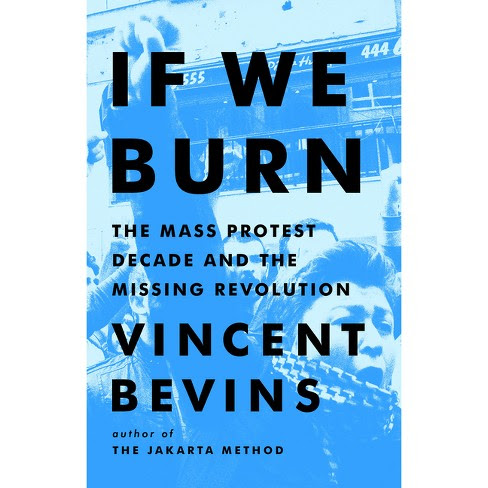
Review of "If We Burn: The Mass Protest Decade and the Missing Revolution" by Vincent Bevins
Among the things that is great about it is the honesty, and the willingness to face the truth - that those protests achieved very little of what the organisers intended, and that the fallout from them often achieved the very opposite. For example, in Brazil the mass protests against transport fare increases, organised by libertarian socialists and anarchists, ended up creating an opportunity for the far right through which Bolsanaro marched to victory.
The last two chapters are analytical, in which Bevins attempts some synthesis and reflection of all that went wrong. This is mostly great, except that there's not enough of it. He's rightly critical of "leaderless" and "horizontal" forms of organisation, and comes across as a reluctant convert to Leninism - though those aren't the only options, are they?
He's also very good on the limits of "protest" as a strategy for opposition movements, and how muddle-headed it is to expect serious change to come from protest.
I hope he writes another book soon, with more learnings, and maybe a bit less grinding detail about who turned up where.
Review of The Commitments
This time round I noticed that although Joey "Lips" Fagan is one of the main characters, you can barely hear his trumpet on any of the performances. Just saying...
Thursday, April 25, 2024
Review of "London Rules" by Mick Herron
I was a bit disappointed. It's a bit formulaic, which is not great. But I just couldn't believe in a plot that was based on the North Koreans activating a sleeper cell in the UK intended to embarrass the UK government by reviving one of its old plans to destabilise a third world country. There are lots of plausible terrorist groups that might attack the UK, but I don't think that the North Koreans are included. So I was carried along by the narrative but unconvinced by the basic premise.
Not sure if I will read any of the others; Le Carre is better.
Monday, April 22, 2024
Review of easy A
Watched on BBC iPlayer.
Tuesday, April 16, 2024
Review of "The Book of Trespass" by Nick Hayes
I couldn't help but get angry when I read it, about the process whereby the aristocracy and their late additions (like the thug Hoogstraten) have seized the whole country for themselves, and locked us out, and how it doesn't have to be that way and isn't in other countries quite nearby - nearby geographically but also economically.
Review of "It's All Greek To Me" by Charlotte Higgins
My enjoyment was further limited by the terrible physical production of the book, which literally fell to pieces as I read it. Did they save on glue or something like that?
Tuesday, April 09, 2024
Review of Seaside Special
Monday, April 08, 2024
Review of "Israelism"
The film was made before the events of October 2023 and the long Israeli retaliation that followed, and that somehow makes it all the more powerful. I was really taken with the way some of the American Jews talked about their journeys, and the not unsympathetic depiction of just how central identification with Israel is in Jewish communities.
I was particularly pleased (if that's the right word) that the film didn't soft-pedal the existence of real, fascist-inspired Jew-hatred in America. For many Jewish and other antagonists of Israel, the question of antisemitism begins and ends with the false accusations aimed at themselves, so there is little recognition that conspiracy theories about Jews are still very very important to the far right. That's definitely not the case here, though there is some consideration to the way in focusing on criticism of Israel has led American Jewish organisations to take their eye off the real threat from real antisemites.
I was also very moved by Sami Awad's spot in the film, where he talked about his visit to Auschwitz and his understanding that Jewish trauma and fear underlies support for Israel's racism. I've rarely heard Palestinians talk about the Holocaust, except in terms of "why should we have to pay for it?".
Watched in the Middle Floor at Springhill, via informal distribution.
Sunday, April 07, 2024
Review of Killers of the Flower Moon
The film makes a good job of depicting racist white Americans, who are sometimes engaged with the Osage to various degrees; the chief villain, brilliantly played by Robert De Niro, speaks their language and seems to have some genuine personal relationships alongside deeply racist attitudes about how the Osage must die out and yield their mineral rights to whites. There's a newsreel depiction of the Tulsa race riots of 1921, which will be new to many Americans and others, and there's an affable chapter of the KKK taking part in what looks like the 4th of July parade in the town of Fairfax, where the story is mainly set.
The pace and tone of the film changes throughout, but especially in the final third, with the arrival of FBI agents in the town. The acting, especially by Leonardo DiCaprio, is really good.
We watched this in the Middle Floor at Springhill having obtained it via informal distribution.
Thursday, April 04, 2024
Review of "The Lincoln Highway" by Amor Towles
Really lots of characters, all of who get turns at being either a first-person or close-third narrator (and it really matters which, as becomes clear), and that's clever too.
I was actually sad that the end had come, even though it's not a short book.
Review of Good Luck to You, Leo Grande
We see their four sessions together, and the development of their relationships with each other and with themselves. It feels a bit like a stage play transferred to the cinema (mainly just the two characters, almost all of it in the same hotel room setting) but is none the worse for that.
Watched on Netflix, natively on our new TV, so no Chromecast.
Saturday, March 23, 2024
Review of Blow Up
There's a lot of stuff about appearance vs reality, and whether there is reality, which seemed important the first time but now comes across as pretentious rather than interesting. It made me think of The Society of The Spectacle, an anarchist/situationist pamphlet that appeared the year after the film, which also seemed to me to profound and important at one point, and now doesn't. There are some ghastly sex scenes with the implication of coercion (see the poster), and another scene in a London club that is both exploiting and poking fun at the tawdry glamour of the emerging rock scene.
Watched in the Middle Floor at Springhill Common House - I think from an actual DVD, which felt very old-school.
Review of Los Amantes Pasajeros
Basically there's a flight with faulty landing gear, and the passengers in business class are drugged by the camp gay stewards so that they end up having a lot of sex with each other - the passengers in economy are just drugged into a stupor. There's more, but you can read the Wikipedia article if you want a summary.
Watched at Jane's shop in Horns Road, Stroud, as part of an ongoing project to watch all of Almodovar's films. This was the worst one for a while.
Friday, March 15, 2024
Review of "97 Orchard: An Edible History of Five Immigrant Families in One New York Tenement" by Jane Ziegelman
To my surprise I learned quite a lot, about the different waves of immigrants...I'd thought that I knew most of it, but I was wrong. In particular, I learned how much more assimilation-oriented the German Jews who came in the 1850s were - Jewish cookbooks with recipes for ham, pork and shellfish, and justifications for why oysters were kosher; and I learned about how poor and despised the second wave of Italian immigrants had been, and how they had done the dirtiest jobs and lived in the worst places, and still believed themselves to be culturally superior (or at least superior in terms of food) to the "native" US population.
And lots more too. I read this on kindle, but I think it's going to be bought as a present for various friends.
Wednesday, March 13, 2024
Review of "In the Skin of a Lion" by Michael Ondaatje
Review of "Occult America: The Secret History of How Mysticism Shaped our Nation" by Mitch Horowitz
The author is more than a little sympathetic to the claims of alternative religious movements, and while he's critical of the worst excesses of some exploitative leaders I think he tries hard - perhaps too hard - to be fair to most of them.
There's some bonkers stuff towards the end that might be categorised as metaphysics, but it's mainly readable and enjoyable.
Review of "The Solutions are Already Here Strategies for Ecological Revolution from Below" by Peter Gelderloos
The last bit, that was supposed to be a vision of how things could be better, seemed disappointing. I don't want a catalogue of techno-fixes that promise a continuation of our present way of life without the environmental costs, but this seemed to be mainly a repetition of "we won't want all that stuff once the miseries of capitalism have been abolished", and I didn't find it satisfying or convincing.
I want to like anarchist approaches to strategies for system change, and to the future organisation of society, but I rarely find much likeable. This wasn't an exception.
Review of "Fight Club" by Chuck Palahniuk
I think that in some ways the film was more subtle, and more ambiguous about the apparent merging of the two main characters - was Tyler Durden always a version, or a personality disorder, of the first-person narrator?
One major difference, at least as far as a remember the film, was the prominence of a castration theme - more than one character is threatened with castration in the book, though it doesn't seem to actually happen. All part of the ugh factor.
Review of "Trouble is my business" by Raymond Chandler
His heroes are always mopping their sweaty necks, and they get hit over the head with monotonous regularity - leaving them with similar wounds on the back of their heads. And they drink all the time from similar sized bottles, and the women are all ciphers rather than proper characters. There are two flavours of cop, corrupt and repulsive or decent and career-blocked. Once or twice I'm pretty sure that the same descriptions popped up in more than story.
I was a bit surprised, though I shouldn't have been, by the casual racism. Some characters - not fully drawn ones - are "heebs", and when there are stereotypical black people they are referred to with a series of racist epithets that I hadn't even heard before - "shine" was one. This isn't to say that race is important in Chandler's fiction (as it is say in Sax Rohmer or John Buchan), but he's certainly not better than the time he lived in.
Tuesday, March 12, 2024
Review of The Noel Diary
It was a nice 90 minutes, and I did have a lump in my throat from time to time.
Watched on Netflix, which seems to have finally got some half-decent films on board.
Review of Poor Things
The plot was implausible (is the book different?) but that didn't really matter - it felt much like a fable or a dream. There have been some nasty comments online that it's a "male gaze" film, but it didn't feel like that to me (or to Ruth, thankfully).
Some great acting, especially by Emma Stone, who manages to make the intellectual and physical development of her character from baby-brain in an adult body to fully grown ersatz human seem entirely believable.
We watched this at a cinema and you should too.
Review of The Monuments Men
Watched via BBC iPlayer I think - I have mainly suppressed the memory.
Friday, February 09, 2024
Review of "Bleeding Edge" by Thomas Pynchon
It's very Jewish, and though there are some Israeli characters it's mainly a paean to New York diaspora Jewish culture, though I don't think Pynchon is Jewish. He's got it down really well, though, the language, the preoccupations.
The plot takes place against the background of the dot.com crash, and the Twin Towers attack, and a complex financial fraud (the main character Maxine is a fraud investigator, working freelance and on her own time for most of the book), so it's sometimes hard to follow. I suspect I missed some of it, but it doesn't seem to have detracted from my enjoyment. It even made me want to visit New York again, which probably isn't going to happen.
Review of Dolly Parton: Here I am
Which makes for a somewhat boring film. She's clever, talented (she's written some great songs), and opaque - a wise decision in an industry that eats people up and spits them out. But she's not great documentary material. We don't even learn anything about her friendships, outside of work relationships.
Watched on BBC iPlayer via Chromecast.
Review of Millie Lies Low
The film was just over 90 minutes but felt longer, though it wasn't bad - just painful.
Well worth watching - we watched on Channel 4 via Chromecast.
Monday, February 05, 2024
Review of Anatomy of a Fall
Watched via informal distribution - our new TV has a slot for USB drives, which makes that rather easier.
Wednesday, January 17, 2024
Review of Rustin
It (probably rightly) doesn't reveal that Rustin in his older years remained committed to workers' rights but became a neoconservative and was praised by Reagan after his death.
Watched on Netflix.
Review of "Cole Porter" by William McBrien
Maybe it's just what reading biographies is like, and I should remember not to read them.
Tuesday, January 09, 2024
Review of "The Honourable Schoolboy" by John le Carre
Eventually I was hooked, though, and engaged with most of the characters (though there were some that were a bit fuzzy for me, so that I had trouble remembering who they were). There's a lot of stuff about the nastier aspects of the Cold War, and no punches pulled about the bad things that "our side" did - in particular involvement in the opium trade. The parts set in Hong Kong, and Indochina, are really evocative - I can actually smell the places he describes.
Monday, January 08, 2024
Review of Leave the World Behind
But there's lots that doesn't make any particular sense and seems just added in for pointless menace...the house is surrounded by oddly courageous deer, for example. And the underlying narrative seems like something from the Qanon playbook - secretive powerful elites, leaflets dropped from planes that are written in Farsi and Korean, and so on.
I was sucked in rather after the fashion of "Lost" (now our reference points for initially intriguing and mysterious narratives that ultimately turn out to be load of meaningless crap), but ended up really disliking this film, despite some good acting and interesting cinematography.
Watched on Netflix.
Review of Go!
Watched this one on a USB stick via informal distribution.
Review of Marry Me!
Yeah, it's that stupid. But it wasn't as bad as it sounds, and there were a few nice moments. And Wilson's character isn't as stupid as some he has played.
Watched on Netflix.
Review of The Courier
Some interesting filming and camera angles, but not much narrative complexity.
I note in passing that at the end there's some footage of the real Greville Wynne, and that he (unlike his portrayal in the film) spoke in a cut-glass upper class accent that absolutely no-one uses any more...though Queen Elizabeth continued to talk like that until her death. What does it mean that a way of speaking can die out so thoroughly?
Watched on BBC iPlayer.
Review of Resistance
The Jewish children are in some sort of scout uniform, though this is never explained or even referred to - are they scouts, or is a Jewish (even Zionist) youth movement?
Watched on Channel4 online - I don't think it's called All4 any more.


.jpg)