Showing posts with label Politics and Economics. Show all posts

Sunday, January 04, 2026

Birkenstock fascists

We are living in chaotic, unsettling times. The pandemic and the muddled, contradictory imperfect response to it leaves people frightened, confused, and often impoverished. This isn't made any easier by the fact that a few people are celebrating the 'slowdown' and arguing that the disruption of 'business as usual' is good for the environment and therefore for all of us.

These conditions are providing an opportunity for the far right, and they are not wasting it. In Stroud we've had leaflets from the "classic" nationalist right shoved through doors in Paganhill and Rodborough. But lots of people who don't identify as any kind of nationalist - let alone as fascist - are helping to open the door to the far right. Every week we see - on the streets and on social media - organised campaigns against lockdown that spread misinformation about the virus and measures to suppress it. They're anti-mask, anti-lockdown, anti-vaccination.

It's not hard to understand why this can be appealing. Masks are uncomfortable. Lockdown brings real hardship (and we're in Lockdown for the third time in part because of the government's inept handling of the pandemic). Vaccination involves a big scary needle, and it's hard to understand the science behind it. The companies that make the vaccine, and other pharmaceuticals, have a long track record of greed, regulatory capture, deceit and cover-ups of their failures. 

Those who believe in alternative and complementary medicine, and who stress the importance of lifestyle and connection with nature in promoting health and well-being, are predisposed to see the government's response to the virus as part of a bigger picture including increased personal and technological surveillance.

Of course your Birkenstock-wearing friend is not an actual fascist. They most likely think that in speaking out against anti-Covid measures they are being some sort of anti-fascist resister. They're just not aware that behind the "scepticism" about lockdown and vaccines there's another agenda. Spend a little time researching the other views of the anti-lockdown folk and you'll find - along with a fear of big corporations and a concern for the poor and downtrodden that might be genuinely felt - climate change denial, and racist conspiracy theories that promote hatred of Jews, and Asian and Black people. 

Piers Corbyn and Sandi Adams, who spoke at Stroud's anti-lockdown rally in Stratford Park, either write this stuff themselves or provide a platform for it. Both Adams and the actual 'classic' fascists promote the idea of The Great Replacement, whereby white people in Britain will be replaced by non-whites.

They're not aware, either, that the far right has a deliberate strategy of drawing people in this way, through 'good causes' like opposition to animal cruelty, and introducing them to the overall world-view only gradually. 

Your Birkenstock-wearing friend is not going to be wearing a swastika armband any time soon. Neither will most of the 'real' fascists; apart from a few re-enactment enthusiasts they mostly don't these days, and they won't while the memory of the Nazi atrocities remains strong (one reason why the real fascists seek to deny, or minimise, or relativize the actual history).

Remember that last time round real fascism wasn't obviously evil to everyone. It celebrated nature and beauty, it liked nature and organic food and kindness to animals. And fascist movements and regimes attracted support and loyalty from people who had no intention to commit genocide. Your Birkenstock friend thinks they are standing up for freedom and nature; but they are being led down a path that leads to genocide. They yet may step off that path, but failing to recognise who they are hanging out with is not a good start.

Monday, September 15, 2025

Feeding the hand that bites us


Last weekend I attended some of the
Festival of Commoning, held in Stroud. There were lots of interesting talks and discussions, but there was one particularly significant moment for me. Jem Bendell, famous as a guru of XR and Deep Adaption, was down to speak on “Great Reclamation”. In retrospect the title of his talk ought perhaps to have rung a few alarm bells, but it didn’t - one assumes that an event like this ought to be a relatively safe place. 

He didn’t talk about climate or deep adaptation at all - the focus of his talk was a call for restrictions on foreigners buying or owning land in Britain. I don’t have a very strong view on this. I’m aware that lots of other countries have such restrictions, and there’s room for a balanced, evidence-based discussion on what the impact might be on the affordability of homes in Britain.


The trouble was that the language that he used was very strongly reminiscent of that used by the far right. He talked about “globalists” and “international bankers”. He spoke about how these people were “sucking the life blood out of our country”, and he said that this was directly linked to “our” children deciding not to have babies. It was all rather “Great Replacement”, and the title may have been a deliberate referece - if it wasn’t, then it’s shocking that no-one noticed. (You can see a version of what he said on his blog here, and judge for yourself whether my reaction was justified).


So when it was time for questions and contributions, I stuck my hand up and pointed this out, saying that on a day when Tommy Robinson had brought 100.000 foot soldiers on to the streets of London, it was a bad day to be fooling around with economic nationalism. I said that “globalists” was often a dogwhistle for Jews, and that focusing on “foreign” ownership of property made it seem as if it was OK for the Duke of Westminster to own huge amounts of property in Britain because he was “one of us” - in Bendell’s word, a citizen.


It would have been easy for him to have agreed that the language was - on reflection - a bit unfortunate, and that it wasn’t his intention to align himself with the far right, but he didn’t. He doubled down, said that “globalists” were the source of the problem, and that the suggestion that he might be unconsciously echoing racist and antisemitic rhetoric was just the sort of thing he’d be expecting from “guilt-ridden Guardianistas”. 


Somebody else from the floor joined in, saying that his language was wrong and bad, and that it was of a piece with the sort of thing one heard from the US far right; rather wonderfully, that person turned out to be Carne Ross, the “accidental anarchist” and former diplomat who was one of the later celebrity speakers at the event. Someone else called out that next he would start talking about the Rothschilds. Still Bendell was having none of it; he was in sympathy with Black and Brown people who couldn’t afford housing, and that was down to the globalists.


The final contribution came from a local activist with whom I’ve had my disagreements who made a generous and kind closing remark about me personally, and about the importance of being careful about language.


Afterwards a few people spoke to me - some of the organisers of the festival, who said that I’d been right to bring it up, and that Jem Bendell didn’t really mean it, and we probably agreed. A couple of others said that they’d never heard that “globalist” and “cosmopolitan” were used code-words for Jew, and I perhaps unkindly replied that they ought to get out more.


I was pretty shaken by the experience, though the solidarity I received helped make it better. Reflecting later, I thought it would of course be easy for Jem Bendell to show that he wasn’t a racist. There’s no sign that he’s an antisemite either, in the sense of someone who hates Jews. Apart from a recent engagement with the cause of Palestine and Gaza, he’s not said or written anything touching on the subject.


I think that’s the point. Antisemitism isn’t a feeling (hate), it’s an ideology - one which puts Jews at the centre of explaining how the world works and what’s wrong with it. It’s possible, and even common, to spread this ideology without personally hating Jews, and even to do it in places where there aren’t many Jews. 


And what’s wrong with it isn’t only that it’s hurtful to actual Jewish people, but that it makes everyone else stupider, and less able to understand the world as it really is. That’s the point about the expression “the socialism of fools”. Antisemitism isn’t just something that is promoted by stupid people, but something that helps to make people stupider.


AFTERWORD: Jem Bendell wrote a response to this post, which is published here. Once again, I wish to make it clear that I am not accusing Jem Bendell of being an antisemite. You can judge for yourself whether the language he uses is helpful to other people who are.


Tuesday, July 29, 2025

Review of "Veteranhood" by Joe Glenton

Interesting and thoughtful book about the politics of veterans - both the politics of the veterans themselves and the way they are used by politicians, including mainstream and far right politicians. Glenton is a good writer and he says a lot that has wider relevance, especially in terms of how the cultural left relates to actual working class people.

Tuesday, June 03, 2025

Review of "Popular Resistance in Palestine A History of Hope and Empowerment" by Mazin B. Qumsiyeh

I was disappointed and upset by this book. It's not specially well written, and it feels poorly edited too - sometimes the same episode is described twice, or the same point made, within a few pages. 

But that's not the main thing that's wrong with it. Its politics and its account of history are often really bad. The first four or so chapters are a "discussion" of the role of violence in struggles of resistance, but there's nothing remotely analytical about it. Sometimes the resistance (wherever) uses violence, and sometimes it doesn't. He's obviously keen not to be seen as criticising armed struggle, whether or not it's appropriate or effective. 

Worse, there's really no distinction between different kinds of armed-struggle tactics or strategies. Sure, the South African regime and its supporters called the ANC "terrorists", but for the most part its armed wing stayed away from indiscriminate attacks on civilians, focusing instead on infrastructure. Whereas the Palestinian armed struggle focused on soft Israeli targets, with lots of attacks on civilians - kidnappings, hostage taking, and exactly the kind of bombings and shootings that had earlier been deployed by the Irgun against Palestinians in Mandate Palestine. The question here is not the abstract "do Palestinians have the right to use violence" but what kind of violence should they use. For both Fatah and later Hamas, the rhetoric was revolutionary but the tactics were those of fascism.

After this there's a long chronological account of Palestinian resistance, beginning with the Ottoman period.  The Zionists start to arrive, but there's absolutely nothing about where they are coming from or why.  As with other Palestinian and Arab Nationalist accounts of "the Zionists" they are presented as pith-helmeted colonialists. There's no indication or reflection at all as to why Jews were leaving the Russian empire. Of course the Palestinians of the time can be forgiven for not thinking about that so much - something bad was beginning to happen to them, and they correctly understood that it was going to get worse. But someone now writing a history owes their readers something better.

This tendency is exacerbated in the history of the Mandate. By the time the book reaches the 1930s it acknowledges that the flow of Zionist immigrants is increasing, but there's absolutely no account as to why. The author manages to talk about the history of this period without mentioning antisemitism or the Nazis. The only mention of the Holocaust in the book is to illustrate a point about the bad education that Jewish children in Israel receive. There's nothing at all about who made up the wave of Jewish immigrants in the immediate post-WW2 period, or about the mass emigration of Jews from Arab countries that came after that. Again, it would contradict the view that "the Zionists" were all European and American colons.

When it gets to 1967 there's a brief mention of Ahmed Shukeiri, the Egyptian-backed first head of the PLO, though no mention of his call to throw the Jews into the sea or his promise that no Jews would survive the coming war.

Overall the history in the book is like a mirror image of the bad history that I received from my Zionist education. There's lots about the pro-Zionist sympathies of the British (we were only told about the bad period in which the British tried to restrict Zionist immigration, not the preceding 16 years in which they had enabled it), and then the Americans. There is of course nothing about the way in which the USSR and the international Communist movement acted as midwives for the birth of Israel, because that would contradict the narrative that Israel was a creation of imperialism. 

It's a shame, because somewhere in there there's a better book struggling and failing to get out.  There's a lot of good documentation about the popular non-violent struggle. The account of the post-1948 and then post-1967 resistance is informative and told me lots I didn't know. Somewhere in this period some good Israelis begin to appear, though without any discussion or reflection as to what that might mean. There's a little bit of an account of Palestinians who are prepared to accept a permanent presence for Israelis, though usually in terms of them being sell-outs. At one point he does actually quote with approval that "there's no place for a second nation in Palestine", though he is far from consistent about this.

I read this on a Kindle, so it's harder to illustrate this with quotes and excerpts. In a way I'd like to write more, because this is an important juncture in the evolution of my perspective on Israel-Palestine...listening to Palestinian voices, but then not finding them easy to listen to.

Monday, August 19, 2024

Review of "The New Authoritarians Convergence on the Right" by David Renton


Declaration of interest - I know David Renton, and I think he's great. He's very astute politically, he avoids glib explanations and snappy prescriptions, and he writes very well in a way that is accessible and intelligent.

So no surprise that I liked this book very much. It makes several very important points; firstly that not every manifestation of the far right is fascist - fascism is a particular form of far right politics, with an emphasis on violence, control of the streets, and a "revolution" against the liberal state. So other versions of the far right, including the electorally successful versions in Europe, North America and Asia, have made their peace with elections and with a version of the liberal state. I don't think Renton says so explicitly, but the main differentiator isn't ideological or policy content. Fascists have been all over the place in terms of policies. They are clearly not free market ideologues, and often advocate a role for the state in managing the economy that would not be out of place in middle-of-the road Social Democracy. 

The second important point is that calling out the far right as fascists isn't only inaccurate, it's also decreasingly effective. There was a time, especially in the 1970s, that it was enough to demonstrate the historic links between the far right and the fascists of the inter-war and wartime periods. Since everyone thought that Nazis and fascists were bad, proving the connection was enough to place the far right outside the domain of acceptable politics. Sadly, that's no longer the case. The taint of Nazism is wearing thin and as a younger generation without personal memories of the antifascist generation don't care nearly so much. Nazism isn't as a toxic as it once was.

Which means that different tactics, and different arguments are called for in confronting the far right in its present manifestations. Responding with classic antifascist rhetoric and tactics is not going to work in the way that it once did.

I think Renton is also saying that addressing the root causes from which the far right draws its strength - in particular the failure of liberal capitalism to live up to its promises - is not only the most comprehensive response to the far right, but it's ultimately the only thing that will be effective.


Sunday, May 19, 2024

The far right under wraps

“The old world is dying, and the new world struggles to be born: now is the time of monsters.” So said Gramsci, and he might have been thinking about the strange conjuncture of the “Cosmic Right” - a blend of new age weirdness, alternative healing and wellness, and reactionary politics. 


Perhaps the seeds of this movement had been germinating out of sight for a while, but the first shoots became apparent with the beginning of the Covid-19 pandemic. It began with “Stand in the park” protests against the lockdown restrictions, and soon there was a movement - or at least a series of Telegram channels and social media presences - with various names, including the Freedom Movement, the Sovereign Citizens Movement, the White Rose (named after the German resistance to the Nazis). 


And there was The Light, a free newspaper full of anti-vaccination misinformation, anxiety-inducing material about radio waves and surveillance by the state and big tech, and a ragbag of other conspiracy theories.


It’s hard to overstate how horrible The Light is. It contains sympathetic articles by and about figures from the traditional far right, like Anne Marie Waters of “For Britain” and “Pegida UK” - who in turn uses the paper as a platform to praise Tommy Robinson of the English Defence League. Another regular contributor is Niall McCrae, a former lecturer involved in far right organisation Hearts of Oak, with Tommy Robinson. McCrae has co-authored with Robin Tilbrook, the founder of the far right “English Democrats” party, originally known as the English National Party. There are articles in defence of Holocaust denial and supporting the genocidal antisemite Graham Hart. 


There’s homophobia and transphobia, and misinformation about sex education in schools. There are attacks on feminism, women’s equality, contraception and abortion rights, and the claim that there is a “war on masculinity”. 


And there is a relentless promotion of climate change denial and obfuscation, alongside attacks on environmentalists and especially on any restrictions on car use. 


The themes in the paper are picked up by an emerging street movement. There are rallies with speakers whose websites feature antisemitic material drawn from “The Protocols of The Elders of Zion” and conspiracy-laden accounts of the toothless United Nations sustainability initiative Agenda 2030. In towns across the UK, and now in Ireland, there are weekly stalls distributing the paper as well as other books and pamphlets. There is a strong presence in several towns in the South West, and the paper has been spotted in London and in towns in the North. 


Groups of protestors converged on Oxford to protest against traffic calming schemes and “Fifteen Minute Cities”, another well-intentioned town planning idea about localisation of services that is characterised as a plan to create urban ghettos in which citizens will be confined. A mob of ‘conspiraloons’ stormed a meeting of Glastonbury Town Council and then crowed that it had forced the administration - the equivalent of a parish council, with few powers - to abandon its non-existent plans for a fifteen-minute city.


What is this?


For some, this phenomenon is both unprecedented and confusing. Sure, the movement’s messages seem to come from the right, but its cultural style doesn’t. The people who hand out The Light look like hippies. The material often has an anti-corporate or Trump-style “workerist” slant to it, with lashings of libertarianism. In our little town of Stroud, where the movement has gained a foothold among wellness practitioners and some members of the Steiner community, the most prominent supporters are ex-socialists and environmental activists. Some continue to wear Jeremy Corbyn t-shirts and loudly profess themselves to be socialists. The Light’s editor (a flat-earther) began his involvement in politics as an anti-fracking campaigner. 


So a new description and analysis is proposed to explain what’s going on. Unsurprisingly some commentators revive the vapid “horseshoe theory”. Others have coined the term “diagonalism” to characterise the leftists who turn right, and this seems to have struck a chord in Germany (as Querdenker), where the pandemic and anti-vaxx activism created a steady pipeline from the Greens and Die Linke to the AfD.


Naomi Klein, in her recent perceptive book Doppelganger, prefers to talk about the “mirror world”, in which rightwing politicians pick up on areas of anxiety that the left has either ignored or lost its interest - technological surveillance, the failings of the medical-industrial complex, the capture of international organisations by mega-corporations, the hypocrisy of the liberal elite and its techno-fixes for profound systemic failures…


I’m not so sure that what we’re looking at is so unprecedented. When “classic” fascism first arrived, in Italy in the early 1920s, some people on the left were confused. Fascism was against traditional conservatives and institutions, against laissez faire and free market economics. It presented itself as a “third way”, modernising, beyond traditional conservatism and socialism, and it was in favour of a great deal of state direction of the economy and society - unlike traditional conservatives. 


Mussolini’s movement in Italy recruited syndicalists and anarchists as well as nationalists. Mosley’s British Union of Fascists was preceded by his “New Party” which attracted former members of the left-wing Independent Labour Party, and a few stayed the course with the later incarnation as fully fledged fascists. Despite his enthusiasm for the British Empire and colonial wars, Mosley was a campaigner for “peace” in the later 1930s, opposing any kind of confrontation with Europe’s Nazi and fascist regimes. Our new rightists are keen to advocate for peace with Putin.


In Germany there were so-called “Beefsteak Nazis”, allegedly brown on the outside but red on the inside. Fabians like George Bernard Shaw admired Mussolini’s hostility to Italy’s liberal institutions. Mainstream social democrats like Henri de Man in Belgium openly embraced fascism.


It’s a defining feature of the far right that it presents itself as against the system. Whereas the mainstream right says that the system is under threat and needs to be defended, the far right says that the system has already been conquered by those it defines as enemies, and it needs to be taken back so that the natural order of things can be restored. So they might be revolutionaries, but they want a revolution that will reimpose hierarchy and inequality.


This can get very weird. In the US the QAnon movement and its wider circle of alt-right militant Trump supporters, which talked a lot about the elites and the ‘deep state’, hoped for a military coup to restore the constitution and Trump to the presidency. It is quite alarming to see Free Alex Jones Tee-shirts on the High Street in Stroud.


So the far right will sometimes be hostile to the same things that the left opposes - but this doesn’t really mean that we share common ground. They are hostile to the banking system, but this hostility is grounded in a racialised understanding of financial institutions (“controlled by Jews”). They are hostile to the international organisations intended to ameliorate the worst aspects of capitalist chaos - not because they are too weak to do the job, but because they believe that these institutions are too strong and so impinge on the rights of nation-states and the free market. They are critical of the healthcare system, not because it's inadequate to meet the needs of the population but because it’s too powerful - and they don’t much like welfare or redistribution of any kind.


To be absolutely clear, I’m not saying that they are really classic fascists, and that all that’s needed is a Scooby-Doo type unmasking. 


The Light is part of a new kind of far right. It doesn’t look like old-style conservatives or fascists. It’s prepared for the internet age, but unlike recent conspiracism with rarely moved offline, has adherents prepared to spend several days a week handing out a paper in the cold, organising face to face meetings and rallies. Their ideas and rhetoric are much more like the US “libertarian” far right, opposed to state intervention and welfare, and in support of “freedom” for those with money and privileges. And although The Light and its supporters are not themselves fascists, the paper has a problematically cosy relationship with some actual fascists. 


It picks up supporters in strange places and funnels them towards far right politics. Many of them don’t realise that they are being funnelled, and don’t have the political background to see what is happening. It builds on seemingly innocuous campaigns such as ‘keep cash’, which offer gateways to conspiracy theories which only become evident when one looks further into the promoters, such as the campaign run by Debbbie Hicks in the Hayes and Harlington local elections. 


It’s possible that some of the most committed supporters don’t even realise this - hence the protestations that they are not far right, the Jeremy Corbyn T-shirts, the claims to be a left splinter group, and so on. It doesn’t matter what they think about this, what matters is what they do - and from that it’s clear that The Light is a phenomenon and a project of the far right. Its positions on LGBTQ people, refugees and migrants, and feminism (all attacked as ‘woke’ at best and part of a conspiracy to divide at worst), free speech for racists and antisemites, and climate change denial, should be enough to demonstrate this. 


It’s important not to be taken in by rhetoric that says we are “all on the same side”. However nice the people handing out the paper are, whatever they used to be, they are, wittingly or unwittingly, part of a project that’s aimed at building a far right movement.


The purpose of classic fascism was to defend capitalism against the labour and socialist movements - to smash workers’ organisations. It’s not entirely clear yet, but it looks to me like the primary purpose of this new far right is to defeat environmentalist organisations and protect a system based on the production and consumption of fossil fuels. 


Though Hope Not Hate have published a piece (written by our Stroud-based campaigning group) and referred to The Light and some other aspects of this phenomenon, and the 12 Rules for What podcast has also explored this issues in audio form and in their book, it’s disappointing that the main anti-fascist organisations don’t seem to be taking much notice. 


It’s easy to dismiss this new movement as just a bunch of cranks who will turn out to be mostly harmless. I think that’s wrong. Sure, they don’t look like the Nazis in 1933 - but they do look a lot like the way the Nazis looked in 1923, a mostly fringe group in funny outfits who believed in all sorts of occultist nonsense and were only picking up limited numbers of recruits and votes. We should be taking notice, and preparing to confront their ideas and their presence.


This article appeared in Jewish Socialist (Issue 79, Spring 2024)


Monday, April 29, 2024

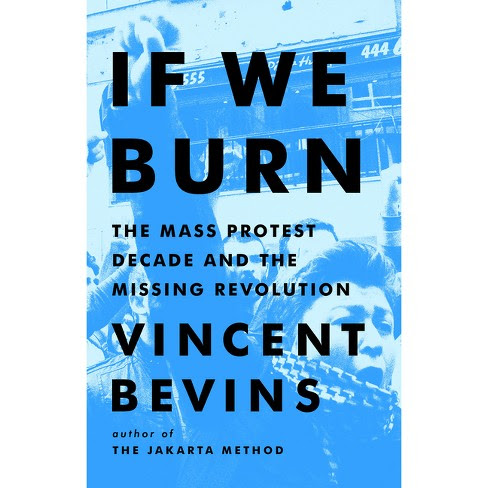
Review of "If We Burn: The Mass Protest Decade and the Missing Revolution" by Vincent Bevins

This is almost a great book - a survey of what actually happened in the mass protests of the 2010s, from Brazil to Hong Kong to Turkey to Chile to the Middle East.

Among the things that is great about it is the honesty, and the willingness to face the truth - that those protests achieved very little of what the organisers intended, and that the fallout from them often achieved the very opposite. For example, in Brazil the mass protests against transport fare increases, organised by libertarian socialists and anarchists, ended up creating an opportunity for the far right through which Bolsanaro marched to victory.

The last two chapters are analytical, in which Bevins attempts some synthesis and reflection of all that went wrong. This is mostly great, except that there's not enough of it. He's rightly critical of "leaderless" and "horizontal" forms of organisation, and comes across as a reluctant convert to Leninism - though those aren't the only options, are they? 

He's also very good on the limits of "protest" as a strategy for opposition movements, and how muddle-headed it is to expect serious change to come from protest. 

I hope he writes another book soon, with more learnings, and maybe a bit less grinding detail about who turned up where.


Wednesday, March 13, 2024

Review of "The Solutions are Already Here Strategies for Ecological Revolution from Below" by Peter Gelderloos

It seems a bit unfair for me to write a review of this, because I didn't read all of it - just the first and the last chapters. The first was a decent run through of a lot (though not everything) that's wrong with our current technical-economic system, though without much new, and in the manner of books already a bit out of date. 

The last bit, that was supposed to be a vision of how things could be better, seemed disappointing. I don't want a catalogue of techno-fixes that promise a continuation of our present way of life without the environmental costs, but this seemed to be mainly a repetition of "we won't want all that stuff once the miseries of capitalism have been abolished", and I didn't find it satisfying or convincing.

I want to like anarchist approaches to strategies for system change, and to the future organisation of society, but I rarely find much likeable. This wasn't an exception. 

Tuesday, June 13, 2023

Review of How To Blow Up A Pipeline

It would be facetious, and also factually wrong, to complain that this film does not tell you how to blow up a pipeline. It's got a lot of specific detail in it, including the requirement to make sure that the explosive is quite close to the pipe itself, which is very strong. The film's protagonists find making detonators the most difficult part, and this involves both chemistry and electronics work. The explosive itself seems to be old-fashioned sugar and weedkiller, and though they bash it about quite a lot as they move the oil drums in which they've packed it, it doesn't go off. 

I haven't read any terrorist (or urban guerrilla, if you prefer) memoirs, but I suspect that there isn't a great deal in them about the nuts and bolts of bomb-making. Perhaps if there was then the crew in the film wouldn't have made such heavy weather of it. Can't help thinking that the IRA had an easier time...perhaps because they had access to supplies from supportive governments?

Most of the film is like a heist movie...about the individuals' back-stories, and about the preparations and mechanics of the operation itself, with tension supplied by unexpected appearances and so on...there's another thing but I won't talk about that because I don't want to commit a spoiler.

Nice that one of the gang is a conventional Texas farmer who looks like he would have been at home in the Tea Party or storming the Capitol, and who has been radicalised by the compulsory purchase of his family farm for the pipeline.

The author of the eponymous book, Andreas Malm, is said to have a walk-on part somewhere in the film, but I didn't see him.

In its own terms it's quite gripping, though I haven't thought much about it afterwards. There's not much political discussion or reflection about the tactic of sabotage and how it might relate to a wider movement, and what there is not very thoughtful.

Worth watching though - how many films about climate activists are there?

Watched in the middle floor at Springhill, via informal distribution.

Monday, January 25, 2021

The contradictions of Zionism

This post is (yet another one) about Zionism...

...and therefore inevitably fraught.

Some of that comes from the fact that supporters of the Israeli government try to deflect all criticism of Israel and solidarity with the Palestinians by saying that it’s motivated - consciously or otherwise - by hatred of Jews. Some of them actually believe this, and sometimes they say it in bad faith because it’s effective.

And there are people who really are Jew-haters, who don’t care much about Palestinians or what Israel does to them, but use “Zionist” as a code-word for Jew. There’s more of this about than there used to be...you don’t have to go far in to many conspiracy theory websites before you find it...David Icke goes on about “Rothschild-Zionists”, Sandi Adams who spoke at the anti-lockdown rally in Stratford Park hosted material like this on her website.

And some people conclude from this that “it’s better not to talk about Zionism at all, because everyone means different things by it”. But we need to, because understanding the different meanings that are attached to it, and where these have come from, is a first step towards developing a decent politics that can address both Palestine and anti-semitism.

The central contradiction of Zionism

There is a distinction that is often made between the ‘nationalism of the oppressed’ and the ‘nationalism of the oppressor’. Zionism is both, and that makes talking about it more difficult. 

In Israel now Zionism underlies and provides the justification for the oppression of Palestinians, inside Israel ‘proper’ - the internationally recognised borders of Israel from 1967 - and in the territories that Israel has occupied since 1967. (For an in-depth illustration see the  website of B’tselem - an Israeli organisation that describes the situation as ‘a regime of Jewish supremacy from the Jordan River to the Mediterranean Sea').

It’s considered an extreme left-wing view in Israel to say that Israel should be “a state for all its citizens”. Two years ago the Israeli parliament narrowly passed a law saying that Israel is ‘the nation-state of the Jewish people’...that is, it belongs to all the Jews of the world, whatever their citizenship status. And not to all of its citizens.

Now to most people around the world who believe in democracy this seems weird, but the debate in Israel is about whether it should be a law or not, not whether it’s right. Stuff like this is part of the intellectual and ideological and legal apparatus that enables oppression.

Nationalism of the oppressed: a response to antisemitism

To have productive conversations about Zionism, we need to go back further - and understand the ideology and movement as something that started out as a response to the predicament of the millions of East European Jews, particularly those in the Russian Empire. 

Antisemitism has a very long history in European civilisation - the blood libels (the often-repeated fiction that Jews murder Christian children for their blood), the massacres during the crusades, sinister Jews in art and literature. Jews were expelled from England in 1290 (and other countries in Western Europe at other times). The first immigration act in Britain, the 1905 Aliens Act, was introduced to keep out Jewish refugees from Russia.

The modern version of antisemitism was a mass political movement with its own parties and newspapers, and an explicit ideology that explained what was wrong with the world in terms of the involvement of evil Jews. 

Jewish life in Russia (Russian-governed Poland was the largest population of Jews in the world) was characterized by legal restrictions, state persecution, and organised street violence - the Black Hundreds was a popular Russian antisemitic organisation involved in organising pogroms (state-sponsored anti-Jewish riots that turned into massacres). 

In 1902-3 the Russian secret service forged a document, ‘The Protocols of the Learned Elders of Zion’, which claimed to be a secret plan for Jews to take over the world and it’s still in circulation today… this is the sort of stuff that Icke and Sandi Adams promote, and is promoted, via Qanon, in the US Republican Party..  

The catalyst for the founding of the political Zionist movement was the 1894 Dreyfus trial in France, which demonstrated to some that Jews would never be accepted as equal citizens by their non-Jewish counterparts.

From the foundation of the Zionist movement in 1897 the mainstream ‘Political Zionism’ sought to get backing from one or more major European powers to help them get a state. Political Zionism argued that the ‘Jewish Problem’ could be resolved by creating a state for the Jewish people and organising the mass migration of Jews to that state. This was referred to as the ‘Normalization of the Jewish People’. From early on the place chosen for that state was to be Palestine, seen as the site of the last time there had been an independent Jewish state. A key slogan was “A land without a people for a people without a land”, which ignored the fact that Palestine was inhabited.

Zionism wasn’t the only kind of Jewish nationalism- there were others like the Sejmists and Jewish Autonomists, and Territorialists; there was the Bund, a Jewish socialist movement that was big in Russia and Poland. In some ways Zionism was similar to the other movements of oppressed nationalities in Europe - the Polish, Czech, Finnish, etc. If history had unfolded differently Zionism might have turned into an interesting footnote in history, like some of the other European settlements in Palestine, or like Marcus Garvey’s  ‘Back to Africa’ movement in the US. And there were other responses to the oppression of Jews - the individual response of migrating to America or somewhere else, for example. Others placed their hopes in the international Communist movement, hoping that the overthrow of capitalism would also put an end to antisemitism.

Nationalism of the oppressor: a colonial movement in Palestine

“Practical Zionism” sought to encourage Jews to migrate to Palestine without waiting for a state, and to establish the nucleus of a new society there. 

This included the creation of communities - sometimes utopian communes with socialist or anarchist characteristics, as well as more conventional businesses, farms and towns. It wasn’t a big success - many more Jews migrated to America than to Palestine; between 1907 and 1914 the comparable figures were 20,000 vs. 1.5 million. 

But Practical Zionism had one important consequence; the Zionists discovered that Palestine was after all inhabited. There were a variety of responses. In general it wasn’t seen as a big problem, partly because they thought there were only a few hundreds of thousands of Palestinian Arabs at most, and millions of Jews would be migrating to Palestine. Some Zionists convinced themselves that the Palestinian Arabs would be pleased once they understood how the creation of a Jewish state would benefit them. 

“Labour Zionists'' thought that it was necessary to create a segregated labour market, with protection for Jewish workers who would otherwise be undercut by low-waged Arab workers - otherwise they wouldn’t be able to persuade Jewish workers to immigrate. They organised unions that called for Jewish-owned businesses to boycott Arab workers, at the same as they tried to persuade those Arab workers to join special Arab-only unions to fight for higher wages. There was a wide spread of opinion, and some socialist-Zionists like the ‘Left Poale Tzion’ and Hashomer Hatzair took the socialism part seriously and tried to make common cause with the Arab workers in Palestine, with very limited success.

After WW1 the British Empire took Palestine away from the Turkish Empire, and the British began to sometimes tolerate and sometimes encourage Jewish immigration into Palestine. 

With the rise of fascism and Nazism in Europe, and other countries closing their doors to Jewish refugees, the pressure to allow Jews into Palestine increased, and the Palestinian Arabs  - who knew that the Zionists were intending to turn their country into a Jewish state - became ever more hostile.
So from early on Zionism had two different aspects, and this is still important now. 

In Europe it was a movement of an oppressed minority, offering national pride and cultural identity. 
In Palestine it acted as a movement and an ideology of colonists, seeking to take over a territory and dominate the local inhabitants. It wasn’t interested in immediate self-government or independence for Palestine because it needed the British Empire to enforce the right of Jews to immigrate - an independent Arab-controlled Palestine would have stopped that. 

The impact of the Holocaust

The Holocaust changed the way that Jewish communities around the world responded to Zionism.

A majority of Europe’s Jews died in the Nazi genocide - two out of three, and many of those who survived were dispossessed, displaced and devastated by the loss of everything and everyone they had known. Before the Holocaust lots of Jews were anti-Zionist or at least not Zionist. Orthodoxy was opposed on the grounds that returning to Erez Yisrael before the coming of the Messiah was sacrilegious. Reform Jews, who were keen to present Jews as a denomination rather than a nationality, were also opposed - as were some successfully assimilated and prosperous Jews, the other kinds of Jewish nationalist, and most Jewish socialists. 

After the Holocaust, the Zionist view that the Jews would never be accepted in the countries in which they lived seemed to have been vindicated. Jews who had never been Zionists, and never became ideological Zionists, nevertheless found themselves supporting the nascent Israeli state in its ‘War of Independence’.  The creation of a state that - unlike the British administration in Palestine - would permit the mass immigration of the displaced Holocaust survivors seemed to have become a matter of urgency.

The brief honeymoon between Zionism one the one hand and the USSR and the international Communist movement on the other made this much easier. The state of Israel was fought for with Soviet and Czechoslovak weapons, Communists across Europe helped Jews breach the British blockade against emigration to Palestine, and Communist-sympathising young Jews volunteered to fight for the newly established state. Isaac Deutscher, the anti-Zionist biographer of Trotsky, regretted that he had opposed Zionism and not tried to persuade more European Jews to migrate to Palestine.

That was then, and Deutscher and his heirs avoided becoming belated converts to Zionism. Every so often the remnants of left Zionism appear to be making a last-ditch stand against what they would like to think of as the ‘betrayal’ of their ideals, but these become progressively intellectually less convincing, and less politically significant and the organisations loyal to these ideas diminish numerically. Some of the opposition to the occupation comes from people who characterise themselves as left or liberal Zionists, but this opposition seems to be forever compromised by ideological acrobatics to distinguish between the nasty things that go on in the Occupied Territories and the ‘democratic’ character of Israel proper.

For most Jews outside Israel, even those who aren’t ideologically or organisationally involved with Zionism, identification with Israel and with the word ‘Zionism’ is part of their personal identity
Most Jews in Britain identify as Zionists, even those who don’t like the Israeli government, oppose settlements and the occupation. People like me, who don’t consider themselves Zionists, are comparatively rare. We don’t know how rare, but we aren’t represented in the Jewish community, and when you start to get embroiled in the arguments between Jews about who represents what, and say things like “not all Jews are Zionists” you are opening up some complex stuff with a long history.

This identification is bound up with a memory of fear and precariousness. The extermination of most of Europe’s Jews happened in my parents’ lifetime, to their cousins. It might seem odd to POC that British Jews, who are mostly white and seem to be safe and privileged, don’t feel themselves to be so...but when I look at the people in rubber boats trying to make it across the Meditterranean or the English Channel, or the columns of refugees trying to cross borders in Southern and Central Europe, I think about my parents’ generation and those who tried and failed to cross borders or seas to escape to safety. 

I grew up Zionist. I went to a state-funded Jewish primary school that was run by a Zionist organisation. The Hebrew that I learned there was the Israeli kind - I didn’t even understand why older people pronounced Hebrew in a completely different way. The songs we sang were Israeli songs, in Hebrew. We celebrated Jewish holidays the way they did in Israel. There were maps of Israel and Israeli flags all over the school...I don’t think there was one British flag or map of Britain. Later on as a teenager I joined a Zionist youth movement, where we went camping, and got off with each other, and sung more Israeli songs and practiced living like a utopian community.

I don’t consider myself a Zionist now… I know too much about the role that Zionism plays in Israel and Palestine, and I don’t think it makes sense for Jews in this country to consider themselves as members of a “Jewish Nation”, even though I can’t think of myself as English either. But I don’t call myself an anti-Zionist either, because of all the stuff that I’ve just been talking about, and because I want to be able to have a conversation with other Jews who have an attachment to the word, and even to Israel, without falling at the first fence.