Tuesday, March 31, 2015

Review of ‘X+Y’

A film about maths nerds and autism, rather well done; had to choke back the odd tear. The protagonist is a maths prodigy and ends up competing in the International Mathematics Olympiad. Nice depictions of relationships between nerds, male and female nerds, and savants and their parents. A few actors usually seen in Mike Leigh films (Sally Hawkins, Eddie Marsan, and I think Rafe Spall) give great performances. 

Nice footage of Taipei; small autobiographical note, I spent some time there during the Ovum Asia Pacific tour a few years ago and found it a surprisingly pleasant place. Several of the places I visited (the big park, the night market) were in the film and it was nice to see them again.

Review of “Dear White People”

A film about racial politics on US campuses, with particular reference to a recent fad for rich white students to organise ‘blackface’ parties and the offence that it caused to African-American students.

Interesting, sharply shot and edited, and with some good conflicted characters, interesting scenario, and some good dialogue. Clearly shows, as if such a thing were necessary, that America is not any kind of ‘post-racial’, just differently racial.

But less than satisfactory for me, and lots of it frankly incomprehensible. I couldn’t understand much of the material about the American university culture (I don’t even know what a sophomore is), or pick up some of the nuances of American racial politics and/or African-American culture, or teen culture – what’s all that stuff about hair-styles really about? I don’t know or care enough to find out.

And I’m a bit mystified by having two of the main protagonists be the son of the white college president and of the black college dean respectively. I don’t know what the two roles mean (are they two halves of the Vice-Chancellor role, maybe?). And is the fact that one boy is white and the other black all that matters here? What about all the other people who aren’t from privileged backgrounds? Well, this is supposed to be an Ivy League university, so maybe they’re just not in the story, unless I missed something.

Friday, March 27, 2015

Review of 'Cuban Fury'

Very disappointed that this was not a searing account of armed struggle in the Cuban Revolution, as I had been led to believe. There were no Cubans in this film at all, and very little fury, though the Brits in it were occasionally a bit peeved.

It turned out to be a mildly amusing romcom with salsa dancing, office rivalry between men over the hot new boss, a bit of slapstick, and some good character acting, particularly Ian McShane as the seedy salsa coach. Not memorable, but not awful to watch either.

I note that the boss didn't need to be American at all. She's learning to salsa like everyone else. It's not part of her latino heritage or anything like that. So presumably British film-makers are back to the old device of putting in an American character in the hope that they can increase US sales. Ho hum...

Tuesday, March 24, 2015

Review of 'Saturday Night Fever'

Rewatched a few weeks ago, on telly via laptop and informal distribution; tried to watch via Chromecast but found the streaming couldn't handle an HD film.

Of course it's a great soundtrack, and very evocative of the period. And some of the social observation (particularly the social climbing of Stephanie, the dance partner who has relocated to Manhattan through her job and philandering boss).

I'd forgotten how nasty it was, though - apart from the ethic gang wars and the dead end jobs, and the boys' attitude to women in general, there are two rapes, neither of which seem to be taken very seriously.

Review of 'Strangers on a Train'

Watched this at a little arthouse cinema in Girona - very comfortable seats, but hard-to-hear soundtrack. I presume the mainly Catalan audience were reading the subtitles and didn't much care.

A classic suspense thriller, perfectly made, though some aspects of the plot don't stand up to much scrutiny. I especially enjoyed it because I'd recently listened to the rather good radio play 'Strangers on a Film', about the tension between Hitchcock and Raymond Chandler, whose name appears on the credits but didn't really write the screenplay.

In the play Hitchcock and Chandler argue about whether it's important for the plot and the characters to make sense; Hitchcock says that's not important in a film, which is a different medium from print. Seeing the movie I can see that he was undoubtedly right. Lots of the plot doesn't make much sense but it doesn't matter.

Small other note in passing; watching it I found it hard to know exactly when it was set. It looked like the 1930's, and only the small poster inviting travellers to visit New York to see the UN was a give-away that it was post-war. No sign in the film that anyone is a veteran, or that the war even had happened. It was made in the early 1950's, which really did look like a vanished world. Interesting how 'grown-up' the actors/characters look, even though they are much younger than me.

Monday, March 23, 2015

Review of "R100".

A Japanese shop worker whose wife is in a coma signs up to a mysterious S&M agency (‘Bondage Corp.’) to provide him with surprise dominatrix attacks in public places, which appears to be the only way he can obtain some sort of ecstasy.

At first it goes well, and we see him reaching this state in a wide range of places – a coffee bar, a sushi counter, the street, even a children’s playground. But the agency increasingly crosses the boundaries between those domains where the protagonist thinks interaction with the dominatrices are appropriate. He’s happy to be attacked in proper ‘public’ – he’s obviously got a thing about being humiliated in front of strangers, but not in his house (where his seven-year old son is cared for by his retired father-in-law) his place of employment, or the hospital room where he sits by the bed of his unconscious wife.

He seeks to have the contract cancelled but is told that he can’t. He goes to the police, but of course they are not interested in what perverts get up to, or enforcing some incomprehensible distinction between acceptable and unacceptable humiliation.

Then he accidentally kills one of the women who has him tied up at home on a waterproof sheet so that she can spit at him. From here on the film moves into pastiche thriller. The CEO of Bondage Corp, a large blonde latex-clad American, flies in the corporate jet to supervise the company’s revenge. Lots of madcap car chases and cartoon violence, as an army of leather-wearing ninja women attempt to storm the father-in-law’s house in the forest while the protagonist holds them off with a box of hand-grenades that he has found.

There are some additional surreal touches. We see a group of people discussing what the film is about between scenes. We see the film-maker watching his movie in a private screening. The characters keep wondering whether they've just felt a minor tremor that might signal an earthquake, though it never materialises. It’s silly, not very erotic, and a not particularly profound exploration of the psychological dimensions of S&M fantasies. Probably better than ‘Fifty Shades’, though.

Friday, March 20, 2015

Review of 'Suite Francaise'

If I hadn't read the book I would have thought that this was a great film about the Occupation of France that focused on everyday life rather than the heroes of the Resistance. But I have, so it was a bit of a disappointment. It was too much of an adventure story, and not enough about the dynamics of the relationship between conquered and conquerors. The silly poster makes it look like it's "Love in the Occupation", and it mainly isn't. In fact, the posters at our local cinema seemed to only have the bottom section of the one on the right.

Naturally it's simplified, with many of the story threads and characters from the book left out altogether; I think it left out some of the best bits in pursuit of more drama and action.

On the positive side, Kirsten Scott Thomas is brilliant - she could probably read the phone book and it would still be captivating. And the early scenes of the refugees from Paris does a good job of evoking the chaos.

Thursday, March 19, 2015

Review of 'Good Vibrations'

Watched this on the telly (well, BBC Iplayer via Chromecast actually - included this in case it becomes useful in a future social history of technology; I can't remember the last time that I watched a film on telly as it was actually broadcast). I was a bit disappointed, the more so since at least one friend with good judgement recommended it.

It seems to me that it's basically a 'kids are all right' sort of film, with a background of paramilitaries for a bit of gravitas. There's some great washed-out and gritty footage of this, but it doesn't add up to anything except the atmosphere. Like 'Northern Soul', but with guns instead of drugs - though of course in real life it was guns and drugs.

Terri is running a record shop in Belfast, and ends up running a label that discovers the Undertones among others. Although it's suggested that he was political before the start of The Troubles (and even that he had left-wing mates in both 'communities') he seems to have no politics at all now, apart from the 'music transcends all boundaries' and 'why can't we just be friends' sort of politics. Bombs go off, nasty sectarian graffiti appears (and is papered over by Terri's army of non-sectarian punks) but there's no meaning or context to it. The only British soldier who appears in the film is a Black squaddie who stops Terri's roadshow one night in the rain, but turns out to be sympathetic to his project and basically decent and respectful. That's just how it was, right?

Monday, March 16, 2015

Review of 'Maleficent'

I really couldn't see the point of this. I'm all in favour of retellings of traditional fairy tales, and I've really liked some of those (not to mention my own One Shoe Tale, of course). But this is dire. You can tell it's going to bad from the very start, because the Disney castle that appears in the opening credits become the castle in which the not-very-nice king lives. Yes, he lives in the pink Disney castle. Later on it inexplicably becomes rather gloomier, but the overall sugar-coated-ness of the story never goes away.

It's supposed to be the backstory of how the bad fairy got to be bad, but she mainly isn't. She's wicked for about ten minutes, before her heart melts and she tries to undo the evil that she has unthinkingly created. Similarly Aurora, the girl who become Sleeping Beauty actually only sleeps for ten minutes, before Maleficent wakes her with a loving kiss - not the Prince, though there is nothing event slightly homoerotic about the girl-on-girl kiss, it's a mother's love even though Maleficent isn't actually Aurora's mother. And Aurora does end up marrying the Prince who failed to wake her with a kiss, because it's not that radical a retelling, despite the big dragon-fight sequence in the castle which I don't remember from the original fairy tale.

It might have been saved by the look of the film, the sets and the special effects, but it wasn't - not creepy enough to be interesting. I can't imagine who this is aimed at - it's not really suitable for little ones, and not interesting enough in for older viewers. I had hoped that Angelina Jolie's costume as featured on the poster might be a hint about some dark erotic content (they are porno horns, aren't they?) but it isn't.

A vanity project, I'd say.


Wednesday, February 25, 2015

The Floating Finger of Blame; My super idea for an Internet of Things start-up

An add-on to project management software for large organisations. A software agent identifies whose fault it is that a project is off-track or behind schedule. The agent then controls a giant floating hand with a pointing finger to hover over the person responsible. A premium version ensures that the hand will track the relevant person as they move round the building. Options to include audio stream 'It's all his/her fault'. Also customisable for organisational culture, so as to identify either the most senior person who can be blamed or the most junior.

Friday, February 20, 2015

Review of 'Not Another Happy Ending'

A lightweight film about books, writers, publishers, occasionally amusing but not really quite good enough. A brief hint of the misery of rejection letters (the young author has them pinned up on a 'wall of pain', and some stuff about not being able to get down to writing, but mainly it's just unexpected celebrity, awards ceremonies and signings. There are a few bits of tension and character dynamics - the unspoken attraction between the author and her publisher, the shitty screenwriter boyfriend who moves in with her, the absent dad who is the main focus of her first book and turns up at a reading...but mainly it's all just fun, hallucinatory conversations with an imaginary friend, and impossibly good hair.

Thursday, February 05, 2015

Review of 'The Imitation Game'

Two weeks since I saw this, and still no review - probably because there's so little to say. It focuses on Alan Turing as played by Cumberbatch, thereby making him out to be a near-autistic geek. I understand that the real Turing was charming and sociable, but films like to represent people who are good at science and maths as awkward as a sort of consolation prize for the rest of us. You know, they understand maths but we can talk to people normally, so yah boo.

Most of the story, including the possibility of Soviet spies, was already told by Enigma, which I think was a better film.

A few things to note, though. MI6 are the goodies, and their desire to intercept and read everyone's communications completely justified by the lives saved - I don't think the real MI6 was nearly as interested and involved in this. And the decrypt, and Colossus, are presented entirely as the result of the genius of Turing and his very small team - though actually Bletchley was an industrial-scale code-breaking installation, and Colossus was built by lots of people, and not just a bunch of posh boys.

Review of 'Inherent Vice'

I really love Pynchon’s books, but I haven’t read the one that this film is based on (yet). If I had the film might have been a disappointment, though the reviews are mainly so bad that my expectations had already been managed sharply downwards.

In fact it turned out to be pretty good – I didn't find the voice-over narrative at all annoying, as some critics have suggested it would be – it was an opportunity to enjoy some Pynchon-esque language, though that is also well represented in the dialogue.

It’s a bit of an art director’s film, in that it looks great – you can almost smell the grease on the hippie characters’ hair and the dirt on their feet. The textures are all there too, and the film is suffused with sex even though not much of it actually happens on the screen.

There were times when I literally lost the plot, as I've done in the novels too. I think that’s partly because it sits somewhere between a detective story and a parody of one, so that the plot is deliberately over-complex with lots of telegraphed twists and turns – and I'm not sure it actually makes sense as a whole. I must read the book.


Great soundtrack, somewhat spoiled by the fact that the North Finchley Vue Cinema insisted on playing it through a speaker slightly smaller than the one on my phone, and stuck in the bottom left hand corner of the screen. And while we’re on the subject of the venue, why whack the air-conditioning up to max on what must have been one of the coldest nights of the year? Just saying.

Friday, January 30, 2015

Review of Selma

This is a great film to introduce people with no previous knowledge of the story of the US Civil Rights Movement. It captures the drama, the deep-seatedness of racism in the US South, the violence of the white backlash, the dignity and the near-miraculous self-restraint of the non-violent Black Civil Rights campaigners. It doesn’t cover the whole history of the movement but focuses on a specific moment – the campaign leading up to the Voting Rights Act, including the eponymous march from Selma, Alabama to state capital Montgomery.

It’s a drama not a documentary, and even though it’s not short it manages to touch on or hint at many of the issues. There is a brief reference to the divisions within the SNCC and between Martin Luther King’s SCLC and the SNCC – but we don’t really find out what this was about. We see that President LBJ is ostensibly sympathetic to King but keeps urging him to wait for voting rights – but we don’t see the extent to which LBJ was a prisoner of the pro-segregation Dixiecrats. In general LBJ seems to be vested with rather more dignity than he deserves. There is some stuff about MLK’s affairs and how the FBI tried to use illegally gathered surveillance of them to try to break up his marriage and thus harm the movement, but there is no attempt at any contemporary relevance – J Edgar Hoover just appears from time to time. 

Tim Roth plays a menacing Governor George Wallace brilliantly, though the epilogue doesn’t mention that Wallace had a late-in-life reconversion to anti-racism (remarkably, Wallace had started out something of a liberal, unsuccessfully running in a Democratic Primary with NAACP backing against a KKK-endorsed candidate).

It’s a really good film with lots of great acting and direction (though occasional slushy music jars) and despite the length does not drag. But I’ve got two issues.
Firstly, it’s American, so it wants a happy ending. Therefore we have to see the Civil Rights Movement as a successful struggle. I saw this as part of a Journey to Justice event, preceded by rather good speeches by among others Chi Onwurah MP, Baroness Helena Kennedy and Baron Herman Ousely, the point of which is about learning from the experience of the movement.

But I’m not at all sure that movement did produce a happy ending, in the Hollywood sense. It seems mean and nasty to say that it delivered for a small education minority of the African-American community but left most of them behind.  The quotation from Dorothy Zellner (a white radical SNCC staffer) "What they want is to let the Negro into the existing society, not to change it..."  seems apposite to me. It’s not that nothing changed, but it didn’t get all fixed in the way that Hollywood wants to imply. This of course has implications for Journey to Justice, because co-option is one of the lessons that future radical movements need to learn about.

The other issue is even trickier, about the tactics and strategy of non-violence. The film doesn’t pull any punches about this. Some of the less pleasant characters in the film point out to King that he while he requires non-violence of his followers, he is relying on a violent response for his enemies. Later on in discussions with the SNCC activists he says much the same himself – when there was no violent backlash, the cameras went away and the tactic failed. King is shown as shocked and pained by the brutality meted out to his followers, but we can’t quite shake the feeling that at some level he must have been relieved and even pleased.

So how to process this? Whether  or not the movement succeeded even according to its own measures, the tactic was clearly successful. It put pressure on the US Federal Government, which needed world public opinion on its side for its wars in Asia. But I can’t help thinking about how those marches have evolved into our own, sanctioned-route police-approved traipses, and whether we have fixated on the form of the public protest while losing all sight of way it is supposed to work. And also the opposite thought – what is the ethics of deliberately putting your supporters in harm’s way for the greater good? Under what circumstances is this permissible – when they know what you are doing? When they knowingly accept the risk? Or when?

Wednesday, January 28, 2015

Review of 'Wild'

A film about the healing power of nature. Cheryl goes off the rails after her mother dies unexpectedly and suddenly of spine cancer. She sleeps around, she snorts and then shoots up heroin, she gets in with a bad crowd. A nice man rescues her, they get married, but she cheats on him, so they get divorced even though they are still friends. Then she decides to walk herself better by doing the Pacific Crest Trail, a 1100 mile hike from the Mexican to the Canadian border.

 The film is about the walk, the physical endurance it requires, and how it does end up healing her. It’s very beautiful, and occasionally scary – not the nature (as in the film 'Into the Wild', where it's the nature that ultimately kills the person who has sought it out), but the men she meets along the way. Sometimes they are overtly threatening, sometimes it’s just the sheer fact of her being alone and vulnerable. We see the men as she would see them, so even those who turn out to be OK in the end are quite frightening.

Two thoughts: one, the film was made much more poignant and moving for me because I watched it with my Mum, who herself had cancer of the spine when she was about 45 – the same age as Cheryl’s mum. But my Mum survived and has had all those extra years that Cheryl and her mother didn’t.
 Two, I was reminded of an observation that I think was by Oliver Burkeman in The Guardian – that we think of nature as healing because being in it removes us from the dense world of signs and context that we are working so hard to interpret all the time. In the forest, things are what they seem to be – a tree just is a tree. Of course, that’s not true in films, because everything is only there because it carries some meaning; the fox that visits Cheryl represents her mother who went away and left her, the fast-flowing stream is a challenge to be overcome, and so on.

Still, a nice gentle, often funny, and thoughtful film.

The Dark Web at Cybersalon

To Cybersalon and this event, held in the delightfully grungy premises of advertising agency Digitalis in achingly cool Brick Lane. A young, educated audience – almost half women, and with a woman (Wendy Grossman) chairing, though very high beard density among the male members of the audience and no women on the panel. A strong contrast with the IoT event that I had attended in the morning, where almost everyone in the mainly government and corporate audience was over 40 and the 50 people in the room did not include a single woman.

Four presenters spoke briefly and clearly about internet privacy issues. Jamie Bartlett, Director of the Centre for the Analysis of Social Media at Demos spoke about his new book The Dark Net, mainly about the sort of stuff that you can buy on The Silk Road 2.0 and how similar to conventional e-commerce sites the ‘dark’ stuff is. Sadly Dr Elena Martellozzo, a Criminologist at Middlesex University and specialist in sex offenders’ use of the internet and online child safety wasn’t able to make it, but Dr Gareth Owen, a cybersecurity and digital forensics researcher at University of Portsmouth spoke about his headline grabbing Dark Net study, mainly about how much Tor traffic (counted in a highly specific way) is to child-porn sites. There were two other speakers, both privacy geeks (in the nicest possible sense) and I’ll update their names later.

The general tenor of the comments from the latter two, and from Wendy Grossman, was that the right to privacy was absolute, that security services should be given no rights to surveillance, and that back doors into communications services would always be exploited by people even worse than the security services. The audience was much more evenly divided, and there were several comments to the effect that people would quite pleased for there to be surveillance of genuine terrorists. Jamie Bartlett argued for a sort of hopeless centrist position, saying on the one hand that the security services were giving the public what they wanted (without much reflection on why they wanted it) and on the other that electronic surveillance would become increasingly ineffective so that much more direct human intelligence (infiltration etc.) would be called for – he did rather call that ‘good police work’. There was also some good well-informed comment on the idea that it was OK to collect all this data, and to analyse it, as long as no human looked at it without proper legal sanction.

My problem with the whole discussion is this. I accept that there is a need for surveillance of real terrorists. I am pleased that the police eventually caught the neo-Nazi nail bomber, and if reading his emails or his Facebook posts would have caught him quicker then I’d be even more pleased, and some people would be more alive than they are.

But I don’t trust the actual agencies. I think they are as likely to consider people like me and my friends as a threat to the state, and they often don’t pay much attention to right-wing conspirators and terrorists. I don’t trust the people who are supposed to monitor and manage them either, who as we have seen have really funny ideas about human rights and national security. Me encrypting my emails and using a VPN doesn’t do anything to solve this fundamental political problem of how to have a secret security service in a democratic state. What to do about the ‘deep state’ has been a perennial problem for reformist or social democratic governments whenever they are elected, and I wish the newly elected Syriza government the best of luck with this.

Monday, January 19, 2015

Review of 'Whiplash'

This is one of those films about triumph over adversity through persistence and determination. A young man goes to a top music school and wants to become one of the best Jazz drummers. An instructor at the school, in the manner celebrated in a thousand drill-sergeant movies, treats all of the young students very harshly to toughen them up and provide them with paradoxical motivation.

In the formulaic versions of this story some students fall by the wayside but our hero only becomes more determined, until at last he (or occasionally she) proves themselves, at which point the apparently harsh drill-sergeant reveals his heart of gold.

‘Whiplash’ pushes the scenario to and then beyond the limits. The instructor is not just harsh; he is a sadist, who heaps personal humiliation on the students. He sets them against each other, plays with their emotions, and sets impossible standards that have everything to do with power and nothing to do with the imparting of technical skill or theoretical knowledge. 

And our hero does become more determined, to an extent which is frankly pathological. Not only does he practice until his hands bleed, but he is involved in a near-fatal car crash and then crawls from the wreckage to make his way onto a stage for a chance to play ‘his’ part in a performance. He is a damaged, unpleasant monomaniac, who treats with derision everyone who is not also a monomaniac. He appears to have no human feeling except ambition to succeed as a drummer. He is nasty to his girlfriend (of brief duration), his kind and loving father, and everyone else he runs into.

This is the personality that the harsh instructor sets out to create, though he does not identify or empathise with our hero; he just carries on tormenting him. The instructor gets to make the occasional speech justifying this as demanding excellence, and this view is not really challenged in or by the film.

There is a beautifully filmed final set-piece in which the young hero, and therefore the cruel instructor’s philosophy, is vindicated by a superior performance. This performance is delivered in the context of an especially cruel and destructive (and frankly implausible) trap set for the hero; but he triumphs, and thereby finally earns the respect of the cruel instructor, as we always knew he would. This does demonstrate that the philosophy is actually sound – it got the desired result. This is a hymn to elitism that at least acknowledges, if only tacitly, the cost. For everyone who makes it to the promised land of excellence there are a hundred, or a thousand, people who might have been quite good players, and had some fun making music, who have been fatally discouraged because they could never be excellent.

I note in passing that none of the music students ever appear to enjoy music or have any fun playing; I know that 'Fame' was made-up and light entertainment, but there were moments when the students at the Fame Academy gave some indication that they were enjoying themselves. Not this lot. It reminded me of Andre Agassi's comment that he hated playing tennis. 

This is a brilliantly made, powerful film, with some amazing photography and exploration of human relationships, but it is also horrible - a sort of 'Triumph of the Will' for Jazz.

Review of 'Birdman'

A successful Hollywood actor in late middle age, best known for his performance in a super-hero franchise (the Birdman of the title) wants to put on a serious literary play on Broadway, doing the adaption and the directing and appearing as one of the main characters. He’s a bit troubled (drug addict teenage daughter, ongoing relationship with ex-wife, relationship with younger woman member of the cast), and he may be actually delusional – the film shows him as having super-powers, but only when no-one else is around, so he may be imagining this. He also hears a voice in his head, which turns out to come from the Birdman character. Oh, and he really doesn’t understand social media, which is presented as a near-disability.

Making the play turns out to be difficult – theatre people (especially an important reviewer) sneer at him, he doesn’t understand social media, the bankable actor they get to play the other male lead is not only arrogant but a bit of a fuck-up, and there are some amusing slapstick scenes as well as some dark ones with hints of suicide.

The delusions and the voices, play games with what we thing is real in the story. Most of the time this is pretty obvious (we know he can’t really fly or move objects with his thoughts), though sometimes it isn’t. What really distinguishes this film, though, is the cinematography – the use of colour, and the almost total absence of jump cuts. I am only certain about one; apart from that it’s all pans and zooms. There really aren’t any cuts, which give the film a really eerie quality.

It also made me think about ‘Maps to the Stars’. Actors, and film people, really do exist in a series of tightly interlocking personal networks. Their reputation, and their personal contacts, are their capital – so who snubs and blanks who really is of fundamental financial significance to them. Of course, this is the human social world that we all live in, and it’s these pecking orders that make us both happy and miserable. But for ‘arts’ people it is literally their livelihood and their material well-being as well as their social relations that are at stake, which is why they seem to have so much capacity for unhappiness despite their material wealth. Just saying…

Tuesday, January 13, 2015

Review of 'Short Term 12'

Another thoughtful, quiet film - this one is about abused kids and the people who help them put themselves back together. Lots of character stuff, nicely observed. Very little violence or threat, and no focus on the abusers; the only one who is depicted appears very briefly, and while he is asleep - vulnerable and innocent.

This isn't a world I have any real insight into, but this struck me as a decent well-made film, dealing with hard stuff in a way that wasn't exploitative or melodramatic.

Review of 'The Lunchbox'

Disappointingly not a film about the bulge in someone's trousers...no, actually a really nice Indian film, somewhat slow and under-stated, but nice and enjoyable for all that. It's a sort of romcom, but almost a sad, wistful one - the poster does it no justice.

An ageing account gets mis-delivered a tiffin tin. The tin has been sent by a much younger, unhappily-married woman who meant it to go to her uncaring husband. It's a really nice observed film about character, relationships (seen and unseen), chance, loss...if it had been Hollywood or even Bollywood it would have had an implausible big finish happy ending. Instead...well, watch it yourself, it's worth it.

Monday, January 12, 2015

Review of 'Philomena'

I watched this last night – the first film I've watched on an actual, physical-form DVD in ages. It was really good, with more dimensions than I would have guessed from the trailer. It’s not just a follow-up to all those nasty-nun lost children films like ‘The Magdalene Sisters’, though it is that as well. 

It’s also a comment on our media, and on how toxic and corroded the people who work in it have become. Steve Coogan, who I don’t like all that much as a comedian, is absolutely brilliant in this, and manages to convey something of the contempt that he and his class feel for working people and their ‘naff’ tastes, while at the same time also showing some recognition that this isn't right or even human.


Judy Dench is of course also wonderful, and her character manages to pose some interesting questions about atheism; I am myself both an atheist and a secularist, but the dynamic between Martin Sixsmith and Philomena does make me aware that there is a ‘taste’ element to the way in which ‘educated’ people look down on the beliefs of religious people. He is angrier with the nuns, on her behalf, than she herself is angry with them. Mind you, I felt just as angry as he did.

Monday, January 05, 2015

Review of 'Ida'

The other intelligent, sensitive, thoughtful film in which I dozed off - this time at a crucial moment. This film both looks and sounds as if it were made in the 1950s - even the screen size is deliberately retro, as is the sound production. It depicts a dreary, depressing Poland which has not come to terms with its wartime past. The main character is a young novitiate in a nunnery, who - just before she takes her vows - is introduced to an aunt that she hadn't previously known about. She soon learns that she is Jewish, her aunt a former Communist partisan who became a judge and has now fallen from favour. The aunt takes her on a trip to find out what became of her family, and they discover that the peasants who were hiding them from the Nazis had murdered them.

The film recalled my own trips to Poland - for work, not a concentration-camp pilgrimage - in which I nevertheless kept bumping into the ghosts of the Jewish past of Warsaw. The city had been one-third Jewish, and the "disappearance" of the Jews must have left an enormous hole in its social, cultural and culinary life; but my attempts to discuss this with a Polish colleague were really not welcome. It was also striking the way in which most Poles looked like each other, and how every so often I would see a face that was obviously Jewish.

The novitiate experiences life outside the nunnery, smokes, drinks, has sex with a jazz musician, and then consciously decides to replace her wimple and shows every sign of heading back to the nunnery as the film closes. Yet the cloistered life is not at all presented as ideal. A really complex, nuanced film - I'm really sorry about the bit I missed.

Review of 'The Theory of Everything'

One of two intelligent, thoughtful, sensitive films in which I have fallen into a deep sleep. I am, of course, ashamed to admit this, but confession is good for the soul or something like that.

This is mainly about Hawking's relationships - with his wife, and then with his carer - and how they fit with what we must call his 'disability', which seems much too mild a word. There is not much about his career, or his science, apart from a few set pieces - defending his PhD thesis, presenting his ideas for the first time at a conference, a TV appearance.

None the worse for that, and it is pretty explicit about his atheism and his rejection of the knighthood, though not some other gong that he did accept - the film implies to please his wife.

The bit I missed was the early, 'glittering prizes' scenes of Cambridge life; I don't think they were that important, though perhaps someone else will tell me otherwise.

Saturday, January 03, 2015

Review of 'Jeff, who lives at home'

A quiet, small film about two brothers, each failures in their own way, coming to terms with the destiny that seems to have passed them by. I think it's supposed to be a 'screwball' comedy with lots of unlikely events conspiring to force the brothers together in difficult situations, but it mainly strikes me as sad. Susan Sarandon is good as the mother and owner of the home where one brother lives in the basement; she, and the two sons, have not got over the death of their father, and life is passing her by too.

Monday, December 29, 2014

Review of 'Where the Heart is'

This is what Natalie Portman was doing 14 years ago, though her career survived.

It's the cinematic equivalent of eating toffee popcorn sprinkled with hundreds and thousands. It's unbearably sweet, and dull. All the poor white people are beautiful and thin. All the alcoholics (of which there are several in the film) have good complexions and teeth. There are occasional funny lines, and lots of product placement. I can't guess how much Wal-Mart must have paid to be featured so centrally and sympathetically. Also Kodak, for all the good it did the company; and I would say that the lingering shots of La Portman's bum are to show off the red tag on her jeans.

Also too long - two hours.

Review of "Safety Not Guaranteed"

Cute, quirky, independent film - almost self-consciously independent, since it's set in and around Seattle and the central character girl is a sort of scrubbed-up skater type.

The self-made geek who is the other central character is supposed to be making his own time machine, but this is (thankfully) not a time-travel film. It's about eccentricity, self-delusion, and small towns.

Some material about internships, magazine journalism, a hint towards conspiracy films, some coming-of-age and 'revisiting your ex' stuff, but a fun film. And short too, which was a pleasure. So many bad films are also too long; presumably editing them down would cost too much.

This won't change the world but it's a bearable way to spend 83 minutes.

Review of 'Gone Girl'

Funny how there is so much less to write about with a good film than a bad one. This is a closely plotted psychological thriller with a possible murder and a missing person. There are two major plot twists, neither of which I saw coming, so good value there. It’s plot driven, but the characters are good and there are lots of nice details, like the media satire and the celebrity murder lawyer. I’ve always liked Rosamund Pike, so that’s another plus. I can’t see how I can say much else without this being a spoiler; this is good and worth watching.

OK, that said, now a SPOILER ALERT; don’t read further if you want to see this and enjoy it properly.

There is one plot/character hole that bothers me. It seems that Amy plans to complete her frame-up of her husband by killing herself. We ‘see’ her minds-eye view of the body drifting in the Mississippi, and she has a note on her meticulous planning calendar that says ‘Kill Self’. But this does seem rather out of character for her. She is a self-centred psychopathic bitch, and she has everything else worked out. So does she have a scenario where she lives on after her husband is executed for her murder? If so, I didn’t catch it. When she goes into hiding she takes a wodge of cash, but it’s not that much. But when she is forced to change her plan because she is robbed, she doesn’t bring forward the self-topping but instead looks up old flame/victim Collings. Also, the note on the calendar to kill herself doesn't appear to be the last item.


Maybe this is much clearer in the book. Can anyone who has read it, or watched the film more carefully, please explain?

Review of 'The Hobbit': Zionism in Middle Earth

“I understand how. I do not understand why.” That’s what Winston Smith says in 1984, and that’s pretty much how I feel about this film. Why expend so much effort and technical expertise to turn a little kids’ book into a mega-epic that bores as much as it is impresses?

There are some good things about it – the scenery, the sets, and sometimes the music. The actors try to do their best with it – the occasional glance that suggest they know this is codswallop but they and we are in it together. The scenes with Gollum in it are well done – the combination of pathos and malice in the character really is remarkable.

But the dialogue is mainly awful. The narrative is padded so as to allow nine hours of epic out of a quite small book, and things have been crowbarred in so as to suggest that Bilbo’s journey is, like the Lord of the Rings trilogy, part of some titanic struggle against evil – lots of portentous dialogue between Gandalf and various elves, and some scenes with a very Osama-like Saruman obviously being deceitful.

The action scenes, which make up so much of the film, are terrible and stupid. Repeatedly the band of dwarves get stuck in an unwinnable battle, in which they fight bravely but from which they are rescued by an outside agency – Gandalf turns up, or elves on horseback, or rescue eagles. Despite being involved in lots of fighting against overwhelming odds no dwarf is every killed or even injured; and the set-pieces in which they fall thousands of feet  down caverns on collapsing wooden structures, and then pick themselves up and rush into another fight, are not even laughable.

Perhaps there is scope for a “film-goers’ cut”, with all the scenery, sets and arch glances, but none of the dialogue or plot. It could be about 20 minutes long. I’d be up for that.

One more thought, on the representation of race and class. In Lord of the Rings the orcs spoke with cockney accents; here they speak orcish, with sub-titles. I know Tolkien actually made up languages for everyone, but are the orcs speaking his orcish? It does sound rather Slavic. Here it’s only the trolls who speak with working-class British accents, with extra comedy provided by the fact that they are talking about the finer points of cooking – it’s obviously funny when working-class people do that, as is proved by ‘Come Dine with Me’.

But are the Dwarves Jews? Of course they are – don’t take my word for it, Tolkien said so.

Leaving aside the reputation for being fearsome fighters for a moment, they live underground, they are good with making things, they love and hoard gold, and – as Bilbo explains – they are a people without a home, living in permanent exile since they were driven out of their ancestral land. In fact, it is his recognition of this, and his wish to help the dwarves recover their homeland, which persuades Bilbo to go on with his quest, making him a sort of Middle Earth Christian Zionist. It’s a good thing that the dwarves’ Zion is only occupied by a dragon rather than say Goblins, isn’t it? Otherwise just think how many bloody sequels there would have to be.

So the answer to the 'why' question might be that this film was made to serve Zionist interests. Or to expose them. Whatever, really.

Friday, December 26, 2014

Review of 'The Interview'

Well, we had to watch this, even though we didn’t think it would be much good. Our expectations were not disappointed; it really isn’t much good. I laughed at this ‘comedy’ maybe two or three times. Although it has an ostensibly political theme, the laughs are supposed to come from the usual gross-out subjects – farts, vomiting, things being shoved up arses…

For once, it’s possible to say that this film wasn’t released, it escaped. Those of a conspiratorial bent might be tempted to consider whether Sony manufactured the controversy to avoid releasing such an awful film, or even to ensure that some people would watch ‘in defence of free speech’. If it had been released in the normal way it would certainly have bombed.

It doesn’t really deserve a detailed review. The talk show host and his producer go to North Korea intending to follow through on the CIA’s request to assassinate Kim Jong-Un; then the host finds that Kim isn’t so bad after all and doesn’t want to kill him, then he finds out that he is, after all, really bad and does want to kill him. Then they decide not to kill him but to ask him difficult questions on air, rather than the prepared ones, so as to humiliate him before his people. But he ends up getting killed anyway, and we see his body burning as the plucky duo shoot his helicopter down from a stolen tank.

Once again, this film has lots of gay themes. Early on we see Eminem come out as gay on air. Kim Jong-Un is worried that his liking for margheritas and Katy Perry might be taken as proof that he is gay. The producer and talk show host are not in a gay relationship, but they are very affectionate buddies.  The producer has to insert what is in effect a very large butt plug into his anus to hide a second delivery of ricin poison from the North Koreans. I suspect that sympathetic depictions of gayness are now an important signifier of ‘civilised values’ – by including some nice stuff about gay people this film proves that it is not merely patriotic warmongering trash like ‘Red Dawn’. 

Thursday, December 25, 2014

It’s been a not-entirely-great year

Maybe the Facebook robots are even cleverer than we know. Most of my friends seem to have had those “It’s been a great year” posts created for them, but the robots seem to have left me out. I’m grateful. It’s not been a great year.

This time last year I posted a picture of a hospital corridor with a pathetic bit of tinsel hanging from a fluorescent light fitting, or something similar. It caught my eye while I was visiting my dad in the Acute Unit at Whipps Cross Hospital, and it seemed to sum up perfectly the contradictory feelings that I had about me, and him, and all the other people including the staff, being there. And part of this not-great year is that he died, in June, after more than a year of dementia and degeneration, so that by the end he was more in hospital than out of it, even though there was not usually anything that could reasonably be called a treatable illness afflicting him.

I dream about him often, not as he was at the end, but more like the way he was about fifteen years ago, when he was an active and engaged grandparent to my two boys, as well as to my brother’s two daughters.

This time last year I also compiled a list of all the things I’d done during the year – trips, work reports, blog posts and book reviews. It seemed worth doing, to confirm that something had actually happened. It rather felt that I’d been in stasis for years, and the log proved that I’d actually done something.

There doesn’t seem much point in doing the same this year, which has been eventful enough. I was made redundant from Ovum, after 14 years there, in April. I’d been imagining that happening for years, from the first time the company was acquired, so it didn’t come as a surprise but it was still a shock. The process was followed to the letter, and I can’t complain that I was treated unfairly. I was offered a much bigger redundancy sum than the statutory entitlement. I was given the chance to interview for a role a bit like my own. And there were some comedy moments in the whole thing, because both I and the other interviewee didn’t want to stay anymore, so we both had to compete to be allowed to leave with the redundancy money.

I didn’t do any more work for Ovum after the beginning of April. In principle I was on a 30-day consultation period, but the outcome was pretty obvious. Then I had three months ‘notice period’, during which I was strictly prohibited from doing any other money-earning work, but not debarred from making contacts for future freelance work. In the end that proved a bit pointless, because I was offered a position by M2M/IoT specialist analyst firm Machina Research, which has proved to be rather exciting and even a bit fun.

All that free time allowed me to spend some time with my dad as his condition deteriorated. I didn’t really know that he was on the final stretch of his life, though, because the slide was so gradual it was hard to notice the progress. Ruth and I went on holiday to France in mid-June. Dad had seemed a little better of late, and was out of hospital when we went. He died while we were still away in the Pyrenees, and we travelled back within the day.

Part of the run-up to the holiday had been the death of our cat, Beauty, who had been with us for nine years or so. It feels odd comparing the death of a pet to the death of my dad, but it all seemed to part of the same thing, a series of blows that life had become. This was how it was going to be from now on.

Of course, it wasn’t. The not-great year has had some great moments too. I’m very proud of my sons’ achievements this year – Louis got a Distinction in his degree, Lexei won a scholarship to help support his studies.

I am closer than ever to Ruth, who has been a partner and best friend through all of this, and who has helped me dealing with some stuff that has hung about in my life for – well, all of it, really. Together we’ve had a year without the twists and turns of the cohousing group that we left at the end of 2013, and we’ve had the pleasure of living in the Springhill cohousing community for the month of November, and discovering that we liked cohousing in practice as well as in theory.

I published a novel, One Shoe Tale, which has had some nice reviews. We got some new cats, who have turned out to be fine animals, funny and affectionate and full of life.


So screw you, Facebook robots. It’s been some good and some bad, because that’s what life is. I might have done without some of it, but that’s not what life is.

Review of 'Dangerous Beauty'

A historical costume romp, with some feminist overtones about the lack of choices available to women in sixteenth-century Venice, and the hypocrisy of men in blaming them for the choices they were forced in to. Veronica Franco (a real historical figure and published poet) becomes a courtesan because she doesn't have a big enough dowry to marry the nobleman she loves. She is inducted into the profession by her mother, a retired courtesan, which is a cue for some scenes of a sexual nature, though nothing particularly shocking. There's lots of beautiful footage of Venice and Renaissance parties. There's a plague, some religious persecution, some scenes in an Inquisition court - what's not to like?

Nothing very heavy or intellectually demanding, but good fun.

Wednesday, December 24, 2014

Review of ‘Kill Your Darlings’

A film about the origins of the Beat Generation, with adolescent Jack Kerouac, William Burroughs and Allen Ginsberg getting up to all sorts of naughty pranks in 1940s New York. Lots of drugs and booze, some vandalism and sneaking into the library at night to substitute rude books like Ulysses and Tropic of Cancer for the university’s recognised canon in glass cabinets. Oh what fun they had!

It all goes a bit wrong when a gay love triangle ends in a brutal stabbing murder, but it works out OK 
for our three hipster heroes, who are bailed out by their parents (or in Kerouac’s case, his fiancée), and even for the murderer himself who gets off on the hilarious defence that his victim was a homosexual predator, and so the stabbing was in “self-defence”.


I’m being a bit unfair, but this wasn't all that good. Daniel Radcliffe is sort of all right as a moody Ginsberg, and there are lots of smouldering looks between him and his not-quite-gay lover, but it’s hard to take a rebellion against metre and rhyme, and based on cutting up books, very seriously.

Monday, December 15, 2014

Review of 'Along Came Polly'

This film never stood a chance. It has Jennifer Aniston in it, and it has Ben Stiller. Either of these are efficient indicators that a film is going to be rubbish; taken together they are a lot more reliable than a triple A rating on a bond that this will be terrible.

And yet, somewhere in here was a good film struggling, and failing, to escape. It has Philip Seymour Hoffman, the opposite of a crap indicator; if he’s in it, it’s usually good. Sure, his character is mainly played for the kind of cheap laughs you’d expect from a romcom/frat-buddy film, but underneath there is a kind of tragic story about someone who never recovered from early success, and who has zero insight into himself. When Hoffman and Stiller’s characters play basketball there is a running gag whereby Hoffman makes all the right noises and calls to indicate that he is about to make a winning shot, but always misses. This underlines the lack of insight thing; Hoffman continues to not notice that he is doing this and is very bad at basketball.

Stiller’s character has too much insight into himself – he understands himself as a man scared of life, with a too well developed sense of statistical risk. Of course this is played for laughs, but there is some sense of the underlying tragedy. Bad things really do happen to him (his new wife shags a scuba instructor on his honeymoon, for example) but those aren’t the things for which he has calculated a probability.

And much of the film is about relationships between men – between Stiller and his buddy Hoffman, Stiller and his new girlfriend’s gay best friend, Stiller and his obnoxious boss, Stiller and the Australian CEO who’s risky life he is supposed to be assessing for insurance purposes, Stiller and his silent father…without the cheap laughs this could actually have been a thoughtful and sensitive film. The Australian CEO makes for a bit of a sub-plot that could have been funny and interesting; the way that Stiller’s new wife humiliates him with the scuba instructor and later tries to resume the relationship as if nothing has happened has genuine tragic potential.

Interestingly, for a romcom, it’s the men’s bodies that are really examined; it’s almost a gay film dressed up as a man-woman romcom. There is very little chemistry between Stiller and Aniston, or between Stiller and his soon-to-be-ex-wife. There’s a bit more between Stiller and his mother, naturally. She manages to unfailingly give him the wrong advice, including the suggestion that he should get back together with the cheating wife.

Despite all this, the film is not worth watching, except perhaps on a plane when the alternative is back-to-back Stallone movies. But it’s interesting to muse on how this could have been made differently, so that it actually was worth watching.

Thursday, November 27, 2014

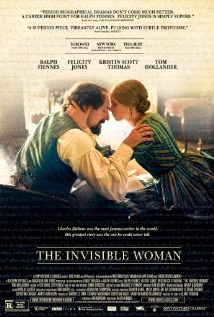
Review of 'The Invisible Woman'

Nice, slow but worthwhile adaptation of Claire Tomalin's book about Dickens's affair. Dickens is rather well played by Ralph Fiennes (who also directed) as a charming and sentimental man who is also a bit of a shit - he humiliates his wife and treats his mistress very badly too. Some good insights into the Victorian world of celebrity, and lots of good performances, including one by Kirstin Scott Thomas as the mistress's mother.

Review of "Jimmy's Hall"

A solid Ken Loach film about Jimmy Gralton, an Irish Communist in the post-Independence period, who opened a little tin-roofed hall for cultural and educational activities in a rural area and thus aroused the enmity of the church and local reactionaries. Good because it recovers from obscurity the story of Gralton, the only Irishman to be deported from Ireland, and because it avoids the usual nationalist cliches about Ireland's troubles all being due to the British. The thugs who close down Jimmy's hall are Free State policemen and soldiers; the rascally landlords who evict tenants are all Irish, not cardboard Anglo aristocrats. The IRA are a useless bunch of ditherers and fence-sitters, not the bold nationalist heroes that they usually are in Hollywood films.

Review of 'The Railway Man'

A good enough film about the life of Eric Lomax, who was a prisoner of the Japanese during WW2 and worked on the notorious Burma railway, where he was tortured. The film depicts his time as a prisoner, and his later life as one of several war veterans horrendously damaged by their experience. Lomax (Colin Firth) is encouraged by his wife (Nicole Kidman playing against type as a rather mumsy middle-aged woman) to deal with his pain rather than push it under the carpet, and he eventually finds and confronts the Japanese man who translated during his sessions of torture.

It's a good film rather than a great one. Firth is rather good as a slightly nerdy 'railway enthusiast'.

Tuesday, November 25, 2014

A cunning wheeze: make the public pay for culinary excellence

I have a cunning wheeze. I am going to open a very expensive restaurant. The food is going to be absolutely top quality, and it will serve the best wines. The prices will be such that only the very rich will be able to afford to eat there. I will talk a lot though about how it benefits the whole of society by raising the standards of cuisine and setting a benchmark for cooking. Wouldn't it be nice if other restaurants could be as good, by ‘levelling up’ to be as good as this expensive one?

The cunning bit is that you lot are going to help to pay for my restaurant, in which only rich people can afford to eat. That’s because my restaurant is going to be a charity. It won’t make any profit, though it will pay me a handsome salary for overseeing it. I will call the charity the Foundation for Excellence in Culinary Knowledge, just to show what I think of plebs like you. Because the restaurant is a charity it will get all sorts of tax exemptions – unlike the restaurants where the hoi polloi eat.


If anyone really makes a fuss I’ll offer to let some pleb chefs train in the kitchen once a month, or even send some of my chefs over to pleb restaurants once a month to show them how we make really good food and serve excellent wine. That should keep the Labour Party sweet, right? I mean, if it works in education, why shouldn't it work for restaurants?

Friday, November 21, 2014

Review of ‘Interstellar’

Was really looking forward to this one, and just a tiny bit disappointed; not entirely sure it’s OK to say so, since so many others have such strong opinions, and lots of people really like it.
It’s visually arresting, though not as much so as other Nolan films. The audio was murky, though this might be my declining ears (I find myself saying that more and more) or even the crappy sound system at Muswell Hill Odeon. Whatever the reason, I missed some of the dialogue, though this didn’t seem to matter all that much. It’s a film of images and themes. The images are striking enough, and they function as visual cues to call up reserves of associations and feelings.

The dust bowl is one. The film begins with documentary-style talking heads, people talking about the wind-blown dust. Actually, they are real documentary talking heads, from another film about the 1930s dust bowl. There are shots of American climate refugees who look just like the Oakies of the 1930s, down to the trucks – explained by the fact that the climate crisis, and a population crash, means that everyone is making do with retro technology.

And maybe it’s just me, but I thought that the space suits – particularly the helmets – looked more like the ones worn by Soviet cosmonauts than American astronauts. That wouldn’t fit with the overall story line, which is about the ultimate triumph of the American way of life – Old Glory on the surface of planets in other galaxies – but it does help to give the space effort a sort of battered retro look.

Another visual cue is the film 2001 A Space Odyssey, to which this has sometimes been compared. I saw 2001 when it was already old, and I don’t have the feeling of reverence for it that some people seem to have. I can still recognise the scenes which evoke the earlier film, though – some of the shots of the ring-shaped array of docked spacecraft, the sequence when they pass through the wormhole – and the overall theme of humans being curated by a benevolent external intelligence.

It’s more about the themes than anything else. The plot and the narrative drags a bit. The dialogue is not important, and the characters are mainly uninteresting – apart from Matt Damon’s character. But there really are lots of big themes. Ecological crisis, climate change, and future food shortages. The relationships between parents and children, and what each owes to the other. The role of science and technology. General and special relativity, and the way that the physics of space travel would impact on the relations between the generations.


Others have commented on the underlying politics of the film – the message that it doesn’t entirely matter that we’ve fucked up the planet, because science and technology will be able to build us an escape route to other worlds, and that anyone who says we need to fix this planet because it’s the only one we have is a misguided liberal – and a dishonest conspiracy nut too, prepared to spread the lie that the moon landings were faked if it serves a purpose. 

Review of Northern Soul

I've never been a member of a music-based subculture, so I don’t know what it feels to define oneself as a member of an in-group based on clothes and music. That’s what this film is about, though. The main character is a slightly geeky, introverted boy whose parents bully him into trying the local youth club, and who – by taking sides in a fight on the spur of the moment – finds himself fallen in among soul boys. He becomes an enthusiastic participant and thereby finds shape and meaning for his life. There are lots of amphetamines, some of them dodgy.

The film is dark and dirty-looking, and the sound is sometimes a bit muffled – funny for a film about music. There is no sense that the palaces of Northern Soul were wonderlands for the people who went to them; they look dismal. The dancing about which so much has been said is energetic but graceless and not at all beautiful. It’s a sort of male competitive display, the boys dancing to impress each other. They certainly don’t seem very interested in the girls, who bob up and down discreetly in the background.

It did remind me a bit about how awful it was being a teenager in the 1970s, even though my suburban London Grammar School wasn’t even close to this world. Fountain pens and ink bottles, uncomfortable school uniforms, the underlying threat of violence between boys, the sarcastic teachers, the horrible dangerous cars…


Funny to recall a time when any kind of recorded music was a rare and precious commodity that you had to seek out, and where finding and owning the right recordings was worth both money and cudos. 

Monday, November 17, 2014

Review of 'Kiss Kiss Bang Bang'

A comedy thriller – not always a good hybrid, but this one works well. Robert Downey Jnr is good as the rather hapless recent arrival in Hollywood who stumbles into a complex plot involving incest, swapped bodies, frame-ups and murder, while failing to get it together with his teenage unrequited love. A few ‘alienation of the audience’ devices as RDJ speaks directly to camera, pauses the action and so on, which also work quite well. The detective to whom RDJ is assigned to ‘learn about the detective business’ for his putative movie role is gay, played by Val Wilmer, and I thought the gay jokes were sympathetic, not nasty, and quite funny; not really for me to say, though.

Is it of any consequence that I had seen it before and forgotten it? I don't think so.

Tuesday, November 11, 2014

Review of 'Wristcutters'

A strange but not unenjoyable film set in an afterlife peopled entirely by suicides. Visually striking, apart from the naff 'miracles', in the way it evokes decay and dereliction. An interesting premise, not too badly done, it doesn't worry too much about plot mechanics or continuity - well, they're all dead, aren't they? Tom Waits is in it, so it can't be all bad. Eugene Hutz, the lead singer of Gogol Bordello, was originally supposed to play the role of...er...Eugene.

The poster and DVD cover art are a bit misleading, in that they suggest it's lighter than it really is.