Saturday, February 03, 2018

Review of ‘Slouching towards Bethlehem’ by Joan Didion

I must have read this years ago, because I found a well-read copy in my book collection, but I have almost no memory of the contents. Perhaps that’s because the writing is more about a feeling – what it feels like to be Joan Didion – than anything else. There are essays about how it felt for her to be a young woman moving from California to New York in the early 1960s, and how it felt for her a little later when the attractions of the city began to pall. There is a sneering piece about a middlebrow, middle of the road think tank called the Centre for the Study of Democratic Institutions, another in much the same tone about a ‘school of non-violence’ run under the auspices of Joan Baez, and a rather long essay about Haight-Ashbury in the later 1960s that put me in mind of ‘Through a Scanner Darkly’.

It’s nicely written, and I’ll seek out more of her old stuff, even though I don’t quite like her.


I was mainly struck by how contemporary it all feels, even though it was written and describes a world of fifty years ago. It’s recognisably still my world, despite the absence of all the technologies that I make use of during most waking minutes. Even the cover photo, which shows Didion and a beardy man in some sort of tent with a vase of flowers and a bottle of wine in front of them, could have been taken at last year’s Womad. That’s weird, isn’t it? We talk so much about how fast things are changing – but I am sure that if my parents had read a book in 1958 (the year of my birth) that depicted the world of 1908 they wouldn’t have felt it was their world. So when was the disjuncture? The war, or the post-war boom?  

Wednesday, January 31, 2018

Review of 'Blockbuster'

There are quirky French films, and there is this. A guy is making short videos for his Dad who is dying from cancer, and he's making them about the development of his relationship with a young woman who he more or less picked up at random in order to make the films. Only, she finds out and then he realizes that he has come to love her and wants to get back with her. Lots of nice touches, including the really cool young woman who is the flatmate, and cameo roles by French actors and director Michel Gondry, the grand master of quirky French films (the woman has a thing for him).

I think it's very French that I only discovered at the end that the young man and his brother, and his Dad (who we see dying in the hospital) are Jewish. It's so understated that most people won't even notice - whereas in an American or British film, a character can't be Jewish unless that's a really important thing about them. (OK, George in 'Being Human' is an exception.)

Watched on Netflix...almost makes me not want to cancel it after all. Almost.

Review of 'Colossal'

I watched this all the way through - not at a single sitting - and am rather bemused by it. The plot is so silly that it has to be an allegory, but it wasn't immediately obvious what it was about. Anne Hathaway is a young and slightly frivolous woman with a drinking problem who is shoved out of her controlling boyfriend's apartment) and goes back to her home town, where she moves into her parents' apparently empty but rather beautiful town house and then hooks up with a guy she used to know from before she left. At the same time a giant lizard-humanoid begins to terrorize Seoul, and she soon realizes that she is the cause of this - every time she sets foot in a playground near the house the giant monster appears in Seoul, and every move she makes is mirrored by the monster.

See what I mean? At one level it's conventional rom-com/rom-dram territory; the guy she used to know turns out to be a bit disturbed and nasty, there's another guy she quite likes who seems to be attracted to her...but it's also this weird stuff that is barely explained, despite one scene close to the end that purports to be show why this is happening.

In the early hours of this morning I decided it was an allegory about alcoholism. A bar is the focus for much of the action. She has a drinking problem, and so does the guy who turns about to be nasty. He drunk-drives, and is violent when drunk. There is a lot about doing harm to innocent people as a result of unintentional actions, and a fairly heavy hint in the final scene. Perhaps the town the monster destroys is Seoul just for the play on words - 'soul'.

If anyone else watches this and can shed any more light, I'd be grateful, particularly if there are other visual clues in there that confirm my hypothesis.

Watched on Netflix.

Tuesday, January 30, 2018

Review of 'Blurred Lines: Inside the Art World'

Art is really about money, and the people who buy contemporary art often don't know what they like or why they should like it. Who knew? Well, everybody really.

But this is a nice documentary about the contemporary art world, with insights into some very sharp practices that border on fraud. I didn't get as angry as I would have watching a similar documentary about say banks, because I can't help but think of this as 'victim-less' crime - or at least one where it's hard to feel much sympathy for the victims. But the interlocking worlds of private super-rich buyers and public institutions are such that we are all being ripped off.

Watched on Netflix, a rare decent film there.

My (old - 2013) review of Ulysses

Not sure there is any point in me writing yet another review of this - what will I add to the sum of human knowledge? But worth remarking that it was not as difficult as I expected, and I really enjoyed reading it most of the time. There was one rather dull section just before Nighttown, which I sort of skimmed. But the rest is brilliant. I was unprepared for how funny it is, or how modern the dirty bits seem - JJ was doing S+M before 'Fifty Shades' was ever thought of. In fact, Bloom's imagination touches on quite a few S+M themes, including cuckoldry, forced, crossdressing, transexuality, and whipping. Who knew? Was JJ into this sort of thing personally, and if not why did he write about it? Is it part of making Bloom some sort of universal victim character? Note that he also kisses his wife's ass, and that she fantasizes about him doing this in a more substantive way.

Also struck by how substantial JJ's knowledge of things Jewish is. Bloom is not just some sort of universal Jew, but a real living breathing Ashkenazi Hungarian with the bits of Jewish folk-culture and Zionism scattered about his head. At one point he sings the opening verse to the Hatikvah - not then the Israeli national anthem, obviously but a Zionist hymn. How did Joyce know about all this? Did he have Jewish friends? How representative is Bloom's luftmensch profession of what Dublin Jews did?

It's worth reading for the Nighttown section alone, which could almost be published as a stand-alone book or performed as a play (though staging would be a challenge).

Very pleased I read, sorry it took me so long to get round to this (nearly 40 years since I studied Joyce at A level) though I don't think I would have got it properly earlier. Some of the poignancy of Bloom's situation can't be understood without the experience of disappointment that goes with male middle age.

The final section Molly Bloom's soliloquy is brilliant though it takes a bit of patience to read pages and pages without punctuation I think it would be better to listen to than read maybe it should be done on the radio...

Monday, January 29, 2018

Review of 'The Good Night'

Felt a bit like a wasted opportunity - all-star cast, including Gwyneth Paltro, Penelope Cruz, Martin Freeman, Danny De Vito, Michael Gambon, Simon Pegg...but it's a film about dreaming, which film people seem to like (maybe it removes the necessity for their narratives to be consistent or to maintain proper continuity), though for everybody else there is nothing more boring than other people's dreams.

I sort of felt that there was something there that could have been developed in a better way - the artist coming to terms with not being great or successful, the relationship with a friend who is more successful, a fantasy about a woman who appears inaccessible because she only appears in dreams. It's really quite sad - the relationship that the artist has with his girlfriend is over but they both pretend it isn't, the dreamed-of woman turns out to be someone from a poster that is on the side of every bus (that is, not someone unique from his personal unconscious).

Watched via clever TV and Netflix...another not very good film from Netflix. Must get round to cancelling it.

Thursday, January 25, 2018

Review of 'The Experiment: Georgia's Forgotten Revolution 1918-1921" by Eric Lee

I thought I knew most of what there was to know about the revolution and the Russian Civil War (especially after all the commemorative exhibitions this year), but much of what was covered in this book was new to me. Eric Lee has produced a compelling account of this little-known episode, setting it in the overall context of the divisions within the Socialist movement as a result of the first world war. He provides a lot of insight into the very different path that the Georgian Mensheviks took as a socialist party ruling over a country not at all ready for socialism. Much of it - especially the section on cooperatives - has a very contemporary feel, and I rather think that John McDonnell would benefit from reading some of the chapters.

It's hard to take seriously the suggestion that the kind of revolution brought by the Bolsheviks could be a model for socialists in a developed country, and apart from a few nutters I don't think anyone does any more. Even the brighter sorts within the mainstream Communist Parties (Gramsci comes to mind) had worked this out by the 1930s; that some of the very clever people in the Trotskyist groups don't acknowledge this is and think about how to move on is an interesting cultural and psychological phenomenon, but not very helpful in formulating an actual strategy to move beyond Capitalism. 

But while Eric Lee does explicate well the route chosen by the Georgian Mensheviks in a backward and isolated country,  I think he underplays the extent to which their side of the argument, and in particular the parties of the Second International, had been discredited by their support for their own governments' side in the war. The Mensheviks (the Martov Group excepted) wanted Russia to carry on fighting for the Allied cause, with all of the slaughter and personal tragedy that would have entailed. That alone made the Bolshevik victory more or less inevitable.

I can't agree, either, with the suggestion that because the Bolsheviks thought they could somehow skip a stage in the inevitable historical development from Feudalism through Capitalism to Socialism, that the 'patient' Menshevik approach made sense. The problem in Russia, and even more in Georgia, was that there was no capitalist class to speak of, and that the task of 'developing the productive forces' was going to have to be carried out under the direction of socialists. Quite how the Georgians were going to allow capitalism to develop naturally is beyond me.


But this is exactly the kind of interesting and intelligent debate that this book makes possible. A must for anyone interested in the history of socialism, or of the Caucasus. A book about the Dashnaks next, please?

Wednesday, January 24, 2018

Review of 'The Promise'

Sad if conventional film (centred around a a love triangle, but with other characters and events too) about the Armenian Genocide during WW1. I'd been sort of aware of this, and even of some of the details (communities being marched into the desert to die), but it is striking how watching a film with identifiable characters actually makes it come alive and feel relevant. In other contexts some of what we see in the film would certainly be regarded as war crimes, but that just didn't happen after WW1.

There were some details of which I hadn't been aware, like the evacuation of Armenians from the Mediterranean coast by the French Navy. Which made me realise that I'm a bit confused about where Armenian communities lived in the Ottoman Empire - clearly not just in Caucasus region.

Watched on Amazon Prime video.

Friday, January 19, 2018

Review of 'Global crisis: war, climate change and catastrophe in the seventeenth century' by Geoffrey Parker

I love reading 'big-picture' history books, and they don't come much bigger picture than this. He brings together conventional history (wars, revolts, etc.) with paleo-climatology, so there's lots of evidence about what the weather was like in the C17th. What it was mainly like was awful - cold, disturbed rainfall patterns (droughts and floods), short growing seasons - all leading to famine and thus to war.

At times the book feels over-long, especially in the middle. There really are a lot of blow by blow accounts of what happened in each of the places he includes in his studies - I didn't need a new narrative history of the English Civil Wars. But it's worth reading for the beginning and the end, which does bring it all together,,,and bring it back up to date with accounts of Katrina, Sandy and other more recent disasters.

Wednesday, January 17, 2018

Review of 'Miss Sloane'

Like the lobbyist bits of 'House of Cards', with all the other bits taken out. Strong women characters who interact with each other about things other than their relationships with men, and a decent critical perspective both on the lobbying industry and on US politics. Nice acting, slightly odd camera work sometimes, as if it couldn't decide whether it wanted to look like a fly-on-the-wall documentary or not.

Long but not boring, and quite a few twists that I didn't see coming. I particularly liked the hacked cockroach, which we had been discussing at home a few days before.

Watched at home on clever TV with built-in Amazon video.

Review of 'Oscar and Lucinda'

Beautiful film, nice acting. Ralph Fiennes and Cate Blanchett are great at conveying how odd the two main characters are, and I can't begin to describe all the meaning that is held in that thing that Fiennes does with his eyes.

I didn't mind that it simplified the plot - I think it still managed to convey, for example, the extent to which the 'benevolent' act of sending the glass church overland causes such death and destruction in its wake. 

But though I enjoyed it, I was cross that it messed about with the ending. The book's ending is much more poignant - the film has softened the edges of the personal tragedies involved, removed a key plot development (and invented a scene to make this possible - I'll avoid writing a spoiler, but it was painful to have this crowbarred in to the narrative), and also weakened the anti-clerical dimension - in the book Oscar ends up cursing the glass church, though not in the film. 

Watched at home via informal distribution, Chromestream and Chromecast.

Thursday, January 11, 2018

Review of Star Wars: the last Jedi

If only I could be convinced that this really was the last Jedi...but instead it's another action-packed but dull installment in the franchise that never ends. This is an evening I'm never going to get back. It wasn't particularly offensive...there was more than a gesture in the direction of ethnic diversity, and several strong women characters who talk to each other about things other than men. But it was mainly a collection of scenes of things crashing into each other and features of the landscape, together with many scenes of 'moderate violence' - that's people being shot or cut up by special weapons but without any blood or gore.

The 'rebel alliance' is no longer (if it ever was) about any sort of rebellion, the 'republic' is led by a princess, and the only difference between the good and bad side is that the latter seem to stand in very straight rows while the former stand around in looser groups. The baddies sometimes wear uniforms that suggest inter-war Poland, but both sides have their fair share of British accents (very confusing for those of us brought up on the tradition of it only being bad guys who sound British); later on both bad and good guy ground troop seem to be looking like US soldiers.

The overall look of the film isn't all that interesting...there is a casino which is sort of art deco themed, and where electro swing light plays in the background, but much of it looks like other Star War films...as usual there is a scene on a narrow bridge over a deep shaft on a spaceship...doesn't the Empire have any safety regulations? The geography of the plot - and the plot as a whole - doesn't seem to make much sense, and there is increasing reliance on supernatural Jedi power to more it along. Admittedly I dozed off for a bit, but I didn't seem to miss much. That little sleep was probably the most enjoyable part of the evening.

I really must stop watching these.

Seen at the Everyman Muswell Hill, in some comfort in a near-empty cinema. I note in passing that the cinema offered me a discount for being over 50, which seems like an odd segmentation choice.

Tuesday, January 02, 2018

Review of My Happy Family

A Georgian film about a middle-aged woman who lives with her family in a small house (that's her mother and father, her husband, her grown-up son, grown-up daughter and boyfriend) and decides to move out and take a flat alone. The first scene is her being shown round the flat by the landlady, with some familiar 'I haven't got round to clearing out the last tenant's stuff' moments.

The decision to move out seems perfectly sensible - the mother is very controlling, the house very crowded (the family all keep their clothes in one wardrobe which is in the daughter's room, because it's too big to move anywhere else), and the husband very lacklustre - it took me quite a while to realise he was her husband because the relationship between them was so empty.

The film is sad and thoughtful, perhaps partly because the central character is an introvert in a society that doesn't seem to like them very much. She doesn't want to have people round for her birthday, but the family ignore her wishes and invite lots of people over for a big meal, which includes drinking and singing. A Georgian friend of mine has told me about the singing and toast-making culture of Georgia (every quaffing must be precluded with a speech) and it's clearly a real thing. The singing is beautiful - Georgians seem to fall naturally into four-part harmony, and to all know the tunes and the words to folk-songs.

In fact, Georgian society looks great. Tiblisi is not crowded or full of traffic. The neighborhoods she moves from, and too, are leafy and quiet, if a bit run down. The children in the schools are respectful (she's a secondary school teacher) and studious - there's no rowdiness that would be an inevitable part of the depiction of a school in a British or American film. There is a lot of community-ness (which gets on the nerves of the heroine) and the food they eat is all bought at the market and then cooked lovingly to make traditional recipes. Just goes to show that it's possible to be unhappy despite all this...

The film is very slow but nicely observed. I'll avoid spoiling the few actual developments that might be thought of as the plot.

Watched on Netflix.

Review of Theeb

A simple, beautiful, brutal film about beduins caught up in Britain's campaigns against the Ottoman Empire during WW1. A little boy tags along with his brother, guiding a British officer across the desert to a rendezvous with others who will help the officer blow up a section of the Hejaz railway. They run into other beduins who are bandits and the story turns into one of survival and revenge.

Stunning to look at (filmed in similar locations as the 1962 Lawrence of Arabia film, so lots of beautiful dunes and wadis) with great music. Most of the actors are beduins, not professionals, though the little boy was apparently the producer's son.

It made me look up some of the background about the railway itself, which proved more interesting than I thought. I also noticed that the Ottoman fort towards the end of the film had the red and white moon and star flag that modern Turkey uses, which I wrongly thought was introduced by Ataturk. Turns out the Ottomans used it too.

Watched in the Middle Floor at Springhill, on a DVD.

Review of Pitch Perfect 2

A while back I stumbled across Pitch Perfect (well, it was broadcast on live TV), and unexpectedly rather enjoyed it. The poster adverts on the side of buses for Pitch Perfect 3 reminded me that there had been a Pitch Perfect 2, so after a few slightly sad thoughtful films lately I wanted to watch something that was just entertaining and feelgood...and thought PP2 would fit the bill.

But it wasn't nearly as funny as the first film, despite a few amusing set-pieces and a nice running gag about the ultra-reactionary a capella singing show hosts. Well, at least I won't have to bother with PP3.

Saturday, December 23, 2017

Review of 20th Century Women

A feminist coming of age film about a boy, being raised by his single mother in late 1970s Santa Barbara, with the help of her young female art-school punk lodger who is recovering from cervical cancer and a fragile, damaged younger woman who literally sleeps with the boy but doesn't want sex to spoil their relationship, though he clearly feels otherwise.

This is a really good film, with nice observations, and great acting, and a way of addressing the emergence of feminism as it appears to a sympathetic boy as he turns into a man. As a bloke watching feminist films I sometimes feel like I am the problem (not unreasonably) but this was both pointed and pointful, but at the same time a joy to watch.

Lots of great scenery in Southern California, some emergence of punk footage, and lots of good teen stuff too.

It happens to be the period in which I came of age too, and it's striking how much it seems to be in a parallel universe - at one point we get Jimmy Carter's 1979 State of the Union message, and whatever you think of Carter, it's hard to imagine how one could ever get from an America in which that mensch was president to this one.

Watched on Amazon Prime on the new TV.

Review of Amnesia

A post-holocaust movie set in Ibiza, and without any holocaust stuff at all. Young German DJ/producer moves to Ibiza for his career, finds himself living next door to an older woman who [SPOILER ALERT] turns out to be a German who refuses to speak the German language because of what happened to her young Jewish love during the war. They develop a relationship (which he thinks is romantic love, but she knows better) but it's all thrown into turmoil when his mother and much-loved grandfather come to visit, causing everyone to re-examine their pasts and the stories they tell about it.

It's beautiful, and Ibiza looks stunning, and even the clubs (especially the one called Amnesia - geddit?) look great. I'm afraid I was a bit annoyed by a film that focused on the holocaust from the perspective of how it felt to people who were either perpetrators (the grandfather, portrayed by Bruno Ganz, who has told various conflicting stories about his role as a 'rescuer') or who were...well, what is my issue here? She lost a loved one. Does that make her, a non-Jewish German who was herself never under threat but fled to Switzerland, a holocaust survivor?

I've been critical of other holocaust films before which focus on the experience of German and Austrian Jews...do I subconsciously think that the holocaust was only about what happened to 'my' people, the Jews of Poland and Eastern Europe that were the object of the explicit policy of extermination? Maybe I do...

Aside from that this is not a bad film and worth watching. We watched on Netflix, on our new TV  but via Chromecast rather than via the native Netflix support...slightly easier to manage...

Wednesday, December 13, 2017

An economics reformation

I went to this event yesterday at UCL - Time for an Economic Reformation. Mainly focused on the academic discipline of Economics and its teaching, with the mission of reforming what is taught and studied - rather than about revising economic thought per se...there seemed to be a view, not explicitly stated, that there wasn't much of a need for new thinking itself, just for the academic discipline to reflect the new thinking that was already around.

Good, clear speakers - perhaps a function of the fact that almost all the panel were women? But the only man, Steve Keen, was also very clear, even though I find much of the econometrics that he presents pretty incomprehensible. Other panelists were: Victoria Chick; Mariana Mazzucato; Kate Raworth, of Doughnut Economics fame; and Sally Svenlen, of the Rethinking Economics student group.

The audience was also star-studded - Hilary Wainright, Charlie Leadbetter, and my favourite - David King, formerly Chief Scientist at DECC, who spoke from the floor with some passion - about how the extent to which our economic system had undermined the ability of our species to continue living on our planet was something of an indictment of our economic theories.

Panel chaired by Larry Elliot, economics editor of The Guardian, and event as a whole compered by Andrew Simms of the New Weather Institute (I hadn't heard of that before).

Good discussions, sensible contributions - nothing that made me groan, though equally nothing that looked like it was the key to a root and branch transformation of economic life and organisation. I suspect that one of the reasons for this, and for the slightly lackluster nature of the '33 Theses for an Economics Reformation' is that it's pitched as a conversation with mainstream economists. So though the implications of what is proposed might actually be very radical (as Andrew Simms proposed) it's all positioned as super-sensible.  Mariana Mazzucato cited Polanyi in her short contribution (which was sparkling and interesting) but there wasn't anything in the proposals that matched up to his ideas about how economies are made and unmade.

Delightfully, we were all asked to comment on the 33 Theses. I didn't contribute, but if I had I might have mentioned that the importance of 'intellectual property' - patent and copyright based monopolies - seemed to be missing; and that there wasn't anything about the process whereby economic ideas move from economists to public discourse (as discussed in this paper by Laurie Laybourn-Langton and Michael Jacobs), and at length in‘Inventing the Future’ by Alex Williams and Nick Srnicek - see my review here.

I think that this second aspect is really important; one of the ways in which what is often called 'neo-liberalism' has been so successful is that it's really hard to think about other kinds of economic relationships, outside the framework of 'market economics'. Pseudo-economic ideas about governments not being able to spend more than they 'earn', and about the private sector as the only place where value is created, become the commonsense of our age. Making other kinds of ideas into common sense is a key task for any economic reformation.

Monday, December 11, 2017

Review of 'The Fencer'


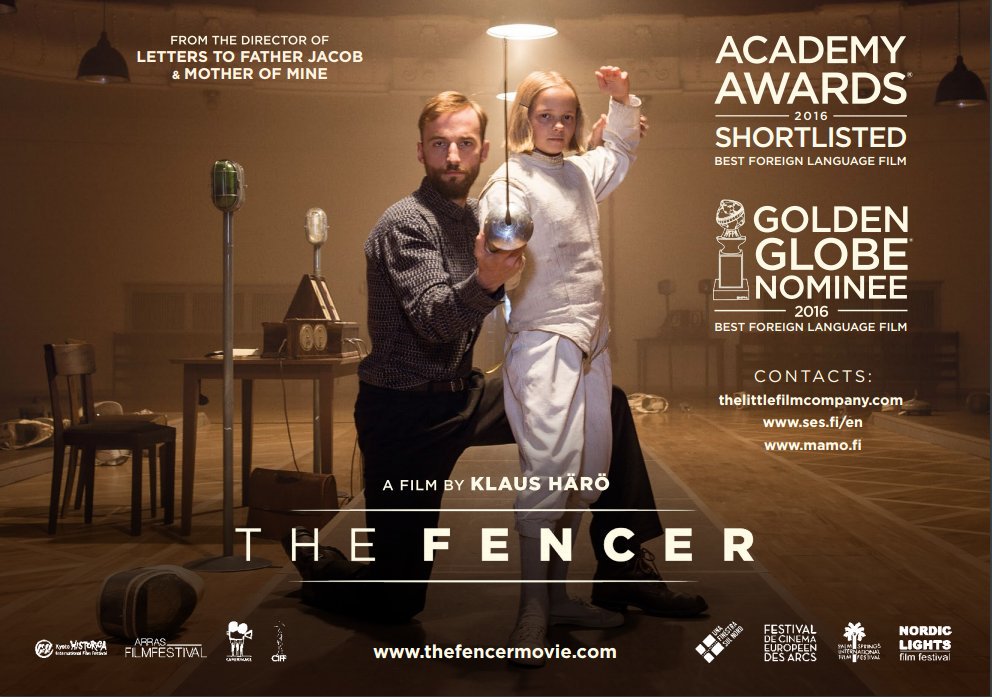
Beautiful to look at Estonian film (actually a Finnish-Estonian co-production, but I've never seen an Estonian film before) set in the early 1950s and featuring a young fencer who moves to a small town to become a PE teacher and ends up starting a fencing club for his students. He's on the run from the secret police because he was conscripted into the German army and has to choose between loyalty to his committed pupils (who want to go to a fencing competition in Leningrad, where he is wanted) and maintaining his low profile. He goes, and then it turns into one of those underdog sports team films. It's well made, without cliches, and the Estonian kids are great.

It's very washed out and grim looking, and the Estonian people and landscapes look very authentic. I was a bit uncomfortable about the way the film treats his 'conscription' into the German army. Estonia and Finland both seem to me to have not really reflected very much on the fact that they fought on the side of the Nazis. It is perhaps forgiveable (if wrong) that young Estonian men thought the Nazis were the lesser evil compared to the Soviets, but some recognition that they were evil, and that they chose to do a bad thing that might have had even worse consequences seems warranted. That rarely happens.

My extensive research (well, the Wikipedia article) tells me that the Estonians who fought for the Nazis were volunteers, not conscripts, and that they fought in a Waffen SS Legion. Most Estonian Jews escapted (some taken into the USSR by the occupying Soviet armies in 1940-41 but there were massacres of those that remained, of Roma, Soviet prisoners of war and Jews from other countries in concentration camps located in Estonia.

The film depicts ruthless Soviets hunting down kindly Estonians; naturally it doesn't reflect that the west was by the early 1950s running networks of former Nazi collaborators as anti-communist partisans, the Forest Brothers.

Watched at the Lansdown Film Club on a proper cinema screen on a very snowy and cold night, which made the whole experience more authentic.


Friday, December 08, 2017

Review of 'Band of Brothers'

Read this, about a volunteer company in the US 101st Airborne (paratroopers) and their experiences in WW2. I found the parts about their training, and the psychological and sociological process of becoming a unit, very interesting - the shot-by-shot descriptions of the actual fighting less so. The battles mainly seem like a series of cock-ups redeemed by the iniative and bravery of the men on the spot; curious that one of the features for which the men were screened was a positive attitude towards authority, and yet authority seems to have let them down again and again.

Very aware that I would not in any way have been capable of anything that these men went through. I'm not any kind of tough, don't have much willpower or endurance, don't have the kind of positive attitude that they did (see what I did with that cynical thought about cock-ups and authority?). Wonder what that says about me as a man, and very glad that there are more ways to be a man than there used to be.

Wednesday, December 06, 2017

Review of "Breakfast at Tiffany's"

One of those books that you think you've read, but you haven't. In my mind it was a frothy quirky romantic comedy sort of thing. On reflection after reading the book I thought it might have been because I was influenced by the film, only then I realised I hadn't actually seen the film either...just seen the poster with Audrey Hepburn looking pretty and cute, and maybe seen a few clips. I'll remedy the film thing shortly.

But the book turns out to be really dark, and rancid, which is not surprising given that it's Truman Capote. It is a fine piece of writing, though it's hard to ignore the casual racism with which Holly Golightly peppers her speech. Holly is not quite a prostitute - Capote subsequently described her as an American Geisha, though that's not quite right either...she's more of a professional mistress, in the French nineteenth century mode. The book is very direct about what that involves, physically and emotionally. Most of the men to whom Holly makes herself available are pretty nasty - Mafia Dons, pro-Nazi tycoons, and so on. She is almost totally devoid of sentimentality herself. The denoument is not exactly unexpected, but the book is well structured and plotted, and a pleasure to read despite the material and the tone.

It's set at a time in which people like the narrator, an aspiring writer without money or success, can apparently afford to rent his own apartment in Manhattan - something that seems much further away than the sexual and social mores it depicts. Oh, and it's war time, 1943, though that barely intrudes on the narrative, apart from the odd military parade in the city. Somehow that seems to magnify the cynicism of the book.

Monday, December 04, 2017

Review of 'A Scanner Darkly' - Philip K Dick

I watched the animated film made from this book a while back, and thought it was good, but this is really powerful. I've never been addicted to any kind of narcotic or hallucinogenic drug, but this book feels right as it describes, from the inside, the dissolution of a mind and a personality. A lot of the book is autobiographical, transposed into a then-future of 1994 because Dick didn't believe he could sell a book that didn't have a science-fiction dimension. It's about the world of loser stoners that he himself was inhabiting, and contains a moving afternote dedication to the young people he hung out with who had since died or ended up mad.

The plot is about an undercover police agent, who is cracking under the strain of maintaining two personalities and narratives, exacerbated by the fact that in his report-back to his handler he must remain anonymous and invisible as a safeguard against corruption, and is required to spy on his own alter-ego,,,all while his brain is deteriorating under the impact of the drugs he is taking to maintain his cover.

It's intentionally hard to distinguish between reality and the character's paranoid fantasies and illusions. Of course stoners are often paranoid, and Dick was himself a clear example; but the real stories of what transpires in the shadowy world of parapolitics and the deep state, and its overlap with the world of drug trafficking, are as weird and alarming as anything a paranoid would make up. We'd call it all conspiracy theories, except that some of these conspiracies actually happened. Alfred McCoy's "The Politics of Heroin: Central Intelligence Agency Complicity in the Global Drug Trade" is a good place to start if you want to know more about that sort of thing.

Sunday, December 03, 2017

Review of Loving Vincent

Visually remarkable animated film about the last days of Vincent Van Gogh, done in the style of his paintings, and involving hundreds of artists. It's presented as a mystery, with the son of Vincent's last host going to the town where he died, ostensibly to deliver a letter but becoming drawn into elucidating the confused circumstances of his last days. Did he really commit suicide, or...

Watched at the Vue cinema in Stroud, at a special lunchtime showing.

Thursday, November 30, 2017

Review of Carol

An oddly soulless film, given that it was supposed to be about a forbidden and taboo love affair between two women (one older, one younger) in 1950s New York. Rooney Mara looks like a young Audrey Hepburn, Cate Blanchett looks like some kind of alien - her face just isn't put together right. And although she manages to convey feeling between herself and her daughter, and even between herself and her not-loved husband, there doesn't seem to be any feeling between Carol and the young Therese.

The film is beautiful to look at, though. It's dominated by long lingering shots of things, which are beautifully depicted and very evocative. There's a shot of a camera being loaded with 35mm film, which is already more alien to many people than writing with a quill pen. We also see Therese developing a film in a darkroom, which reminded me of doing the same thing with my dad in our kitchen - does anyone recognize those smells nowadays? There are shots of Therese playing records on a huge wooden gramophone - kids today would recognize a turntable and a needle/cartridge/arm because vinyl is still alive, but what was the point of such a huge piece of furniture to host a record deck? In the unlikely event that we had gramophones now, they'd be flatpack and made out of MDF - but this was clearly something made by skilled cabinet-maker...another thing that more or less doesn't exist now.

Lots of fabulous clothes, and textures - of walls, tables, payphones. Everything was so big in the 1950s - cars, steering wheels and gear sticks (with big white balls on the end). Suitcases. Bedsteads - even though the beds themselves looked rather small - when did the King Size bed arrive?

The score is quite wonderful too; I was convinced it was by Philip Glass as I watched the film, but it's not - it's just very much like his work.

Watched on Amazon Prime on our new clever TV....two Amazon Prime films in two days. It does seem to have more good stuff than Netflix.

Wednesday, November 29, 2017

Review of Jackie

A longish film about the JFK assassination and its aftermath, including the background conflicts about the funeral, from the perspective of Kennedy's wife Jacqueline Bouvier.

The most notable thing about this (everybody knows, or thinks they know, about the assassination itself) is the non-linear structure of the narrative. The film darts about between the assassination, the immediate aftermath, a later interview that Jackie gives to a carefully selected and briefed journalist, the earlier episode in which she had welcomed TV cameras into the White House and another in which Pablo Casals performs for the President and his entourage. And yet it's never confusing, even though there is no heavy-handed signalling as to where these segments fit together temporally. Is that because it's particularly well done, or have we all just got very good at reading this sort of thing?

I thought it conveyed very well the ambivalence and ambiguity about Jackie's response to the death of JFK - it managed to show both her vulnerability/fragility and the extent to which she and other members of the family (especially Bobby) were thinking strategically about how the funeral would create JFK's legacy.

BTW I knew that Jackie subsequently married Aristotle Onassis, but I didn't know that she did a proper job as a book editor for the twenty years after the assassination.

Watched on our new clever TV via entirely legitimate Amazon Video.

Monday, November 27, 2017

Review of 'In the Heart of the Sea'

A visually stunning sea-faring movie, with lots of sails ripping, masts splintering and so on. It's based on the true story that inspired Herman Melville's Moby Dick, about a Nantucket whaling ship called the Essex that was sunk by a white whale bent on revenge. Melville appears in the film, interviewing the now-older sailor who was one of the survivors of the disaster, and helping him to resolve his torments via a talking cure of telling his story.

The film wasn't on release for long, which is a bit of a surprise because it's very well made. The cinematography is really striking...it really felt like I was on the ship, in the storms and out on the whaling boats.

Of course no-one has much sympathy with whaling now, but it's impossible not to be struck by the bravery of the men involved; it was brave and physically demanding for anyone to put to sea in tiny fragile boats, but the demands of whaling were so much more - going out in tiny boats, being dragged across the rough seas by huge whales, fires on deck to boil down blubber...

It does make it clear just how significant the discovery of oil in the ground was - it gets a mention towards the end of the film. For the northern world whale oil was an industrially significant source of fuel for lamps. Only the non-availability of other sources in sufficient quantities could have justified the effort and risk to which the whalers subjected themselves; only the absence of other sources of employment could have compelled men to take up such work.

Watched on TV via Chromecast, PC, Chromestream - and informal distribution.

Wednesday, November 22, 2017

Some things I particularly liked in 'Sharing Cities: A Case for Truly Smart and Sustainable Cities'


Most of them are from Seoul, where I once spent a day and a half on the gruelling Ovum Asia-Pacific tour, but nevertheless have positive memories.
  • Kozaza and Lobo Korea – local alternatives to Airbnb
  • Woozoo – a house-sharing platform and social enterprise
  • Wonderlend and Billi – platforms for sharing goods.
  • Socar – car sharing
  • Kiple – for exchanging children’s clothes
  • Zipbob – a meal sharing platform

 Sadly, few of them have anything much to read in English.

Review of Run Lola Run

A German film from 1998 which illustrates the contingency of events. Lola's drug-dealer boyfriend is in trouble, and she has twenty minutes to come up with DM100,000 to pay off his boss. We see the same story play out three times, in which small changes (whether she trips on the stairs leaving her flat) have consequences as to what happens thereafter. (BTW It's not a patch on Hal Hartley's Flirt, in which we see three different films with exactly the same dialogue).

It's a nice idea, but the film isn't really satisfying. Unlike say Sliding Doors it doesn't play by its own rules - we don't really see the consequences of a single action because other new elements are introduced into the three versions of the story line. And the film looks really dated - not just in the big red landline phone that Lola uses, and the payphone from which the boyfriend calls, but also in the annoying jump cuts and animation inserts.

Watched on TV from a usb drive, the film having been earlier obtained via informal distribution network.

Tuesday, November 21, 2017

Review of 'People First Economics'

Too bad Amazon doesn't let me give this three-and-a-half stars, because that's what I think it deserves. I've only just read it, which seems a bit unfair because it was published in 2009. Some of it feels very dated (lots of hope and expectation about Obama in some of the chapters); I think a contemporary version would be sharper about the way in which not just 'neoliberalism' but also mainstream liberals abandoned the inhabitants of their countries' rust belts, and how this led to Trump and Brexit, and the rise of right-wing populism across Europe.

There isn't much about the economics of migration, or about 'platform capitalism' either - not surprising, but a warning that it's easy to miss what's coming. On the other hand, there is quite a lot about the Commons, which illustrates how long ideas about that have been swilling about...to no particular end?

Some very good essays - I was particularly impressed by Susan George and Naomi Klein, but also by Walden Bello (who I had never heard of) on emerging global social democracy and Danny Chivers on Climate Choices - the latter was really good and still valid eight years on.

I'd still like a primer on progressive economics that was definitively, robustly argued but easy to read. This is easy to read but despite the variety of authors and scope doesn't cover everything. On the other hand, I think it has persuaded me to re-subscribe to New Internationalist.

Monday, November 20, 2017

Review of 'Sharing Cities: A Case for Truly Smart and Sustainable Cities'

I loved and hated this. There's so much in terms of examples and analysis of the sharing economy, but I found the structure (an example of a city and the way it demonstrates particular aspects of sharing, and then a general discussion of those aspects...which touches on the cities in the other chapters) confusing, and the language downright impenetrable. It's hard to believe that I could once read and write the language of academic social science - now I find it impossible to engage with. I really have to fight to engage with content that's written like this. I notice it particularly in the sentence structure, which could easily be fixed either by the authors or by a tougher editor - but also in the choice of words, and in particular in the use of everyday words in special meanings.

A real shame, because the authors have a superb depth of knowledge and understanding, and the book is full of links and references that make it a great gateway...I hope that they write another, more accessible one soon, perhaps with more of a handbook for activists and cities feel.

Review of 'Mudbound'

Well-crafted period drama about racism and poverty set in post-war Mississipi, and focusing on the relationships between a relatively poor family of white farmers and their extremely poor black tenant-neighbours. It's a Netflix original, and rather well made, though nothing terribly innovative in terms of narrative or cinematography - does Netflix specify that its original-made content has to work on a range of devices?

It becomes generally harder to watch as it sinks from casual racism to the muderous kind, driven by the way in which the young returning ex-soldier son from the black family no longer properly knows his place in the white-dominated order; his 'crime' is compounded by the unlikely friendship he develops with the white farmer's returning brother, since neither of them can get over the undigested experience of the war and the death of comrades alongside them.

Worth watching, and what I thought was a good performance from Carey Mulligan as the farmer's wife - would be interested to hear from friends who know better how she did with the accent.

Watched at home on TV via Netflix on phone and Chromecast.

Thursday, November 16, 2017

Review of 'A Little Life'

A brilliant and terrible book which has haunted me for the last six weeks. Not at all the sort of thing I usually read - I'm more a person for genre fiction that provides me with a light and slightly dull escape in the evenings, rather than something that offers intense emotional catharsis. But I couldn't stop reading, in part because it's very well written, and also because it would have felt too much like cowardice and betrayal.

This starts of as a sort of multiple life story - four friends who had met at Harvard and their continuing lives threaded together. They are living cool lives in Manhattan and they are bourgeois-bohemian poor (a bit) but marked for success. Gradually it begins to focus on the life of one of the young men, who is a brilliant but damaged lawyer.

Most of the book is about how he got to be that damaged and how it plays out into his life and those of the others. It's very hard to read - lots of abuse, child-rape, unspeakable violence, self-harm, mental and physical disease. I'm glad I read it, and I appreciate what a superb work it is, but I am really relieved that it's over.

Review of Effie Gray

Standard period drama about the unhappy marriage (imdb calls it a love triangle, but there is nothing of the kind going on here) between John Ruskin and his wife Euphemia Gray. Written by and starring Emma Thompson, and her partner Greg Wise as Ruskin. A bit slow, a bit Merchant-Ivory when they get to Venice, and generally rather old-fashioned looking...in general period dramas have moved on a bit, but this look tired and made-for-TV.

Ruskin comes across as a damaged and nasty person who is under the thumb of his dominating parents, Effie is more or less a doormat who is suddenly empowered by the advice of Emma Thompson's character into seeking a scandalous annulment for impotence and non-consummation. Ruskin's suspected pedophilia is hinted at.

I thought it didn't entirely convey how important a cultural figure Ruskin was; his reactionary ideas about art and aesthetics really set the tone for the second half of the Victorian period and have arguably plagued Britain's sense of itself and its place in the world ever since.

Watched on BBC iPlayer, now built in to our new Samsung TV so no need to use Chromecast.

Monday, November 13, 2017

Review of 'Primer'

Watched this confusing film about start-up geeks who invent a time machine by mistake. I really didn't understand or follow it - not just the technology, but the plot. I managed fine with other time travel films, so I think the problem here was that the narrative hooks that are meant to show what is going on were absent; as with so much you don't realise how much work these do until they aren't there. Impressive that a film which looks OK could be made for so little money ($7k I think) and it would have been interesting to see whether a less complex plot and subject material could have made a more mainstream film for the same money.

Watched on our TV via Chomestream (on Linux PC) and Chromecast. That worked fine at least.

Sunday, November 12, 2017

Review of 'The Death of Stalin'

A well-made British 'comedy', with all of your favourite character actors, about the last days of Stalin and the aftermath. Ought to be required watching for anyone still a bit soppy about the USSR. Not many laughs, though the couple next to us seemed to find lots of it very funny; even the absurdities of the dictatorship and the bureaucracy can't be very funny against a background of so many juidicial and extra-judicial murders.

A few odd things; what seems to take a few days in the film (death of Stalin to fall of Beria) actually took a year. Almost no mention of anti-semitism, though of course it pervaded everything - even the references to the Doctors' Plot are without a mention of Jews, though that's what it was about.  And I didn't much like the depiction of Nikita Kruschev as a wise-cracking New Yorker - I much preferred the way Bob Hoskins played him in Enemy at the Gates, as a rather coarse USSR native.

But these are quibbles, and it's a really good film. Ruth and I couldn't help but think about our grandfathers who had so loved Stalin.

Watched at the Everyman Cinema in Muswell Hill.

Review of 'The Other Side of Hope'

Pleasantly quirky and uplifiting film about a Syrian refugee who ends up in Helsinki. We see the wheels of bureaucracy preparing to deport him to a situation it deems safe even as the news reports the massacres, some Fascists who try to kill him, but also lots of nice ordinary decent Finns (and some desperate down-and-outs too) who rally to his support. It's a lot like Le Havre, but in Finland.

Some visual jokes, notably that though it's contemporary everything looks like it's in the 1950s or some other recent-history period. The restaurant where the refugee ends up working is stuck in a time-warp in terms of decor and cuisine (a reminder of the time when Finnish food was considered the worst in the world), the restaurant owner drives a 1950s car, and the truck driver who smuggles in the sister has a vintage mobile transportable from the early 1980s - which wouldn't even work now, the network on which it ran having long been closed down. Not entirely sure why any of this - I've noticed it in other Kaurismäki films, notably the noire Hamlet that we saw at the Sydney Film festival in the early 1990s, which was all Soviet-style plumbing and industrial locations.

Watched in the Middle Floor at Springhill via laptop and projector, having been obtained via informal distribution.

Tuesday, October 24, 2017

Review of 'Weiner'

A rather sad political fly-on-the-wall documentary about the unsuccessful run for New York mayor of Democratic congressman Anthony Weiner. Why people allow fly-on-the-wall documentaries I'll never understand; perhaps the answer is that although he's not too bad for an American politician, with decent enough views and policies, and a focus on the interests of what he calls the 'middle class' (by which he means the working class), he is still a narcissist. He can sit on the phone making call after call to rich friends and acquaintances, asking for money, without flinching. There are several Bulworth-type moments in the film, where he repeats the same speech over and over again, to camera or to an empty room, practicing. Normal people can't do that without being self-concious, but politicians can.

The thing about Weiner is that he's disgraced and fails because of a character flaw, and by the standards of American political life it's a small one. He 'sexts' pictures of his bulging underwear to a young woman that he's never met, and she senses the opportunity for celebrity and feeds him to the media. He didn't touch her, he didn't hurt anyone - they never even met, except online. He didn't embezzle, he didn't cheat on his wife, who by the way is a bigger political operator than him and close to Hillary. At one point in the film she's apparently faced with the choice of dumping him or losing her own political career, and it's not clear which way she is going to go.

Ultimately he's a big loser, the more so because his insight into his situation is lost in the face of innappropriately dogged resolution to go on no matter what. It's an over-used metaphor, but it is a bit like watching a car crash in slow motion. As the audience we know how this is going to go, but he can't or won't.

Watched via Chromestream and Chromecast, shortly before a Windows 10 update trashed my laptop.

Sunday, October 22, 2017

Review of 'Paddington'

A very liberal film which makes much of Paddington's status as an immigrant...he's not really a refugee or an asylum seeker, but parallels are drawn between him and Mr Gruber's experience as a Kindertransport kid, and there's a lot about the need for people to be generous to the displaced and homeless. There's not much about what actually happens to people (or presumably bears) who enter the country illegally; the Brown family just adopts him, and that's that.

Pretty much every British comedy or character actor you can think of is in it, and seem to be having fun. There are lots of cinematic jokes and parodies of other films. I rather thought that Nicole Kidman as the wicked museum curator was reprising her role as Mrs Coulter in The Golden Compass, though she's not quite as menacing here.

Watched in two halves: in the Middle Floor at Springhill via legitimate iTunes download on someone else's laptop and the Springhill projector, and then at home via informally obtained download and Chromestream from my Linux laptop to the Chromecast in our TV. The second of these turned out to be much easier than the first - it took about 40 minutes to get the legitimate version working...first two DVDs didn't work in any of the available DVD players, and then there were issues with getting the mac laptop to talk to the projector.

Friday, October 13, 2017

Review of 'The Corruption of Capitalism'

A bit of a disappointment, in that the ideas in the book are better than the book itself.  I've heard Guy Standing talking about the ideas on the radio, and he was very good. It rather feels like the publisher told him to make it longer, so he crow barred in some other stuff about how shit everything is - how the political system is broken, how platform capitalism is turning lots of people into pure labour-for-hire...I don't disagree with any of it, and he makes his points well with lots of examples; but it distracts from the main argument, which is about how 'free' markets are anything but.

Capital isn't interested in free markets or competition, and does everything it can to structure and seek out markets where competition is weak or non-existent - through licensed monopolies from the state and/or through patents and copyright. Indeed, I think too many people on the left believe the neo-Liberalism is about rolling back the state, as it pretends to be, when actually the state is crucial for assembling the markets (think the NHS or benefits system) so that they can be exploited, and for enforcing and protecting the monopolies.

There is also a sense in which the relentless barrage of numbers become a bit wearing - an infographic or two to break up the page might have been nice.

Overall this is a good and important book, buried inside a slightly less good one.

Tuesday, October 10, 2017

Review of 'Blade Runner 2049'

Except not really a review, just a note about my personal impressions. Other people have done so much reviewing, and I think I couldn't do this properly unless I read all their reviews, and I don't have the time or the energy.

I quite liked it, or at least I quite liked the way it looked. It was a visual treat, and continued the combination of science fiction and noir that the first film pioneered. Others have said that the plot was flimsy, and I rather think the opposite - there was too much plot, including some elements that felt crowbarred in for the next sequel. I suspect the plot had holes or inconsistencies in it (like, either replicants can have children or they can't, but either way it's not a religious miracle, it's a designed-in feature that ought to be in the documentation), but again I can't be bothered to list or work them out...it wasn't really about the plot. Some others have commented on Ryan Gosling's acting - not much too say here; he has one fewer expression than Harrison Ford, I'd say. I liked the performances of the other actors, particularly the women.

I noted a few bits of product placement...we had a corporate logo for Diageo, and Deckart is drinking Johnnie Walker whisky; Black Label, which presumably he's been drinking for thirty years while holed up in the decaying hotel in Vegas. And Sony, and some others.

Oh, and the baddie who makes the robots that go wrong is called Wallace - wouldn't it be great if this was a homage to the Wallace who hangs out with Gromit? He also made robots that went wrong, more than once.

I noted that the urban dystopia is now aligned to a rural dystopia - we see a truly horrendous 'farm' early on the film. Hating cities (except perhaps New York) is a mainstream trope of American cinema, and often nature and rurality is counterposed to this. Not here.

I also noted some cyrillic writing early on, and also an add that seemed to feature 'Product of CCCP' - has the USSR been revived by 2049? In any case this made me realise that for Americans, part of what was dystopian about the original Blade Runner was the presence of so many different nationalities in the future LA, especially Asians - Neo LA looks a lot like Neo-Tokyo. Well, by 2017 the presence of Russian script is further evidence that everything has gone to the dogs.

Finally, the ruined Vegas hotel where Deckart is hiding out looked a lot like some of the actual derelict hotels featured in some 'ruin porn' movies about Detroit.

Ultimately a good experience, though 'enjoyable' doesn't seem quite right.

Watched at the Vue Cinema in Stroud...worth doing for the volume and depth of the sound!


Thursday, October 05, 2017

Review of 'Paterson'

A strong candidate for the most boring film I have ever seen. Very little happens. There are few 'quirky' touches but mainly it's just everyday life, work, breakfast, walking the not-very-nice dog. Everybody in the film is quite nice, from girlfriend who imagines herself to be talented and turns out to be quite talented, and co-workers, and guys down at the bar...

The central character is a bus-driver poet, quirkily called Paterson which is the same name as the town. We see him writing some poems, all of which seemed so awful to me that I thought his lack of talent was the point of the film...but it wasn't, they are actual poems written by an actual poet. The one good poem in the film, attributed to a little girl that the bus driver meets, was actually written by director Jim Jarmusch.

Watched at Landsdown film club in Stroud.

Wednesday, October 04, 2017

Review of Blade Runner (Final Cut)

I watched this again after a long interval in preparation for the new sequel. Surprised to find how little I remembered, though some of this may have been due to the fact that I'd previously watched a different 'cut' - at least that's what I kept telling myself as unfamiliar scenes unfolded, but I may have just forgotten.

The plot turned out to be much simpler than I remembered, despite the subtleties about androids who may not know that they are (possibly including Deckard himself), but I don't recall it being quite so violent. I later watched the 'deleted scenes' available on YouTube, and found that most of it was voiceover explaining what was going on to presumed dopier US cinema audiences.

Anyway, it was still enjoyable, though much slower than a comparable film would be nowadays. Made in 1982, the future still looks credible, despite the Prestel-like screens (no web in 1982) and phone booths. Very atmospheric, largely delivered via constant drizzle, a largely Asian Los Angeles and lots of derelict and deserted buildings, including some that look like they were straight from the actually-derelict Detroit.

Watched in the Midde Floor at Springhill via laptop and informal distribution.

Thursday, September 21, 2017

Review of 'Y tu Mama Tambien'

An odd mixture of frat/fart movie and social-political critique...is this the way to get a political movie made in Mexico, or is it an attempt to add a layer of 'quality' content on to what's essentially a film about two teenage boys fucking their girlfriends, an older woman, and each other?

I'm not sure. Some of the bolted on social critique is heavy handed - the voice-overs that tell us how the poor family the boys encounter will have a dire future - but in other places it's done with a good deal of subtlety - the checkpoints on the road that the relatively affluent boys just cruise through but where poorer Mexicans are being given a hard time. And the illustration of the class differences between the boys, despite their friendship and common interests (fucking, drugs, and masturbation) is very well done.

One scene puzzled me...eventually the boys have a gay experience, when the older woman takes them both to bed and then sort of slips away. In the morning they awake to find themselves entwined and are shocked. Soon after their friendship ends. But is this homosexual dimension to their friendship hinted at in the scene in which they wank together from the diving board at a deserted luxurious swimming pool? I have read that teenage boys of all sexual orientations, not just gay ones, engage in collective wanking, but it never formed part of my experience.

Watched in the Common House at Springhill via laptop and cable to projector, having obtained the film via informal distribution.

Review of 'Carrie Pilby'

A film that turned out to be better than expected...about a young woman living alone in New York who is extremely intelligent (and a bit of a prig about other people's morals) and therefore finds life difficult and unhappy. Her therapist gives her tasks to complete (acquire a pet, etc) and she resists then complies, and so ends up engaging with life and people. Reconciliation with absent dad, closure on near-abusive episode with college professor, etc.

I note in passing that in this film, as in most others, that it depicts everyone living in apartments that they could only afford if they were millionaires. I also note that the lead, Bel Powley, reminds me very much of the way Alexandra Shulman looked when she was the flatmate of a friend at Sussex University in the late 1970s.

Watched via Netflix and Chromecast - the first almost good film I've watched on Netflix for ages.

Monday, September 11, 2017

Review of 'Arrival'

A rather good science fiction movie, with most of the emphasis on plot and character rather than special effects. It's about the difficulties posed by first contact with a clearly superior species...and there is a time-travel/time-perception dimension to it that is really rather well done. Some of the early parts linger a bit on the military preparations, which are supposed to be tense but I found a bit slow, but this is more than made up for by an intellectual female lead who doesn't have to do some special 'female' version of clever - she is just cleverer than most of the male characters around her. Extra points too for an internationalist dimension (humans need to overcome their national differences to solve a big problem) and for acknowledging the value of expertise rather than celebrating some ordinary guy who just happens to...

And extra points too for at least mentioning, and even trying to explain, the Sapir-Whorf hypothesis, which actually becomes an important plot element. Don't remember hearing about that since my undergraduate days, so hooray.

Watched on TV via Chromecast, having been obtained via informal distribution network.