Wednesday, August 14, 2019

Review of Animals

I intended to like this film; the trailer had made it look like a film about what happens when one of two friends grows up into a more mature adult while the other wants to remain in extended adolescence. But it wasn't really like that; both the women were actually pretty wedded to a dissolute post-teen lifestyle of booze, drugs and parties, though one of them (the pretty one, played by Holliday Grainger) seems to be drifting ever-so-slowly away from casual sex towards a monogamous relationship. Nothing really developed with either of them, and their back-stories didn't become much clearer either.

I note in passing that though they are both supposed to be in precarious low-paid jobs (one works in a warehouse, the other is a barista) they never seem short of cash, and there is absolutely no sign that their work makes any demands on their time. Every frame of the film has at least one large glass of white wine in it, to the point that I was beginning to think about going teetotal. I also note that the place they live, in a beautiful Georgian house in central Dublin, would have been gentrified in any British city, while the bourgeois suburban house that the one girl's parents live in would have been an outer-city working class suburb.

Watched at the Phoenix cinema.

Friday, August 09, 2019

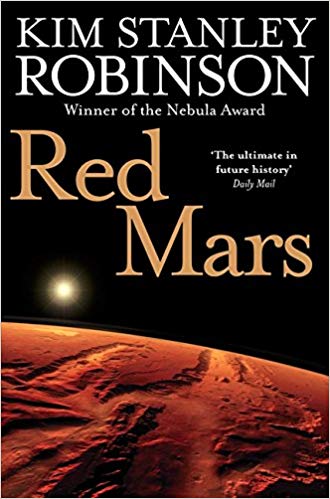
Review of 'Red Mars'

I wish I'd liked this more. It's very long, and while some of it is great - especially the political discussions, and the dynamics between the characters - there's huge swathes that I found unreadable, about Mars geology, or descriptions about technical solutions to problems. I'm sure other people have exactly the opposite reaction, loving the detail and bored by the politics. I'm sure that, as in The Martian, the point of the technical detail is to make the whole thing convincing, but as there, it doesn't work for me.

I note in passing that KSR (who is great, by the way - I heard him talk a few years ago and he's marvellous on climate change and politics) can imagine people moving to Mars without either nation-states or capitalism coming to an end...lots of the stuff on Mars is supplied by familiar corporations, though the big names that dominate our lives now - Google, Amazon, etc are of course not there. Prediction is hard, especially about the future.

Review of 'The Photograph'

A rather odd film, directed by Ritesh Batra, who made The Lunchbox. It's billed as a 'romantic drama', and it has all the elements of a romcom but without any comedy, or indeed much drama - and yet it's compelling, though a bit too long.

I don't want to spoil the plot, but the main impression I had was of being teased, because all the scenes that were flagged up as plot points - are either not shown or not dwelt on at all. The girl agrees to pretend to be a girlfriend for the photographer she doesn't really know, but we don't see the discussion where she agrees. Later, he manages to obtain, at considerable effort, a bottle of a long-existinct soft drink that she remembers from her childhood, but we don't actually see him giving it to her, or her response. It's almost like watching the out-takes from a romcom, or the bits that happen in the narrative that don't make it into the film - and for this I liked it.

It also avoids almost all of the cliches of cinematic India, and touches on issues of class. He's not nearly as wealthy as her, but she's not super-rich and he's not super-poor - not a slum-dweller or a beggar, just a street hustler sharing an attic with several other men from the countryside. Mumbai was such an awful, terrible shock to me, as was the behaviour of middle-class Indians to the poor and street people, and this film brought a lot of that back even though it didn't show it.

Watched at The Phoenix in East Finchley.

Thursday, August 01, 2019

Review of 'The Blind Assassin' by Margaret Attwood

I read this a couple of weeks ago, and loved it, and decided not to write a review straight away because I wanted a bit of time to process it. At the time I felt quite emotionally churned up by it - there was death, and betrayal, and sibling relations...but now, a few weeks later, I'm surprised that I don't remember all that much about it. There's a story within a story, which is the eponymous 'blind assassin', a fantasy tale that the narrator's pulp-writing lover tells her during their occasional assignations. It's meant to be pulpish, but this is Margaret Atwood, so it's actually very good - a sort of parody of bad fantasy that can't help becoming ever-more literary. There's a lot about high society in Canada, and political and labour unrest in the 1930s Canada, most of which I didn't know about.

Anyway, despite my failing memory it's good and well worth the long time it took to read.

Wednesday, July 31, 2019

Review of 'Resonance and Revolt' by Rosanne Rabinowitz

I just loved this collection of stories. Overall I think they count as 'weird fiction', but I'd say they stay well clear of the 'horror' genre to which that often tends. Instead they are sort of politically engaged urban realism. They are funny, and sexy, and the people are real characters rather than the two-dimensional stereotypes that often turn up in short fiction.

They're from different stages of life too - some coming-of-age, some from other stages - which is great, though I don't remember one about older cis het white blokes who are out the other side of middle age...I guess I will just have to wait for that one. But the politics, and the sexual politics, are well done - not heavy-handed, but not just layered on for colour.

And there's a bit of a psychogeography dimension too, which I really liked - a feeling for 'liminal spaces' and the way that the city changes under our feet.

I won't discuss the individual stories, except to say that the collection is worth buying just for 'The Matter of Meroz' (which I had read before, in the Jews Versus Aliens collection) - kind of like Isaac Babel on acid.

Review of 'Excursion'

A time travel film, and one that reminds me why I generally don't like the genre. Very confusing, and I'm not sure whether my confusion was because I'm a dope and couldn't follow it, or because the film-makers weren't very good at story-telling.

Surprisingly the scientists who have discovered the secret of time travel are in the Soviet Union (in 1986) so there's a lot about the end of Communism, which does make it more interesting. It's unfortunate that the Soviet institute is quite so nasty, and run by a sinister professor and a uniformed thuggish general who quickly resorts to torture with a hammer - surely they could have been more subtle, even on a low budget.

In the end I resented the time I spent on this, although there were some good touches. I don't understand how it seems to have won so many awards, though it will make me more wary of awards in the future.

Watched on Amazon Prime, one of the first to be watched via Chromecast, which Prime now supports.


Thursday, July 18, 2019

Review of 'The Upside'

An American remake of a French film with dodgy racial politics, that was an unexpected and somewhat inexplicable success. A rich white guy who is quadiplegic after a paragliding accident takes on an unsuitable Black ex-con as his carer, partly to annoy his business assistant and perhaps also to ensure that he doesn't survive long due to the Black guy's incompetence. But in a familiar trope from the movies, the poor guy turns out to know a lot about life and revives the rich guy's sense of joy through experience.

Despite the thinness of the plot and the dodginess of the premise it's quite enjoyable to watch.

Watched on Amazon Prime.

Saturday, June 29, 2019

Review of 'The Anubis Gates' by Tim Powers

Not read any Tim Powers before, and I ended up really liking this. It's a bit of a romp, with touches of horror too (and I try to never read horror) but it's clever, and well-written too. There's plenty of action and suspense, but good characters and emotional depth - even the bad guys have their own inner life and problems.

I don't know that much about the Romantic poets, but I have the feeling that Powers did his research here - Byron and Coleridge are both characters in the plot, and they feel right to me. So does his early nineteenth century London, which includes lots of streets and neighborhoods that have now disappeared.


Thursday, June 20, 2019

Review of 'The War in the Air' by H G Wells

Re-read after many years, and not as much fun as I remember it having been. Desperate to gratify my craving for steampunk, but it's hard to find anything that's much good. Perhaps I've muddled it up with Michael Moorcock's 'Laughter of Carthage' series.

I remembered this as having lots of airship combat and ornithopters, but there isn't all that much; and the dialogue - Wells' pechant for transliterating working-class speech so that the characters who use it seem rather stupid - really grates.

Review of 'Going Underground' by Phil Brett

A worthy successor to 'Comrades Come Rally', Phil Brett's sequel is set in the same post-revolutionary Britain. Our hero Pete Kalder is recovering from trauma in a sort of therapeutic community, but is soon pulled out of convalescence to help unravel another plot to reverse the gains of the revolution. It's tightly plotted, with lots of twists, good characters and vivid descriptions of locations and settings - plenty of long meetings, which made it all feel sadly rather true to life...that's probably what a post-revolutionary Britain would be like. Kalder is a great wise-cracking, sharp-dressing lead, with an encyclopedic knowledge of mid-C20th music and a trust-nobody attitude that gets him into trouble with the party and the remnants of the police. An enjoyable read, and I hope there's more to come.

Wednesday, May 29, 2019

Review of 'I, Tonya'

I enjoyed this way more than I expected to...I'm not very interested in sport, and less so in figure skating. I have only the dimmest recollection of the events it describes.

But this was very much the antithesis of the conventional sport film in which an underprivileged outsider triumphs over adversity through will power and determination. Here adversity triumphs over the underprivileged outsider, who very obviously has plenty of talent but nothing else - no contacts, no network, no social graces, and none of the insight that she might have needed to work out how to get by without those things.

It's well acted and shot in a way that seems to recall the nastier, shinier period it depicts.

From the film's narrative Tonya Harding actually got a rough deal - she doesn't seem to have done all that much wrong apart from choosing the wrong mother, and then the wrong husband who chose the wrong friends and associates. She seems to have been punished harder than she deserved for not dobbing her vile husband in, while others got off more lightly.

Watched on Amazon Prime.

Monday, May 27, 2019

Review of 'The Road Home' by Rose Tremain

Another beautifully written book by Rose Tremain, with a great portrait of the central character - Lev, a middle-aged Polish man who leaves his village to come to England so as to be able to support his mother and daughter - and lots of great secondary characters too. Despite the miseries that befall Lev, and some of the awful people that he encounters, it's basically positive and hopeful...probably more so than real life would be, but that's sometimes what we need books for.

Review of 'The City of Lost Children'

Re-watched this after attending some events at the Stroud Steampunk Weekend. I remembered the film as being visually arresting but couldn't recall much about the story line...and now, ten minutes after it ended, I understand why; the plot is basically incomprehensible, a mish-mash of images and cliches that doesn't add up to anything. There is a summary on Wikipedia which suggests that it's an anti-capitalist film...

Another film where there is a strong argument for a twenty-minute "extended trailer" or "art director's cut", so that we can enjoy the visuals and not have to worry about narrative.

Watched on the Middle Floor at Springhill, all by myself because no-one else wanted to sit through it.

Thursday, May 23, 2019

Review of 'The Three Body Problem' by Cixin Liu

The "hardest" hard science fiction I have read for ages, with lots of theoretical physics in it. Lots of ideas and weirdness too, including a virtual reality game that rather recalled to me the 'Second Life' thing that was going on in Snow Crash.

There's lots to like in this - especially the earlier parts, set during the Cultural Revolution, which is as hard to understand for us as the alien civilisation depicted later. And the early sections about SETI.

But other aspects were sort of clunking, and I did get a bit bored by the very long section on unfolding a proton in n-dimensional space...at least that's what I think it was about.  And I find the suggestion that advances in civilisation depend on increasing theoretical knowledge in subatomic physics (the aliens intend to stymie all progress on Earth by muddling up experiements in particle acceleration) very problematic...it's one way to think about the relationship between science and technology, but not the only way.

Review of Tolkien

Rather plodding biopic about Tolkien, who didn't have a very interesting life (student then professor at Oxford). Some interest from the cutting backwards and forwards to awful experiences in the Great War, into which fantasy sequences have been inserted (dragons, monsters). I note in passing that depictions of WW1 in films tend to emphasise the slaughter and the horror, but depictions of WW2 do so less consistently.

Without the intercollated WW1 scenes it would be a dull biopic about a quite dull bloke and his dull posh friends (and nice kind wife). They drink a lot of tea and eat cake. Once he and his girlfriend are thrown out of a hotel tea room for mucking about with sugar cubes.

The more interesting bits of the story really happened before the film starts and aren't covered at all in the film...the family's move to South Africa, his mother's conversion to Catholicism and her Baptist family's decision to cut her off from all support as a result, the extraordinary education she must have given her two children at home...

Watched at the Vue in Stroud in a nearly-empty cinema, with annoying subtitles.

Friday, May 17, 2019

Review of The Post

Liberal film about the days when the mainstream media were the good guys, exposing the crimes and lies of the government, and focusing on the Washington Post's decision to publish The Pentagon Papers. Hard to believe that there was time when it was considered significant when the government was caught out lying or deliberately misleading the public, or that people believed that there would be consequences if this was revealed.

Bits of the films dragged for me, but it came to life towards the end with the decision to publish despite the fear of doing the wrong thing (endangering American lives by revealing details of war plans) or being prosecuted. It's about this point in the film that the pre-digital process of producing and distributing newspapers begins to dominate the imagery - typewriters, sub-editing by hand, vacuum capsules to take copy from editorial to typesetting, hot metal type...again, hard to believe that this was something in my lifetime.

Watched on Amazon Prime.

Review of The Children Act

Another slow emotional film, with Emma Thompson as the judge who must decide whether to force a blood transfusion on an unwilling 17-year-old Jehovah's Witness boy who will otherwise die. Nice depiction of the dilemma, and great acting from all the cast. Screenplay by Ian McEwan who wrote the book, but very cinematic...lots of powerful close-ups.

Two really trivial thoughts. Firstly, we see the judge distracted and disengaged from her marriage, but she mainly does this by working late on her laptop. She has a smartphone but the only thing she does with it is make and receive phone calls...which is not the way that modern people really are disengaged and distracted; they spend all their time checking their phones and browsing social media, and so on. I know she's a bit old that for that but the taking phone calls thing felt wrong.

Secondly, there is a good supporting performance from Jason Watkins as the devoted and self-effacing judge's clerk. But I was really aware of the other actors' eyes in the film - Thompson's eyes, and the eyes of Fionn Whitehead who plays the boy, in particular. Jason Watkins has very distinctive dark eyes, that seem to be all black pupil, and I couldn't help noticing them and remembering his performance as the vampire policeman William Herrick in Being Human.

Watched on Amazon Prime.

Review of Lucky

Slow film about an old guy in a small town in Arizona (I think) contemplating the closing stages of his life. He is remarkably well and mentally fit, though he smokes and drinks and lives alone. His life is pared down to the bare essentials, but he is content and positive about it all. He's never had a family, but he has his buddies and seems on good terms with lots of others in his community. He has no expectations of an afterlife or religious sentiments of any kind; there are a lot of shots of him walking around the fairly bleak little town, and in one of them he walks past a church...that's it, the only appearance of anything church-related in the film.

It's described as heart-warming and uplifting, and I can see why someone might think that, but my heart wasn't that much warmed or my spirit that much uplifted. If you've got to grow old and die alone, then this is a great depiction of the best way to do it, but I'm not sure that I want to think too much about the possibility that I will.

Watched at the Lansdown Film Club.

Friday, May 10, 2019

Review of 'The Art of Flying' by Antonio Altarriba

A clever, beautiful graphic novel about the Spanish Civil War and its aftermath, told through the eyes of an anarchist fighter who has a miserable middle age as an exile and then a returnee to Fascist Spain, and then a miserable old age in a home in newly 'democratic' Spain.

As that suggests there are not a lot of laughs and no happy ending. Even the part that describes the brief exhileration of the revolutionary period in Catalunya are pretty bleak - the revolution seems to be betrayed and corrupted even in its best moment.  And after the defeat the ex-comrades fall into criminality and backstabbing, first in France and then back in Spain.

I'm also not really sure how much I like graphic novels as a way of telling a story. I don't read them very often, and I think it's because although they can be beautiful, they don't allow me to use my own imagination - it all feels very prescriptive. I'm not sure exactly why that's different from say film, but it is.


Thursday, May 09, 2019

Review of 'Made in Belfast'

Quite a nice film, set in post-troubles (is that a bit premature) Belfast, about a writer who comes back for his unloved Dad's funeral and needs to reconcile with all of his old friends who's lives he ruined by putting them in his first book.

No fabulous cinematography, but nicely scripted and acted. The tone gradually lifts as the film progresses, though it beats me why Amazon has this categorised as a comedy. The poster doesn't capture the feeling of the film at all.

Watched on Amazon Prime, on the smart TV.