Monday, August 31, 2020

Review of Radioactive


A biopic of Marie Curie that I quite liked, though the reviews are all terrible. Nice to Rosamund Pike playing against type as an older woman who's not a romantic character, and I quite liked the occasional bits of weirdness (dream sequences and the like) in the narrative. Some of the flash-forwards to show how radioactive worked out for everyone (the atom bomb, radiotherapy) seemed a bit laboured, but I was quite satisfied with the film, including the dialogue (which some critics hated) and the settings.

Watched on Amazon Prime via Chromecast and tablet.

Monday, August 24, 2020

Review of Waking Ned

One of those films in which a whole village conspires to deceive an outsider (it reminded me of The Grand Seduction) - in this case the man from the lottery, because the bloke who has won the six million pound jackpot has died with the winning ticket in his hand, and the two men who find him decide that one of them will impersonate the deceased so as to claim the winnings. It's mainly comic, despite the death thing, and nicely done, with lots of good village-life detail. Not too long, nice music and stunning landscapes.

Monday, August 17, 2020

Review of "All About My Mother"


Another Almodovar film (part of the Jane Opher program), and another good one - he's obviously hit his stride by now. This one has everything that you expect from Almodovar - junkies, prostitutes, transexuals - but now they are proper characters in a proper film with a plot. Curiously this one starts with the same plot device as "The Flower of My Secret" - a woman faced with the death of her son who has to deal with the transplant doctors' request for his organs, and as in that film, it turns out to be a training video that she's making. Only this time the woman, who is a transplant nurse, then does lose her son almost immediately afterwards in an unpredictable car accident, and then has to deal with the same situation for real. 

Hard to convey the plot without giving too much away (in fact I have already spoiled the car accident death thing, haven't I?) but it's complex, and on the boundary of plausibility, but gripping and full of pathos.

Watched at Days Cottage in a beautiful roundhouse yurt, on Jane's laptop and projector, the film having been obtained by informal distribution.


Saturday, August 15, 2020

Review of 'Flights' by Olga Torkarczuk


Oh my...an unusual, amazingly different sort of book...one of the weirdest and most 'modern' that I've ever read. It's described on the back as 'a novel about travel in the twenty-first century and human anatomy', but it's not a novel in the sense that I was expecting or (I think) most people would understand. There aren't characters, there isn't a plot or even a continuous narrative. It's a series of fragments with different narrators. Sometimes they are like substantial short stories with engaging characters and situations, and some of these resolve and some don't. Some are only a few sentences long. Some re-appear through the book, and some don't.

There's an anatomical theme, but it's as much about anatomists - and how the discipline and its skills developed - as it as about the subject matter. There's a travel theme, but it's mainly not about the places we go but how it feels to travel, to be dislocated and in the liminal places that are involved in the process of travelling...airports, departure lounges, the tunnel on to the aeroplane, and so on.

I absolutely hated this book for the first 150 pages, and that would normally be quite enough for me to give up, content that I'd have given it a fair go. But it was for a book group so I ploughed on, which was a good thing because it has turned out to be rather an amazing experience that I'm glad I didn't miss. A meditation on the human condition, an exploration of identity and self and physicality, and beautifully written. 


Thursday, August 06, 2020

Review of Moana


As with Frozen, I think I'm not the target market for this Disney film, but I wanted to catch up on it. There was lots to like. The visuals, especially the tattoos and the animated tattoos on the Maui character, really look Polynesian, rather in the way that Frozen acknowledges the Sami visual culture. It's thoroughly pagan, with no concessions to a Christian world-view. There aren't any redeeming white people - it's just a Polynesian story. The heroine is a little girl, and one of the other significant characters is her grandmother. But it's not hard to see why it isn't a Disney classic. The songs are mainly not great, and the sidekick animals - a pig and a chicken - are not good enough to inspire affection or humour. Which is a shame, because there's a lot to like. I loved the depiction of the outrigger canoes, especially the big ocean-going ones that make an appearance at the end. And the way that Moana learns to do the Polynesian hand navigation theme is great, and represents part of the film's homage to the navigational feats of the Polynesians
One thing I didn't like, though, was the implicit message of the ending - that it's important not to be confined by the ecological constraints of your island. There's a song early on that says 'The Island Gives Us Everything We Need', but it turns out to be wrong - the answer to the ecological crisis that besets the islanders turns out to be partly magical, but also involves learning to voyage beyond the island again, as the ancestors did. Which is a nice anti-colonial message, but not a good one in terms of recognising ecological limits and learning to live within them. I can't help thinking of the nutjobs in California who think that Elon Musk's private rocket program is the 'answer' to climate change.

Review of "The Luminaries" by Eleanor Catton

I just loved reading this book. I was led to it by the BBC TV series, which I enjoyed - but the book is so much better. The TV series was quite a free adaptation, and doesn't stay true to the narrative of the book - unsurprisingly it telescopes the plot, gets rid of some complexity and characters, and so on. Curiously it makes much more of the astrological affinity between Emory Staines and Anna Wetherell - that barely gets a mention in the book, even though it does do some of the heavy plot explication. 

The last part seemed a bit disappointing, almost as if the author thought it had gone on long enough and needed to be finished - which it does in a series of very small vignette-like chapters, all of which are set in the period before the main narrative. But I still loved it sufficiently for that not to matter.

Friday, July 24, 2020

Review of 'Late Night'

Cheerful and enjoyable but not very consequential film, in which Emma Thompson (looking gorgeous with great clothes and hair) plays a host on a late night talk show that's been going downhill, and she tries to put some life into it by hiring a new writer - ending up with an Indian woman with no TV experience who just sort of walks in to an interview. The other writers are all men of a certain age and demeanour, with no enthusiasm, who Thompson's character barely knows. It has some good funny moments, but is rather spoiled by taking the business of late night TV too seriously, so that we are really supposed to believe, and admire, and care about the fact, that the host character has devoted her life to delivering 'excellence' in late night talk show hosting.

Watched on Amazon Prime via Chromecast and smartphone.

Sunday, July 12, 2020

Review of 'One Day'

I read the book a long time ago - 2011 - and remember it more fondly than my review (which only gave it two stars) suggests. It's sort of a romcom/romantic drama, with an odd twist rarely seen in the genre...yeah, avoiding spoilers here. One of the two principal characters is very obnoxious, though less so in the film; and while the book is a fairy-tale about Britain's class system, this dimension is largely absent from the book - Dexter is obviously a self-assured posh boy, but Emma is faintly Northern but otherwise classless and indeed background-less...she just doesn't have any backstory at all.

The film is from the same year as the book, but I'd managed to avoid watching it until now. Did David Nicholls write anything else ever again?

So watchable, and quite enjoyable, but not memorable.

Watched on Netflix via smartphone and Chromecast.

Review of 'Margin Call'

A film set in a trading house at the very beginning of the 2008 financial crisis, with the implication that this institution and its Mortgage Backed Securities was responsible. Lots of good actors and good acting, but sort of vaccuous. The drama is about the way that the characters plan to stick it to each other and let each other take the blame. There's just a faint whiff of criticism of capitalism in there - the Kevin Spacey character says, as part of his farewell to the troops who are all busy liquidating the company's "position" and will all be sacked shortly afterwards, that the work that they have done has somehow made the world a better place, but you can see that he doesn't believe it and can barely bring himself to say the words. And all of the suits who preside over this have empty, meaningless but wealthy lives. But that's it...no sign that this is a gross, evil system that wrecks lives, wastes resources, mis-applies creative and intellectual resource...if you weren't minded to be anti-capitalist before, this won't make you any more critical of the system. If you think that working in finance is glamourous and interesting, you will probably still think so.

Watched on Amazon Prime via smartphone and Chromecast.

Saturday, July 04, 2020

Review of Dating Amber

A nice coming-of-age drama-comedy about two young people, at school in rural Ireland in the mid-1990s, both gay, who agree to pretend to have a relationship so that everyone else will leave them alone. They develop a nice friendship, even though the young man is in part-denial about whether he's really gay, and confused as to whether his friendship with the eponymous Amber is romantic or a relationship of solidarity.

Hilarious Catholic-school sex education film, and I learned a new word - "beard".

I note in passing that the film feels entirely contemporary - the clothes, the language, the music (the club the two protagonists go to in Dublin looks much the same as one would now, I think) - except that there are no mobile phones and no IT at all...no laptops, no internet, because it's 25 years ago and none of that existed. And yet social relationships seem to be mainly the same.

Watched on Amazon Prime via smartphone and chromecast.

Wednesday, July 01, 2020

Review of Tully (spoiler alert - plot twist revealed, sorry)

Another Hollywood film, billed as a 'comedy-drama' but with no actual laughs - look at that poster and tell me this is supposed to be a comedy. Marlo (Charlize Theron) is an affluent mum with two 'challenging' children and an unplanned third one on the way, when her even-more-affluent brother suggests that she and her husband get a 'night nanny' At first Marlo refuses to share the intimate parts of her life with a stranger but after the baby is born, and she's overwhelmed with the workload and the stress, and then the night-nanny arrives. She's beautiful, and cool, and she solves all of Marlo's problems - she cleans the house at night while Marlo sleeps, she bakes muffins for the children, she discusses Marlo's career frustrations and disappointments in life, and so on.

Then she helps Marlo to re-engage with her husband sexually, and then the two women go out on the town, get drunk and have a car accident that almost kills Marlo - and while she is recovering in hospital we realise that the night-nanny is actually a product of Marlo's imagination. She's been solving her problems herself, via her imaginary helper, but doing so in a way that is frankly psychotic. No-one else seems to have noticed.

So it's interesting, and has led to some thoughtful reflections about post-partum psychosis, but ultimately unsatisfactory as a film. It just doesn't seem fair to have been so misled without any hint that this is a psychological film, not a buddy movie - though in fairness, the sex scene with night-nanny in a diner waitress uniform ought to have been a clue.

Watched on Netflix via smartphone and Chromecast.

Sunday, June 28, 2020

Review of 'The Girl on the Train'

Great to see that Hollywood can sometimes turn out a really good film - a mystery thriller without stupid supernatural elements or a spirit-led redemption, but a really good plot and good acting.

Rachel is an alcoholic with an unreliable memory who spies on her ex-husband from the window of a train as she commutes past the Long Island suburb in which he, his new wife and their baby live. She spies on another neighbouring couple too, and creates a fantasy around what seems to be their perfect love. But she is moved to intervene in their lives, and this puts her inside a chain of events that forms the basis for the murder mystery plot.

One thing that I didn't like was that for the first three quarters of the film, the story is told - sometimes unreliably - through the eyes of the women characters. Then, in the last quarter, we get to see "what really happened", seen through the eyes of an omniscient camera-narrator. I find this unsatisfactory, and I think it was unnecessary.

But it's a good film, tense and well-crafted, and I can't say much more than that without ruining it for you.

Worth noting that although this is the Greater New York area everyone is white - no black people or latinos at all.

Watched on actual live TV, the first time for a while.

Review of 'The Watcher in the Shadows' by Carlos Ruiz Zafon

I picked this up almost by accident; I was stuck outside for a few hours with nothing to read, and miraculously one of the charity shops was open, and it felt safe to go inside (almost my first time inside a shop for weeks), and I recognised the author and didn't feel like picking up and touching a lot of other books till I found one that I liked better. I'd quite liked The Shadow of the Wind, and been less keen on The Angel's Game.

A little way in I realised that this was a "young adults" book, and also something he wrote years ago, before he was a success. It's a bit cliched, and there were bits of description that were a chore to read. Nevertheless you can see that he knows how to tell a story and to maintain tension, even when the story itself is a bit nonsensical...it relies on supernatural elements that are grounded in a unfamiliar and unstated supernatural universe. I mean, if you read something that's basically Christian, with a Devil and Hell, and demons and so on, you know where you are. Here that's not the case - there's a horrid evil at the heart of the story, but we don't understand where it comes from or what are the rules by which it works.

I note in passing that the story is set in the 1930s, and that in an afternote there are references to the war - and some of the backstory narrative is set in 1916, though there are only the darkest of hints about the war that was going on then. But at one point in the story the characters find themselves in a a large disused shower room, and something nasty comes out of the shower heads. I couldn't help but find that objectionable...it's obviously drawing on the reality of the fake showers in the Nazi concentration camps, but this felt to me like exploitation rather than explication.

In an afterword the author explains that it's a work aimed at young adults around 13 years of age, and he cites Jules Verne, Victor Hugo and Enid Blyton as the sort of thing he thinks his target audience is reading...which seems odd to me. Is anyone reading Enid Blyton by the time they are 13? And reading Victor Hugo as well?

Saturday, June 27, 2020

Ratko's dilemma

When I was writing 'The Girl in the Red Cape' this quote, from Engels' fab book The Peasant War in Germany kept coming back to me.

"“The worst thing that can befall a leader of an extreme party is to be compelled to take over a government in an epoch when the movement is not yet ripe for the domination of the class which he represents and for the realisation of the measures which that domination would imply. What he can do depends not upon his will but upon the sharpness of the clash of interests between the various classes, and upon the degree of development of the material means of existence, the relations of production and means of communication upon which the clash of interests of the classes is based every time.

What he ought to do, what his party demands of him, again depends not upon him, or upon the degree of development of the class struggle and its conditions. He is bound to his doctrines and the demands hitherto propounded which do not emanate from the interrelations of the social classes at a given moment, or from the more or less accidental level of relations of production and means of communication, but from his more or less penetrating insight into the general result of the social and political movement.

Thus he necessarily finds himself in a dilemma. What he can do is in contrast to all his actions as hitherto practised, to all his principles and to the present interests of his party; what he ought to do cannot be achieved. In a word, he is compelled to represent not his party or his class, but the class for whom conditions are ripe for domination. In the interests of the movement itself, he is compelled to defend the interests of an alien class, and to feed his own class with phrases and promises, with the assertion that the interests of that alien class are their own interests. Whoever puts himself in this awkward position is irrevocably lost."

I think Engels was writing about Thomas Müntzer, but it was so similar to the dilemma facing Ratko and his revolutionary government that I wanted to work it into the text - perhaps as a speech by Ratko himself. I didn't manage it, so I've put it here instead.

Friday, June 26, 2020

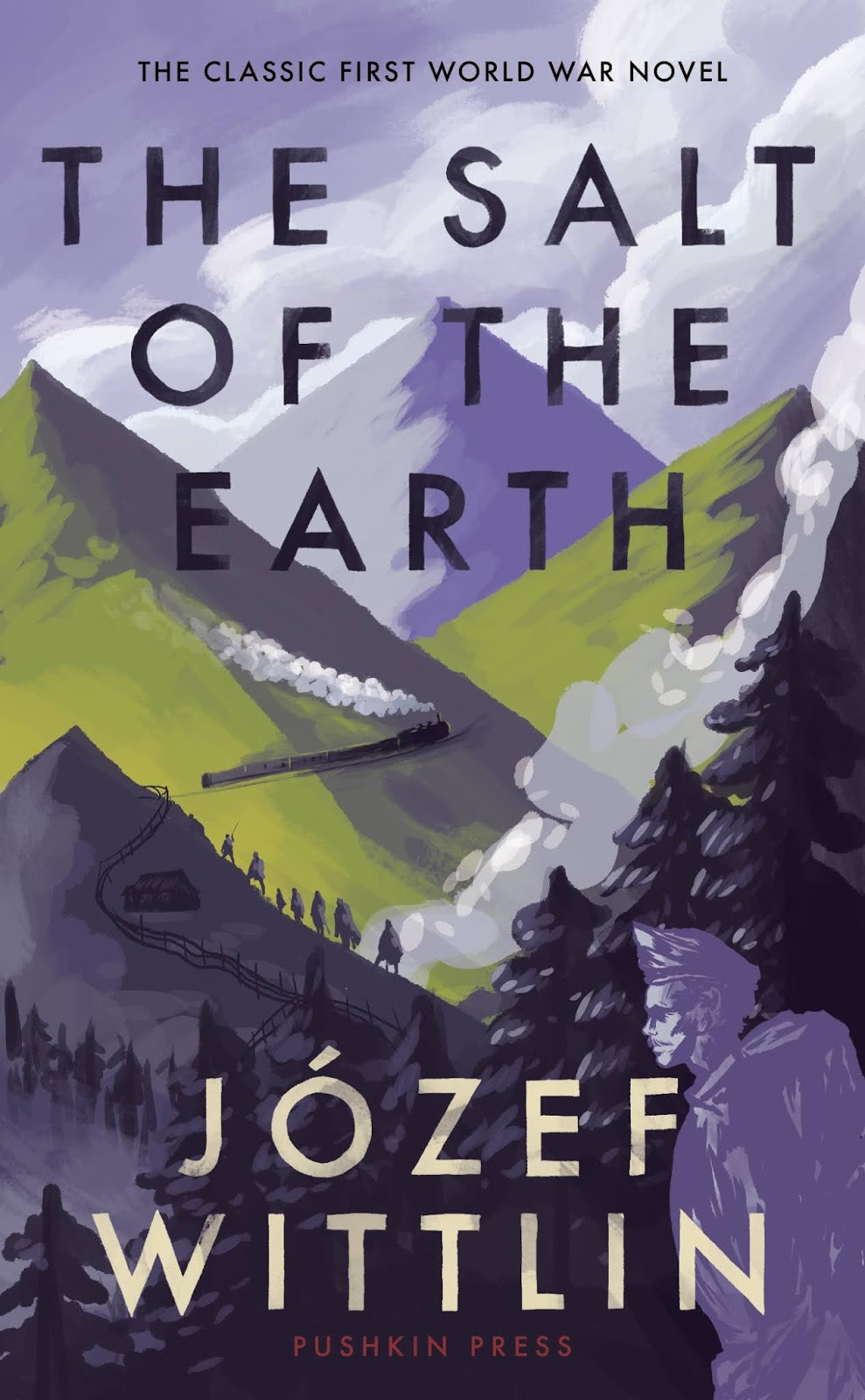
Review of 'The Salt of the Earth' by Josef Wittlin

I really enjoyed this book about the outbreak of WW1 from the perspective of a single, not-very-bright, Polish-Ruthenian man. It covers his life history before the outbreak of war, his feelings for the Austro-Hungarian empire, and the process by which he is conscripted and then taken away for basic training at a garrison town in Hungary. It's beautifully written, and it introduces lots of fantastic detail about Ruthenia, the natural landscape, farming, and an ethnic group I'd never heard of before (hutnuls).

Most of the time I was reading it I was comparing it to Von Rezzori, whose writing - about the neighbouring region of the Bukovina - I love.

It's a bit Schweik-like...our main character is a bit simple (though not also shrewd like Schweik), and there's a lot of journeying, and there is some lampooning of the bureaucratic absurdities of the army. The tone is as much tragic as comic, though, which I rather preferred...I've never really got into Schweik.

It's impossible not to comment on the tone of the writing about Jews, of which there is rather a lot. Jews are ever-present in the story, and they are described in lots of detail, as weak, crafty, and somewhat physically repulsive. It's not a very vicious portrayal - it's almost like the way a not-very-nasty anti-black racist would talk about Africans as physical specimens. It just goes with the territory; Jews were part of the social landscape in Galicia and Ruthenia (and the empire), and the stereotype of Jews was part of the mental landscape - again, hard not to think of Von Rezzori's Memoirs of An Antisemite. From time to time it made me feel uncomfortable. Afterwards, I learned that Josef Wittlin was a baptized Jew who identified as Jewish and wrote Jewish-Polish poetry in the interwar years. Go figure.

Sunday, June 21, 2020

Wobblies! A Graphic History of the Industrial Workers of the World

I'm not all that fond of graphic novels...though this is more of a collection than a single narrative, with different authors and artists telling different bits of the Wobbly story. The makes it slightly more palatable to me, though I'd just as happily have read a straightforward narrative text.

It's a pretty comprehensive work, and a good introduction for people who no nothing about either the Wobblies or how much effort went into suppressing socialism in the US. I learned lots that I didn't know.

Two things stand out for me: how grim the struggle was, and how limited were the Wobblies' successes - lots more heroic defeats and martydoms than success stories; and how important the divide was between skilled workers, organised in the 'labour aristocracy' unions in the AFL, and unskilled workers, in the IWW and other industrial unions. Perhaps the AFL unions actually did represent the class interests, at least in a narrow sense, of their memberships. Something similar happened in the UK, I think, though the division seems to have blurred in the twentieth century.
And perhaps our current divide, between a 'working class' and a 'middle class' defined in terms of culture is closer to this than we realise.

Review of 'The Essex Serpent' by Sarah Perry

I so loved this historical novel - the atmosphere, the writing style, the characters, and the plot. I became as involved with the characters as I would in a TV series, and I cared what happened to them and shared the triumphs and sorrows. I missed them when the book ended.

It's set in a late-Victorian England, in many ways recognisably like our world, with a London that includes electricity and the Tube. But it's also a world in which things that seem primitive - superstitions, belief in monsters, strange requirements of etiquette - sit alongside this modernity.

Hard to say much more without describing the story or giving it away, even though it's not strongly plot-driven. But I won't, I'll just say that I'm really pleased that I read it and will certainly try to read more by Sarah Perry.

Saturday, June 13, 2020

Review of Days of the Bagnold Summer

Gentle, mildly humourous British film about a fifteen year old heavy metal fan unexpectedly spending the summer with his mum after his divorced dad, who has moved to Florida and has a new younger wife, cancels his visit. Nicely observed, and Monica Dolan (the lead character really, though not listed among the 'stars') is good as the downtrodden and dowdy mum. Some good bits of dialogue - I liked the 'vegetarian' girl at the wedding who won't eat chicken but is fine with ham.

Watched on Amazon Prime, and paid for...not sure it was really worth the money, even though it wasn't too bad.

Monday, June 08, 2020

Review of “The Evil Eye; the magic of envy and destruction” by Jack Shamash

I sort of grew up with the evil eye, or at least the idea of it. When we went on a long journey my mum would remind us – in a jokey way, of course – that we should wear something red, like socks or pants; and she would say ‘puh puh puh’, mock-spitting, if she said something that seemed to be risking the evil eye, like referring to some good fortune. It was all in fun, of course, and we would all have been shocked if anyone had seriously suggested that we were in thrall to ancient superstitions, but we still did it.

So I’m familiar with some of the material that is covered in this book – some of the charms and strategies to ward off the evil eye, for example. Others are completely strange, because as it turns out, just about everything is used somewhere as a protective charm – plants, metals, things that are the shape of a penis, hand gestures that represent a penis or something horned, semi-precious stones...funnily enough one of the few things not listed seems to be wood (I may have missed this, among the shit, piss, milk and other substances), though most of us are familiar with touching wood when we might have invited some ill-luck.

Among the things that I learned from this book is that the Evil Eye is a separate thing from supernatural entities like gods and demons, and separate too from witchcraft and sorcery. It’s almost like a force of nature such as magnetism, a property of eyes that can bring bad luck despite the intention of the person to whom the eyes belong. Although the eye is sometimes put on people or things deliberately by ill-wishers, at other times it can happen even though the person casting it wishes the receiving person or thing no harm. There’s a whole chapter more or less taken up with Pope Pius IX, who seems to have caused no end of harm with his unfortunate gaze.

If you have even a passing interest in folklore or popular superstition you’ll enjoy this book. It’s beautifully written, with some nice illustrations (a shame there aren’t more!) and lots of personal and historical anecdotes.

Review of 'One Green Field' by Edward Thomas

This is a beautiful little book...a collection of short descriptive pieces about the English countryside that I might never have read. It was given to me by our lovely friend Pat Kattenhorn as a birthday present. If it hadn’t been for Covid-19 and Lockdown I wouldn’t have got nearly so much out of it; but we’ve tried to pass some of the time by going for very long walks away from roads and people. The weather has been glorious, and we’ve taken in some wonderful scenery. We’ve been much more aware of nature, both plants and animals. At the beginning it was all very quiet too, so it seemed much closer to Thomas’s world of the early twentieth century. As the pandemic has worn on  there’s been more traffic on the roads, and even though we’ve been on the footpaths we can hear it again. Even so, I can still feel a connection with the world that Thomas describes. Like him we’ve come across hidden brooks that splash and meander on their way towards rivers, and cattle resting in fields, and old farm machinery left to rust. 

If it hadn’t been for this time I’m not sure I would have appreciated the book so much. It’s been perfect for late-night reading, full of wonderful imagery without much plot or narrative, at once capturing and pacifying the restless mind. When I finished it I read a little of Thomas’s biography, and learned that he was a friend of Robert Frost, and that in a way Frost’s poem ‘The Road Not Taken’ killed him. I guess I won’t hear that again in the same way.