Tuesday, March 06, 2018

Review of 'Lady Bird'

I can't believe this entirely conventional teen-coming-of-age/mother-daughter movie got such rave reviews. It was OK, in a dull and predictable sort of way, with little critical perspective on anything. Our heroine has a bit of under-age sex with her boyfriend, pretends to be richer than she is to impress the cool attractive girl at her Catholic school (of course, in the UK you can't pretend to be posher than you are without major deception, because everyone can tell), has spats with her mum. It's all just a bit ho hum, and much too long.

Watched at the Vue in Stroud...I paid real money to see this.

Sunday, March 04, 2018

Review of 'The Limehouse Golem'

Apparently 'based' on the book by Peter Ackroyd, but it would be more accurate to say something like 'inspired by'. It's different in lots of ways, including the plot and the denoument.

Very bloody and violent, and rather graphic. It makes an attempt at the 'unreliable narrative' theme that underlies the book but I don't think it does it terribly well. It looks great, rather in the way that 'Penny Dreadful' does - um, why are we so keen to watch stuff about the cruelty and brutality of Victorian London?

Not surprised that this was not in cinemas for long - I'd meant to go see it, but it was gone before I got the chance. Bill Nighy plays one of his regular slightly confused characters, but it's not his usual sort of film - it's close to horror.

Watched on TV via Chromestream and Chromecast, following informal distribution.

Saturday, March 03, 2018

Review of 'South Pacific'

One of those musicals that you think you've watched, but you haven't - you just know all the songs. Finally got round to watching it yesterday, and found it long, a bit tedious, and shapeless - the plot seems to meander along with a few meaningful incidents but no real dramatic tension. Like a lot of Rogers and Hammerstein, it seems to spend a great deal of time setting up the scenario and then resolve it very quickly.

And yet this is a famously anti-racist musical, with one song about how people become racist (not one that anyone knows, You've Got To Be Carefully Taught) forming the emotional and intellectual centre of the show. It was denounced at the time as 'inspired by Moscow'. The sentiments are much better than the standard liberal guff about racism. Oh, and when the original musical went on tour, Rogers and Hammerstein refused to let it play in segregated theatres.

And there's more, which rather passed me by while watching - some of the 'native' characters are not Polynesian but Vietnamese, deported to the islands to work on the French plantations. There's even a slight gesture in the direction of gender identity - while the female lead is singing a song in which she's a guy singing about her 'honeybun' girl, the guy who runs the laundry drags up for the big show within the show to entertain the troops, although we know he's brave and comfortably male.

Watched in the Common House at Springhill on a proper DVD.

Review of 'Oriented'

A surprising film about young gay Palestinians living in Tel Aviv...surprising in that the narrative that we are expecting, that these men can be free in a tolerant, secular, Jewish city but not in their own communities, is not what we get at all. Instead they're mainly comfortable in their own skins as gay men, but not as Palestinians in Israel. One is very clearly accepted and cherished by his tolerant, secular, modern family - one is loved and cherished but hasn't come out yet, though it's reasonably clear that his sisters can see what's going on and are sympathetic, and the third falling in and out of love with Jewish men, and feeling bad because he's sleeping with the enemy.

There's also a woman friend who hangs out with them all the time, and provides lots of support and friendship, but doesn't even merit a name, much less a back story...a shame, because that misses an opportunity to introduce a whole lot more issues.

Another surprise is the boys' trip to Amman, where they attend a huge gay concert-party. The point of this, well made, is that the picture that Israeli liberals draw of the Arab world as a place where gays are only persecuted, is incomplete. Dancing in the crowd, they say that this is what Palestine could have been. Of course, they would have had less fun in some other parts of the Arab world, and even in some other parts of Palestine - I don't think there's much of a gay scene in Gaza.

But though it's a little bit long, and includes too much footage of the boys' self-indulgent 'art' videos, it's a really interesting thoughtful film, worth watching even for people who are not specially interested in the gay experience but want to see the dynamics between Israeli Jews and Israeli Palestinians from another angle.

Friday, March 02, 2018

The Today Programme today

Having spent the early part of the day shouting at the radio, I can at least share some of the grumpiness with you.

Great to see how the government's decision to cancel the second stage of the Leveson Inquiry was not worth commenting on the following day...when the BBC wants to it keeps a story going by covering 'reactions' and 'comments', and when it doesn't...well, it reported on it once and that's enough. So no news about how the victims of press corruption and intrusion feel about this decision, or reaction by campaigning groups, like this statement by Hacked Off: "This is probably the first time that a Government has overruled the views of the judicial Chair of a statutory Inquiry by cancelling an inquiry against his will."

Oh, and the panel for Any Questions tonight: Barry Gardiner MP, Anna Soubry MP, Fraser Nelson and Brendan O'Neill. Two right wing journalists, a europhile Tory, and Barry Gardiner representing everything to the left of that (look him, especially the China connection).

Monday, February 26, 2018

The Exchange of Beautiful Ideas

The building was not at all as he had imagined it. Standing in the chill wind that blew shreds of litter across the deserted piazza, Robin felt as if he was getting his disappointment in first, before he even went through the double doors. The grey of the concrete matched the grey of the sky behind. A desultory strip of red tiles divided the ground floor from the eight stories above, as if someone had told the architect at the last minute that some form of decoration was required.

Apart from this the building, which occupied one side of the square, was a dull matt slab with mean dark windows and a flat roof. Next to the doors there was a scrappy sign in tarnished metal, screwed into the concrete.  “The Exchange of Beautiful Ideas”, it proclaimed, in three centimetre Times Roman.

Robin walked slowly up to the entrance, the shoebox that held his idea resting heavily against his bent arm.

Inside the air was too warm, and uncomfortably dry. There were notice boards with flapping leaflets and schedules. A woman in a nondescript uniform jacket sat behind a reception counter, her eyes fixed on a screen. She did not look up as Robin approached.

“Excuse me,” he said, and then she did look up, with a show of reluctance. “I’ve got an idea that I’d like to -”

“What sort of idea?” said the woman, turning her attention back to her screen, which now cast a blue-green glow onto her face.

Robin hesitated for a moment. He had not expected to have to explain his idea at the reception desk.

“It’s...it’s about how people can be nicer to each other, by -”

“Social and political, third floor. Second door on the left,” said the woman, in a bored tone. “They’ll explain how the exchange works to you there.”

The lift to the third floor seemed as decrepit as everything else about the place. The door slid closed with agonizing slowness. Inside, there were two signs about what do in the event of an emergency, with contradictory instructions as to which buttons to press and what number to call. There was no sign of a telephone.

At the third floor the corridor was dimly lit. One of the overhead strip lights flickered and buzzed. There were more unkempt-looking noticeboards. The second door on the left had another metal sign that read ‘Social and Political’. One of the corner screws was missing.

The room was too small for its contents. There was another counter, with another uniformed woman sitting behind it. Shelves crammed with bulging lever arch files covered the walls from floor to ceiling.  Behind the counter there was a table, on which Robin could see piles of paper spilling onto the floor.

The woman behind the counter gave Robin a friendly smile, and for the first time that day he felt himself relax a little.

“I have an idea,” he said. “I hope it’s - I think it’s beautiful, and I’d like to -”

“Here’s the form, and the notes,” said the smiling woman. “It’s quite straightforward, but if you need any help just ask.” She handed him a thin sheaf of papers and indicated a desk on the other side of the room.

Robin sat down and looked at the form. There were several pages for personal information, but only a very small space in which he was requested to describe the idea itself. He looked around for a pen, and finding none, took out his own.

The minutes passed, slowly. Robin was aware of the ticking of a large electric clock above the counter. The personal information sections were exhaustive but easy enough to understand. The notes, and the later parts of the form, were very confusing. At last he finished, and went back to the woman at the desk.

She took the form from him and begun to copy out his entries on what looked to be a very old computer. She typed slowly, pecking at the keyboard with two fingers, and looking backwards and forwards between the handwritten form, the keys, and the flickering monochrome monitor.

“Wouldn’t it have been quicker if I’d just typed it straight in myself?” asked Robin.

The woman shrugged. “Administrative Improvements is on the sixth floor,” she said. “We’re just Social and Political here.”

Robin waited for what seemed like a long time.

“You’ve not assigned a nominated beneficiary,” the woman said, at last. “Or signed the primary assertion of ownership. We can’t put it in if you don’t do that.”

“I don’t understand,” said Robin, feeling small and stupid. “I don’t want to own anything. I  just want to exchange my idea. My beautiful idea.”

“Don’t worry,” said the woman, in the patient, slow tone one would use to explain to a not very bright child. “A lot of people find it confusing, the first time they file an idea.”

She thinks I’m an idiot, thought Robin.

“The whole point of the exchange is to enable ideas to be owned,” she said. “So that they can be traded. Bought and sold.”

“Oh,” said Robin. “I thought the exchange was to encourage the spread of ideas. Like a sort of library.”

“Exactly!” said the woman. “You wouldn’t steal books from a library, would you?”

“Of course not,” said Robin. “Only, an idea isn't the same as a book, is it?”

“No, it’s not,” said the woman. “A proper idea is unique. That’s what makes it intellectual property. And we can’t have people stealing each other’s property. That’s why we made the exchange; to establish ownership and property in thought. Because everything should belong to someone.”

“But I want my idea to spread,” said Robin. “I want as many people as possible to hear about it. A book in a library, well, only one person can borrow it at a time...unless there’s two copies, of course, and then…” His voice trailed away.

“We can’t have two copies of an idea,” said the woman, with a hint of irritation creeping in to her voice. Her smile had vanished. “How would we know which was the real one?”

“Aren’t they both the real one?” asked Robin. “A copy of the idea is...well, it is the same as the real one. Exactly the same. It’s not a counterfeit idea, or anything like that.”

“It’s a pirated idea,” said the woman. “The originator owns the idea, unless they’ve sold it to someone else, and then the buyer owns it. If anyone else has the idea, then they’ve stolen it. Like they walked into a shop and taken took something off the shelf without paying for it.”

“No they haven’t,” said Robin, who was also becoming irritated now. “Because if I steal something from a shop it’s not there anymore. But if someone else has my idea, I’ve still got it. It’s not gone anywhere.”

“If we followed your logic, nobody would make ideas,” said the woman. “There’d be no point, if they couldn’t own them. What would be the incentive?”

“I don’t have ideas because of an incentive,” Robin replied. “I have them because I think about something, and it leads to an idea. Or it doesn’t...but whether it does or not is nothing to do with incentives or ownership. It’s what brains do, have ideas.”

And then Robin had another idea.

“You know what?” he said. “I don’t think I want to put my idea into the exchange after all. I’ll find somewhere else to put it.”

“Suit yourself,” said the woman. “Only mind out. Someone else might put your idea - “ she held up her fingers to make air quotes as she said the word - “Into the exchange. And then it wouldn’t be yours anymore, it would be theirs.”

“I’ll take the chance,” said Robin. “And all this talk about owning ideas has given me another idea. I don’t know what I’ll do with it. I just know I won’t be putting it into the exchange.”

“Suit yourself,” said the woman, shrugging. “I don’t care either way.” She began to peck at her keyboard again.

Robin left the room and walked back to the lift.

Information wants to be free, he thought. Now there’s an idea.

Review of 'On Body and Soul'

A Hungarian romantic drama, mainly set in a slaughterhouse - sounds like an insane 1970s arthouse project, but was actually one of the most moving films I've seen for a long time.

The film centres on the slaughterhouse's financial director and a new external meat inspector, who is a stickler for the regulations in the way that her predecessor wasn't. There is an alert at the plant because some 'cattle mating drug' has been stolen and used at a party, and the police suggest that all the staff undergo psychological screening. The psychologist asks all the staff really very prurient questions about their sex lives and histories, during which it emerges that the finance director and the inspector are meeting in their identical dreams, in which they are both deer.

That's the only fantastical element; it's not explained, but it makes the rest of the plot and development possible. The inspector is a high functioning and ethereally beautiful woman with severe asperger's syndrome. She continues to visit her child psychologist and resists his suggestions that she see an adult therapist. The finance director gradually falls in love with her, despite (or because of?) her alien-ness - she makes Saga Noren from the Bridge, the beautiful blond aspergers detective from The Bridge, look well-adjusted. Their relationship and how it develops is the centre of the film, but there is plenty of other character development and interaction. The sexy pyschologist (Réka Tenki) is remarkable.

The cinematography is understated but remarkable; the deer are beautiful, and in a beautiful winter forest landscape, but the cows in the industrial setting of the slaughterhouse are also beautiful - there are lots of close-ups of their faces and eyes. And it's possible to infer from some other details (for example, what the characters wear) that it's the height of summer, and therefore hot, but it never looks like it is; it somehow manages to be literally gloomy, both indoors and outdoors.

Watched at the Lansdown Film Club in Stroud, with less than a dozen other people in the audience.

Healthy New Towns - a good idea or a tech-washed way for the healthcare industry to grab a slice of the property boom?

Another day, another on-trend article from Architects Data File - this one, entitled 'Care Pathways', about Healthy New Towns.  It doesn't seem to be avaiable online, so you'll have to trust my summary until I can add a link to the original.

Roughly it goes:

  • Health a big problem, the NHS usually reactive and attuned to ill-health
  • Healthy New Towns, an initiative 'from the NHS) via its Five Year Forward View 2014 strategy aimed at prevention and well-being, not sickness, calls for policy and planning to take health in to account
  • Lots of demonstrator sites in progress or planned - to encourage walking and make for mult-generational housing
  • Technology jolly important and we need lots more of it - tele this and that, needs 5G networks and the Internet of Things, communities should be built around the internet
  • Healthy New Towns need private capital and development opportunities
See what I mean about the tech-washing? I have no trouble believing that technology can help to solve human problems or even transform societies - I'm a big fan of genuinely radical visions for technology, from solarpunk through Paul Mason's PostCapitalism to more mainstream versions like Jeremy Rifkin's Zero Marginal Cost Society.

But there is no link here at all between the call for more technology and more infrastructure on the one hand, and the proposed transformation on the other...just a touching belief that tech is needed.  And not much engagement with big questions either, like why the commercial market is unable to offer 'multi-generational neighborhoods'? Hint: it's to do with a housing market that no longer bears any relation to other parts of the economy, including the labour market and what young people can expect to earn in a lifetime. 

Oh, and I didn't see any mention of cars or transport policy, or even parking...just the information that one of the planned pilots is 'just outside the M25'. 

Thursday, February 22, 2018

Against Decluttering

I picked up a cutting from the Architect's Data File, and it was all about decluttering and de-materialization and microhomes/tiny homes. It was linked to some material about building regulations and minimum space standards, and to the ideas of 'futurist and author' James Wallman, responsible for the book and blog 'Stuffocation'.

Normally I'm a sucker for this sort of thing. I've said more than once that we go on holiday to get away from our own stuff, because so much of it nags us to do something - fix it, put it away, do the thing that it represents, remember that we bought it in order to take up a new activity that we haven't got round to...you get the picture. As a Green I know that our lives are full of shit that we don't really need, or even want, or have space for, that cost resources to make and will leave toxic traces behind when we eventually dispose of them. I watched the original 'Story of Stuff' film.

But now I'm thinking about the flip side to all this. If capitalism wants to sell us stuff (whether we need it or not) why is it paying consultancy fees to Wallman? Because it doesn't care whether it sells us stuff, and because it quite likes a future where we give it money but it doesn't have to give us stuff.

I'm not the first one to think about this, obviously; this article argues that in handing back 'ownership' of our things to the companies that sold them to us, we are effectively going to back to the middle ages, when all property belonged to the crown, and the rest of us just had some limited rights to use it.

But I still want to give two cheers for ownership over the 'experience economy'. In the old days, when I bought a physical book, or physical DVD, they were mine to do what I liked with. Sure, there were copyright restrictions, and that blurb in the front of the book about it not being re-lent or re-sold without permission, but unless you were involved in parallel imports it didn't really matter. I can give a book (or a DVD) to a friend, or take it to a charity shop. If I pay for a film on Amazon Prime (or Google Play, or anything else) I pretty much can't. Google offers me the choice of 'renting' the film or 'buying' it, but in neither case do I own it in the same sense that I did the physical item. Even though the marginal cost of producing the 'digital experience' that is a streamed film is close to zero, I pay almost the same for it that I would pay for a physical item, and I can do less with it.

In the Economics textbooks that I studied at school there was a lot about the supply curve. As the price of a thing rises, more firms enter the market to produce it, so that the price eventually falls back to an equilibrium representing the marginal cost of production (I may have rushed that a little). In real life capitalists move heaven and earth to stop this happening, and much of what you get taught in business school is stuff that ought not to be of any use if classical Economic theory was true. Barriers to entry - patents, regulations, licensing rights, state-protected monopolies via 'outsourcing' contracts...if you need a refresher it's all nicely set out in Guy Standing's book The Corruption of Capitalism, which re-introduces the Economic meaning of 'rent' as unearned income.

Nevertheless, the trajectory of economic and technological development over the last few years has made the fiction of the supply curve a bit more true. Globalization, competition from China, the increasing automation of physical production, and the increasing software component of physical goods has all helped to ensure that the marginal cost of producing stuff is also tending towards zero, even if it will never actually get there. Stuff is getting cheaper, and competition from low-cost no-brand producers is a constant concern for big branded manufacturers. Chinese Android mobile phones are pretty much as good as the more expensive branded versions; the after-sales service is not much good (but actually it's not much good from the big brands either, for the most part) but there's pretty good free support from other users via the web.

Hence, I think, the increasing emphasis on things-as-a-service, and on rolling back ownership of things we thought we had bought. Warranties and licence agreements that are breached if we try to repair or enhance the things; software that acts against the interests of the apparent owner; Delightfully, Amazon rubbed our noses in it by deleting, of all books, Orwell's 1984 from the Kindles of customers who thought they had bought the book.

It bears saying, too, that while the manufacture of things is subject to this cost curve, I don't think the same applies to the creation of 'experiences'. The latter are much more likely to involve human labour (even though some it will be robotized and automated, I suspect the premium experiences will involve humans, almost by definition) - and on present experience, not very well paid human labour. And it's not necessarily true that the ecological footprint of experiences is less than that of stuff - especially not if that experience is a carbon-heavy trip to Kilimanjaro, or a cheap flight stag weekend in Tallinn.

And let's come back to those microhomes, where this began. Is it really true that millennials and others are embracing smaller homes out of a values-driven rejection of stuff and clutter, or is that rejection actually the consequence of smaller homes? So-called 'luxury flats' have minimal storage space nowadays - one reason for the huge boom in out of town storage. It's not only piles of meaningless plastic crap that you don't have room for; it's also your parents' photo album, and your grandmother's candlesticks. Letting go of some of these items, even when they are not in frequent use, is an emotional process. It's nice to think we are freer because we're not burdened with stuff, but are we also giving up a bit of ourselves? Erving Goffman's famous account of total institutions drew attention to the way that inmates are stripped of their identity-defining personal possessions. Something to think about the next time you hear someone waxing lyrical about decluttering, and dematerialisation, and 'x as a service'. And while we're at it, let's have a look at James Wallman's house.


Friday, February 16, 2018

Review of "Hamlet Liikemaailmassa" (Hamlet Goes Business)

A Finnish noir comedy version of Hamlet, set in a family-owned corporate group. If you can imagine that you can pretty much imagine the film. As with other Kaurismaki films the time period of the setting feels a bit indeterminate - there are some computers on desks, but otherwise it looks 1950s (the clothes, the interiors) or even earlier. The screenplay credit goes to William Shakespeare, though I rather feel that there are some departures from the text and from the story-line as I remember it. Certainly the Hamlet character doesn't seem to be as tortured and indecisive as the one that I think Shakespeare imagined.

I watched this once before, at the Sydney Film Festival in 1991 - Ruth was pregnant with Louis, iron-deficient and so eating bunches of parsley as a cinema snack. I joined in to keep her company, so I associate this and other films that I saw there with the taste and feel of parsley. I didn't remember much about it, apart from some of the interior shots; curiously I remembered it as being in washed out colour, but it's black and white.

Watched in the Middle Floor at Springhill, from a real DVD.

Wednesday, February 14, 2018

Review of 'The Black Panthers: Vanguard of the Revolution'

A sympathetic documentary about the Panthers, which brings out many of the good things - the social services they offered within the community, the move beyond racial nationalism towards a socialist and class-baseed analysis, the identification with anti-imperialist struggles - but more or less glosses over the bad things - the sexism, the uneasy relationship with criminality and gangs, the glorification of guns and violence...

The film is pretty analytical though, and shows how the FBI targeted the Panthers, and how successful its program of inflitration and destabilisation was. One thing I didn't get at all from the film was how the party related to other Black nationalist, liberation and civil rights groups. There was some mention of the King assassination, and the odd quote from someone in the SNCC, but one could be forgiven for thinking that the Panthers were the only radical group in the Black community. How did they relate to Malcolm X's Nation of Islam, for example?

Lots of great footage, though, including some nice film from the breakfast programs (why don't radicals do that sort of thing any more?) and from demonstrations in support of jailed Panthers that are very clearly multi-racial. And great music.

Watched via informal download, Chromestream and Chromecast.

Sunday, February 11, 2018

Review of Mr Rooseveldt

An unfunny comedy that has unnaccountably attracted rave reviews and ratings - why? Is there something deeply corrupt about the world of cinema and peer-reviewing sites?

This is 'quirky' - a word that is actually dissected in the film. A young woman who is apparently a comedian in LA but mainly works in a video editing job (many people would think of that as relatively glamorous, but it's presented as dreary and meaningless). She has to return to Austen (her home town) because (spoiler alert) her cat is ill...it's dead by the time she gets back, and her boyfriend has taken up with a new woman who is also grieving for the cat...some casual sex, some ex stuff, too long and not really funny at all - I may have smiled once or twice.

Another bad film from Netflix.

Friday, February 09, 2018

Review of 'The Dressmaker'

From the stable of quirky, set in small town Australia with lots of dark secrets and petty jealousies. Kate Winslett very good as the eponyomous young woman dressmaker returning to look after her aged and dementing mother, who re-enters into the life of the town by making stunning dresses for the women (several of them former enemies). Funny how they are transformed in every respect when they put on the dresses - they have better make-up, hair, complexions and walk as well as the outfits themselves. But it's only a movie.

I was slightly puzzled by the abrupt changes of tone and mood in the film. It starts out as a 'dark comedy', swaps into romcom territory as Kate's character gets the guy, then suddenly it's melodrama, and then we're back with dark comedy again only it's very dark, with a climax involving multiple murders. Mind you, I did sort of experience Hamlet as a comedy because I only saw it after I saw 'Rosencrantz and Guildernstern are dead', so I found the corpse-strewn ending funny in a way that few others watching did.

Anyway, this is good, and worth watching for the outfits alone.

Surprisingly watched on live TV - Film4.


Wednesday, February 07, 2018

Review of Victor Victoria

I really enjoyed this cross-dressing musical comedy from the early 1980s - it's a remake of a German film from the early 1930s. Julie Andrews is really great as the eponymous Victor/Victoria, a woman singer who becomes successful by pretending to be a female impersonator. I can't help thinking how much she looks like David Bowie (I've broken with my blog convention by posting a still rather than the film poster).

There is plenty of positive depiction of gay relationships, and the gay and cross-dressing characters aren't there to suggest decadence, as they are in other films of this genre (Cabaret comes to mind); they are just people with their own lives and loves.

I suspect the film was ahead of its time - it won several awards and was nominated for others, but I don't think it made much money.

Watched at home via Chromestream, having been obtained from those good old informal distribution networks.

Saturday, February 03, 2018

Review of Suffragette

Competent historical drama about the women's suffrage movement in the early 20th century. Well made enough to keep my interest, but not so special either in terms of cinematography, or narrative, or insights, as to make me think very much. The acting is good (though it's hard to like Helena Bonham-Carter as a radical after the stupid things she's said), and it's a shame that Anne-Marie Duff, who is one of the main characters gets left off the poster - not pretty enough? Pass me the irony bag.

Still, for my money it really looks like Edwardian England. The force-feeding scene in the prison was suitably horrible though I suspect it was actually rather prettied up. I can't complain that it ignores the dynamic between working-class and posher suffragettes, because that's one of the main themes. Just a bid ploddy.

Watched via Chromestream and informal distribution.

Review of ‘Slouching towards Bethlehem’ by Joan Didion

I must have read this years ago, because I found a well-read copy in my book collection, but I have almost no memory of the contents. Perhaps that’s because the writing is more about a feeling – what it feels like to be Joan Didion – than anything else. There are essays about how it felt for her to be a young woman moving from California to New York in the early 1960s, and how it felt for her a little later when the attractions of the city began to pall. There is a sneering piece about a middlebrow, middle of the road think tank called the Centre for the Study of Democratic Institutions, another in much the same tone about a ‘school of non-violence’ run under the auspices of Joan Baez, and a rather long essay about Haight-Ashbury in the later 1960s that put me in mind of ‘Through a Scanner Darkly’.

It’s nicely written, and I’ll seek out more of her old stuff, even though I don’t quite like her.


I was mainly struck by how contemporary it all feels, even though it was written and describes a world of fifty years ago. It’s recognisably still my world, despite the absence of all the technologies that I make use of during most waking minutes. Even the cover photo, which shows Didion and a beardy man in some sort of tent with a vase of flowers and a bottle of wine in front of them, could have been taken at last year’s Womad. That’s weird, isn’t it? We talk so much about how fast things are changing – but I am sure that if my parents had read a book in 1958 (the year of my birth) that depicted the world of 1908 they wouldn’t have felt it was their world. So when was the disjuncture? The war, or the post-war boom?  

Wednesday, January 31, 2018

Review of 'Blockbuster'

There are quirky French films, and there is this. A guy is making short videos for his Dad who is dying from cancer, and he's making them about the development of his relationship with a young woman who he more or less picked up at random in order to make the films. Only, she finds out and then he realizes that he has come to love her and wants to get back with her. Lots of nice touches, including the really cool young woman who is the flatmate, and cameo roles by French actors and director Michel Gondry, the grand master of quirky French films (the woman has a thing for him).

I think it's very French that I only discovered at the end that the young man and his brother, and his Dad (who we see dying in the hospital) are Jewish. It's so understated that most people won't even notice - whereas in an American or British film, a character can't be Jewish unless that's a really important thing about them. (OK, George in 'Being Human' is an exception.)

Watched on Netflix...almost makes me not want to cancel it after all. Almost.

Review of 'Colossal'

I watched this all the way through - not at a single sitting - and am rather bemused by it. The plot is so silly that it has to be an allegory, but it wasn't immediately obvious what it was about. Anne Hathaway is a young and slightly frivolous woman with a drinking problem who is shoved out of her controlling boyfriend's apartment) and goes back to her home town, where she moves into her parents' apparently empty but rather beautiful town house and then hooks up with a guy she used to know from before she left. At the same time a giant lizard-humanoid begins to terrorize Seoul, and she soon realizes that she is the cause of this - every time she sets foot in a playground near the house the giant monster appears in Seoul, and every move she makes is mirrored by the monster.

See what I mean? At one level it's conventional rom-com/rom-dram territory; the guy she used to know turns out to be a bit disturbed and nasty, there's another guy she quite likes who seems to be attracted to her...but it's also this weird stuff that is barely explained, despite one scene close to the end that purports to be show why this is happening.

In the early hours of this morning I decided it was an allegory about alcoholism. A bar is the focus for much of the action. She has a drinking problem, and so does the guy who turns about to be nasty. He drunk-drives, and is violent when drunk. There is a lot about doing harm to innocent people as a result of unintentional actions, and a fairly heavy hint in the final scene. Perhaps the town the monster destroys is Seoul just for the play on words - 'soul'.

If anyone else watches this and can shed any more light, I'd be grateful, particularly if there are other visual clues in there that confirm my hypothesis.

Watched on Netflix.

Tuesday, January 30, 2018

Review of 'Blurred Lines: Inside the Art World'

Art is really about money, and the people who buy contemporary art often don't know what they like or why they should like it. Who knew? Well, everybody really.

But this is a nice documentary about the contemporary art world, with insights into some very sharp practices that border on fraud. I didn't get as angry as I would have watching a similar documentary about say banks, because I can't help but think of this as 'victim-less' crime - or at least one where it's hard to feel much sympathy for the victims. But the interlocking worlds of private super-rich buyers and public institutions are such that we are all being ripped off.

Watched on Netflix, a rare decent film there.

My (old - 2013) review of Ulysses

Not sure there is any point in me writing yet another review of this - what will I add to the sum of human knowledge? But worth remarking that it was not as difficult as I expected, and I really enjoyed reading it most of the time. There was one rather dull section just before Nighttown, which I sort of skimmed. But the rest is brilliant. I was unprepared for how funny it is, or how modern the dirty bits seem - JJ was doing S+M before 'Fifty Shades' was ever thought of. In fact, Bloom's imagination touches on quite a few S+M themes, including cuckoldry, forced, crossdressing, transexuality, and whipping. Who knew? Was JJ into this sort of thing personally, and if not why did he write about it? Is it part of making Bloom some sort of universal victim character? Note that he also kisses his wife's ass, and that she fantasizes about him doing this in a more substantive way.

Also struck by how substantial JJ's knowledge of things Jewish is. Bloom is not just some sort of universal Jew, but a real living breathing Ashkenazi Hungarian with the bits of Jewish folk-culture and Zionism scattered about his head. At one point he sings the opening verse to the Hatikvah - not then the Israeli national anthem, obviously but a Zionist hymn. How did Joyce know about all this? Did he have Jewish friends? How representative is Bloom's luftmensch profession of what Dublin Jews did?

It's worth reading for the Nighttown section alone, which could almost be published as a stand-alone book or performed as a play (though staging would be a challenge).

Very pleased I read, sorry it took me so long to get round to this (nearly 40 years since I studied Joyce at A level) though I don't think I would have got it properly earlier. Some of the poignancy of Bloom's situation can't be understood without the experience of disappointment that goes with male middle age.

The final section Molly Bloom's soliloquy is brilliant though it takes a bit of patience to read pages and pages without punctuation I think it would be better to listen to than read maybe it should be done on the radio...

Monday, January 29, 2018

Review of 'The Good Night'

Felt a bit like a wasted opportunity - all-star cast, including Gwyneth Paltro, Penelope Cruz, Martin Freeman, Danny De Vito, Michael Gambon, Simon Pegg...but it's a film about dreaming, which film people seem to like (maybe it removes the necessity for their narratives to be consistent or to maintain proper continuity), though for everybody else there is nothing more boring than other people's dreams.

I sort of felt that there was something there that could have been developed in a better way - the artist coming to terms with not being great or successful, the relationship with a friend who is more successful, a fantasy about a woman who appears inaccessible because she only appears in dreams. It's really quite sad - the relationship that the artist has with his girlfriend is over but they both pretend it isn't, the dreamed-of woman turns out to be someone from a poster that is on the side of every bus (that is, not someone unique from his personal unconscious).

Watched via clever TV and Netflix...another not very good film from Netflix. Must get round to cancelling it.

Thursday, January 25, 2018

Review of 'The Experiment: Georgia's Forgotten Revolution 1918-1921" by Eric Lee

I thought I knew most of what there was to know about the revolution and the Russian Civil War (especially after all the commemorative exhibitions this year), but much of what was covered in this book was new to me. Eric Lee has produced a compelling account of this little-known episode, setting it in the overall context of the divisions within the Socialist movement as a result of the first world war. He provides a lot of insight into the very different path that the Georgian Mensheviks took as a socialist party ruling over a country not at all ready for socialism. Much of it - especially the section on cooperatives - has a very contemporary feel, and I rather think that John McDonnell would benefit from reading some of the chapters.

It's hard to take seriously the suggestion that the kind of revolution brought by the Bolsheviks could be a model for socialists in a developed country, and apart from a few nutters I don't think anyone does any more. Even the brighter sorts within the mainstream Communist Parties (Gramsci comes to mind) had worked this out by the 1930s; that some of the very clever people in the Trotskyist groups don't acknowledge this is and think about how to move on is an interesting cultural and psychological phenomenon, but not very helpful in formulating an actual strategy to move beyond Capitalism. 

But while Eric Lee does explicate well the route chosen by the Georgian Mensheviks in a backward and isolated country,  I think he underplays the extent to which their side of the argument, and in particular the parties of the Second International, had been discredited by their support for their own governments' side in the war. The Mensheviks (the Martov Group excepted) wanted Russia to carry on fighting for the Allied cause, with all of the slaughter and personal tragedy that would have entailed. That alone made the Bolshevik victory more or less inevitable.

I can't agree, either, with the suggestion that because the Bolsheviks thought they could somehow skip a stage in the inevitable historical development from Feudalism through Capitalism to Socialism, that the 'patient' Menshevik approach made sense. The problem in Russia, and even more in Georgia, was that there was no capitalist class to speak of, and that the task of 'developing the productive forces' was going to have to be carried out under the direction of socialists. Quite how the Georgians were going to allow capitalism to develop naturally is beyond me.


But this is exactly the kind of interesting and intelligent debate that this book makes possible. A must for anyone interested in the history of socialism, or of the Caucasus. A book about the Dashnaks next, please?

Wednesday, January 24, 2018

Review of 'The Promise'

Sad if conventional film (centred around a a love triangle, but with other characters and events too) about the Armenian Genocide during WW1. I'd been sort of aware of this, and even of some of the details (communities being marched into the desert to die), but it is striking how watching a film with identifiable characters actually makes it come alive and feel relevant. In other contexts some of what we see in the film would certainly be regarded as war crimes, but that just didn't happen after WW1.

There were some details of which I hadn't been aware, like the evacuation of Armenians from the Mediterranean coast by the French Navy. Which made me realise that I'm a bit confused about where Armenian communities lived in the Ottoman Empire - clearly not just in Caucasus region.

Watched on Amazon Prime video.

Friday, January 19, 2018

Review of 'Global crisis: war, climate change and catastrophe in the seventeenth century' by Geoffrey Parker

I love reading 'big-picture' history books, and they don't come much bigger picture than this. He brings together conventional history (wars, revolts, etc.) with paleo-climatology, so there's lots of evidence about what the weather was like in the C17th. What it was mainly like was awful - cold, disturbed rainfall patterns (droughts and floods), short growing seasons - all leading to famine and thus to war.

At times the book feels over-long, especially in the middle. There really are a lot of blow by blow accounts of what happened in each of the places he includes in his studies - I didn't need a new narrative history of the English Civil Wars. But it's worth reading for the beginning and the end, which does bring it all together,,,and bring it back up to date with accounts of Katrina, Sandy and other more recent disasters.

Wednesday, January 17, 2018

Review of 'Miss Sloane'

Like the lobbyist bits of 'House of Cards', with all the other bits taken out. Strong women characters who interact with each other about things other than their relationships with men, and a decent critical perspective both on the lobbying industry and on US politics. Nice acting, slightly odd camera work sometimes, as if it couldn't decide whether it wanted to look like a fly-on-the-wall documentary or not.

Long but not boring, and quite a few twists that I didn't see coming. I particularly liked the hacked cockroach, which we had been discussing at home a few days before.

Watched at home on clever TV with built-in Amazon video.

Review of 'Oscar and Lucinda'

Beautiful film, nice acting. Ralph Fiennes and Cate Blanchett are great at conveying how odd the two main characters are, and I can't begin to describe all the meaning that is held in that thing that Fiennes does with his eyes.

I didn't mind that it simplified the plot - I think it still managed to convey, for example, the extent to which the 'benevolent' act of sending the glass church overland causes such death and destruction in its wake. 

But though I enjoyed it, I was cross that it messed about with the ending. The book's ending is much more poignant - the film has softened the edges of the personal tragedies involved, removed a key plot development (and invented a scene to make this possible - I'll avoid writing a spoiler, but it was painful to have this crowbarred in to the narrative), and also weakened the anti-clerical dimension - in the book Oscar ends up cursing the glass church, though not in the film. 

Watched at home via informal distribution, Chromestream and Chromecast.

Thursday, January 11, 2018

Review of Star Wars: the last Jedi

If only I could be convinced that this really was the last Jedi...but instead it's another action-packed but dull installment in the franchise that never ends. This is an evening I'm never going to get back. It wasn't particularly offensive...there was more than a gesture in the direction of ethnic diversity, and several strong women characters who talk to each other about things other than men. But it was mainly a collection of scenes of things crashing into each other and features of the landscape, together with many scenes of 'moderate violence' - that's people being shot or cut up by special weapons but without any blood or gore.

The 'rebel alliance' is no longer (if it ever was) about any sort of rebellion, the 'republic' is led by a princess, and the only difference between the good and bad side is that the latter seem to stand in very straight rows while the former stand around in looser groups. The baddies sometimes wear uniforms that suggest inter-war Poland, but both sides have their fair share of British accents (very confusing for those of us brought up on the tradition of it only being bad guys who sound British); later on both bad and good guy ground troop seem to be looking like US soldiers.

The overall look of the film isn't all that interesting...there is a casino which is sort of art deco themed, and where electro swing light plays in the background, but much of it looks like other Star War films...as usual there is a scene on a narrow bridge over a deep shaft on a spaceship...doesn't the Empire have any safety regulations? The geography of the plot - and the plot as a whole - doesn't seem to make much sense, and there is increasing reliance on supernatural Jedi power to more it along. Admittedly I dozed off for a bit, but I didn't seem to miss much. That little sleep was probably the most enjoyable part of the evening.

I really must stop watching these.

Seen at the Everyman Muswell Hill, in some comfort in a near-empty cinema. I note in passing that the cinema offered me a discount for being over 50, which seems like an odd segmentation choice.

Tuesday, January 02, 2018

Review of My Happy Family

A Georgian film about a middle-aged woman who lives with her family in a small house (that's her mother and father, her husband, her grown-up son, grown-up daughter and boyfriend) and decides to move out and take a flat alone. The first scene is her being shown round the flat by the landlady, with some familiar 'I haven't got round to clearing out the last tenant's stuff' moments.

The decision to move out seems perfectly sensible - the mother is very controlling, the house very crowded (the family all keep their clothes in one wardrobe which is in the daughter's room, because it's too big to move anywhere else), and the husband very lacklustre - it took me quite a while to realise he was her husband because the relationship between them was so empty.

The film is sad and thoughtful, perhaps partly because the central character is an introvert in a society that doesn't seem to like them very much. She doesn't want to have people round for her birthday, but the family ignore her wishes and invite lots of people over for a big meal, which includes drinking and singing. A Georgian friend of mine has told me about the singing and toast-making culture of Georgia (every quaffing must be precluded with a speech) and it's clearly a real thing. The singing is beautiful - Georgians seem to fall naturally into four-part harmony, and to all know the tunes and the words to folk-songs.

In fact, Georgian society looks great. Tiblisi is not crowded or full of traffic. The neighborhoods she moves from, and too, are leafy and quiet, if a bit run down. The children in the schools are respectful (she's a secondary school teacher) and studious - there's no rowdiness that would be an inevitable part of the depiction of a school in a British or American film. There is a lot of community-ness (which gets on the nerves of the heroine) and the food they eat is all bought at the market and then cooked lovingly to make traditional recipes. Just goes to show that it's possible to be unhappy despite all this...

The film is very slow but nicely observed. I'll avoid spoiling the few actual developments that might be thought of as the plot.

Watched on Netflix.

Review of Theeb

A simple, beautiful, brutal film about beduins caught up in Britain's campaigns against the Ottoman Empire during WW1. A little boy tags along with his brother, guiding a British officer across the desert to a rendezvous with others who will help the officer blow up a section of the Hejaz railway. They run into other beduins who are bandits and the story turns into one of survival and revenge.

Stunning to look at (filmed in similar locations as the 1962 Lawrence of Arabia film, so lots of beautiful dunes and wadis) with great music. Most of the actors are beduins, not professionals, though the little boy was apparently the producer's son.

It made me look up some of the background about the railway itself, which proved more interesting than I thought. I also noticed that the Ottoman fort towards the end of the film had the red and white moon and star flag that modern Turkey uses, which I wrongly thought was introduced by Ataturk. Turns out the Ottomans used it too.

Watched in the Middle Floor at Springhill, on a DVD.

Review of Pitch Perfect 2

A while back I stumbled across Pitch Perfect (well, it was broadcast on live TV), and unexpectedly rather enjoyed it. The poster adverts on the side of buses for Pitch Perfect 3 reminded me that there had been a Pitch Perfect 2, so after a few slightly sad thoughtful films lately I wanted to watch something that was just entertaining and feelgood...and thought PP2 would fit the bill.

But it wasn't nearly as funny as the first film, despite a few amusing set-pieces and a nice running gag about the ultra-reactionary a capella singing show hosts. Well, at least I won't have to bother with PP3.

Saturday, December 23, 2017

Review of 20th Century Women

A feminist coming of age film about a boy, being raised by his single mother in late 1970s Santa Barbara, with the help of her young female art-school punk lodger who is recovering from cervical cancer and a fragile, damaged younger woman who literally sleeps with the boy but doesn't want sex to spoil their relationship, though he clearly feels otherwise.

This is a really good film, with nice observations, and great acting, and a way of addressing the emergence of feminism as it appears to a sympathetic boy as he turns into a man. As a bloke watching feminist films I sometimes feel like I am the problem (not unreasonably) but this was both pointed and pointful, but at the same time a joy to watch.

Lots of great scenery in Southern California, some emergence of punk footage, and lots of good teen stuff too.

It happens to be the period in which I came of age too, and it's striking how much it seems to be in a parallel universe - at one point we get Jimmy Carter's 1979 State of the Union message, and whatever you think of Carter, it's hard to imagine how one could ever get from an America in which that mensch was president to this one.

Watched on Amazon Prime on the new TV.

Review of Amnesia

A post-holocaust movie set in Ibiza, and without any holocaust stuff at all. Young German DJ/producer moves to Ibiza for his career, finds himself living next door to an older woman who [SPOILER ALERT] turns out to be a German who refuses to speak the German language because of what happened to her young Jewish love during the war. They develop a relationship (which he thinks is romantic love, but she knows better) but it's all thrown into turmoil when his mother and much-loved grandfather come to visit, causing everyone to re-examine their pasts and the stories they tell about it.

It's beautiful, and Ibiza looks stunning, and even the clubs (especially the one called Amnesia - geddit?) look great. I'm afraid I was a bit annoyed by a film that focused on the holocaust from the perspective of how it felt to people who were either perpetrators (the grandfather, portrayed by Bruno Ganz, who has told various conflicting stories about his role as a 'rescuer') or who were...well, what is my issue here? She lost a loved one. Does that make her, a non-Jewish German who was herself never under threat but fled to Switzerland, a holocaust survivor?

I've been critical of other holocaust films before which focus on the experience of German and Austrian Jews...do I subconsciously think that the holocaust was only about what happened to 'my' people, the Jews of Poland and Eastern Europe that were the object of the explicit policy of extermination? Maybe I do...

Aside from that this is not a bad film and worth watching. We watched on Netflix, on our new TV  but via Chromecast rather than via the native Netflix support...slightly easier to manage...

Wednesday, December 13, 2017

An economics reformation

I went to this event yesterday at UCL - Time for an Economic Reformation. Mainly focused on the academic discipline of Economics and its teaching, with the mission of reforming what is taught and studied - rather than about revising economic thought per se...there seemed to be a view, not explicitly stated, that there wasn't much of a need for new thinking itself, just for the academic discipline to reflect the new thinking that was already around.

Good, clear speakers - perhaps a function of the fact that almost all the panel were women? But the only man, Steve Keen, was also very clear, even though I find much of the econometrics that he presents pretty incomprehensible. Other panelists were: Victoria Chick; Mariana Mazzucato; Kate Raworth, of Doughnut Economics fame; and Sally Svenlen, of the Rethinking Economics student group.

The audience was also star-studded - Hilary Wainright, Charlie Leadbetter, and my favourite - David King, formerly Chief Scientist at DECC, who spoke from the floor with some passion - about how the extent to which our economic system had undermined the ability of our species to continue living on our planet was something of an indictment of our economic theories.

Panel chaired by Larry Elliot, economics editor of The Guardian, and event as a whole compered by Andrew Simms of the New Weather Institute (I hadn't heard of that before).

Good discussions, sensible contributions - nothing that made me groan, though equally nothing that looked like it was the key to a root and branch transformation of economic life and organisation. I suspect that one of the reasons for this, and for the slightly lackluster nature of the '33 Theses for an Economics Reformation' is that it's pitched as a conversation with mainstream economists. So though the implications of what is proposed might actually be very radical (as Andrew Simms proposed) it's all positioned as super-sensible.  Mariana Mazzucato cited Polanyi in her short contribution (which was sparkling and interesting) but there wasn't anything in the proposals that matched up to his ideas about how economies are made and unmade.

Delightfully, we were all asked to comment on the 33 Theses. I didn't contribute, but if I had I might have mentioned that the importance of 'intellectual property' - patent and copyright based monopolies - seemed to be missing; and that there wasn't anything about the process whereby economic ideas move from economists to public discourse (as discussed in this paper by Laurie Laybourn-Langton and Michael Jacobs), and at length in‘Inventing the Future’ by Alex Williams and Nick Srnicek - see my review here.

I think that this second aspect is really important; one of the ways in which what is often called 'neo-liberalism' has been so successful is that it's really hard to think about other kinds of economic relationships, outside the framework of 'market economics'. Pseudo-economic ideas about governments not being able to spend more than they 'earn', and about the private sector as the only place where value is created, become the commonsense of our age. Making other kinds of ideas into common sense is a key task for any economic reformation.

Monday, December 11, 2017

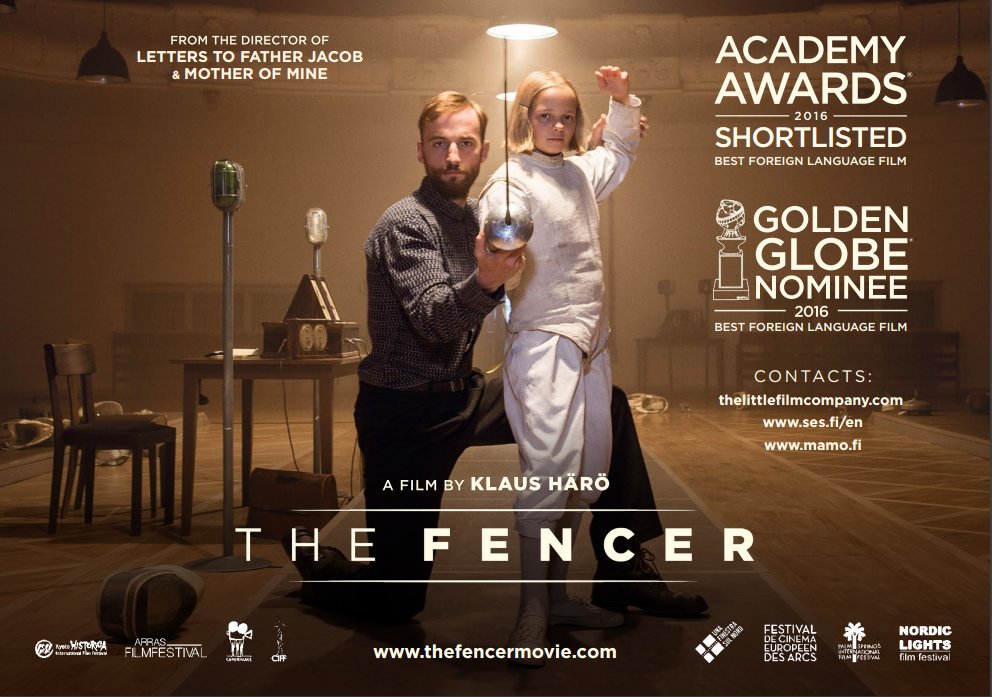
Review of 'The Fencer'


Beautiful to look at Estonian film (actually a Finnish-Estonian co-production, but I've never seen an Estonian film before) set in the early 1950s and featuring a young fencer who moves to a small town to become a PE teacher and ends up starting a fencing club for his students. He's on the run from the secret police because he was conscripted into the German army and has to choose between loyalty to his committed pupils (who want to go to a fencing competition in Leningrad, where he is wanted) and maintaining his low profile. He goes, and then it turns into one of those underdog sports team films. It's well made, without cliches, and the Estonian kids are great.

It's very washed out and grim looking, and the Estonian people and landscapes look very authentic. I was a bit uncomfortable about the way the film treats his 'conscription' into the German army. Estonia and Finland both seem to me to have not really reflected very much on the fact that they fought on the side of the Nazis. It is perhaps forgiveable (if wrong) that young Estonian men thought the Nazis were the lesser evil compared to the Soviets, but some recognition that they were evil, and that they chose to do a bad thing that might have had even worse consequences seems warranted. That rarely happens.

My extensive research (well, the Wikipedia article) tells me that the Estonians who fought for the Nazis were volunteers, not conscripts, and that they fought in a Waffen SS Legion. Most Estonian Jews escapted (some taken into the USSR by the occupying Soviet armies in 1940-41 but there were massacres of those that remained, of Roma, Soviet prisoners of war and Jews from other countries in concentration camps located in Estonia.

The film depicts ruthless Soviets hunting down kindly Estonians; naturally it doesn't reflect that the west was by the early 1950s running networks of former Nazi collaborators as anti-communist partisans, the Forest Brothers.

Watched at the Lansdown Film Club on a proper cinema screen on a very snowy and cold night, which made the whole experience more authentic.


Friday, December 08, 2017

Review of 'Band of Brothers'

Read this, about a volunteer company in the US 101st Airborne (paratroopers) and their experiences in WW2. I found the parts about their training, and the psychological and sociological process of becoming a unit, very interesting - the shot-by-shot descriptions of the actual fighting less so. The battles mainly seem like a series of cock-ups redeemed by the iniative and bravery of the men on the spot; curious that one of the features for which the men were screened was a positive attitude towards authority, and yet authority seems to have let them down again and again.

Very aware that I would not in any way have been capable of anything that these men went through. I'm not any kind of tough, don't have much willpower or endurance, don't have the kind of positive attitude that they did (see what I did with that cynical thought about cock-ups and authority?). Wonder what that says about me as a man, and very glad that there are more ways to be a man than there used to be.

Wednesday, December 06, 2017

Review of "Breakfast at Tiffany's"

One of those books that you think you've read, but you haven't. In my mind it was a frothy quirky romantic comedy sort of thing. On reflection after reading the book I thought it might have been because I was influenced by the film, only then I realised I hadn't actually seen the film either...just seen the poster with Audrey Hepburn looking pretty and cute, and maybe seen a few clips. I'll remedy the film thing shortly.

But the book turns out to be really dark, and rancid, which is not surprising given that it's Truman Capote. It is a fine piece of writing, though it's hard to ignore the casual racism with which Holly Golightly peppers her speech. Holly is not quite a prostitute - Capote subsequently described her as an American Geisha, though that's not quite right either...she's more of a professional mistress, in the French nineteenth century mode. The book is very direct about what that involves, physically and emotionally. Most of the men to whom Holly makes herself available are pretty nasty - Mafia Dons, pro-Nazi tycoons, and so on. She is almost totally devoid of sentimentality herself. The denoument is not exactly unexpected, but the book is well structured and plotted, and a pleasure to read despite the material and the tone.

It's set at a time in which people like the narrator, an aspiring writer without money or success, can apparently afford to rent his own apartment in Manhattan - something that seems much further away than the sexual and social mores it depicts. Oh, and it's war time, 1943, though that barely intrudes on the narrative, apart from the odd military parade in the city. Somehow that seems to magnify the cynicism of the book.

Monday, December 04, 2017

Review of 'A Scanner Darkly' - Philip K Dick

I watched the animated film made from this book a while back, and thought it was good, but this is really powerful. I've never been addicted to any kind of narcotic or hallucinogenic drug, but this book feels right as it describes, from the inside, the dissolution of a mind and a personality. A lot of the book is autobiographical, transposed into a then-future of 1994 because Dick didn't believe he could sell a book that didn't have a science-fiction dimension. It's about the world of loser stoners that he himself was inhabiting, and contains a moving afternote dedication to the young people he hung out with who had since died or ended up mad.

The plot is about an undercover police agent, who is cracking under the strain of maintaining two personalities and narratives, exacerbated by the fact that in his report-back to his handler he must remain anonymous and invisible as a safeguard against corruption, and is required to spy on his own alter-ego,,,all while his brain is deteriorating under the impact of the drugs he is taking to maintain his cover.

It's intentionally hard to distinguish between reality and the character's paranoid fantasies and illusions. Of course stoners are often paranoid, and Dick was himself a clear example; but the real stories of what transpires in the shadowy world of parapolitics and the deep state, and its overlap with the world of drug trafficking, are as weird and alarming as anything a paranoid would make up. We'd call it all conspiracy theories, except that some of these conspiracies actually happened. Alfred McCoy's "The Politics of Heroin: Central Intelligence Agency Complicity in the Global Drug Trade" is a good place to start if you want to know more about that sort of thing.

Sunday, December 03, 2017

Review of Loving Vincent

Visually remarkable animated film about the last days of Vincent Van Gogh, done in the style of his paintings, and involving hundreds of artists. It's presented as a mystery, with the son of Vincent's last host going to the town where he died, ostensibly to deliver a letter but becoming drawn into elucidating the confused circumstances of his last days. Did he really commit suicide, or...

Watched at the Vue cinema in Stroud, at a special lunchtime showing.

Thursday, November 30, 2017

Review of Carol

An oddly soulless film, given that it was supposed to be about a forbidden and taboo love affair between two women (one older, one younger) in 1950s New York. Rooney Mara looks like a young Audrey Hepburn, Cate Blanchett looks like some kind of alien - her face just isn't put together right. And although she manages to convey feeling between herself and her daughter, and even between herself and her not-loved husband, there doesn't seem to be any feeling between Carol and the young Therese.

The film is beautiful to look at, though. It's dominated by long lingering shots of things, which are beautifully depicted and very evocative. There's a shot of a camera being loaded with 35mm film, which is already more alien to many people than writing with a quill pen. We also see Therese developing a film in a darkroom, which reminded me of doing the same thing with my dad in our kitchen - does anyone recognize those smells nowadays? There are shots of Therese playing records on a huge wooden gramophone - kids today would recognize a turntable and a needle/cartridge/arm because vinyl is still alive, but what was the point of such a huge piece of furniture to host a record deck? In the unlikely event that we had gramophones now, they'd be flatpack and made out of MDF - but this was clearly something made by skilled cabinet-maker...another thing that more or less doesn't exist now.

Lots of fabulous clothes, and textures - of walls, tables, payphones. Everything was so big in the 1950s - cars, steering wheels and gear sticks (with big white balls on the end). Suitcases. Bedsteads - even though the beds themselves looked rather small - when did the King Size bed arrive?

The score is quite wonderful too; I was convinced it was by Philip Glass as I watched the film, but it's not - it's just very much like his work.

Watched on Amazon Prime on our new clever TV....two Amazon Prime films in two days. It does seem to have more good stuff than Netflix.