Coming of age film about a young Pakistani Muslim boy growing up in Luton, whose passage into adulthood is eased by the songs of Bruce Springsteen. He's a thoughtful, creative sort of boy, who has been writing poems since childhood, and he's lucky to find an encouraging English teacher at his six form college. He's lucky to have a supportive, anti-racist friend next door who sticks up for him, and for the glum looking older white neighbour to be a sympathetic ex-soldier with anti-Nazi convictions. And for the cute activist girl in his English class to fancy him. And to have a new Sikh mate who introduces him to Springsteen. There's a long period in the middle of the film which is just too feel-good, when everything seems to be going right; I can't help feeling the film would have been better and tighter if it had been 30 minutes shorter.
Much of the drama centres on the relationship between the young man and his dad, who wants the best for him but also wants him to be dutiful and obedient, even though (as his mum points out) the dad himself came to Britain despite his own parents' wishes. There's enough tension to make this interesting. In fact, I've noticed that coming of age films often seem to have an Asian family background, because they can support that kind of family dynamic in a way that seems implausible in a mainstream Western family. Interestingly the dad tells the boy to follow the Jews, because they have the right kind of ambition and ethnic solidarity; as a kid, in an earlier time, my dad would tell me that Asian families were like us, so it went both ways.
There's some nice depictions of anti-fascist political action in the late 1980s (though I suspect that most of the impetus had gone out of the National Front by then); I can identify with that more than I can with the Springsteen adulation. I like 'Born to Run, but I can't help preferring the Frankie Goes to Hollywood version.
Watched on Amazon Prime via Chromecast.
Thursday, March 26, 2020
Saturday, March 21, 2020
Review of Justine
Sort of a liberal film for not very liberal Americans. Lisa is a single mum with two mixed race kids who is unqualified (didn't finish college) and unemployed, and she ends up taking a caring job for a young girl (the eponymous Justine) who has spina bifida - as well as horrible affluent entitled parents. They're very controlling, and they belittle Lisa while absolutely relying on her to care for their child, and the dad is privately racist...but Lisa is deserving - she's single because her husband was a marine killed on active service, and she's nice and kind to her chidren and to Justine. There's a redemption at the end, but no-one and nothing has really changed. Watchable but not very satisfying.
Watched on Netflix.
Watched on Netflix.
Thursday, March 19, 2020
Review of 'The Doors of Perception' by Aldous Huxley
Re-read after an interval of about forty years, following a renewed interest in altered states of consciousness...some bits of this are brilliant, and some bits feel really tedious. I'm aware that he is more knowledgeable about eastern philosophy and religions, and about the history of art, than I am - but it feels a bit like he'd rather show off about it than use his knowledge to educate me.
He's also more interested in the sensory aspects of altered states (the bright colours) than in the...I don't know, there's probably a proper word for it...aspects that relate to the self and identity. I'm aware that others write more about the dissolution of identity and self that comes with psychedelics.
But a good read nevertheless. And I really loved the cover of this edition!
Tuesday, March 17, 2020
Review of 'The Siege' by Helen Dunmore
What a time to be reading this book. As if everying didn't feel dystopian and collapsing already, I end up reading something about hunger and fear, and survival in awful circumstances. It's made me even more wary and nervous about the fragility of our food system - there are some very memorable passages about cities and food.
It's a very, very good book though. Great descriptions, a good understanding of the siege itself (without lots of dull military description), good characters with interesting backstories. I was very pleased to learn that there's a sequel with the same characters several years on.
Monday, March 16, 2020
Review of Into the Woods
A mash-up of several fairy tales, linked by a frame-tale of a childless couple cursed by a witch - the others were classics like Little Red Riding Hood, Jack and the Beanstalk and Cinderella, but I didn't recognise this one.
Anyway, nicely done, with pleasant special effects and decent acting. Surprisingly dark, with some deaths and disfigurement - especially in the Cinderella, which is also more than a little erotically charged.
Watched on BBC iPlayer via Chromecast.
Anyway, nicely done, with pleasant special effects and decent acting. Surprisingly dark, with some deaths and disfigurement - especially in the Cinderella, which is also more than a little erotically charged.
Watched on BBC iPlayer via Chromecast.
Saturday, March 14, 2020
Review of Where Angels Fear to Tread
Another period dress film, this one really quite Merchant-Ivory, even though it isn't actually theirs. Edwardians going off to Italy, that sort of thing. It's based on E M Forster's first novel, which looks like it was quite good, though the film isn't. It's stilted, and the emotional and moral universe of the people involved is incomprehensible - as distant as Saudi Arabia.
A posh family's widowed daughter-in-law (Helen Mirren playing ditzy) goes off to Italy and the family sends a chaperone (Helena Bonham-Carter, looking surprisingly ugly and dowdy). But the chaperoning doesn't go well, because she sends a letter saying that the daughter-in-law is going to marry an inappropriate Italian aristocrat and calling for help. In fact it's gone worse, because when the son arrives she's already married, and not to an aristocrat but to a dentist's son.
And so on, with lots of Edwardian-era racial stereotypes and class prejudice. The film is criticising rather than sharing these, but it still feels uncomfortable and hard to enjoy.
Watched on Amazon Prime.
Friday, March 13, 2020
Review of The Aeronauts
Period dress historical pic about meterologist James Glaiser (a real person) and the fictional female balloonist Amelia Wren, who ascend higher into the clouds than anyone has ever. Mainly a ripping adventure yarn, but with some nice moments between the two of them, and ocassional hints about prejudice against women balloonists (she's more a circus performer than a pilot, even though she inexplicably seems to come from a very posh family). Although she's fictional she's apparently based on some real female balloonists.
Scary and striking aerial scenes in the balloon.
Watched on Amazon Prime on our smart TV.
Scary and striking aerial scenes in the balloon.
Watched on Amazon Prime on our smart TV.
Tuesday, March 10, 2020
Review of The Midwife
Very French, and enjoyable - though not shaped in the way that a British or American film would be. A highly professional midwife whose hospital is being closed down, and has the option of finding a new job in new commercially-oriented facilities that she doesn't really like, is visited out of the blue by her father's former mistress, who went away when she was a teenager and who doesn't know that the father has died. The ex-mistress is a bit of a sponger and loser, but the drama that an Anglo-Saxon movie would have made of this is mainly left out - instead it's about the complexity of the relationship between the two women, and also of the slowly developing and uncertain relationship between the midwife and the truck driver who has the allotment next to hers.
Really rather good, and this description doesn't entirely do it justice.
Watched on BBC iPlayer via Chromecast.
Really rather good, and this description doesn't entirely do it justice.
Watched on BBC iPlayer via Chromecast.
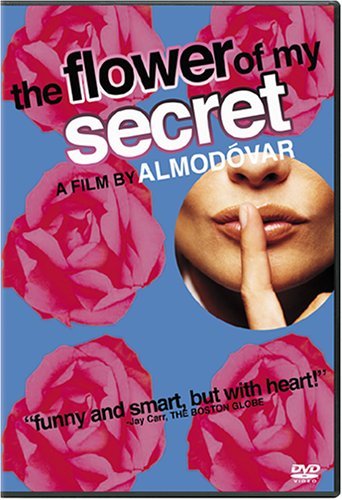
Review of The Flower of My Secret
We've been working our way through the Almodovar complete oeuvre for a few months, and this was the first one that everyone liked - a proper story without too many slapstick gags or obvious contrived taboo-breaking.
Still lots of very Spanish detail - the return to the village, the interiors heavy with knick-knacks, but no drug-crazed nuns or sex-hungry priests.
Odd relationships to other works; arguably the central scene, in which the heroine's husband comes home on leave from the army, is borrowed directly from a Dorothy Parker short story. The initial scene, in which she acts the part of a mother whose son is brain dead and whose organs are needed for transplants, is borrowed as the basis of another work of fiction, transplanted to California. And the story that's stolen and becomes the plot of a film after the heroine has discarded it, is the plot of another Almodovar film, Volver.
Watched at The Old Co-op in Horns Road as part of Jane's Almodovar season.
Review of 'Gifted'
Nice Hollywood movie about a little girl who is a maths prodigy being raised by her uncle in Florida after the suicide-death of her maths-genius mother. The uncle is nice and kind and doesn't want her to be a socially isolated genius like her mum, the grandmother doesn't want her to waste her talent...
Occasionally schmaltzy but quite good and enjoyable.
Watched on a DVD recorder at Minnie's flat.
Occasionally schmaltzy but quite good and enjoyable.
Watched on a DVD recorder at Minnie's flat.
Thursday, March 05, 2020
Salussola 1945
Salussola 1945
I play mummies and daddies with my doll. My doll is Mummy. I don’t have a doll to be Daddy so I use my teddy bear. Daddy doesn’t really look like a bear but I don’t remember what he looks like very well so the bear is good enough. I was only little when he went away to Africa to fight the English. Now he is in Africa but a different Africa and he doesn’t fight the English any more. He is a prisoner but he is not in a prison, he works on a farm. He writes letters to Mummy but it takes them a long time to arrive because they have to go to the Red Cross first. Mummy says the English might send him home now that Italy is not fighting them any more.
Uncle Stefano’s visits to Mummy are a secret, but they are one of those secrets that everyone knows, like who really brings the presents at Christmas. Uncle Stefano parks his bicycle at the back of the house so that everyone can pretend his visits are secret. Mummy says that sometimes the best place to hide a secret thing is inside another secret. She says I will understand when I am older.
Uncle Stefano is gone when his bicycle is not there anymore. Then I can come home and Mummy takes me back to the piazza. I have a lemonade and a little sweet cake, and Mummy has coffee. The old ladies in the piazza, who all wear only black, look away when we arrive and make a clicking noise with their mouths. These noises mean that they think Mummy is not a nice lady. Because Uncle Stefano comes to visit during the afternoons. Mummy doesn’t wear black. She wears a white dress, and lipstick, and she smells nice, not like the old ladies. I wear the pretty blue dress that Mummy bought me.
The Black Brigade sit at a table in the piazza. They wear black shirts with medals, and black boots. They look at Mummy but they don’t talk to us. The Captain makes a nasty joke about bicycles and they all laugh a horrid old-man laugh. Mummy says something quietly, but loud enough for them to hear, about how strange it is that such brave fascists are drinking coffee in Italy and not fighting in Africa or in Russia.
The Captain says Mummy should be glad that he and his men are there to protect from the partisans, because the Communists don’t like whores and string them up when they can. It’s because they believe in free love, he says to his men, and whores don’t give anything away for free. Then they all laugh again.
Sometimes there are German soldiers in the piazza. They look tired and their uniforms are not smart like the Black Brigade. They are nervous and hold their guns at the ready, even in the town. The Captain and his men salute the soldiers and heil them but the soldiers do not respond or return the salutes. They smile at Mummy, though, and sometimes she smiles back.
Uncle Stefano used to be a soldier, but in another war, a long time ago. He was wounded and that’s why he walks funny. Mummy says he was very brave and could wear medals if he wanted to, but he doesn’t.
Sometimes at night other men come to visit Mummy. I am supposed to be asleep, but I hear them arrive at the back door, and I hear their low voices in the passageway. Once I crept out of my room to see them. They wear dark clothes, and they have guns like the soldiers.
Mummy gives them grappa to drink, and little packets of brown paper. I don’t know what is in the packets, but I think it might be one of the private things that Mummy does with Uncle Stefano. He brings a bag when he visits, and once I saw that it was full of brown packets like the ones Mummy gives to the men.
Mummy says that honour and shame are cousins, not enemies, and sometimes they help each other out. She says I will understand when I am older.
Scene: A throne room. GOD is seated on a celestial throne. He is reading a report. Beams of light stream from behind him. To his left an angel plays a harp; to his right a twelve-person gospel choir sings.
Enter the Angel of Death. He is dressed all in black and carries a ledger under his arm.
GOD: Well?
AoD: Not this time. Not this time either.
GOD: Again? How many times does that make it?
AoD: Thirty four. Thirty four years, it’s been. Thirty four games, and I haven’t won a single one.
GOD: Obviously.
AoD: Obviously. You know, it wasn’t my idea, the whole chess game thing. I liked it better when I just turned up and tapped them on the shoulder. It was you that suggested -
GOD: Well, it works out just fine for almost everyone. Even Grand Masters, they feel like they’ve had a fair go, and they lose, and they come without a fuss. Everyone except him.
AoD: I think he might be cheating.
GOD: You can’t cheat at chess. It’s all there, right in the open, all the pieces.
AoD: Maybe he’s using some kind of magic.
GOD: Don’t come over all Harry Potter on me, D. There’s no such thing as magic.
AoD: Well, there’s some sort of trick. Something to do with bending time.
GOD: What do you mean, “bending time”?
AoD: Don’t ask me. You’re the one that lives in the Eternal Present. For me it’s all linear, one damn thing after another, until the end of time. But it might be a maths thing. He’s a mathematician, isn’t he?
GOD: (Nodding) He is...well, that would explain why he doesn’t look...what is it, a hundred and three?
AoD: (Consults ledger) A hundred and seven actually. I don’t think he’d have that girlfriend, if he looked a hundred and seven.
GOD: So what happens, when he bends time?
AoD: It feels just like a normal game of chess. I’m seeing like thirty moves ahead, which is enough to beat anyone, right? Only somehow the moves that I’m seeing ahead, they’ve...already happened. So I’m not seeing ahead at all, I’m seeing behind. And pieces that were taken, they’re back on the board again, in different positions.
GOD: Does he...could he just be sneaking them back on, when you’re not looking?
AoD: (Looks at GOD with an exasperated expression)
GOD: Sorry...I just asked.
AoD: And that’s not even the worst of it, not this time.
GOD: What?
AoD: Notice anything? Anything different about me?
GOD: Of course I do. I’m omniscient, I notice everything. Just give me a minute. Oh, where’s your scythe?
AoD: (Points at GOD) Bingo. We’re on the empty beach, and I’ve lost again, and I’m just about to get up and leave. And then he says, “Fancy another game? And just to make it interesting…”
Review of Parasite
Hard to say much about this now that it's won best film at the Oscars. It's suspensful and gripping all the way through, and it feels like it's saying something about class and power...though on reflection I'm not really sure how profound or important the message is. Bad things happen to poor people, and their lives feel like a long series of bad luck incidents - as the father in the poor family says, the best plan is to have no plan, presumably because there's no point in planning when you are so subject to the forces of fate.
This starts out looking a bit like a comedy scam film as the poor family wheedle their way into the gullible rich family and start taking them for a ride, happily trashing the lives of their existing servants to supplant them without much concern. Then it suddenly turns into something a lot more like horror, though there's no real torture-porn and nothing supernatural.
I can't say I 'enjoyed' it, but I appreciated it as a good well-made film. I note in passing that almost no-one has drawn any comparison with Bong Joon-Ho's earlier film 'Snowpiercer', which was also about hierarchy and class power, and had lots of blood and gore.
Watched at the O2 complex in Finchley Road, London.
Tuesday, February 25, 2020
Review of Kika
Basically loathsome...another one about a man who has a passion to kill people for no reason. Anytime someone tells you that Almodovar understands and likes women, refer them to this one. It has nasty cum jokes, an absolutely vile rape scene that is played for laughs, a central character that recapitulates every 'ditzy' woman stereotype.
There are a few decent visual jokes - I couldn't help liking the psychologist-turned-TV-presenter's outside broadcast outfit that has a camera on her head and lights built into her tits, and she wears some good gothic horror stuff to actually present her shows.
But mainly it's just horrible.
Watched at Jane's shop, the Old Co-op on Horns Road in Stroud.
Saturday, February 22, 2020
Review of 'Revolution in Rojava – Democratic Autonomy and Women’s Liberation in Syrian Kurdistan"
I read this for Stroud Radical Reading Group, having not really engaged with Rojava before - except via the occasional Facebook post, and the bit in the film 'The Accidental Anarchist'. There's a long and sometimes confusing sprint through Kurdish history; I knew the early bits but not the later parts, particularly since the beginning of the Syrian Civil War. It's hard following all the groups and organisations that are referred to, and the dominant groups in Rojava seem down on all other Kurdish movements. It's also the case that the book (inevitably) is out of date, in that the enclaves it writes about are now for the most part occupied either by the Turkish or the Syrian Army. There's a lot about the wider politics of the region, but curiously there's no reference at all to Israel - as it it's somehow nothing to do with Syria. And yet the suggestion that the YPG are supported by Israel is often made, so it seems like the sort of allegation that ought to be addressed rather than ignored.
There's lots that isn't in the book. I don't really understand how the Rojava not-statelet works, and I certainly don't understand what economic model it follows in the absence of a state. There are co-ops, but are there wages, prices, profits? Are these set by the market or something else?
Some bits are too turgid to read, and some too confusing. I find it hard to believe that a Marxist-Leninist inflected nationalist armed struggle turned itself into an eco-anarchist inflected feminist movement, and I'd like to know a lot more about how that happened and what it felt like. I can't believe it was all due to a revelation in prison of Ocalan.
Still, it's utterly amazing what they are even trying to do - to build a libertarian, feminist society in the midst of monstrous hierarchical and patriarchal regimes and movements. Even the fact that they aspire to this is magnificent, and they deserve all the help that they can get...and the book is worthwhile for bringing that out.
Thursday, February 20, 2020
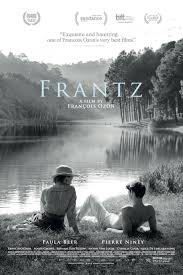
Review of Frantz
A slow but intriguing film set (mainly) in a small town in Germany, when a young woman whose fiance fell in the closing months of WW1 finds a young French man putting flowers on his grave (BTW why is he buried in a churchyard in his home town rather than in a battlefield war grave like almost everyone else? Were German practices different is or is this just a mistake by the film-makers?).
Hard to say more without a spoiler, but it's beautifully shot, acted and plotted.
Watched on BBC iPlayer on smart TV.
Hard to say more without a spoiler, but it's beautifully shot, acted and plotted.
Watched on BBC iPlayer on smart TV.
Sunday, February 16, 2020
Review of Schultze Gets the Blues
Another one of those light social comedies for which German cinema is so justly famous...well, this is sort of a comedy, though there aren't many laughs.
Schultze and his two mates are made redundant from the salt mine in former East Germany where they work, and they don't know what they'll do with themselves. Schultze picks up his accordion, and accidently discovers Zydeco on the radio, and now he wants to play that instead of the polkas that he's played to date.
If this had been an British film, he'd have been charmingly redeemed by his discovery and he would have had a new life as a Cajun...but it's a German film, so he just carries on as before, sort of half-heartedly searching but not finding. The poster and the blurb and really misleading...he never has a moment in which he finds new life through the new music, and he never leaps for joy, or for anything else.
He goes to America and rents a small boat, which he drives down a river (the Mississipi?) through the bayous, but he never quite finds the local music that he's apparently after...just more people playing German polkas, and then Czechs playing Tex-Czech polkas. He almost makes friends along the way, but not quite. And it mainly gets bleaker and bleaker.
Watched in the Middle Floor at Springhill, from an old-fashioned DVD.
Tuesday, February 11, 2020
Review of 'Vertigo" by Boileau-Narcejac (Pierre Boileau and Thomas Narcejac
Wow, what a book! A very short thriller with lots of narrative and emotional depth...it's the book on which the Hitchcock movie (which I've never seen, but will now) is based. Hard to say much about it without giving away the plot, but it's brilliant, and the atmosphere - of Paris during the Phoney War of 1940, and then the immediate post-War period, is brought to life with little details. I didn't see any of the twists coming.
Monday, February 10, 2020
Review of Honeyland
Ruth liked this more than I did...I found it hard to like, though much to appreciate. It's about honey producers in Macedonia - one oldish woman (living with her much-older mother) who produces honey through a combination of wild gathering and a few semi-natural hives, and one family of micro-scale commercial producers, who know almost nothing about bees or honey (or cattle farming, their other main activity). Despite the poster this is not a depiction of any rural idyll - they are a few miles from Skopje, but it's poor and harsh in a nasty way.
The family is a personal, social, cultural and agricultural disaster zone - their children suffer from bee stings, cow kicks, each other, abuse and neglect. Although they are barely part of the commercial nexus (they sell their honey to a small-scale dealer for cash) they have absolutely no feel for sustainabilty...not just in environmental terms, but in terms of planning for any kind of crop next year. They lose fifty calves because the husband has delegated feeding them to his wife, who has delegated it to the children, who just don't. Naturally their slash-and-burn methods devastate the production of their old woman neighbour, who has told them all she knows about honey production - I was going to say 'taught them all she knows', but she has taught them nothing.
Oh, and it's all actual 'found footage', in that the camera crew apparently went there and filmed without understanding Macedonian or knowing what was going on. Which means all that the brutal and incompetent and harsh scenes really happened, and no-one did anything different because they were being filmed.
It's beautifully filmed, but it's not beautiful. The landscape is harsh, the woman is ugly, the dwellings are impoverished but without the beauty that sometimes comes from simplicity. The music is amazing, but sometimes it's almost like atonal noise, so that it seems to be pure emotion rather than anything like a tune.
Watched at Lansdown Hall through Stroud Film Club.
Sunday, February 09, 2020
Review of "Down to Earth: Politics in the New Climatic Regime"
Is it possible to hate a book and love (or at least like) it at the same time? This one makes some really important points about the sense of dispossession and displacement that underlies some of the popular support for the new right, and about the vaccuity of the project of modernisation and globalisation that has been the principal objective of both liberalism and neo-liberalism. This is important, and he makes the distinction between "good" internationalism of accepting that we all live on one planet with one atmosphere, and that refugees (especially climate refugees, of which there will be many) are people like us, displaced - and the "bad" internationalism of saying that we can't fight the deregulatory race to the bottom and outsourcing.
And it's something that I not only understand, but feel - I'm aware that I now feel like an ex-Londoner, because London doesn't want people like me and my family any more, but I don't really feel like I belong in small-town Gloucestershire either; many of my friends are also people who moved here from somewhere else, and some of the locals feel aggrieved that I'm part of the trend that makes their town no longer affordable for their kids, and I can see their point. There are great bits about that in the book, and I was delighted to learn about Zadists.
But it's written in the most abstruse, complicated language - and with incomprehensible diagrams that are supposed to illuminate the argument but really really don't. I've had this experience before with Bruno Latour, when I read his stuff about science and the labour process, and later about the embedded social relations of technology like caravels. He's got really important things to say, but it's absolutely not accessible to a lay audience, at least not one of English-language heritage. I wonder whether he's let down by bad translation, but I don't think it's that. It's more that the English and French intellectual traditions are so alien from each other, that even though this book appears to be in English, it isn't. Which rather speaks to his point, if you think about it.
Review of Marilyn Hotchkiss ballroom dancing and charm school
Soppy but quite enjoyable romantic comedy/drama, in which a baker played by Robert Carlyle (but what accent is that even supposed to be?) goes to a dancing school as part of a favour to a dying man, and finds the happiness and love that he's lost after the unexpected suicide of his wife.
Watched on Netflix...or was it Amazon Prime? I don't remember.
Sunday, February 02, 2020
Review of Groundhog Day
Just watched this again in the Middle Floor at Springhill (on a DVD) and had forgotten how great it is. Really enjoyed it, in all its feelgood schmaltziness. Bits of it - about how life is capable of perfection if we only had the time, and the inclination - felt very profound, though I wonder if that feeling will evaporate on reflection.
Review of 'On Tyranny; Twenty Lessons from the Twentieth Century'
If you think that 'totalitarianism' is a useful concept for analysing political systems, that it's useful to compare 'democracies' and 'tyrannys', and that democracy is like pregnancy - you are either are you aren't - then this is the book for you. It will help if you think everything was fine in the UK, and the US, and Europe, before the nasty right-wing populists turned up. Otherwise you might not like it so much.
This couple of sentences stuck out so much I wanted to quote them in full:
"Some spoke critically of neoliberalism, the sense that the idea of the free market has somehow crowded out all others. This was true enough, but the very use of the word was usually a kowtow before an unchangeable hegemony."
So is neoliberalism a useful concept or not? Speaking critically of it is...er, true? Or a kowtow to something?
Thursday, January 30, 2020
Review of JoJo Rabbit
A comedy about a kid in the Hitler Youth, whose imaginary friend is Hitler, doesn't sound very promising. I was a little stunned by the trailer - I almost thought it was a spoof, like 'Springtime for Hitler'. But actually this is a very good film, though a little uncomfortable at times - especially at the beginning, where shots of Nazi rallies are overlaid with a Beatles soundtrack. After a while, though, I appreciated the point - the Nazis were people like us, and the rallies were fun and exciting to them in the way that other people enjoy rock concerts.
There's some really good acting in the film, and lots of arresting images. Good to see Rebel Wilson in a better role - she's been in some real dross lately.
This is a 12A, and although there's not much bloody violence there's a lot of tension and some horrible scenes; I don't think I'd take my 12-year old.
Watched at the Everyman Cinema in Muswell Hill.
Review of 'This is an uprising' by Mark Engler and Paul Engler
I think this is a dangerous book, and not in a good way - in the way that a manual for a difficult and important task with significant mistakes (a bomb-making manual, maybe?) would be.
It purports to be a ‘playbook’ for non-violent revolt, but it isn’t. It’s a partial survey of some mass outbreaks for civil disobedience in the early 21st century, with some partial analysis and some glaring omissions and failures of analysis.
It starts with an account of the US Civil Rights movement tactics in Birmingham in the early 1960s, and how much impact that managed to create despite - or rather because of - the movement’s weakness in the face of overwhelming repression and violence from their enemies, both in the State government and in civil society. Then there’s a discussion of the difference between two US schools of radical organizing - the tradition of community organising created by Saul Alinsky, and the ad hoc ‘movement on the fly’ tradition attributed to theorist Francis Fox Piven, and a sensible suggestion that the differences might be more apparent than real.
After this there’s a detailed analysis of the successful unseating of Slobodan Milosevic in Serbia by a mass movement called Otpor. Bizarrely, there is absolutely no mention of the links between Otpor and the CIA, though I could find them online within seconds. Later in the book there’s a brief reference to the so-called ‘colour revolutions’ in the successor states to the USSR, and why they failed - but no indication that the authors know about the deep involvement of the US government. I later found some reference to ‘external funding’ in the footnotes to the discussion about Otpor, but I couldn’t follow it up - and really, that’s not nearly good enough.
The same applies to the discussion (again!) of the work of Erica Chenoweh and Maria Stephan - which is largely a re-presentation, without any critical engagement, of their conclusions that non-violent protest is more effective than violent protest. Others have criticised some of the deficiencies in their methodology so I will hold off that here. But it’s odd to present these two - who are embedded in the mechanics of the US government’s regime change armoury - as either disinterested scholars or as friends of a movement for transformational social and political change. This stuff has a long history - at least as far back as the overthrow of Mossadegh in Iran in the early 1950s - and ignoring it undermines the good parts of the book.
This absence is little short of breathtaking. There’s been years of work situating the Civil Rights movement in the political context of the Cold War, and analysis of the relationship between the movement and the transformations taking place within US capitalism at the time. But this is simply ignored, in favour of an account that says the movement was successful because it got the tactics right.
There’s extensive coverage of three pivotal mass movements of non-violent action; the Occupy movement; the mass mobilisations against the Iraq war; and the Arab Spring. My take on all three of these is that they are perfect illustrations of the limitations of mass street protests as a political strategy for transformation. The anti-war mobilisation made those of us who took part in it feel better (the awful slogan ‘Not In My Name’ really sums up what this was about) but did not stop, deflect or limit the invasion of Iraq. Occupy got a lot of people involved in politics for the first time (and I heard some rather good talks at the ‘Occupy University’ next to St Paul’s) but it’s really hard to find much legacy, apart from the hand signals thing. The Arab Spring - especially in Egypt - has left almost nothing behind. The same military crony gangsters are in power as before, and the leaders of both the democracy movement and the electorally-oriented Islamists are in jail.
I can’t say that the book doesn’t address this, because it does - but in a drive-by analysis from the hip sort of way. Yeah, the democracy movement people didn’t have an organisation, or a political program or a strategy for seizing state power, so they lost....Isn’t this what the book ought to be about? Not how to have good demonstrations, but how these can actually lead to a shift in the balances of forces. There is an entire tradition of revolutionary theory and practice that has an answer to these questions - the Bolshevik tradition. I think that it’s ultimately wrong and leads us to a bad place, and its track record is not great - but it is an answer. Reformist socialists have another answer, that nothing else matters except winning elections and thus “getting in to power”; again, a flawed answer, but a coherent one. I don’t see an answer from the authors’ perspective, just a belief that there ought to be one.
Which points to the biggest shortcoming of all; despite the title, this is not for the most part about uprisings. The Civil Rights movement was not an uprising but an effort to get Black Americans a bigger piece of the pie and a seat at the table of political decision making. In another context, Eric Hobsbawm talked about “collective bargaining by riot”, and I think that’s not a bad way to characterize the Civil Rights movement. That’s why it could attract funding and support from corporate think-tanks and foundations, and why it succeeded as far as it went but no further.
There’s a difference between mass protests with a specific and limited aim, and an uprising. Of course one can turn into the other sometimes, either in a planned or an unplanned way; but for those taking part, it’s important to know the difference and what you are involved in. In that way XR is being disingenuous in calling itself a ‘rebellion’ when, despite the occasional fantasy, it does not have any plans to overthrow the state and seize power. It wants to pressure the government to do the right thing; along the way it proposes some important changes to the political process (notably the idea of a Citizens’ Assembly), but these aren’t really any more revolutionary than the people who think proportional representation will fix a dysfunctional political system.
This is not to say that there’s nothing useful in the book. The Englers are decent sorts, not CIA stooges. There are some good thoughts about tactics (though there is something of a tension between the occasionally contradictory suggestions), and especially on the pragmatic adoption of non-violence as distinct from ideological pacifism. There is a good bibliography and pointers towards other literature. But it’s not a playbook for system change, and those using it as such will get themselves into trouble.
Wednesday, January 29, 2020
Some thoughts about Holocaust Memorial Day 2020
On the 25th of January I joined with my comrades from the Stroud Red Band to play at a Holocaust Memorial Day interfaith event in Rodborough Tabernacle. We’d played at last year’s event too - a couple of antifascist resistance songs including Bella Ciao and Zog Nit Keynmol, and the anthem of the Jewish workers’ Bund, Di Shvue. This year we didn’t get to play Di Shvue, but as a bonus we played ‘The Internationale’ as the congregation filed out.
We were pleased to be included, and we know it’s important to not only engage with our own left-wing ‘bubble’. I know that other band members found the event very moving, and we hope they’ll have us back next year. But there are some things about the event that I find unsatisfactory. This year, in the evening, I was fortunate to join a discussion about why and how we mark Holocaust Memorial Day at Stroud Radical Reading Group, and that helped me to clarify my thoughts as to why I was unhappy.
At the Group we discussed why we should commemorate the Holocaust. There is truth in the idea that failing to do so would dishonour the victims and would be in some sense a victory for the perpetrators, who would have been thrilled by the possibility that their crimes would fade from memory. But I think that there is another reason for commemoration - to learn from what happened, to understand it, so that we can be better prepared to prevent similar crimes in the future and to place roadblocks in the way of the Nazis’ successors.
I think that the event in Rodborough didn’t help that objective. The Holocaust - meaning the Nazi genocide, and other genocides, was commemorated, but in a way that was devoid of everything specific about it. Most of the commemoration was prayers - from a variety of denominations and religious traditions, to God about his loving kindness, and some injunctions that we should all show loving kindness to each other. There was a children’s choir that sang some uplifting songs including ‘Something Inside So Strong’, which I love, and a woman who sung ‘Bridge Over Troubled Waters’ a capella.
I think there is something deeply problematic about all this. The Nazi genocide was not a personal challenge that needed to be overcome through personal resilience. It was not the result of a deficit of loving kindness, or a surfeit of cruelty. Most of the people who participated were not personally cruel, and even leading Nazis regarded the extermination as something that was personally difficult and for which they had to steel themselves. It was the culmination of a thousand years of European antisemitism, and a hundred years of scientific racism and eugenist thinking, and the specific ideology and mass movement of Fascism, to which was added all the power of a modern industrial state and its administrative capabilities. It did not begin with death camps but with small administrative steps of discrimination and separation. Many of the perpetrators were not monsters but people like us, drawn into a mass movement based on nationalism that gave them hope and made them feel good about themselves. If we don’t say these things then we haven’t learned anything that might prepare us to resist the next genocide-in-the-making.
Some of this is perhaps inherent in the way that the Nazi genocide is conceptualised as ‘the Holocaust’. Although this has become the generally accepted term, its use has been contested by some - notably Elie Wiesel. The word ‘holocaust’ means a religious offering that is completely consumed by burning. I think it is worth reflecting on the idea that the Nazi genocide was a ‘sacrifice’ - by whom? To what? And also on whether treating this genocide as primarily an event of religious significance obscures the role of human agency, and the political and historical context - and on what it means to do that.
I’d also like to reflect on the decision to make Holocaust Memorial Day about other genocides, as well as about the Nazis’ efforts to exterminate the world’s Jews. Again, doing this is largely accepted by all those who organise commemorations, and the arguments for doing so are obvious. The Jews were not the only victims of the Nazis. The Nazi genocide was not the first, and it wasn’t the last. If we don’t commemorate those other genocides on Holocaust Memorial Day, when will we? Having separate events for the extermination of the Tasmanian Aborigines, and the Armenian Massacres, and the Africans murdered in the European-organised slave trade, and the many others, would mean that the entire year’s calendar would be full.
The list of genocides presented at the Rodborough event was very partial and incomplete, as it must inevitably be. But it’s hard to avoid wondering about the basis for selection and for the omissions. Why nothing about the Germans’ extermination of the Hereros of South West Africa, the first genocide of the twentieth century? Why the victims of Stalin’s collectivisation of agriculture but not the three million victims of the Bengal famine of 1943, which might be laid at the door of the British Empire? Once you begin to set out a list, then every inclusion and every omission becomes significant.
And by having a generic commemoration we lose sight of what was specific about each of them. The Nazi genocide of Jews was unique in its mechanisation and industrialisation, and in the thoroughness of the administrative organisation and its objectives. Informed by ‘race-science’, it was intended to eradicate everyone who was genealogically Jewish, whatever their religious beliefs or cultural identification.
Relativising this particular genocide has long been part of the stock-in-trade of Nazi apologists; alongside outright denial there is also the suggestion that the Nazi genocide was not so special, that lots of bad things have happened in history...the suggestion that Soviet repression was equivalent is a frequent theme of those who want to whitewash the historical record of the Nazis and their collaborators, especially in Eastern Europe.
So I’d like to make a plea for Holocaust Memorial Day commemorations to be specific, not generic - about the Nazi genocide, and about other genocides too, when we talk about them. Because focusing on the historical context of these terrible events holds out the possibility of learning something, but emphasising the commonality of all of them brings us to a shapeless reflection on ‘inhumanity’ that doesn't take us anywhere.
The theme for this year’s Holocaust Memorial Day was ‘Stand Together’. Let’s think about who needs us to stand with them now.
Friday, January 24, 2020
Review of 'Case Histories' by Kate Atkinson
My first Kate Atkinson book, and on the strength of this I don't think there will be others. I'd heard this one discussed on a book program on Radio 4 and it sounded great, but it wasn't. It captures lots of details about British social and everyday life, but in a way that feels rather sneery, especially about class markers. It also seems a bit cliched, and I don't much like the reported thought speech of some of the characters. The plot elements are nicely developed, and nicely tied up, but it didn't compensate for the slightly uncomfortable feeling that I had all the way through.
Wednesday, January 22, 2020
Review of Vanity Fair
The 2004 version, with Reese Witherspoon - there have been lots of film versions.
Notable for being a bit more sexy than one might have expected...most of the women wear awful Regency dresses, but Witherspoon somehow manages to look good in hers. And there's a ridiculous set-piece 'Arabian' dance towards the end, in which she captivates the Prince Regent.
Earlier, she sings a song based on Tennyson's sonnet 'Now Sleeps the Crimson Petal', which was written by the time that the novel was published, but not in the Regency Period in which it is set - and the music seems really wrong for the time period, though rather nice.
Watched on Netflix.
Review of 'Now You See Me'
Upbeat, jolly and enjoyable heist movie, with some not-very-surprising plot twists. Good to look at, and some fun 'Robin Hood' themes - the four magicians are using their trickery to rob bad buys and give the money to...well, to the people who turn up to their shows, who sort of represent the poor.
Some bits don't add up entirely, and I'm also not so sure about representing stage illusions on screen - is there a point?
But quite good fun, and no dozing.
Watched on Netflix
Some bits don't add up entirely, and I'm also not so sure about representing stage illusions on screen - is there a point?
But quite good fun, and no dozing.
Watched on Netflix
Tuesday, January 21, 2020
Pygmalion
I read this - I'm not calling this post a review, because GBS does not need any reviews from me. Just noting that I felt a very odd mixture of admiration and loathing in response to Shaw's narrative about class. On the one hand he recognises that speech is a class marker, and that it helps members of the dominant class identify each other and people who are other - and he recognises too that teaching someone to 'speak posh' does not really give them admittance to the dominant class. Some of the discourse about class is very acute.
And he satirises Professor Higgins's callousness towards Eliza - he doesn't care about her as a person, only as an experimental subject. Except that's about him, not his class - his mother Mrs Higgins is much kinder, as is Colonel Pickering, who show kind fellow-feeling towards Eliza, because...well why? Because they are a lady and a gentleman?
And the 'social comedy' of Eliza using her new posh voice to ignorantly speak of things that good manners require that she shouldn't? And the humorous spectacle of Eliza's father elevated to wealth despite himself? Who is laughing at this, and what do they find funny?
And the fact that the two representatives of the working class are a flower girl and a dustman...more like servants than proletarians?
Saturday, January 18, 2020
Review of 'Ship breaker' by Paolo Bacigalupi
Again, one that I meant to write a while ago and then got distracted. This is a rather good dystopian science fiction novel, set in a near-future that's harsher, more resource-constrained and more unequal than our present world...but it's actually pretty much like the world of now. It's particular good on the distance between the super-rich and the people at the bottom, including those who work on shore-based ship breaking; and on the way that outsourcing and subcontracting make a mockery of environmental and other standards. Good plot and characters too, and nice descriptions and settings. Not as good as his others, but still good.
Review of 'Hollywood Bombshell'
Sorry I forgot to finish this review...a nice documentary film about Hedy Lamarr, who was a rather brilliant woman but had a less than brilliant Hollywood career, even though she was beautiful and a good actress. I think it's an object lesson in the importance of image and career management, and of course luck.
Lamarr is also sometimes credited with having invented CDMA, and the film gives a good account of this.
It's a while ago since I watched the film, but pretty sure it was on BBC iPlayer, and that I watched it via phone app and Chromecast.
Lamarr is also sometimes credited with having invented CDMA, and the film gives a good account of this.
It's a while ago since I watched the film, but pretty sure it was on BBC iPlayer, and that I watched it via phone app and Chromecast.
Review of 'How to Change Your Mind' by Michael Pollan
Good science writing about psychedelics, that made me think a lot about whether I wanted to try them or not, and also about how the mind and brain work. There's a section about the modern history of the drugs, including the scientists who experimented with using them as treatments in the 1950s and early 1960s, and whose research progams were shut down following the exhuberance mischief-making of Timothy Leary...the CIA's MK-Ultra program also gets a mention. There's a discussion about the natural history of psychedelics as they occur in nature - like, why? And a 'travelogue' recounting the author's own experiences, which is honest, nuanced, and not entirely attractive, even though he's pretty sure he benefitted from taking the drugs.
There's a section on the therapeutic uses of psychedelics, which was interesting and more convincing, and some speculation about the big picture - what does it mean about consciousness and about the universe that these things exist?
I have some entirely amateur thoughts about this - I wonder if the aspect of a memory or an experience that marks it down as 'mine' - as happening to me now, or as having happened to me - is a sort of meta-tag added by the brain, and that my sense of self comes from threading together memory items with that meta-tag. But it's possible for that tag to be added to things that didn't actually happen to me - as when I feel that something is a real memory, even though it didn't happen to me...I've witnessed this sort of false memory in others, and have some experience of it in myself. Conversely, experiences that actually did happen to me might not get the tag for chemical reasons, in which case my experience of selfness would not apply even to things that actually did happen to me - perhaps even at the time they were happening. Hence the sense of dissolution of self and one-ness with everything that some psychedelic users seem to feel.
BTW Pollan is advised not to try MDMA because of his heart issues - a particular shame because I'd like to see how he reacted to that, and how he described it.
Review of 'The Girl on the Fridge' by Etgar Keret
Quirky, disturbing very short short stories...occasionally touching on the politics of Israel and Palestine, but mainly focused on the absurdity and cruelty of normal life. I can't say I enjoyed this, but I appreciate the quality and I'm glad I read it.
Review of 'The People's Act of Love' by James Meek
So jealous of James Meek to have written such a wonderful book - set in Siberia during the Russian Civil War, and focused on the soldiers of the Czech Legion marooned on the Trans Siberian Railway, desperate to escape via Vladivostok but still caught up in the fighting and in the consequences of their actions on behalf of the Whites. With lots more too, including great characters, a complex plot, unreliable narrators, wonderful descriptions of Siberia. Probably the best novel I have read in a very long time.
Thursday, January 16, 2020
Review of Red Joan
Judy Dench is usually in good films, and this is one - 'based on a true story', it's really about Melita Norwood, who passed on information to the NKVD and KGB about Britain's nuclear weapons program in the belief that she was making for a level playing field in world politics, and thereby providing the basis for proper mutual deterrence.
It's well made, with allusions to the Cambridge spy ring. It's not that closely based on the real story, though, and reading the Wikipedia article about Norwood is revealing about the mindset of the people who make films. Unlike the fictional Joan Smith, Norwood was already a commited socialist, not someone who had her head turned by glamorous handsome European Communists. Her dad had published a socialist newspaper, and she'd been involved in politics herself for her whole adult life. And she studied at Southampton University, not Cambridge. And she studied Latin and Logic, not Natural Sciences - maybe they also wanted to make the 'woman making it in the man's world of science' film too...
Watched on Netflix.
Wednesday, January 15, 2020
Review of Tamara Drewe
Surprisingly enjoyable comedy...not exactly a romcom, more a comedy of manners, with lots of acute observations about various English 'types'. And not exactly a comedy all the time, for reasons that will become apparent if you watch it. Lots of great character actors.
I note in passing that I thought I'd already seen this but I'd actually seen 'Gemma Bovary', an entirely different Posy Simmons graphic novel made into a film.
Watched on BBC iPlayer.
I note in passing that I thought I'd already seen this but I'd actually seen 'Gemma Bovary', an entirely different Posy Simmons graphic novel made into a film.
Watched on BBC iPlayer.
Review of 'We Fight Fascists: The 43 Group and the Forgotten Battle for Post-war Britain' by Daniel Sonabend
After VE Day in May 1945 the British government lifted the Defence Regulations under which the country’s home-grown fascists had been interned as potential traitors. Some fascists, interned under Regulation 18B, had already been released on ‘compassionate’ grounds, and others had managed to avoid internment altogether; before the war was even over they began to organise, at first through fund-raising to support the wives and children of internees, and then with increasing boldness in more openly political organisations. By the end of December 1945 there were several openly fascist organisations in operation, arranging meetings in halls and on street corners, their captains jockeying for position as they waited for their once and future fuhrer, Oswald Mosley, to return and lead them.
In May 1946 four young Jewish ex-servicemen came upon a fascist platform at Whitestone Pond in Hampstead, chased off the speaker and the stewards, and then rushed to tell others at Maccabi House in West Hampstead what they’d just done. Thus was born the 43 Group, originally an organisation of Jewish ex-servicemen, but soon open to others who weren’t Jewish, or weren’t former servicemen. Women participated as equal members, though none seem to have been part of the group’s leadership. The Group’s aim was to fight fascism, politically and physically, in ways that more cautious and respectable Jewish organisations including the Jewish Defence Committee and the ‘official’ Association of Jewish Ex-Servicemen (AJEX), found unacceptable.
And fight they did, with their fists, with bricks and bottles and coshes, and with their own publication “On Guard”. Daniel Sonabend’s book, using material including interviews with former group members originally gathered for a documentary film that didn’t happen, tells their story in intricate and affectionate detail. It’s a more thorough treatment than the only other book about the Group, Morris Beckman’s “The 43 Group: Untold Story of Their Fight Against Fascism”, published in 1993 and much more a personal memoir.
Sonabend tells of the efforts to break up fascist marches and overturn street platforms, of vicious fights with fascist thugs acting as stewards and with policemen who were often in sympathy with the fascists, and in any case carried out their duty to protect fascist meetings on the orders of the Labour Home Secretary Chuter Ede.
Much of the story was familiar to me, because my Dad was a 43 Group member. He had a collection of copies of “On Guard”, and several souvenir brochures from the fund-raising balls that the Group held. As a kid I’d grown up on tales of platforms overturned and street meetings broken up. I knew about the ‘elephant’ - the armoured lorry that formed a mobile speaker’s platform for the fascists - about the ‘aryan squad’ of blond, blue-eyed Jews that infiltrated Mosley’s movement, and about the wheezes the Group pulled, including the time they dressed up as police officers to abduct and beat up one of the fascists.
Like the members Sonabend interviews, for my Dad participation in the Group was the part of his life of which he was most proud. He’d not served in the forces - his father, who had volunteered in the ‘Great War’ and been gassed at Ypres in 1915, had moved heaven and earth to get his only child a job into a reserved occupation - and his involvement in the 43 Group had been his ‘war’. He talked often of the camaraderie and the excitement of participating in street fighting. When the ageing veterans of the Group began to hold reunions in the early 21st century he was excited to attend. He schlepped me along to one, and beamed with delight when his hero, the ex-paratrooper Gerry Flamberg, told me in his earshot that ‘your father was a real Shlugger’.
But I still found things to surprise me in Sonabend’s book; the extent to which, so soon after the end of the war, the resurgent fascists openly embraced Nazi iconography, slogans and imagery. The participation of actual German Nazis, including an SS man ostensibly in the UK for ‘deNazification’ who marched in the fascists’ drum band, alongside aristocratic fascist sympathizers. The occasional social personal contacts between the fascists and their Jewish enemies - though I’d had a hint of this when, some time during the 1980s, Mosley’s former chief lieutenant Jeffrey Hamm had actually phoned my Dad at his shop to suggest that they met for coffee and to reminisce over old times. The virulence of antisemitism in all strata of British society, including in the working class and within the Labour Party, catalysed by the sharpening conflict between British soldiers and Zionists in late-Mandate Palestine; I hadn’t known about the days of anti-Jewish riots, including smashing of Jewish shops and attempts to burn down synagogues, that followed the Irgun’s execution of two abducted British seargants in August 1947.
I was also - despite myself - shocked by the level of violence that characterized the fighting between the Group and its fascist enemies. I’d participated in anti-fascist demonstrations during the 1970s and 1980s, but I don’t recall seeing anything like the armoury that Sonabend reports - knuckle-dusters, coshes, knives, razors, potatoes studded with razor blades...perhaps men who had only recently used guns and grenades were just less fastidious about lesser weapons.
Sonabend is very good at chronicling the details of the battles against the fascists, from Ridley Road to Brighton and beyond. He’s also very good at describing the conflicts within the fascist parties and grouplets, the maneuvering between Mosley’s would-be deputies, the splits and the betrayals, and Mosley’s increasingly desperate attempt to find a post-Nazi future for his movement as a pro-European, anti-Communist force. I think this analysis actually makes it clear that, despite what the 43 Group thought at the time, there really wasn’t much scope for a fascist revival in Britain in the post-war period. Although there were some hard times in the immediate aftermath of the war and the cruel winter of 1946-7, the economic collapse that Mosley expected did not occur. Britain’s Conservatives did not see the need for a strongman to overthrow Atlee’s Labour government by force, and if they had they probably wouldn’t have turned to an obvious discredited has-been like Mosley.
Sonabend is also good on the politics of the Jewish community, including the tensions between the Jewish establishment and those who wanted to take a more assertive stand against the renaissant fascists. The lines were not always drawn where they might be expected; the Group had allies within AJEX, inside the Board of Deputies, and had support from rabbis of some provincial congregations. Most importantly, they also had support from Jewish-owned businesses large and small, which made donations both openly and secretly, to fund the organisation and the burgeoning legal defence costs.
He’s less good, I think, on the relations between the Group and the left. He does refer to the convergence of actions with the Communist Party, to overlapping membership in the cases of some individuals, and to the organisation of a Communist ‘cell’ within the Group. But he doesn’t give the politics of left wing anti-fascist organisations the same lavish detail that he devotes to the fascists themselves. So there’s no feeling for the twists and turns in Communist Party strategy in the fight against fascism. He’s aware of the extent to which the 43 Group members began to identify as Zionists, so that several of them (including Vidal Sassoon, who’s always been proud of his role in the Group) went to find in the emerging Israel Defence Forces; but he doesn’t seem to know that the period of his story takes place during the brief honeymoon between the USSR, the international Communist movement, and Zionism. This goes some way towards explaining how the Group could so often stand together with Communist fighters, and could actually take a consistent position against racism in America and South Africa in the pages of ‘On Guard’, while steadfastly maintaining that it was ‘non-political’. In his wrap-up of what Group members did next, he talks about those who went on to business and career success, but not those who remained involved in left-wing politics.
It’s mean to quibble too much about what’s not in the book, which already weighs in at some 370 pages. This is a thorough account of the 43 Group and its fight against resurgent fascism in Britain which will stand as the authoritative text for years to come. For me it was also thoroughly enjoyable, bringing back to life my Dad’s stories of his time as a shlugger.
Monday, January 13, 2020
Review of Only You
Really sad film about a nice young couple in Glasgow - he's not very Scottish though his dad seems to be , she's Spanish - who get together, love each other, but can't have children even though everyone around them seems to be doing so.
Not much happens but it's beautifully made and very evocative. Really nice music too.
Watched on Netflix.
Not much happens but it's beautifully made and very evocative. Really nice music too.
Watched on Netflix.
Review of Yesterday
Nice, feel-good sort of film with a mildly intriguing scenario - following some sort of unexplained discontinuity Jack has a road accident and wakes up in a parallel universe in which The Beatles never happened - only he still remembers them and all their songs, so suddenly he's the greatest singer-songwriter in the world.
Some interesting meditations on success and talent, though the view the film takes is exquisitely conventional - the Beatles were just brilliant, and anyone would have made it with their fabulous songs, whatever their personal connections and characteristics (or lack of them).
Watched on Amazon Prime - I think the first film on Prime that I've actually paid to 'rent'.
Review of 'Woman on the Verge of a Nervous Breakdown'
Another one in the Almodovar season watched at Jane's shop, the Old Co-op on Horns Road in Stroud.
Very much in the spirit of 'screwball' comedies, with lots of scope for suppressed aggression and sexual jealousy. All your favourite Almodovar actors, and the first one I've seen with a major part for Rossy de Palma (though she was in 'Law of Desire', with her fabulous nose.
Sunday, January 05, 2020
Review of 'Wild Honey'
Not very interesting or enjoyable film about a middle-aged phone sex operator, overweight and unattractive and back living with her hyper-controlling mother, who decides to pursue a relationship with one of her clients who seems nicer than the others.
Implausible, not well sustained, and at once painful and dull to watch. But look how many awards it won! Let that be a lesson, about awards.
Watched on Amazon Prime.
Implausible, not well sustained, and at once painful and dull to watch. But look how many awards it won! Let that be a lesson, about awards.
Watched on Amazon Prime.
Thursday, January 02, 2020
Review of 'Wild Rose'
A quite nice film about a country singer in Glasgow - a young single mum with a great voice and stage presence, but no other musical skills (she can't play an instrument, she doesn't write her own songs) who longs to go to Nashville to start her career, but has no money or backers or connections...
She's not very good at life - she's just come out of prison for smuggling heroin into a prison, and the electronic tag she wears doesn't fit well with doing singing stints in Glasgow's Old Opry.
Some nice music (even though I'm not that keen on country as a genre), and good acting. It's not as brilliant or uplifting as some of the reviews suggest, but it was enjoyable and not too downbeat.
Watched on Amazon Prime via Chromecast.
Sunday, December 29, 2019
Review of 'Playback'
A very small Chandler novel, with an unusually upbeat ending - but nicely formed and plotted, with good characters and atmospheric settings. The usual crop of corrupt rich people, bent coppers, and so on.
Review of 'The Long Goodbye'
Possibly the best Chandler ever...complex plot (which I'm not sure I entirely followed...), great characters and settings, and an atmosphere of dank, over-ripe corruption that pervades everything. Written in another time and world, but feels very appropriate for our time.
Review of 'Smallpox Hill'
Unusual crime thriller with a GP protagonist, good characters and a rural West Country setting - not the chocolate-box version of the Cotswolds, but the gritty reality of the western side in the shadow of Bristol. This isn't by any means a rural idyll, but the author has a good feel for the landscape, and I also like the descriptions of buildings and interiors.
Nice, taut writing, a tense plot and believable bad guys - and some additional medical details that make the action more interesting and more believable.
Review of 'Funny Cow'
Maxine Peake plays a comedian on the Northern working men's club circuit, with a narrative that flits back and forth during her life and career. It's not a happy or feelgood film, and it depicts well the environment of male violence and abuse that she grown up in. She's ultimately successful as a comic (not really a spoiler as we see this in more or less the opening sequence, in which she returns to look back at her child self) but she does so by participating in the racist, sexist, homophobic culture of the clubs - anything else would have been an ahistorical fantasy, of course. A really good film but not an entirely enjoyable one. The poster makes it look much lighter and funnier than it really is - I can't remember laughing at all.
Netflix - quite a good one, for once.
Review of 'City of Dreamers'
Not very interesting film about a young Irish woman who moves to Brighton after the break-up of a relationship, moves into a house with a nice but weird young man and then meets a succession of other nice young people with whom she builds meaningful friendships. She's a singer-songwriter, and has one bad night singing in an open mike night, busks on the street and makes loads of money because she's really very good (apparently - it's not obvious to me, though she has a nice voice) and then has a good spot at a party.
Inexplicably this film has wonderful reviews, though it's just slightly better than boring. One useful insight though; note to singer-songwriters - do at least two cover versions for every one of your own songs that you sing, and people will love you for it.
One odd thing - the Irish woman doesn't have a mobile phone and spends a lot of her time in phone boxes, calling her mum and making fruitless job-seeking phone calls. This is not explained. Everyone else in the film has phones, so why doesn't she?
Watched on Netflix. Are there any good films on Netflix?
Subscribe to:
Posts (Atom)