Sunday, September 24, 2023

Review of Casablanca Beats

I watched this at the Lansdown Film Club, where there is a post-film "bead voting" system, and I was the only person to put a bead in the bowl marked "Poor".  I didn't enjoy it much. I was bored, I dozed off sometimes, and I felt that it was shapeless and bad storytelling. I'm all in favour of films that leave the viewer to fill in or imagine some of what's left unsaid, but this felt like there were gaps in the narrative that had just been overlooked. 

There were some great young Moroccans who were learning to rap with a charismatic teacher at a cultural centre called Les Etoiles de Sidi Moumen - Sidi Moumen is a poor district of Casablanca . The young people were playing themselves, and the teacher is played by moody Moroccan actor Abdelilah Basbousi. There are some really great set-piece debates between the kids, notably about whether young women ought to dress "decently" in order to be respected. There's a big dance "fight" between the kids and some religious fundamentalists.

Ultimately though it was a disappointment. It feels a bit like it ought to have been a documentary, without the pretence of a plot, and with lots of interviews with the kids about why they felt that an American art form spoke to them as a young Moroccans.

Like I said, watched at Lansdown, and a testament to how bad the film was is that I managed to doze off even on the world's most uncomfortable chairs.


Review of "The Treasure of the Sierra Madre" by B Traven

An absolute ripping yarn about American hobo-adventurers in Mexico in the 1920s, written by a mysterious perhaps-German author about whom almost nothing is known. I've known about B Traven for years and have thought about reading this, but it was only when I picked up a free copy at a tube station book drop that I finally got round to it - partly as a way of avoiding reading a heavier non-fiction book that I was supposed to be doing.

It's in a spare, hard-boiled style, with little description and not much introspection, and yet it was absolutely compelling reading that carried me on. The characters are casual workers who become gold prospectors, set in a background of reforming post-revolutionary Mexico, with Indians and Mestizos and bandits. There's some nods in the direction of progressive politics - a paean to the railway workers' union, a brief speech in favour of Bolshevism and Communism by one of the characters - but there's some racism that would be unacceptable now too.

Monday, September 18, 2023

Review of My Sailor, My Love

Ireland-set, Scandinavian-made romantic drama about an older man finding love late in life with an older woman sent by his daughter to be housekeeper-carer, and the impact that has on the very troubled daughter who has spent her whole life traumatised by the effort of caring for first her mentally ill mother and then her deteriorating and unloving father. Lots of heavy emotional work, and lots of beautiful scenery and perfectly drawn interpersonal dynamics. It's not as unremittingly bleak as this makes it sound, but there aren't many laughs.

Watched on Netflix via phone and Chromecast, an unusual good film found there.

Review of "All the Light We Cannot See" by Antony Doerr

I really liked and enjoyed this lovely book. It's hard to imagine that something about a blind girl making her way through the world of occupied Brittany during WW2 could be so heartwarming, but it was, despite all the awful things that happen to the characters. There's a narrative that's split between different characters and switches backwards and forward in time, which can sometimes be annoying but wasn't here. One of the central characters is a very young German soldier, and I'm sometimes upset by books which foreground the experiences of people like that, but this didn't affect me that way at all. 

It was long and occasionally harrowing, but I'm so glad I read it and was sorry when it ended.

Friday, September 08, 2023

Review of Oppenheimer

The fact that it's been several weeks between seeing the film and writing a review says something. I know it's an important subject and that it's seen as an important film, but despite the length (3 hours) I was a bit underwhelmed. Visually it felt a bit trite. And I've often liked Christopher Nolan's films for complex narrative structures, but this one felt ponderous and contrived rather than interestingly complex. 

I thought I knew the story of Los Alamos, and I wasn't aware of any major surprises as I watched the film. It felt to me like the conflict with Lewis Strauss, which I didn't know about, was the dramatic centre of the film...I think I'd rather that it hadn't been so long and convoluted, and that it had focused on that more. The claustrophobic scenes of the private hearing that more or less finished Oppenheimer as a public figure, because his security clearance was not renewed, are really well done.

Despite the length of the film the tension between Oppenheimer and Strauss doesn't really feel well explained - was it really because Oppenheimer said something that made Strauss feel humiliated at a Congressional hearing of some kind? Was there really nothing more to it than that?

Watched at the Vue in Stroud with two good friends and an extra large popcorn.


Review of "Sapiens: A Brief History of Humankind" by Yuval Noah Harari

Forced my way through this, didn't like it so much. It's a "broad sweep" history, with a perspective that wobbles between neo-liberal ("hasn't capitalism made everything brilliant!") and neo-conservative ("medieval peasants were perhaps happier than modern people because they believed that their lives had a purpose in a way that secular people can't). As I read it I found myself coming up with objections to the broad sweep argument from stuff that I knew, and I suspect that people who know more about the disciplines he references - archaeology, anthropology, and so on - might find lots more.

Looking forward to reading "The Dawn of Everything: A New History of Humanity" which I understand has a more detailed take-down.


Monday, August 28, 2023

Review of "Drink?: The New Science of Alcohol and Your Health" by David Nutt

I like what David Nutt writes about other recreational drugs - he's sensible rather than sensationalist and gives good evidence-based advice.

I knew he was a bit down on alcohol, and since I don't think of myself as having a problem with it, and quite like it, I was reluctant to read this book.

But I'm glad that I did. I learned a lot, both about how alcohol works in the brain, and how really bad it is. I don't think I will stop drinking completely, but I am really going to try to drink less, and to examine my own relationship with the drug, and with other people where it's mediated by alcohol.

Towards the end he writes a lot about policy, and his experiences trying to advise government. That is really...dispiriting. It's an eloquent description of how a moderately powerful industry captures the institutions intended to regulate it, and writes policies that suit itself despite the harm that they do to society and individuals. It's particularly depressing to see how much worse the UK has done than other countries, and how useless our legislators and governments are. And this is only the drinks industry...just think what it is like to go up against the fossil fuels industries.

It's also an illustration of how daft the conspiracy nut-jobs view of the world is. Powerful industries don't have to use secret conspiracies to control governments - they can do it right out in the open, using mechanisms that are not secret or illegal.


Wednesday, August 23, 2023

Review of "Use of Weapons" by Ian M Banks


This is the third novel in The Culture series, and quite different from the others. The plot is more complex, it shifts backwards and forwards in time, and there is some confusion about who the characters are. I have a slight suspicion that it was assembled out of a series of disparate stories, because the atmosphere and the descriptions of places and characters are great - it's just a hard-to-follow narrative thread. 

Still enjoyable, mind you.

Tuesday, August 22, 2023

Review of "Noughts and Crosses" by Malorie Blackman

I suppose this is not really aimed at me - it's Young Adult fiction - and maybe that's why I didn't like it. It's easy to read, with short chapters and un-challenging language, and a plot with plenty of emotion and action to carry the reader along. Still, I was a bit bored. And I can't see the point about writing about a fantasised, alternative-reality racism, when the real thing is everywhere and needs writing about.

Do young adult readers respond to an account of racism in which the positions of blacks and whites are reversed, and Black Africans have colonised white Europe? Maybe they do, though I can't see why. And there's so much about the scenario that's not really fleshed out. Why are the Blacks called Crosses and the Whites Noughts? Are the Crosses and Noughts roughly equal in number, or are the Crosses a tiny colonial elite? There's some suggestion that the Noughts were once enslaved, but we don't know how long ago this was...within living memory, like in the US? Or way back in history? Is this our Earth with a point of departure in history, or a parallel one? And so on...


Review of "Demon Copperhead" by Barbara Kingsolver

I finished this a few weeks ago, but it has taken me ages to get around to writing a review...perhaps because I hoped that I would have something profound to say, but I haven't. It was a great and mainly enjoyable novel, even though the subject matter was anything but enjoyable. It's a retelling of Dickens's "David Copperfield", but relocated to the Appalachian mountains. It focuses on an orphaned poor White boy, and his progress through the "care" system. It has Dickens's eye for the details and the nuts and bolts of institutions, and how they grind people down. And it's set against the background of the opioid plague that has devastated regions like that, as well as much of the rest of the US.

It's a great book, another triumph from Barbara Kingsolver. 

Wednesday, August 16, 2023

Review of Hugo

Nice enough steampunk-ish (well, period drama really, but with so much steampunk detail that it felt faux-period) kids' film about a boy living in the walls of a Paris railway station, trying to solve a mystery that was left to him by his now-dead father. Quite a lot of cinema history in that rose-tinted way that Hollywood sometimes likes. Lots of famous people in cameo roles - Jude Law, Sacha Baron Cohen, Frances de la Tour, Peter Ustinov, Ben Kingsley, and the lead for Asa Butterfield, before he became famous as Otis from Sex Education.

Whisper it not, but I was a bit bored by the end, despite the chases and the drama. For the most part the peril never felt very perilous. Still, it was lovely to look at.

Watched via informal distribution.

Monday, August 07, 2023

Review of "Operation Mindfuck QANON AND THE CULT OF DONALD TRUMP" by Robert Guffey

Much more detail about the nature of the Qanon conspiracy theories than I was prepared for...I knew this stuff was pretty batshit crazy, but I was still unprepared for how stupid it all is. And at some level I can't help thinking that the people pushing it out know that it's stupid, and are laughing at their followers; for example, the references to Deep Underground Military Bases, for which the followers unreflectingly use the acronym D.U.M.B. 

Some of this was compellingly awful, and other parts were mind-numbingly boringly awful...not the author's fault, it's just that there's only so much of this you can take. 

Sometimes his political instincts are spot on - he manages to despise the right-wing nutjobs who perpetrate this stuff without embracing their opponents, the mainstream Democrats who really don't give a shit about the damage that they've done with their policies and their wars. 

At other times he - no doubt exasperated by the depth of the bullshit he's had to wade through - descends into sarcasm that isn't interesting or edifying to read. That's a shame, a better editor would have cut a lot of that out.

He's quite well informed on the historical background to conspiracy theories, but I found that there are things that I wish he'd known about - for example, he cites Will Eisner's "The Plot: The Secret Story of The Protocols of the Elders of Zion" for an explanation of the historical background to this foundational conspiracy theory, rather than Norman Cohn's "Warrant for Genocide: The Myth of the Jewish World-Conspiracy and the Protocols of the Elders of Zion". 

Probably not the definitive source on Qanon, but a good one to read. I was reading this as the news came through about Trump's indictment, and it made me glad that there was a prospect, however small, that the bastards responsible for all this might go to jail.

Review of Barbie

I enjoyed this a lot more than I expected to. It seemed quite clever and funny to me, and I liked the acting - playing the live-action equivalent of plastic doll is obviously role that Ryan Gosling has been waiting for.  The Guardian review is itself clever and funny, and hard to improve on...but a few things in passing occur to me that don't seem to have been noted elsewhere. 

Firstly, this film is overtly self-referential - it doesn't quite have characters addressing the fourth wall, but the narrator does refer to it being a film, with casting choices - not something I remember from anything else. It does't need to make sense of the fact that Barbieland is a fantasy, and instead it chooses to make fun of this...Barbie doesn't expect drinking vessels to have fluids in them when she's in the real world, and the wave on the beach is of course solid, as is the surface of the pool at Barbie's dream house.

Is this lost on what I assume is the film's target audience...young girls who either still play with Barbies or did until recently? Or is that not the target audience at all? The film opens with a parody of the opening of 2001 A Space Odyssey, complete with Thus Spake Zarathustra, and showing very young girls smashing their baby dolls as they embrace the possibilities of the new Barbie toy. I thought it was funny...but who else did? Is today's pre-teen audience so media-literate that they get this joke too? Or what?

Watched at an actual cinema, the Vue in Stroud - the first time in ages!

Tuesday, August 01, 2023

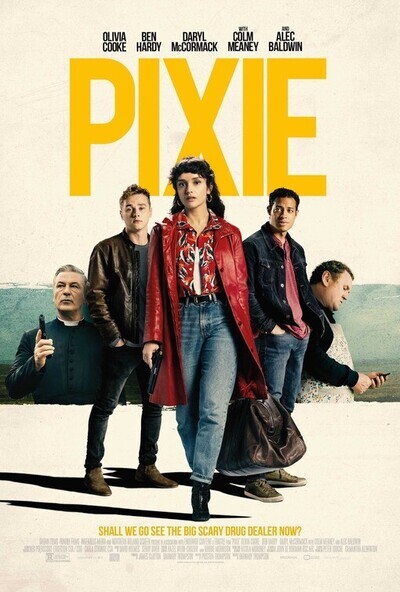
Review of Pixie

Quite enjoyable Irish dark comedy, set in the wild west where we've just been on holiday, and populated with feuding drug-dealing families, some of whom are priests. Held my attention, had a few laughs, a strong woman character and some interesting takes on male buddydom and sexuality. 

I note in passing that the font for the titles suggested the 1974 film "Foxy Brown", which was also about a woman taking revenge on drug gangs. Pixie, Foxy, that's not an accident, is it?

Tuesday, July 25, 2023

Review of Belfast

Nice, beautiful-to-look-at coming of age movie by Kenneth Branagh that is apparently autobiographical. Young Buddy is growing up at the start of the troubles - the first scene takes place in August 1969, in an idyllic mixed working class Belfast neighbourhood, where Catholics and Protestants live happily together. Perhaps it's too romanticised...I'm sure everyone who was there has their own version of what this experience was like. Certainly we don't see any sign of the symbols of sectarianism, no union flags or tricolours, no Orange lodges...even the murals on the gable ends of terraces are harmless.

But then we see things quickly slide into pogroms and burning-out of Catholics from the Protestant streets, and vigilantes and barricades - though only in a Protestant street. In fact, Catholics are largely absent from the story, except in the imaginations and conversations of the Protestant characters, especially the ones from the central family. 

One thing struck me - the family, especially the mum and the dad, and some of the other characters including the local Protestant thug-gangster - are all really gorgeous to look at. Funny how striking that is, because almost everyone in documentary footage from this period looks so ugly.

Watched in the Middle Floor at Springhill, via usb stick and informal distribution...one consequence of this was odd melting transitions between some scenes, because the video player couldn't quite cope. It made it even more arty.

Tuesday, July 18, 2023

Review of Aftersun

Moody slightly menacing film about a dad on holiday in a Turkish resort with his pre-teen daughter. At first it has all the dullness of a resort holiday (and I admit to having a little doze) but the mood and the menace take over, and I ended up being really quite moved by it. It's a depiction of a father-daughter relationship that's kind and loving, even though the dad is really troubled. 

It's occasionally a bit confusing - most of the narrative is set during the holiday but some of it is in the future when the girl is grown up and reflecting back on the past...and perhaps some of it is in the further past, depicting the dad's break-up with the girl's mother - it's not 100% clear. 

Not what you'd call enjoyable but I am pleased I watched it...via informal distribution and USB stick to the projector in the Springhill Middle Floor.

Review of The Last Letter From Your Lover

Sort of OK, watchable romantic drama with a split-chronology narrative. In the 1960s a wealthy socialite has an affair that ends abruptly, and in the present a young woman journalist finds love letters in her magazine's archive and becomes intrigued by the story. It's engaging enough, but not really great...the 1960s scenes are sumptuously filmed and the socialite wears some great clothes. Some nice backing track music.

Watched on Netflix - the film was produced independently but Netflix bought it up.

Sunday, July 16, 2023

Review of Escape From Room 18

Unsettling but also unsatisfactory documentary about a Jewish young man who was a member of a Nazi skinhead gang in the US...at first the Nazis don't know he's Jewish, but then they find out and try to murder him, and he miraculously survives and escapes to Israel, where he and his family make a new life. Later - at the time the documentary is made - he meets up with one of his old Nazi skinhead friends, now no longer a Nazi or a skinhead, and they go on a trip to the Theresienstadt concentration camp together.

There's so much about this film that's weird - of course - but also so much that is unsatisfactory. There's not much consideration about the roots of Nazism and White Supremacy in the US, and no examination at all of what it means to escape from racists by going to live in Israel. The main character has moved to Israel with his mum, who speaks with a strong Southern accent, obviously misses the food and culture of the American South, and has a twin sister (who has also moved to Israel), and the two of them dress identically. Which would have been enough for a weird documentary in itself.

Thursday, July 13, 2023

Review of Wild Men


Billed as a comedy but dark and violent and a bit nasty - a little like Riders of Justice. What is it with Danish comedies? Is the audience in a Danish cinema roaring with laughter at this, or do they just mean a different thing by 'comedy'?

This one features an unhappy man who has left his family to live in the wilds of Norway so that he can reconnect with his proper, natural, manly self...but he's actually not very good at it. Failing to kill anything to eat bigger than a frog, he ends up robbing a petrol station instead, and is then half-hardheartedly pursued by the local police, who are mainly oblivious of a trio of drug smugglers in their neighbourhood. The drug smugglers hit a moose/elk, and one of them runs off with the cash leaving the others for dead, but they aren't, and then they run in to the aspirant wild man.

Lots of violence, and blood, and unhappiness, and almost no laughs at all. Even so I found it quite thoughtful and interesting, though Ruth didn't.

Watched on BBC iPlayer. 

Review of Transition by Ian Banks

A novel set in the multiverse, with characters who are aware of and can travel between parallel universes. It's nicely done (or perhaps nicely overdone, since quite a lot of the descriptions are sort of camp in the way that steampunk sometimes is - especially the lavish settings and costumes of Madame d'Ortolan, who functions as a principal villain). 

Lots of drugs, some sex, not much rock and roll.

It took me a little while to get into it, but I ended up enjoying it and was almost sorry when it ended.

Thursday, June 29, 2023

Review of Mixed By Erry

Italian film about three brothers who stumbled into music piracy and became, for a while, a very big part of the Italian music business. A bit dull - I had to watch it in two tranches because I kept dozing off, despite the violence and the depiction of heavily militarised organised crime. The brothers are pretty much the heroes of the film, and the captain of the Financial Police who is trying to catch them is pretty much the villain. 

There's almost no reflection at all on the ethics or the politics of copyright infringement - I'm rather relaxed about such matters, but I would have at least liked some reflections on who are the winners and losers from this. 

Watched on Netflix, and a good example of why one perhaps ought to cancel one's subscription.

Monday, June 26, 2023

Review of The Fabelmans

The sort of film that I think is meant to be heart-warming...a semi-autobiographical coming of age thing by and about Steven Spielberg...apparently he waited until his parents were dead before it was finally made, though his sister wrote the screenplay. 

I was a bit bored at the beginning...it looks up briefly in the middle, but it's a bit self-indulgent and not all that engaging. Sometimes films about movies are great, but this isn't one of those.

I don't know how autobiographical it is, but the not making it until the parents were dead suggests that it must have been seen as potentially hurtful to them.

Watched via informal distribution and an HDMI cable.

Wednesday, June 21, 2023

Review of "Bonjour Tristesse"

A quite annoying book about sex and relationships among affluent, comfortable middle-class French people, set in the holiday villas and nightclubs of the French riviera. The first person narrator is a precocious adolescent girl, who enjoys her widowed father's dalliances with women younger than himself but takes fright when he plans to marry an elegant older woman.

There are some good moments in it, and it gradually grew on me, but it wasn't especially memorable.

On the other hand, I've just read the Wikipedia article, and I learn (a) that the author was only 19 when she wrote it, which is remarkable, and (b) that the Spectator said "Bonjour, Tristesse, which has achieved remarkable celebrity by virtue of its subject-matter and its authoress's age, is a vulgar, sad little book." So now I like it a little more.

Review of "The Little Drummer Girl" by John Le Carre

I really enjoyed this but it wasn't quite my favourite Le Carre. As with the Cold War ones, he's good at exploring the moral ambivalence of the sides...but perhaps because of the subject matter, Israel and Palestine, I find it more difficult. He tries to have it both ways, with sympathy for both the Israelis and the Palestinians, but I am not sure he really succeeds.

The plot is quite simple (if implausible - Israeli intelligence recruits a young English actress to infiltrate pro-Palestinian networks in Europe) but as with other Le Carre, he's good at providing the detail, of atmosphere and interiors and characters. 

It was a good lesson for me in the secondary importance of plot...I sometimes got a bit confused, and I don't really think that this would have happened (though I was rather reminded of the scene in Spielberg's Munich where the two competing groups of Palestinians and Israelis are staying in the same safe house in Athens), but it didn't detract from my enjoyment.

I'm also aware that this is a novel about a double agent/infiltrator, and that here as in real life the cultivation of a successful infiltrator personality results in a lot of inner emotional turmoil. Being convincing as an infiltrator means that you have to develop friendships and connections with the members of the group that you are targeting, while partitioning off the "real" you that is reporting back to your own side. I think I'd like to look at other books that deal with this, both fiction and non-fiction...I'm aware of the story about a Shin Bet infiltrator of left groups in Israel in the 1970s, who went native, and also of Philip K Dick's "A Scanner Darkly". But there must be lots of others, surely?

Tuesday, June 13, 2023

Review of How To Blow Up A Pipeline

It would be facetious, and also factually wrong, to complain that this film does not tell you how to blow up a pipeline. It's got a lot of specific detail in it, including the requirement to make sure that the explosive is quite close to the pipe itself, which is very strong. The film's protagonists find making detonators the most difficult part, and this involves both chemistry and electronics work. The explosive itself seems to be old-fashioned sugar and weedkiller, and though they bash it about quite a lot as they move the oil drums in which they've packed it, it doesn't go off. 

I haven't read any terrorist (or urban guerrilla, if you prefer) memoirs, but I suspect that there isn't a great deal in them about the nuts and bolts of bomb-making. Perhaps if there was then the crew in the film wouldn't have made such heavy weather of it. Can't help thinking that the IRA had an easier time...perhaps because they had access to supplies from supportive governments?

Most of the film is like a heist movie...about the individuals' back-stories, and about the preparations and mechanics of the operation itself, with tension supplied by unexpected appearances and so on...there's another thing but I won't talk about that because I don't want to commit a spoiler.

Nice that one of the gang is a conventional Texas farmer who looks like he would have been at home in the Tea Party or storming the Capitol, and who has been radicalised by the compulsory purchase of his family farm for the pipeline.

The author of the eponymous book, Andreas Malm, is said to have a walk-on part somewhere in the film, but I didn't see him.

In its own terms it's quite gripping, though I haven't thought much about it afterwards. There's not much political discussion or reflection about the tactic of sabotage and how it might relate to a wider movement, and what there is not very thoughtful.

Worth watching though - how many films about climate activists are there?

Watched in the middle floor at Springhill, via informal distribution.

Shlomo Epstein

My mum's grandfather, who I knew when I was a little child (until I was about eight, when he died) was usually called Solomon Epstein, though he seems to have sometimes been called Itzko. He was a tailor in the East End, and worked for other master tailors. He was never a master himself, and seems to have been unemployed outside the season. Family tradition says he had attended a yeshiva but became a Bundist, back in the town of Pruzhana (now in Belarus but then Eastern Poland). Later he was very pro-Communist, if not a party member, and thought very highly of Stalin.

He hadn’t meant to emigrate to England. He’d taken a boat to America but was refused entry, perhaps at Ellis Island, because he was suffering from the eye disease trachoma. As a result he ended up in London. 


He must have already been married to Sarah Trappski, who was the mother of his three daughters and a son; I know this because Sylvia’s father, Louis Epstein, was born in Poland (then part of the Russian Empire). I have a picture of him with his wife and four children, in which Sarah looks quite plump. A later picture of her, when she was probably already ill (I think with TB but it might have been cancer), shows a very emaciated woman.


He was married two more times after Sarah Trappski died (she’s buried in Frankfurt, where I think she went for treatment which was unsuccessful). The first time he married the widowed mother of Louis’s wife (Sylvia’s mother, known variously as Fay, Fayge, and Ruchel), the second time another widow called Lena, who had a daughter in Israel - I remember a picture of her in her army uniform. Lena kept chickens in the backyard, and fermented and pickled, and my mum remembers her infusing cherries in alcohol. 


When conscription was introduced in WW1 he wasn’t liable to be conscripted, because he wasn’t naturalised British. The British government went to some effort to sign military conventions with the governments of allied nations, allowing it to either conscript non-naturalised immigrants or deport them to serve in their ‘home’ armies, but it didn’t do this with Russians because there was some recognition that they were refugees from Czarist oppression. This changed in March 1917 when the first revolution overthrew the Czar, and the Kerensky government continued to fight alongside the allies. In August 1917 the Anglo Russian military convention was signed, making Russian subjects liable to conscription or deportation. 


One of the documents in my possession is of some sort of certificate, issued in 1918, by the Russian Embassy in London, then based in Gordon Square. It shows that the embassy staff have manually corrected the headed notepaper to remove the word ‘Imperial’. On the back, in pencil, is some text in the first person about Shlomo/Itzko - I don’t think he wrote it himself. It describes how he came to England and concludes with words that emphasise his claim to be a Russian.


As described in Harold Shukman’s book ‘War Or Revolution: Russian Jews and Conscription in Britain, 1917’, the mainly anti-war immigrants were advised by their socialist leaders to opt for deportation - it was assumed that the government was too busy to organise deportation and transport to Russia. This turned out to be wrong (though perhaps not bad advice, given the level of slaughter on the western front by then) and the immigrants - Jews, but also Lithuanian miners in Scotland - were rounded up and put on a ship for Archangel. 


Shukman describes what happened to them thereafter. By the time they arrived there was no Russian army left for them to serve in, and they wandered around Russia during the early stages of the civil war. At some point in 1918 they reached Ekaterinoslav, now Dnipro in Ukraine. I have a composite picture, with lots of insets, showing portraits of what was probably the deportees; some text on one of the insets says ‘Members of the Convention, taken in Ekaterinoslav XI 1918.’ There is also a picture of a ship and some railway lines. 


Shlomo spent several years in Russia, during what must have been the civil war. At some point he is said to have found his way to family members who stayed behind in Russia, and there recovered from typhus. Eventually he found his way back to London (some time in the early 1920s), though family tradition says that when the ship docked he wasn’t allowed to disembark, and had to return the following day on another ferry. 


Saturday, June 03, 2023

Review of "White Skin, Black Fuel: On The Danger of Fossil Fascism" by The Zetkin Collective and Andreas Malm

Lots to like about this book. It's clear and to the point (though sometimes slips into unfortunate academic language and uses complex, unfamiliar words where a familiar one would have worked just as well).  It makes some good distinctions between different kinds of climate change denial...though it doesn't always use those distinctions in a consistent way. Still, I appreciate the difference between "fossil fascism" and "capitalist climate governance".

It made me think whether the climate movement, broadly, has focused too much on the latter, and not enough on fascist-tinged denialism. Until recently I've rather thought that actual deniers were a tiny band of nutters - after reading the book I'm more aware of how widespread and powerful their ideas are, and how they serve as a radical flank for the foot-dragging mainstream..."of course this is a very serious problem but we can only do what's possible, and that is limited by all those people who don't even believe this is happening." In its earliest days XR majored on taking the facts about climate change to a much broader audience, with its introductory talk that activists could learn. Perhaps it gave up on that too quickly in favour of stunts that grabbed headlines and felt like action.

It also made me thing about the role of consumption - especially of some particular goods, and especially cars and meat - as the symbols of a limited kind of prosperity, and thus as a substitute for class consciousness. In a demented sort of way having a big car and eating lots of meat is a sign of what "we" have achieved, and what must be defended in the face of "elite" plans to take it away from us. We may not have a decent welfare state or healthcare or education, and our kids might never be able to afford to buy or even rent houses, but we still have our big cars and steaks. 

It's also worth thinking about how anti-car rhetoric is also a class marker. The richest people often don't have cars or drive much; they live in the cool, walkable inner-city areas from which everyone else has been priced out - see Paris, or London, or New York. The poor and the working classes are living out in the outer suburbs, and in the absence of proper public transport a car is a necessity for a decent way of life, including getting to work, shopping cheaply at big supermarkets, and taking the kids to visit grandparents and friends and to activities.

Two more things - first, that the relative absence of green nationalism is surprising. I know the authors have an explanation, but I am still mystified. It's a largely vacant political position, and the attractiveness of it is not hard to see. The far right's hostility to renewable energy is hard to understand. Perhaps it only makes sense in the context of actual cash flowing from fossil fuel companies and owners to the far right parties.

Second, I am still mystified by the pathetic uselessness of capitalist climate governance. Why don't the mainstream right parties do more? After all, it's the role of the capitalist state to protect the overall system against the particularist interests of particular fractions of capital. So why aren't they doing their job here? Is it that they are worried about being unpopular? That seems unlikely, they are prepared to do lots of other unpopular things when it's necessary for even the short term interests of the system. Are they really just short-termists, who don't care about climate change because it won't happen on their watch? Do they really not believe in the science? In which case those of us who have tried to thrust it under their noses have failed. Do they think that they personally, and the ones they care about, will be able to escape to somewhere where this won't happen? Genuine question, if we knew the answers to this we might know better what to do next.

Thursday, May 18, 2023

Review of "The Secret History" by Donna Tartt


I was drawn in to this story about a group of over-privileged white kids at a posh and slightly useless American college...the narrator has got in on a scholarship so he's not so over-privileged, but he's pretending that he's as rich as the rest of them. The secret of the title is about some terrible things that they do, and I won't spoil by disclosing...I was captivated for the most part, even as I was repelled by the characters and what they'd done. But it rather falls apart in the last fifty pages. It felt to me like she'd got bored with them and it, which can't possibly be right because it shows all the signs of being put together and revised over a long period, and she is a really good write. But still, that's how it felt.

Monday, May 15, 2023

Review of Olga

Film about Olga, a young woman athlete who is on verge of being selected for the Ukraine national gymnastics team, but gets the opportunity to take out Swiss nationality and train in Switzerland instead - her now-dead dad was Swiss. Her mum is an investigative journalist exposing corruption in the government and we see her survive an assassination attempt while she's taking her daughter out for an evening. Olga goes to Switzerland, becomes Swiss, but is then transfigured by the unfolding political crisis in her home country and doesn't know where she belongs any more. Lots of hard-to-watch gymnastic training.

Watched at Lansdown Film Club, and I knew it was good because I forgot about how uncomfortable the seats were.

Review of The Field

Amazing, clever, emotionally laden Irish film about conflict over the ownership of a field in a poverty-stricken rural village. Bull McCabe, the farmer who has worked the field for all of his life even though he rents it from a widow in the village, wants to buy it for what he considers a fair price, but a visiting American has more cash and is determined to buy it himself. Lots of overlaying tragedy in the relationships between the farmer and his wife, and with his son, played by a younger Sean Bean. 

I think it's set in the 1930s, though it's not easy to tell. It might be the 1950s. Electricity has just arrived in the village...there is nothing else technological, and no reference to outside events, that might help to place the exact time. But the Famine is still a living memory and source of pain. There's a really strange ambivalent attitude to those who emigrated and left their land...are they traitors or victims? Similarly the tinkers who are in the village are regarded as having lost 'caste' because they are the descendants of people who abandoned their land.

I was slightly put off at the beginning by the murkiness of the colours, but I came to realise that anything else would have been wrong. It's a dark film and needs to be dark visually. This is like a Greek tragedy, but with protagonists who are poor.

We watched this at a community arts centre in Kenmare, a tiny town in the west of Ireland, where villages like the one depicted are all around, at a free showing by a community group that provided meals on wheels to the poor and isolated. There was free tea and cake too...we made a donation that was not expected and received with much thanks.

Sunday, April 30, 2023

Review of Riders of Justice

Strange genre-crossing Danish film, which switches between philosophical considerations (the meaning of events and the chain of causality in particular), slapstick comedy, violent action thriller, parent-child relationships...and that's not even all of it. A Danish special forces veteran serving in what looks like Afghanistan hears that his wife has died in an apparently meaningless subway accident, but a geeky statistician who was present appears to tell him that it was not an accident after all. With the help of the statistician and his even more geeky friends the veteran seeks to take revenge on those he believes responsible...

It's not really possible to tell write any more without spoiling this film, and it's really worth watching. Despite the violence it's really thoughtful and interesting.

Watched via informal distribution.

Thursday, April 27, 2023

A review of "Pigtopia" by Kitty Fitzgerald

A really unusual book, with a slightly fantastical but also gritty subject and setting - a birth-deformed young man abused by his disabled mother who finds solace in the company of pigs that he steals and breeds in a secret hideaway. Two narrators, the young man and the introverted young girl whose company he seeks, with different styles.

It reminded me a bit of Elmet, in the juxtaposition of the off-grid underclass and the appreciation of nature - as well as the violence, though in this book it's more of an undertone most of the time. 

I can't say much more without spoiling, but this was a good read. 

Review of "A Long Petal of The Sea" by Isabel Allende


Sickbed reading, and very suitable - interesting without being too emotionally taxing, despite the subject matter. A good family saga, well told, covering some terrible events (the fall of the Spanish Republic, the abysmal treatment of Republican refugees in France, the coup in Chile) via some characters who manage to live through all of this. The characters themselves are engaging, and there are some nice plot twists and devices to maintain interest. The title is from a Neruda poem, and though I've always known he was a good sort I've never read any of him - I plan to now.

I enjoyed this more than other recent works by her - this doesn't have any magical realism, which these days I find a bit of a bore.

Small personal note - I have stayed in Argeles-Sur-Mer, the town on the French Mediterranean coast where the Republican prisoners were interned. Even in the Summer, and even on holiday and staying in a nice house, it wasn't enjoyable; the wind blows sharp sand into your face all the time.

Friday, April 21, 2023

Review of "The Rise of Ecofascism: Climate Change and The Far Right" by Sam Moore and Alex Roberts

The first thing to say is that this is a brilliant book...even better than their other book "The Post Internet Far Right", which was also great. It's not long, but it is very dense, with lots of links and footnotes, and lots of examples...many of which were derived from things that I had never heard of, even in the historical sections (and I'm quite well informed about the history of fascist and proto-fascist movements)...I'd never heard of Henry Dorgères or his French "Greenshirt" movement, to cite just one. The history section, which forms Chapter 1, is really good and would more or less work as a standalone piece; it's better than other things that I've seen before which more or less say there used to be environmentalists who were fascists, and the Green movement has skeletons in its cupboard and so on...this addresses the contradictions of fascist nature-loving, the Nazis's biodynamic farms alongside the massive program of autobahn-building and their need for cheap food.

Chapter 2 looks at the far right and nature now - how the climate crisis provides new opportunities for the far right. On the one hand climate breakdown, and its consequences, can be used by the far right to justify their programs and policies - a tighter grip on immigration and harsher policies against refugees. Conversely the far can also use opposition to climate mitigation methods as mobilising tool - either in terms of denialism ("climate change is a hoax being used to take away our freedoms") or a sort of Poujadist non-denial denialism ("all these green policies are too expensive and it's ordinary people who have to pay for them, not the liberal elite").

Chapter 3, which is slimmer, addresses the online far right ecologism, a peer into the cesspool of what they will say when they think they are anonymous or untraceable, with a much greater to misogyny, homophobia and murderous Social Darwinism.

Chapter 4 is about ecofascist terrorism, with a closer look at where the far right goes when it doesn't care how it looks to others - including the role of appeals to nature in the manifestos of fascist shooters and terrorists, the so-called "black-pilled".

And Chapter 5 looks forward into a future in which national and global politics will be dominated by climate chaos - in which science, and technology, and the political choices associated with them, will be ever more contested and fragmentary. They sketch out future responses, including: 
  • "fossilized denialism", essentially the Trumpist postponement of effective mitigation measures while there's still money to be made from oil reserves; 
  •  "batteries bombs and borders" - the search for technological and political fixes to address the climate while leaving the current distribution of wealth and power intact, including fighting multiple small wars for newly important resources alongside the militarisation of mitigation and adaption measures. Pretty much what we are being offered by Silicon Valley, Biden, and even the World Economic Forum.
  • "climate collapse cults", a more thoroughly fascist response to the multiple crises, which will include, at least in rhetoric if not in practice, far right breakaway sub-states and communities, and more fantasies of violence.
The last of these offers the prospect for a return to actual fascism...most of the time the authors are careful to distinguish between that and other far right forms. Actual militarised fascist street movements and parties are for the most part pretty rare at the moment, but they might become a bigger part of a far right response as the climate crises worsen.

Monday, April 17, 2023

Review of Rye Lane

A really funny, enjoyable, clever romcom. Great to look at, witty, cool. It's a romcom so the plot is never going to be very sophisticated, but it's good enough with a few unexpected twists. It's a very London film, but it's almost all shot in the bits of London that rarely make it into mainstream films - Brixton and Peckham, not Notting Hill or Primrose Hill...there is a bit of South Bank and Tate Modern at the end, but I will let that go.

Good diverse characters - the leads are both young Black people, and it's not a film about racism.

Just watch, it's nice, you won't be disappointed.

Watched via laptop, HDMI cable and informal distribution.

Review of "Pirate Enlightenment or the real Libertalia" by David Graeber

I begin this review with some unease...some years ago I wrote a review of one of David Graeber's other books (I think it was "The Utopia of Rules", and although it was a generally enthusiastic review (because I really do like his work) there was one slightly negative comment - and the great man took the time to write a full and damning response setting out why my slight showed how stupid I was. This made me like him slightly less, even though I still think his work is great. But he's dead now, so I should be fairly safe...though it rather begs the question as to how he can be so prolific after his demise.

I think the answer is that this is the remains of an unpublished older work, containing elements from academic papers (perhaps themselves unpublished) bolted together to make a book by a dead person. It's pretty enjoyable, but not quite right. In the preface he says it grew out of a long essay, and maybe it should have stayed one...or maybe it should have become a longer book setting out more of the context for a general reader like me. Reading "The Many Headed Hydra" I got a feeling for the role of the Atlantic in the C17th emerging economy of racial capitalism. This book focuses on the Indian Ocean and its role in a different colonial network, and I didn't know anything about that...the book seems to me to assume that I did. So a longer book would have included stuff about that, and the role of all the different actors who briefly stroll across the stage, from Armenian merchants to the French to the Dutch to translocated Caribbean pirates...

It also touches on what might be called the influence of non-Europeans on the European enlightenment, but that goes by in a flash too...on the other hand there's lots of detailed stuff about relationships between different groups in Madagascar, and I found some of that hard to follow.

Overall this was an enjoyable book with some benefits for a general reader, but I suspect it might have been better as a series of academic papers. Or a different bigger book for a general reader.

Friday, April 07, 2023

Review of "Number 9 Dream" by David Mitchell

It's really annoying that there are two David Mitchells, the author and the comedian. It's even more annoying that they are both so talented, especially the author, who has written a lot of good books and only a few duff ones.

This is an early work but really good - it's set in quite-modern Japan, with a Japanese protagonist (is he an otaku?) and only Japanese character. It acknowledges a bit of a debt to Haruki Murakami, but it reads to me as an authentically Japanese novel. It's sometimes a bit surreal and fantastical, and the style varies between sections, but in a good way. It's a novel with a quest, and coming of age, and in between there are some fantasy sections and a gritty violent yakuza story. 

It's pretty great, read it.


Review of Elvis

Really rather good biopic, which foregrounds but does not demonise the figure of Colonel Tom Parker, Elvis's manager who took 50% of everything that he earned.

Elvis comes out rather well...anti-racist, though not political or public about it, and rather more talented musically than I'd recognised. Elvis died at 42 when I was 19 and I barely marked it - I thought of him as a washed-up has-been playing a kind of music that I didn't think much of or about. 

It's a Baz Luhrmann film so lush and very colourful, but quite inventive in the shooting, cutting and editing. 

Parker is at least as much the focus of the film as Elvis, and he's a complex figure. The film says Elvis never toured abroad because Parker didn't have a passport, or indeed any legal identity at all. Oddly the colonel title seems to have been the only thing about him that was genuine...the colonelcy was bestowed upon him in 1948 by Jimmie Davis, the crooning governor of Louisiana. Jimmie Davis was a racist and a segregationist, btw, so perhaps the colonel didn't share Elvis's feelings about Black people.

Watched on TV via HDMI cable to laptop and informal distribution.


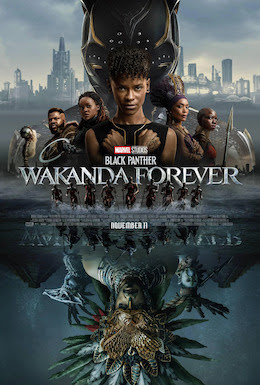
Review of Black Panther: Wakanda Forever:

What a wasted opportunity! The first fifteen minutes are great - views of the prosperous and beautiful fictional African country, a great anti-colonial scene in the UN, and it seems that this is going to be the Afrocentric, Afrofuturist film that I've been waiting for. And then just superhero trash...two and a half hours of things crashing into each other and people hitting each other, mostly to no purpose.

Which is a shame, because somewhere in there might be a good film struggling to get out. No, not really, just a good art director looking for a good film to work on. 

It's made worse by the fact that the two different groups of non-white anti-colonial people in the film, the Wakandans and the crypto-Mayan water people, are locked in an unnecessary war over...well, I'm not really sure. They ought to be fighting the extractive imperialists, and they both know this, but something about honour...so not only are the mass battle scenes tedious, but the viewer doesn't even want one side or the other to win. In that sense it's worse than Star Wars, where at least the baddies are clearly defined.

I realise how much superhero stuff is about the use of physical force and weaponry, sometimes high-tech weaponry, to overcome over-confident enemies. Perhaps this speaks to the fears and fantasies of ground-down teenage boys, or the inner teenage boy of so many grown-up men. I find this depressing to watch and rather sad.

Watched in two tranches, because it was too much to sit through. Ruth gave up at the half way mark and I watched some more, and then finished it a few days later. On the big screen at Springhill, following informal distribution.

Tuesday, April 04, 2023

Kasatchok!

For years the Red Band in London, and then the Stroud Red Band, played a tune called Kasatchok. It's a Russian traditional dance tune, or so I thought. Since the Russian invasion of Ukraine we stopped playing it, not because we're boycotting everything that ever was Russian, but it didn't feel too good. Someone pointed out that a kasatchok was also a Ukrainian dance; did that make it better? Did the fact that it was a Ukrainian cossack dance make it worse again? After all fear and hatred of cossacks in part of Jewish folk-memory; my dad told me that in the 43 Group they used to call the mounted police in London "cossacks".

Then a friend reminded me that there are Italian words to the tune, which became a song of the Italian partisan resistance to the Nazis - Fischia il Vento. With that name it was programmed into a little electric keyboard that his child has. Here is a nice version by the Modena City Ramblers, an Italian lefty band...for some reason they are wearing kilts to perform this, perhaps because they think of themselves as playing Irish traditional music.

And then I remembered that the song used to be played a lot at Jewish weddings and barmitzvahs, at which the young men would try to dance a pseudo-Russian squatting dance that they would call the "kazotzkas", which would result in everyone getting very sore thighs. In fact I had once thought of it as a Jewish tune, and I recalled that there was a Hebrew version. I'm pretty sure we sang it once or twice in my Zionist youth movement, and it turns out that it was translated into Hebrew as early as 1945, probably as part of the Socialist-Zionist love affair with all things Soviet.

And finding the Hebrew version on YouTube, I also came across this, which has to be a strong contender for the weirdest thing on the internet - a Yiddish version, syncopated, performed by some sort of folk choir from Birobidzhan, in a made-up Jewish folk costume. Are these people actually even Jews? What tradition does this costume, and this song and dance, form part of?

Of course it turns out that the tune is not a traditional one but was written by Matvey Isaakovich Blanter,  a Soviet (Jewish) composer in 1938. 

Monday, April 03, 2023

Review of Mr Jones

A well-told tale about the Welsh reporter who broke the story about the 1930s famine in the Ukraine, when the rest of the Moscow-based western press corps didn't...because they were too lazy and supine, it's implied. There's a bit of a hint that they judged the Communists to be the lesser evil vs. the Nazis, and some of them probably did. One of the main characters is Walter Duranty, the New York Times bureau chief, who was actually even weirder than the he is portrayed in the film...he hung out with Aleister Crowley for a start. 

I understand the family of Gareth Jones were unhappy about some of the details, and it's perhaps not unreasonable to think about the wider context of the famine...the Soviet drive to industrialise, the scissors crisis during the early Soviet period ...and so on. Don't know whether he really met Eric Blair either...certainly Animal Farm wasn't written until after 1943 and Blair's experiences in the Spanish Civil War, which turned him into an anti-Stalinist, though the film implies that he was writing it during the 1930s as he met Gareth Jones.

But a decent film nonetheless, cinematically interesting and with decent acting and dialogue. Watched on BBC iPlayer.

Sunday, March 26, 2023

Review of Living

Is it possible for a film to be boring and enjoyable at the same time? Well, this one does a pretty good job. Bill Nighy is a bureaucrat at the London County Council in the 1950s, and he's emotionally sclerotic (with his co-workers and his son) and acts as a road block to stop anything happening - a group of women from an estate in the East End want to turn a bomb site into a children's playground, and they are routed back and forth between departments to ensure that nothing ever happens to their proposal.

Then he learns that he's going to die from cancer, and he goes very slightly off the rails, visiting an improbably bohemian Brighton, taking a young woman who is a former colleague to lunch at Fortnum's, not turning up to work, and so on. 

It's all beautifully done, though not much really happens. It's all about the feelings, and the facial expressions that are about not revealing them.

I note in passing that there's something of a geographical error in the film. The bureaucrat and his colleagues arrive by suburban commuter train into Waterloo Station, and then cross a bridge over the Thames to approach County Hall, then the HQ of the London County Council. Except that County Hall is on the same side of the river as Waterloo, so how can they be crossing the river to approach it?

Watched in the Middle Floor at Springhill, having obtained it via informal download.

There's a very good review in the London Review of Books here.


Thursday, March 23, 2023

Review of "On Earth We're Briefly Gorgeous" by Ocean Vuong

A short book, but one with a lot to it...coming of age as gay in rural Connecticut, the Vietnam war and its impact on Vietnamese and Americans, the devastation wrought by opioids on working class communities, deindustrialisation and poverty...and what it's like to be a writer in the shadow of all that. And death, and abandonment, and separation. Just brilliant really, and I may read it again.

Review of Where the Crawdads Sing

A feel-good film about nature, child abuse, male violence, rape, murder...what's not to like? Actually a really good film, with a moderately complex narrative structure, some nice acting, lovely nature footage, a courtroom drama aspect, and a great ending. Hard to say much else without spoiling, but well worth watching.

Watched in the middle floor at Springhill, obtained via informal distribution.


Wednesday, March 15, 2023

Review of "The Debt to Pleasure" by John Lanchester

Hard to do justice to this while avoiding spoilers. It's a great, clever, well-written and thoroughly nasty book. It's written in the first person by a snobbish food bore, who writes pretentiously about a journey to his summer home in France through a series of menus and recipes. Despite the fact that he's deeply unpleasant it's not too terrible to spend all this time in his company, because some of his knowledge about food and history is actually enjoyable. 

It's so pretentious that there are laugh-out-loud moments, along with insights into the narrator's history and personality of which he seems to be unaware. We gradually learn that he's an unreliable narrator, though this is done so slowly that it wasn't apparent to me. 

And that's pretty much all I can say without ruining it for you.