Monday, October 30, 2023

Review of Denmark

Watched in two tranches, because we gave up at the first attempt - it was so unremittingly miserable. An unemployed recently divorced bloke in Wales lives in a squalid flat below a neighbour who plays loud house and techno all the time, and he's estranged from his son and his mother and pretty much everyone. He has almost no money, though he has a little for drink and weed. But he's robbed, and everything bad happens to him, and then he hears that prisons in Denmark are really nice places to live, so he resolves to go to Denmark and get sent to prison.

Which was where we stopped watching. But the next night I was home alone, and watched the rest, and there is a sort of redemption and a development of characters, and it was worth staying and seeing it through.

Watched via BBC iPlayer, smartphone and Chromecast.

Review of Baby Done

A really terrible New Zealand comedy about a young woman who becomes pregnant but doesn't want to embrace parenthood and give up her life as an aboriculturalist and competitive tree-climber. Her British partner really wants to be a dad, so she doesn't tell him she's pregnant, though he finds out soon enough. I laughed once or twice, but really it was not funny, and sleazy and slightly misogynist - no-one could really be as stupid as this woman. 

Watched on BBC iPlayer via smartphone and Chromecast. Apparently it was only 84 minutes long, but it felt much much longer.

Monday, October 16, 2023

Review of Liquorice Pizza

An odd and rather unsatisfying film...I'm sure when they pitched it the word "quirky" was used, but it's as much shapeless as quirky. At first I liked the fact that is was not only set in the early 1970s but seemed to have been made then too - the colours, the shots, the camera resolution... And some of it is nicely observed, with good close-ups and dynamics between the characters. But the narrative becomes a set of increasingly implausible vignettes and incidents that don't seem to relate to each other.

Quite fed up by the end, it seemed overlong and not so interesting.

Review of The Old Oak

Not one of Ken Loach's best, though it is moving and well acted. It's about a former mining village in the north-east where everything is closed down and the local pub - the eponymous Old Oak - is just about holding on. A group of Syrian refugees are housed in the village, where house prices are in free fall, and where the locals who already feel dumped on feel that these people are just one more thing that's been dumped on them. The pub landlord tries to be kind and welcoming, but his remaining regulars are hostile and racist. 

A good scenario, and lots of sensitive and thoughtful portrayal of the locals...the Syrians are more like ciphers, apart from the female lead played by Ebla Mari, who is a photographer and a rounded-out character. Incidentally, I note in passing the actor is actually a Druze woman from the Golan Heights, so she's never lived in Syria, having been born and grown up under Israeli occupation; oddly this may have kept her alive, because ISIS massacred Druze in the civil war. 

The film is pretty bleak, but then ends with an entirely implausible happy ending in which one of the Syrian families hears that their father, who was missing and then briefly believed to have been found, has died. The entire community, including some of the horrible racists, rallies round to support them in their mourning. The final scene shows the refugees accepted into the traditions of the local labour movement and marching with their own Arabic-inflected banner in the Durham Miners' Gala.


Wednesday, October 04, 2023

Review of "The Perfect Heresy; the revolutionary life and death of the Medieval Cathars" by Stephen O'Shea

Nicely written popular history about the Cathars with an entirely reasonable focus on southern France and Languedoc. Mainly focuses on the Albigensian crusades and the suppression of the heresy, and not much about how the Cathars grew and became established in the first place. Very little about the intellectual roots of Gnosticism, but hey you can't have everything. I still learned some stuff about Cathar practices, not least the names of the prayers and rituals that they used.

I'd happily read more by this author.

Thursday, September 28, 2023

Review of "Single and Single" by John le Carre

Set against the background of the end of the USSR, and in the context of a company that facilitates dodgy deals, money laundering, offshore ownership, and eventually the logistics for heroin distribution. Not le Carre's usual intelligence agencies setting...the "white hats" are customs officials rather than spooks, though they seem to use much the same methods and have similar access to tradecraft and stuff. Some lovely descriptions of places and people...though the main characters do seem to shimmer a little and not feel as consistent as they might. Still, carried me along and an enjoyable read.

Review of "Disaster Anarchy: Mutual Aid and Radical Action" by Rhiannon Firth

First up - we read this in the Stroud Radical Reading Group, and my friend and comrade Mar Florence wrote a really good summary, which I have pasted just below.

"Here's the longer version of my book summary of Disaster Anarchy by Rhiannon Firth (5-10 min read).
Capitalism and neoliberalism make disasters more likely to happen because they prioritise profit and maintaining power.
Mainstream disaster management is focused on restoring order, maintaining capitalism, and keeping power in the hands of the existing governments.
The human cost in every sense - lives lost, suffering, negative and traumatic experiences - only matter to the extent to which they impact the capitalist system.
She describes non anarchist critiques of mainstream disaster relief, such as ones that point out that existing systems contribute to and unevenly distribute the impacts of disasters.
She says these don't go far enough because they often posit a state led solution, when the state will always prioritise it's own power, and so will fail at prioritising the experience and safety of its citizens.
She then describes an anarchist theoretical approach where rather than asking for help from a state, people help each other through horizontal organising (between peers) and in the form of mutual aid (in which everyone is a helper and everyone is helped).
She describes some ways capitalism stops or reduces the effectiveness of these social movements -
Recuperation - which is when anarchist organising gets absorbed back into the system, eg by becoming part of an ngo or the state or a private company. This imposes hierarchies, reduces the energy of a movement, limits what the movement can do and who can be part of it (she gives the example of excluding immigrants from helping if official papers are required, which would push them into the role of only receiving help, removing the mutual aspect), and prevents more radical action against the status quo like resisting evictions.
Repression - when anarchist action is clamped down on directly by the state. She gives the example of mutual aid after hurricane Katrina.
She describes how some people criticise anarchist ideas as unrealistic because they think people are fundamentally selfish, she calls this Hobbesian.
Terminology.
She uses the words prefiguration, post-Fordist and cybernetic a lot.
I think prefiguration means creating something with an idea that it is part of the future.
Post-Fordist seemed to mean neoliberal capitalism, maybe post industrial?
Cybernetic seems to mean feeding back into the current system in a loop - I always thought it meant something to do with robots.
She then has two chapters of case studies, the first about occupy sandy, a mutual aid movement in new York after superstorm sandy, which was modelled on the occupy wall street movement and involved some of the same people. And covid mutual aid groups in London during the early pandemic.
In the examples she talks about how the different disasters are tackled differently but there are some similarities. In both cases mutual aid groups are faster and more effective at meeting people's needs than the official groups. In both cases the state and ngos try to piggyback on the grassroots efforts, impose rules, and take credit for their successes.
She talks about difficulties such as people joining with different politics who disagree with how things are done or want to impose rules or hierarchies on the groups. She also talked a bit about inclusion and how to solve problems of making sure everyone has the opportunity to help as well as be helped.
Occupy sandy used more in person organising, turned up at people homes to clean out their basements and used community centres and churches to distribute food, blankets and medical supplies. They received a lot of financial donations from the public to do this work and she talks a bit about the difficulties when managing money in this sort of movement. I read in hot money (naomi klein) that they used a shop front as a makeshift medical centre where volunteer doctors and nurses could help people. Occupy sandy used amazon wishlists so people could buy and donate supplies directly. Occupy sandy used bike couriers and bike powered generators so people could charge their phones.
Covid mutual aid groups organised mostly online but had some social centres, and she says where they had some physical space that really helped the organising and distribution of help. Covid mutual aid groups organised people to do shopping for other people and collect their medications, as well as giving individuals money from donations when they applied for financial help. There was a similar discussion about transparency and the difficulties and ethical concerns of managing money.
She talks a lot about the social principle vs the political principle and how they are mutually exclusive. As far as I understand it, the social principle is about helping one another as equals and the political principle always prioritises retaining power in some form between a smaller group."

Such a brilliant summary that there's no need for me to write any more...but I would like to say a bit about my feelings about the book. From the first sentence the language is academic and difficult. Being charitable, I suppose that's inevitable. Leftist thinkers are mainly academics these days - there's not much of an economic base for "organic intellectuals" in the Gramscian sense, so they have to write to the style of their community and their job expectations. And probably much of the market for this kind of book is students who want to learn to write in that sort of language so that they pick up the credentials of academic social science. It's just too bad for activists who are interested in the subject matter but don't have the academic hinterland.

Also, I wasn't all that taken with the actual arguments in the book, once I had decoded them. Yeah, there's a tension between wanting to advance your politics in a mutual aid group which includes others who don't share your outlook, and wanting the group to be effective. And yeah there is something problematic about using tools (especially technology ones with built-in surveillance) developed by exploitative capitalist corporations...though I suspect that the FAI-CNT militias in revolutionary Barcelona didn't worry too much about the provenance of the guns that used to fight fascism. There are great big gaps in the book too...very little about the actual working class history of permanent mutual aid groups, some of which were anarchist-inspired. She seems committed to the idea of spontaneous informal organisation, as if there were no other traditions or ways of organising on the left. Which, I think, is part of the reason why we are in the pitiful, disorganised, ineffective place that we are. We won't get anywhere, we won't involve more people, we won't achieve anything at all, without building permanent organisation that are here today, here tomorrow, and don't burn people out in a couple of years because everything is urgent.

One last thing...the discussion about whether mutual aid provided a sticking plaster for capitalism and actually helped prop it up reminded me of this poem by Brecht, which I will also paste in full.

Bertolt Brecht: A Bed for the Night I hear that in New York At the corner of 26th Street and Broadway A man stands every evening during the winter months And gets beds for the homeless there By appealing to passers-by. It won’t change the world It won’t improve relations among men It will not shorten the age of exploitation But a few men have a bed for the night For a night the wind is kept from them The snow meant for them falls on the roadway. Don’t put down the book on reading this, man. A few people have a bed for the night For a night the wind is kept from them The snow meant for them falls on the roadway But it won’t change the world It won’t improve relations among men It will not shorten the age of exploitation.


Monday, September 25, 2023

Review of "Oh Jeremy Corbyn: The Big Lie"

I was really disappointed by this film. The title says it all. Antisemitism in the Labour Party, and the movement, was just a big lie, something concocted by the Zionists - Israel and British Jews - to sink Jeremy Corbyn.

Some of the film is nice and heartwarming; some scenes of big rallies from the Corbyn moment, when we won the leadership, and the 2017 election campaign. Some of the parts about sabotage by Labour Party staffers are still shocking, even though I have read about them before. 

I have no doubt that Jeremy Corbyn is not an antisemite, certainly not in the sense of someone with a personal antipathy towards Jews. Nor do I doubt that people in the Labour Party and outside who don't care much about Jews, or racism, were keen to use and abuse the allegations of antisemitism for factional and party-political purposes without any concern either for truth or for the impact that their tactics would have on actual Jews. Claims about antisemitism were indeed weaponised and abused.

But it's also true that there were actual antisemites in the Labour Party. Not many - I've hardly ever met any - though even a few is too many. Some of them were and are people who are just clumsy in the way they express hostility to Israel and Zionism, and unthinkingly draw on anti-Jewish themes. Some are a bit nastier than that, and some are lot nastier. Pretending that this isn't so, or that it doesn't really matter because no-one is slaughtering Jews in the streets, is bad for our movement. Being stupid is never a good idea.

Sometimes Corbyn just made mistakes - like with the business about the awful mural in the East End of London, which he initially didn't denounce as anti-Jewish. When he did make mistakes he wasn't given much opportunity to admit that, apologise and move on - though who is these days?

It would have been better if he could have admitted that "our movement" does not have a proud history on the subject of antisemitism, from labour movement opposition to the immigration of Jewish refugees and the antisemitic rhetoric that well-known labour and socialist figures used, the silence of the plight of refugees in the 1930s, the protection of Mosley's revived fascist movement in the 1940s by the Labour home secretary, and so on. It would have been better if he had occasionally denounced antisemitism without instantly adding "and all forms of racism"...like some weird left version of "All Lives Matter". It would have been great if he could have showed some understanding of why antisemitism is such an important dimension of far right thought, as a unifying explanatory theme for conspiracy theories.

But the film isn't about any of that. Although it has plenty of talking heads denouncing the accusations of antisemitism, it barely touches on what those accusations were. Watching it you would think that it was only about criticisms of Israel and Zionism.

And it doesn't help that some of the talking heads have absolutely turned out to be people who are antisemites. An obvious example is Professor David Miller of Bristol University...really, when Socialist Worker says you've crossed the boundary from anti-Zionism to actual antisemitism, you really have. Also appearing is Chris Williamson, who has recently joined George Galloway's red-brown "Workers Party". Galloway has appeared on platforms with Nigel Farage and with Breitbart's Steve Bannon.

And Jackie Walker. Jackie Walker appears more than anyone else in the film, and she seems to be clear and reasonable. From the film you wouldn't know that lots of people on the left have acknowledged that she has spread antisemitic conspiracy theories, and that the only shred of an excuse that anyone can make for her is that she didn't know this stuff was untrue and therefore her intentions weren't antisemitic. 

I'd like to hope that one day the left will realise that it needs to deal honestly and fairly with its own history of antisemitism, and that this film will be a terrible embarrassment. I'm not holding my breath though.

And in the final analysis, the politics of the film are really not at all thought through. Although there's quite a lot about how horrible Starmer is - much of which I don't dispute - there's nothing about how he came to be leader, by the same process that had previously allowed Corbyn to win. There's nothing except a prolonged "we was robbed" whine, nothing about what should happen now for the left. Because what the film appears to say is that not only is it impossible for the left to take control of the state and use it for socialist purposes, it's not even possible to take control of the Labour Party. 

I'm going to leave the last word to Andrew Murray, who does feature in the film as an adviser to Corbyn...but neither these words, nor the sentiment that they reflect, appear anywhere in the film:

“I do not believe that Corbynism was defeated by conspiracies in the common sense of the term. It was defeated by the class enemy, and its own mistakes contributed to that significantly. One can argue about which mistakes carried what relative weight, but that is where the debate needs to be.

“As far as antisemitism goes, it has always been my view that the Jewish community had real concerns which were not properly addressed. Bad faith actors in the mass media and those opposed to Corbynism for other reasons surely exacerbated the problem (that’s political life wherein any weakness is exploited by opponents), but they did not invent it. Antisemitism on the left is a complex issue that needs addressing in a sober fashion… [the film] would have done better to interview at least a more balanced range of those involved in the Corbyn movement rather than leaning heavily in the conspiracist direction […]

“To conclude, for anyone on the left to believe that Corbyn was defeated by a conspiracy by Jewish organisations is doubly dangerous:

“First, it risks stirring up animosity towards the Jewish community and breathing further life into antisemitism at a dangerous time.

“Second, it misdirects the Left down a blind alley and prevents it learning the lessons that need to be drawn from the achievements and failures of the Corbyn years.”


Sunday, September 24, 2023

Review of Casablanca Beats

I watched this at the Lansdown Film Club, where there is a post-film "bead voting" system, and I was the only person to put a bead in the bowl marked "Poor".  I didn't enjoy it much. I was bored, I dozed off sometimes, and I felt that it was shapeless and bad storytelling. I'm all in favour of films that leave the viewer to fill in or imagine some of what's left unsaid, but this felt like there were gaps in the narrative that had just been overlooked. 

There were some great young Moroccans who were learning to rap with a charismatic teacher at a cultural centre called Les Etoiles de Sidi Moumen - Sidi Moumen is a poor district of Casablanca . The young people were playing themselves, and the teacher is played by moody Moroccan actor Abdelilah Basbousi. There are some really great set-piece debates between the kids, notably about whether young women ought to dress "decently" in order to be respected. There's a big dance "fight" between the kids and some religious fundamentalists.

Ultimately though it was a disappointment. It feels a bit like it ought to have been a documentary, without the pretence of a plot, and with lots of interviews with the kids about why they felt that an American art form spoke to them as a young Moroccans.

Like I said, watched at Lansdown, and a testament to how bad the film was is that I managed to doze off even on the world's most uncomfortable chairs.


Review of "The Treasure of the Sierra Madre" by B Traven

An absolute ripping yarn about American hobo-adventurers in Mexico in the 1920s, written by a mysterious perhaps-German author about whom almost nothing is known. I've known about B Traven for years and have thought about reading this, but it was only when I picked up a free copy at a tube station book drop that I finally got round to it - partly as a way of avoiding reading a heavier non-fiction book that I was supposed to be doing.

It's in a spare, hard-boiled style, with little description and not much introspection, and yet it was absolutely compelling reading that carried me on. The characters are casual workers who become gold prospectors, set in a background of reforming post-revolutionary Mexico, with Indians and Mestizos and bandits. There's some nods in the direction of progressive politics - a paean to the railway workers' union, a brief speech in favour of Bolshevism and Communism by one of the characters - but there's some racism that would be unacceptable now too.

Monday, September 18, 2023

Review of My Sailor, My Love

Ireland-set, Scandinavian-made romantic drama about an older man finding love late in life with an older woman sent by his daughter to be housekeeper-carer, and the impact that has on the very troubled daughter who has spent her whole life traumatised by the effort of caring for first her mentally ill mother and then her deteriorating and unloving father. Lots of heavy emotional work, and lots of beautiful scenery and perfectly drawn interpersonal dynamics. It's not as unremittingly bleak as this makes it sound, but there aren't many laughs.

Watched on Netflix via phone and Chromecast, an unusual good film found there.

Review of "All the Light We Cannot See" by Antony Doerr

I really liked and enjoyed this lovely book. It's hard to imagine that something about a blind girl making her way through the world of occupied Brittany during WW2 could be so heartwarming, but it was, despite all the awful things that happen to the characters. There's a narrative that's split between different characters and switches backwards and forward in time, which can sometimes be annoying but wasn't here. One of the central characters is a very young German soldier, and I'm sometimes upset by books which foreground the experiences of people like that, but this didn't affect me that way at all. 

It was long and occasionally harrowing, but I'm so glad I read it and was sorry when it ended.

Friday, September 08, 2023

Review of Oppenheimer

The fact that it's been several weeks between seeing the film and writing a review says something. I know it's an important subject and that it's seen as an important film, but despite the length (3 hours) I was a bit underwhelmed. Visually it felt a bit trite. And I've often liked Christopher Nolan's films for complex narrative structures, but this one felt ponderous and contrived rather than interestingly complex. 

I thought I knew the story of Los Alamos, and I wasn't aware of any major surprises as I watched the film. It felt to me like the conflict with Lewis Strauss, which I didn't know about, was the dramatic centre of the film...I think I'd rather that it hadn't been so long and convoluted, and that it had focused on that more. The claustrophobic scenes of the private hearing that more or less finished Oppenheimer as a public figure, because his security clearance was not renewed, are really well done.

Despite the length of the film the tension between Oppenheimer and Strauss doesn't really feel well explained - was it really because Oppenheimer said something that made Strauss feel humiliated at a Congressional hearing of some kind? Was there really nothing more to it than that?

Watched at the Vue in Stroud with two good friends and an extra large popcorn.


Review of "Sapiens: A Brief History of Humankind" by Yuval Noah Harari

Forced my way through this, didn't like it so much. It's a "broad sweep" history, with a perspective that wobbles between neo-liberal ("hasn't capitalism made everything brilliant!") and neo-conservative ("medieval peasants were perhaps happier than modern people because they believed that their lives had a purpose in a way that secular people can't). As I read it I found myself coming up with objections to the broad sweep argument from stuff that I knew, and I suspect that people who know more about the disciplines he references - archaeology, anthropology, and so on - might find lots more.

Looking forward to reading "The Dawn of Everything: A New History of Humanity" which I understand has a more detailed take-down.


Monday, August 28, 2023

Review of "Drink?: The New Science of Alcohol and Your Health" by David Nutt

I like what David Nutt writes about other recreational drugs - he's sensible rather than sensationalist and gives good evidence-based advice.

I knew he was a bit down on alcohol, and since I don't think of myself as having a problem with it, and quite like it, I was reluctant to read this book.

But I'm glad that I did. I learned a lot, both about how alcohol works in the brain, and how really bad it is. I don't think I will stop drinking completely, but I am really going to try to drink less, and to examine my own relationship with the drug, and with other people where it's mediated by alcohol.

Towards the end he writes a lot about policy, and his experiences trying to advise government. That is really...dispiriting. It's an eloquent description of how a moderately powerful industry captures the institutions intended to regulate it, and writes policies that suit itself despite the harm that they do to society and individuals. It's particularly depressing to see how much worse the UK has done than other countries, and how useless our legislators and governments are. And this is only the drinks industry...just think what it is like to go up against the fossil fuels industries.

It's also an illustration of how daft the conspiracy nut-jobs view of the world is. Powerful industries don't have to use secret conspiracies to control governments - they can do it right out in the open, using mechanisms that are not secret or illegal.


Wednesday, August 23, 2023

Review of "Use of Weapons" by Ian M Banks


This is the third novel in The Culture series, and quite different from the others. The plot is more complex, it shifts backwards and forwards in time, and there is some confusion about who the characters are. I have a slight suspicion that it was assembled out of a series of disparate stories, because the atmosphere and the descriptions of places and characters are great - it's just a hard-to-follow narrative thread. 

Still enjoyable, mind you.

Tuesday, August 22, 2023

Review of "Noughts and Crosses" by Malorie Blackman

I suppose this is not really aimed at me - it's Young Adult fiction - and maybe that's why I didn't like it. It's easy to read, with short chapters and un-challenging language, and a plot with plenty of emotion and action to carry the reader along. Still, I was a bit bored. And I can't see the point about writing about a fantasised, alternative-reality racism, when the real thing is everywhere and needs writing about.

Do young adult readers respond to an account of racism in which the positions of blacks and whites are reversed, and Black Africans have colonised white Europe? Maybe they do, though I can't see why. And there's so much about the scenario that's not really fleshed out. Why are the Blacks called Crosses and the Whites Noughts? Are the Crosses and Noughts roughly equal in number, or are the Crosses a tiny colonial elite? There's some suggestion that the Noughts were once enslaved, but we don't know how long ago this was...within living memory, like in the US? Or way back in history? Is this our Earth with a point of departure in history, or a parallel one? And so on...


Review of "Demon Copperhead" by Barbara Kingsolver

I finished this a few weeks ago, but it has taken me ages to get around to writing a review...perhaps because I hoped that I would have something profound to say, but I haven't. It was a great and mainly enjoyable novel, even though the subject matter was anything but enjoyable. It's a retelling of Dickens's "David Copperfield", but relocated to the Appalachian mountains. It focuses on an orphaned poor White boy, and his progress through the "care" system. It has Dickens's eye for the details and the nuts and bolts of institutions, and how they grind people down. And it's set against the background of the opioid plague that has devastated regions like that, as well as much of the rest of the US.

It's a great book, another triumph from Barbara Kingsolver. 

Wednesday, August 16, 2023

Review of Hugo

Nice enough steampunk-ish (well, period drama really, but with so much steampunk detail that it felt faux-period) kids' film about a boy living in the walls of a Paris railway station, trying to solve a mystery that was left to him by his now-dead father. Quite a lot of cinema history in that rose-tinted way that Hollywood sometimes likes. Lots of famous people in cameo roles - Jude Law, Sacha Baron Cohen, Frances de la Tour, Peter Ustinov, Ben Kingsley, and the lead for Asa Butterfield, before he became famous as Otis from Sex Education.

Whisper it not, but I was a bit bored by the end, despite the chases and the drama. For the most part the peril never felt very perilous. Still, it was lovely to look at.

Watched via informal distribution.

Monday, August 07, 2023

Review of "Operation Mindfuck QANON AND THE CULT OF DONALD TRUMP" by Robert Guffey

Much more detail about the nature of the Qanon conspiracy theories than I was prepared for...I knew this stuff was pretty batshit crazy, but I was still unprepared for how stupid it all is. And at some level I can't help thinking that the people pushing it out know that it's stupid, and are laughing at their followers; for example, the references to Deep Underground Military Bases, for which the followers unreflectingly use the acronym D.U.M.B. 

Some of this was compellingly awful, and other parts were mind-numbingly boringly awful...not the author's fault, it's just that there's only so much of this you can take. 

Sometimes his political instincts are spot on - he manages to despise the right-wing nutjobs who perpetrate this stuff without embracing their opponents, the mainstream Democrats who really don't give a shit about the damage that they've done with their policies and their wars. 

At other times he - no doubt exasperated by the depth of the bullshit he's had to wade through - descends into sarcasm that isn't interesting or edifying to read. That's a shame, a better editor would have cut a lot of that out.

He's quite well informed on the historical background to conspiracy theories, but I found that there are things that I wish he'd known about - for example, he cites Will Eisner's "The Plot: The Secret Story of The Protocols of the Elders of Zion" for an explanation of the historical background to this foundational conspiracy theory, rather than Norman Cohn's "Warrant for Genocide: The Myth of the Jewish World-Conspiracy and the Protocols of the Elders of Zion"

Probably not the definitive source on Qanon, but a good one to read. I was reading this as the news came through about Trump's indictment, and it made me glad that there was a prospect, however small, that the bastards responsible for all this might go to jail.

Review of Barbie

I enjoyed this a lot more than I expected to. It seemed quite clever and funny to me, and I liked the acting - playing the live-action equivalent of plastic doll is obviously role that Ryan Gosling has been waiting for.  The Guardian review is itself clever and funny, and hard to improve on...but a few things in passing occur to me that don't seem to have been noted elsewhere. 

Firstly, this film is overtly self-referential - it doesn't quite have characters addressing the fourth wall, but the narrator does refer to it being a film, with casting choices - not something I remember from anything else. It does't need to make sense of the fact that Barbieland is a fantasy, and instead it chooses to make fun of this...Barbie doesn't expect drinking vessels to have fluids in them when she's in the real world, and the wave on the beach is of course solid, as is the surface of the pool at Barbie's dream house.

Is this lost on what I assume is the film's target audience...young girls who either still play with Barbies or did until recently? Or is that not the target audience at all? The film opens with a parody of the opening of 2001 A Space Odyssey, complete with Thus Spake Zarathustra, and showing very young girls smashing their baby dolls as they embrace the possibilities of the new Barbie toy. I thought it was funny...but who else did? Is today's pre-teen audience so media-literate that they get this joke too? Or what?

Watched at an actual cinema, the Vue in Stroud - the first time in ages!

Tuesday, August 01, 2023

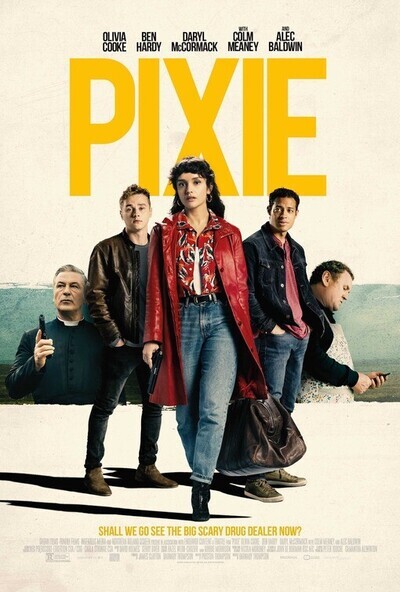
Review of Pixie

Quite enjoyable Irish dark comedy, set in the wild west where we've just been on holiday, and populated with feuding drug-dealing families, some of whom are priests. Held my attention, had a few laughs, a strong woman character and some interesting takes on male buddydom and sexuality. 

I note in passing that the font for the titles suggested the 1974 film "Foxy Brown", which was also about a woman taking revenge on drug gangs. Pixie, Foxy, that's not an accident, is it?

Tuesday, July 25, 2023

Review of Belfast

Nice, beautiful-to-look-at coming of age movie by Kenneth Branagh that is apparently autobiographical. Young Buddy is growing up at the start of the troubles - the first scene takes place in August 1969, in an idyllic mixed working class Belfast neighbourhood, where Catholics and Protestants live happily together. Perhaps it's too romanticised...I'm sure everyone who was there has their own version of what this experience was like. Certainly we don't see any sign of the symbols of sectarianism, no union flags or tricolours, no Orange lodges...even the murals on the gable ends of terraces are harmless.

But then we see things quickly slide into pogroms and burning-out of Catholics from the Protestant streets, and vigilantes and barricades - though only in a Protestant street. In fact, Catholics are largely absent from the story, except in the imaginations and conversations of the Protestant characters, especially the ones from the central family. 

One thing struck me - the family, especially the mum and the dad, and some of the other characters including the local Protestant thug-gangster - are all really gorgeous to look at. Funny how striking that is, because almost everyone in documentary footage from this period looks so ugly.

Watched in the Middle Floor at Springhill, via usb stick and informal distribution...one consequence of this was odd melting transitions between some scenes, because the video player couldn't quite cope. It made it even more arty.

Tuesday, July 18, 2023

Review of Aftersun

Moody slightly menacing film about a dad on holiday in a Turkish resort with his pre-teen daughter. At first it has all the dullness of a resort holiday (and I admit to having a little doze) but the mood and the menace take over, and I ended up being really quite moved by it. It's a depiction of a father-daughter relationship that's kind and loving, even though the dad is really troubled. 

It's occasionally a bit confusing - most of the narrative is set during the holiday but some of it is in the future when the girl is grown up and reflecting back on the past...and perhaps some of it is in the further past, depicting the dad's break-up with the girl's mother - it's not 100% clear. 

Not what you'd call enjoyable but I am pleased I watched it...via informal distribution and USB stick to the projector in the Springhill Middle Floor.

Review of The Last Letter From Your Lover

Sort of OK, watchable romantic drama with a split-chronology narrative. In the 1960s a wealthy socialite has an affair that ends abruptly, and in the present a young woman journalist finds love letters in her magazine's archive and becomes intrigued by the story. It's engaging enough, but not really great...the 1960s scenes are sumptuously filmed and the socialite wears some great clothes. Some nice backing track music.

Watched on Netflix - the film was produced independently but Netflix bought it up.

Sunday, July 16, 2023

Review of Escape From Room 18

Unsettling but also unsatisfactory documentary about a Jewish young man who was a member of a Nazi skinhead gang in the US...at first the Nazis don't know he's Jewish, but then they find out and try to murder him, and he miraculously survives and escapes to Israel, where he and his family make a new life. Later - at the time the documentary is made - he meets up with one of his old Nazi skinhead friends, now no longer a Nazi or a skinhead, and they go on a trip to the Theresienstadt concentration camp together.

There's so much about this film that's weird - of course - but also so much that is unsatisfactory. There's not much consideration about the roots of Nazism and White Supremacy in the US, and no examination at all of what it means to escape from racists by going to live in Israel. The main character has moved to Israel with his mum, who speaks with a strong Southern accent, obviously misses the food and culture of the American South, and has a twin sister (who has also moved to Israel), and the two of them dress identically. Which would have been enough for a weird documentary in itself.

Thursday, July 13, 2023

Review of Wild Men


Billed as a comedy but dark and violent and a bit nasty - a little like Riders of Justice. What is it with Danish comedies? Is the audience in a Danish cinema roaring with laughter at this, or do they just mean a different thing by 'comedy'?

This one features an unhappy man who has left his family to live in the wilds of Norway so that he can reconnect with his proper, natural, manly self...but he's actually not very good at it. Failing to kill anything to eat bigger than a frog, he ends up robbing a petrol station instead, and is then half-hardheartedly pursued by the local police, who are mainly oblivious of a trio of drug smugglers in their neighbourhood. The drug smugglers hit a moose/elk, and one of them runs off with the cash leaving the others for dead, but they aren't, and then they run in to the aspirant wild man.

Lots of violence, and blood, and unhappiness, and almost no laughs at all. Even so I found it quite thoughtful and interesting, though Ruth didn't.

Watched on BBC iPlayer. 

Review of Transition by Ian Banks

A novel set in the multiverse, with characters who are aware of and can travel between parallel universes. It's nicely done (or perhaps nicely overdone, since quite a lot of the descriptions are sort of camp in the way that steampunk sometimes is - especially the lavish settings and costumes of Madame d'Ortolan, who functions as a principal villain). 

Lots of drugs, some sex, not much rock and roll.

It took me a little while to get into it, but I ended up enjoying it and was almost sorry when it ended.

Thursday, June 29, 2023

Review of Mixed By Erry

Italian film about three brothers who stumbled into music piracy and became, for a while, a very big part of the Italian music business. A bit dull - I had to watch it in two tranches because I kept dozing off, despite the violence and the depiction of heavily militarised organised crime. The brothers are pretty much the heroes of the film, and the captain of the Financial Police who is trying to catch them is pretty much the villain. 

There's almost no reflection at all on the ethics or the politics of copyright infringement - I'm rather relaxed about such matters, but I would have at least liked some reflections on who are the winners and losers from this. 

Watched on Netflix, and a good example of why one perhaps ought to cancel one's subscription.

Monday, June 26, 2023

Review of The Fabelmans

The sort of film that I think is meant to be heart-warming...a semi-autobiographical coming of age thing by and about Steven Spielberg...apparently he waited until his parents were dead before it was finally made, though his sister wrote the screenplay. 

I was a bit bored at the beginning...it looks up briefly in the middle, but it's a bit self-indulgent and not all that engaging. Sometimes films about movies are great, but this isn't one of those.

I don't know how autobiographical it is, but the not making it until the parents were dead suggests that it must have been seen as potentially hurtful to them.

Watched via informal distribution and an HDMI cable.

Wednesday, June 21, 2023

Review of "Bonjour Tristesse"

A quite annoying book about sex and relationships among affluent, comfortable middle-class French people, set in the holiday villas and nightclubs of the French riviera. The first person narrator is a precocious adolescent girl, who enjoys her widowed father's dalliances with women younger than himself but takes fright when he plans to marry an elegant older woman.

There are some good moments in it, and it gradually grew on me, but it wasn't especially memorable.

On the other hand, I've just read the Wikipedia article, and I learn (a) that the author was only 19 when she wrote it, which is remarkable, and (b) that the Spectator said "Bonjour, Tristesse, which has achieved remarkable celebrity by virtue of its subject-matter and its authoress's age, is a vulgar, sad little book." So now I like it a little more.

Review of "The Little Drummer Girl" by John Le Carre

I really enjoyed this but it wasn't quite my favourite Le Carre. As with the Cold War ones, he's good at exploring the moral ambivalence of the sides...but perhaps because of the subject matter, Israel and Palestine, I find it more difficult. He tries to have it both ways, with sympathy for both the Israelis and the Palestinians, but I am not sure he really succeeds.

The plot is quite simple (if implausible - Israeli intelligence recruits a young English actress to infiltrate pro-Palestinian networks in Europe) but as with other Le Carre, he's good at providing the detail, of atmosphere and interiors and characters. 

It was a good lesson for me in the secondary importance of plot...I sometimes got a bit confused, and I don't really think that this would have happened (though I was rather reminded of the scene in Spielberg's Munich where the two competing groups of Palestinians and Israelis are staying in the same safe house in Athens), but it didn't detract from my enjoyment.

I'm also aware that this is a novel about a double agent/infiltrator, and that here as in real life the cultivation of a successful infiltrator personality results in a lot of inner emotional turmoil. Being convincing as an infiltrator means that you have to develop friendships and connections with the members of the group that you are targeting, while partitioning off the "real" you that is reporting back to your own side. I think I'd like to look at other books that deal with this, both fiction and non-fiction...I'm aware of the story about a Shin Bet infiltrator of left groups in Israel in the 1970s, who went native, and also of Philip K Dick's "A Scanner Darkly". But there must be lots of others, surely?

Tuesday, June 13, 2023

Review of How To Blow Up A Pipeline

It would be facetious, and also factually wrong, to complain that this film does not tell you how to blow up a pipeline. It's got a lot of specific detail in it, including the requirement to make sure that the explosive is quite close to the pipe itself, which is very strong. The film's protagonists find making detonators the most difficult part, and this involves both chemistry and electronics work. The explosive itself seems to be old-fashioned sugar and weedkiller, and though they bash it about quite a lot as they move the oil drums in which they've packed it, it doesn't go off. 

I haven't read any terrorist (or urban guerrilla, if you prefer) memoirs, but I suspect that there isn't a great deal in them about the nuts and bolts of bomb-making. Perhaps if there was then the crew in the film wouldn't have made such heavy weather of it. Can't help thinking that the IRA had an easier time...perhaps because they had access to supplies from supportive governments?

Most of the film is like a heist movie...about the individuals' back-stories, and about the preparations and mechanics of the operation itself, with tension supplied by unexpected appearances and so on...there's another thing but I won't talk about that because I don't want to commit a spoiler.

Nice that one of the gang is a conventional Texas farmer who looks like he would have been at home in the Tea Party or storming the Capitol, and who has been radicalised by the compulsory purchase of his family farm for the pipeline.

The author of the eponymous book, Andreas Malm, is said to have a walk-on part somewhere in the film, but I didn't see him.

In its own terms it's quite gripping, though I haven't thought much about it afterwards. There's not much political discussion or reflection about the tactic of sabotage and how it might relate to a wider movement, and what there is not very thoughtful.

Worth watching though - how many films about climate activists are there?

Watched in the middle floor at Springhill, via informal distribution.

Shlomo Epstein

My mum's grandfather, who I knew when I was a little child (until I was about eight, when he died) was usually called Solomon Epstein, though he seems to have sometimes been called Itzko. He was a tailor in the East End, and worked for other master tailors. He was never a master himself, and seems to have been unemployed outside the season. Family tradition says he had attended a yeshiva but became a Bundist, back in the town of Pruzhana (now in Belarus but then Eastern Poland). Later he was very pro-Communist, if not a party member, and thought very highly of Stalin.

He hadn’t meant to emigrate to England. He’d taken a boat to America but was refused entry, perhaps at Ellis Island, because he was suffering from the eye disease trachoma. As a result he ended up in London. 


He must have already been married to Sarah Trappski, who was the mother of his three daughters and a son; I know this because Sylvia’s father, Louis Epstein, was born in Poland (then part of the Russian Empire). I have a picture of him with his wife and four children, in which Sarah looks quite plump. A later picture of her, when she was probably already ill (I think with TB but it might have been cancer), shows a very emaciated woman.


He was married two more times after Sarah Trappski died (she’s buried in Frankfurt, where I think she went for treatment which was unsuccessful). The first time he married the widowed mother of Louis’s wife (Sylvia’s mother, known variously as Fay, Fayge, and Ruchel), the second time another widow called Lena, who had a daughter in Israel - I remember a picture of her in her army uniform. Lena kept chickens in the backyard, and fermented and pickled, and my mum remembers her infusing cherries in alcohol. 


When conscription was introduced in WW1 he wasn’t liable to be conscripted, because he wasn’t naturalised British. The British government went to some effort to sign military conventions with the governments of allied nations, allowing it to either conscript non-naturalised immigrants or deport them to serve in their ‘home’ armies, but it didn’t do this with Russians because there was some recognition that they were refugees from Czarist oppression. This changed in March 1917 when the first revolution overthrew the Czar, and the Kerensky government continued to fight alongside the allies. In August 1917 the Anglo Russian military convention was signed, making Russian subjects liable to conscription or deportation. 


One of the documents in my possession is of some sort of certificate, issued in 1918, by the Russian Embassy in London, then based in Gordon Square. It shows that the embassy staff have manually corrected the headed notepaper to remove the word ‘Imperial’. On the back, in pencil, is some text in the first person about Shlomo/Itzko - I don’t think he wrote it himself. It describes how he came to England and concludes with words that emphasise his claim to be a Russian.


As described in Harold Shukman’s book ‘War Or Revolution: Russian Jews and Conscription in Britain, 1917’, the mainly anti-war immigrants were advised by their socialist leaders to opt for deportation - it was assumed that the government was too busy to organise deportation and transport to Russia. This turned out to be wrong (though perhaps not bad advice, given the level of slaughter on the western front by then) and the immigrants - Jews, but also Lithuanian miners in Scotland - were rounded up and put on a ship for Archangel. 


Shukman describes what happened to them thereafter. By the time they arrived there was no Russian army left for them to serve in, and they wandered around Russia during the early stages of the civil war. At some point in 1918 they reached Ekaterinoslav, now Dnipro in Ukraine. I have a composite picture, with lots of insets, showing portraits of what was probably the deportees; some text on one of the insets says ‘Members of the Convention, taken in Ekaterinoslav XI 1918.’ There is also a picture of a ship and some railway lines. 


Shlomo spent several years in Russia, during what must have been the civil war. At some point he is said to have found his way to family members who stayed behind in Russia, and there recovered from typhus. Eventually he found his way back to London (some time in the early 1920s), though family tradition says that when the ship docked he wasn’t allowed to disembark, and had to return the following day on another ferry. 


Saturday, June 03, 2023

Review of "White Skin, Black Fuel: On The Danger of Fossil Fascism" by The Zetkin Collective and Andreas Malm

Lots to like about this book. It's clear and to the point (though sometimes slips into unfortunate academic language and uses complex, unfamiliar words where a familiar one would have worked just as well).  It makes some good distinctions between different kinds of climate change denial...though it doesn't always use those distinctions in a consistent way. Still, I appreciate the difference between "fossil fascism" and "capitalist climate governance".

It made me think whether the climate movement, broadly, has focused too much on the latter, and not enough on fascist-tinged denialism. Until recently I've rather thought that actual deniers were a tiny band of nutters - after reading the book I'm more aware of how widespread and powerful their ideas are, and how they serve as a radical flank for the foot-dragging mainstream..."of course this is a very serious problem but we can only do what's possible, and that is limited by all those people who don't even believe this is happening." In its earliest days XR majored on taking the facts about climate change to a much broader audience, with its introductory talk that activists could learn. Perhaps it gave up on that too quickly in favour of stunts that grabbed headlines and felt like action.

It also made me thing about the role of consumption - especially of some particular goods, and especially cars and meat - as the symbols of a limited kind of prosperity, and thus as a substitute for class consciousness. In a demented sort of way having a big car and eating lots of meat is a sign of what "we" have achieved, and what must be defended in the face of "elite" plans to take it away from us. We may not have a decent welfare state or healthcare or education, and our kids might never be able to afford to buy or even rent houses, but we still have our big cars and steaks. 

It's also worth thinking about how anti-car rhetoric is also a class marker. The richest people often don't have cars or drive much; they live in the cool, walkable inner-city areas from which everyone else has been priced out - see Paris, or London, or New York. The poor and the working classes are living out in the outer suburbs, and in the absence of proper public transport a car is a necessity for a decent way of life, including getting to work, shopping cheaply at big supermarkets, and taking the kids to visit grandparents and friends and to activities.

Two more things - first, that the relative absence of green nationalism is surprising. I know the authors have an explanation, but I am still mystified. It's a largely vacant political position, and the attractiveness of it is not hard to see. The far right's hostility to renewable energy is hard to understand. Perhaps it only makes sense in the context of actual cash flowing from fossil fuel companies and owners to the far right parties.

Second, I am still mystified by the pathetic uselessness of capitalist climate governance. Why don't the mainstream right parties do more? After all, it's the role of the capitalist state to protect the overall system against the particularist interests of particular fractions of capital. So why aren't they doing their job here? Is it that they are worried about being unpopular? That seems unlikely, they are prepared to do lots of other unpopular things when it's necessary for even the short term interests of the system. Are they really just short-termists, who don't care about climate change because it won't happen on their watch? Do they really not believe in the science? In which case those of us who have tried to thrust it under their noses have failed. Do they think that they personally, and the ones they care about, will be able to escape to somewhere where this won't happen? Genuine question, if we knew the answers to this we might know better what to do next.

Thursday, May 18, 2023

Review of "The Secret History" by Donna Tartt


I was drawn in to this story about a group of over-privileged white kids at a posh and slightly useless American college...the narrator has got in on a scholarship so he's not so over-privileged, but he's pretending that he's as rich as the rest of them. The secret of the title is about some terrible things that they do, and I won't spoil by disclosing...I was captivated for the most part, even as I was repelled by the characters and what they'd done. But it rather falls apart in the last fifty pages. It felt to me like she'd got bored with them and it, which can't possibly be right because it shows all the signs of being put together and revised over a long period, and she is a really good write. But still, that's how it felt.

Monday, May 15, 2023

Review of Olga

Film about Olga, a young woman athlete who is on verge of being selected for the Ukraine national gymnastics team, but gets the opportunity to take out Swiss nationality and train in Switzerland instead - her now-dead dad was Swiss. Her mum is an investigative journalist exposing corruption in the government and we see her survive an assassination attempt while she's taking her daughter out for an evening. Olga goes to Switzerland, becomes Swiss, but is then transfigured by the unfolding political crisis in her home country and doesn't know where she belongs any more. Lots of hard-to-watch gymnastic training.

Watched at Lansdown Film Club, and I knew it was good because I forgot about how uncomfortable the seats were.

Review of The Field

Amazing, clever, emotionally laden Irish film about conflict over the ownership of a field in a poverty-stricken rural village. Bull McCabe, the farmer who has worked the field for all of his life even though he rents it from a widow in the village, wants to buy it for what he considers a fair price, but a visiting American has more cash and is determined to buy it himself. Lots of overlaying tragedy in the relationships between the farmer and his wife, and with his son, played by a younger Sean Bean. 

I think it's set in the 1930s, though it's not easy to tell. It might be the 1950s. Electricity has just arrived in the village...there is nothing else technological, and no reference to outside events, that might help to place the exact time. But the Famine is still a living memory and source of pain. There's a really strange ambivalent attitude to those who emigrated and left their land...are they traitors or victims? Similarly the tinkers who are in the village are regarded as having lost 'caste' because they are the descendants of people who abandoned their land.

I was slightly put off at the beginning by the murkiness of the colours, but I came to realise that anything else would have been wrong. It's a dark film and needs to be dark visually. This is like a Greek tragedy, but with protagonists who are poor.

We watched this at a community arts centre in Kenmare, a tiny town in the west of Ireland, where villages like the one depicted are all around, at a free showing by a community group that provided meals on wheels to the poor and isolated. There was free tea and cake too...we made a donation that was not expected and received with much thanks.